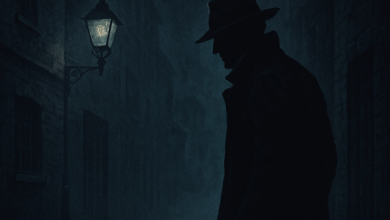
The Whispering Figure

In a quiet town nestled just outside the rolling hills of the English countryside, tales of a mysterious figure began to emerge from the shadows as the sun set. Those who claimed to have encountered it spoke in hushed tones, weaving suspenseful stories that rippled through the community like an autumn breeze. They referred to it as The Whispering Figure.
The origin of the legend created an air of intrigue. Decades ago, the town had been home to a reclusive artist named Eliza Harrow. She was known for her hauntingly beautiful paintings, which depicted the landscapes and folklore of the surrounding countryside. Yet, as her fame grew, so did her isolation. Rumours swirled that she had been blessed—or perhaps cursed—with a gift that allowed her to tap into the very essence of the world, seeing the hidden truths and sorrows that lurked beneath the surface of the mundane.
However, as her popularity soared, Eliza became more withdrawn. After the tragic death of her husband in a freak accident, she disappeared from the public eye entirely. Those who wandered past her old cottage claimed to hear faint whispers emerging from its cracked windows at the twilight hour—soft murmurs that seemed laden with sorrow and longing. Months later, when curiosity peaked and a few brave souls ventured inside, they found her canvases abandoned, yet vibrant with life. It was as if she had poured all her grief and despair into the paintings, leaving behind a part of herself that could never be reclaimed.
It was shortly after Eliza’s disappearance that The Whispering Figure made its first appearance. A local lad named Tommy Cartwright was the first to come forward, swearing he had seen a shadowy silhouette in the fading light of dusk, hovering just beyond the trees near the artist’s cottage. He said it whispered his name, coaxing him closer, as though seeking to share secrets of the past. He returned home shaken and pale, clutching a small, torn piece of parchment with scribbled notes he could not explain.
As the weeks turned into months, others began to share Tommy’s experience. Each account diverged slightly, with some claiming they caught glimpses of a woman clad in flowing garments, while others insisted it was a dark, indistinct shape. Yet all testimonies shared a common factor: the sound of whispers that lingered in their ears long after they had fled.
Sophie, a spirited teenager with an adventurous streak, found the stories particularly compelling. Curious about the figure, she often spent evenings at the old railway bridge near the cottage, where the whispers seemed strongest. Her friends would gather, daring one another to venture closer to the ominous woods that edged the artist’s domain. Yet Sophie alone felt a magnetic pull, an unshakeable yearning to unravel the truth behind the legend.
One autumn evening, as the leaves turned crinkly and gold, Sophie ventured forth. Evening mist curled lazily around the twisted branches like gnarled fingers stretching towards the sky. With a flickering torch in hand, she stepped closer to the cottage—the wooden door creaked ominously as she pushed it open. Inside, dust motes hung in the air, and the once vibrant canvases seemed to whisper tales of yesteryear. She could neither shake the sense of melancholy nor the pervasive feeling that she was being watched.
With every footfall, she felt the hushed silence of the cottage pressing in on her, until she reached an easel standing in the midst of the gloom. A fresh canvas awaited her, blank but yearning, calling for the strokes only Eliza had once placed. As she stood there, caught in a trance, the whispers began to swirl around her, melodic yet sorrowful. Those murmurings formed words, each syllable tinged with emotion—she could almost feel Eliza’s despair, echoing through time.
Sophie shut her eyes tightly, trying to dispel the sensations flooding her mind. She thought of her own troubles: the pressure to excel at school, her family’s struggles, and the weight of expectations. As she exhaled, the air vibrated with unspent energies, and in that moment, she felt an overwhelming need to express her fears and dreams. She grabbed a brush that had lain abandoned in a jar of frayed bristles, dipped it cautiously into the paint, and began to move.
Hours passed like minutes as she poured her heart onto the canvas, the whispers guiding her every stroke. Images emerged—shadows of her insecurities, hopes stretching towards the horizon, the pain transforming into vivid colour. As she stepped away from the easel, breathless, she felt an exhilarating connection to something much larger than herself.
But as the last light of day dissipated, a chill wound its way through the room. The whispers grew more intense, rising to a fever pitch. Sophie turned, and there she saw it—the figure, illuminated by the dim glow of her torch. Its form was indistinct, yet she could sense the essence of a woman within it. Eliza’s sorrow had manifested before her eyes, her pain yet undiminished by the passage of time.
“Help…” the whisper reverberated through the air, echoing deep within Sophie’s soul. In that instant, she realised the burden the figure bore was not simply her own, but a collective anguish that had echoingly woven itself into the fabric of the town. The townsfolk had lived on with their own pain, caring little for the broken spirit who had once gifted them beauty and emotion.
Sophie, heart racing, stepped forward. “I can help you,” she whispered, her voice trembling with determination. “We can let it go together.”
And as those words hung in the air, she felt the figure draw nearer, the sorrow beginning to transform into something softer—hope. The painting she had created had bridged the gap across time, gracing Eliza’s spirit with the understanding that she was not alone. Together they faced the remnants of all the pain that had marred the artist’s soul, allowing tears to flow freely—each one a tribute to lost dreams and unsettled matters.
As dawn broke that day, the townspeople awoke to discover a miracle: the old artist’s cottage stood silent, reverent, bathed in warm golden light. Sophie emerged, breathless but resolute, with her heart alight and the weight of the legend now lighter. The Whispering Figure had returned to the shadows, no longer a harbinger of despair, but a messenger of reconciliation.
In the days and weeks that followed, Sophie spoke of her experience, and others gradually began to feel the shift. The whispers that once echoed through the town transformed into laughter, stories shared, and artistic expression blossomed within the hearts of its inhabitants. Eliza Harrow’s legacy lived on, not just in the paint but in the bonds of community forged through vulnerability and understanding.
Sophie could often be found at the old railway bridge, drawing and painting, while others followed suit. They brought their own struggles, hopes, and fears, creating a tapestry of human experiences that celebrated both joy and sorrow. The Whispering Figure, once a ghost of the past, had become a beacon of possibility—an enduring reminder that, even in darkness, one could find light through connection and compassion.
And so the legend of The Whispering Figure lived on, evolving in the stories shared by each generation, a testament to healing, connection, and the importance of acknowledging the whispers within. The whispers that once frightened were now a soft embrace, a gentle nudge to recall the weight of loss, and to remember that everyone has a story to tell, waiting to be heard.