
Whispers of the Haunted Trinket
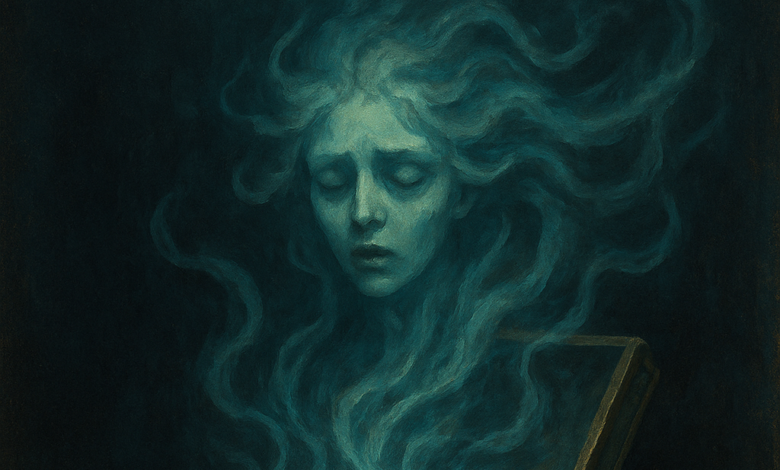
In the quaint village of Moreton Hollow, nestled between rolling hills and ancient woodlands, local folk had long shared stories of strange occurrences that caused shivers to run down the spine. The most chilling of them all revolved around a trinket known simply as the Whispering Locket.
It was said that many years ago, a widow named Eleanor Prescott had owned the locket, which she received from her late husband, a soldier who had perished in the war. The locket was beautiful, crafted from intricate silver filigree, its heart-shaped form adorned with a tiny portrait of Eleanor and her husband, vibrant even in its age. But the locket was not merely a piece of jewellery; it was imbued with an unsettling secret.
Eleanor had a peculiar affinity for the supernatural, often visiting the village’s apothecary to seek out herbs that promised to unveil hidden truths and connect with the spirits of the deceased. As sorrow consumed her after her husband’s death, she delved deeper into her mystic pursuits, seeking solace in conversations with the restless. When she wore the locket, she began to hear whispers—soft, seductive murmurs that seemed to flow from the very essence of her beloved.
For a while, these whispers brought her comfort. They spoke sweetly of shared memories, of hot summer afternoons and starlit dances. But as time went on, the whispers turned darker, beckoning her to join her husband in the otherworldly realm. Stifled by her grief, Eleanor’s mind began to fray. She spent her nights wandering the village, dressed in a tattered nightgown, clutching the locket to her chest, following the sinister calls that echoed in her ears.
Villagers, perplexed and fearful, attempted to help her. Old Mrs Hargreaves, the town witch, warned Eleanor that the locket had been cursed by a jealous sorceress, and she advised her to rid herself of it. But Eleanor, in her fragile state, declined. The whispers had become a haunting melody in her heart, a siren’s song that promised release from her earthly woes.
Tragically, one stormy night, Eleanor vanished. The villagers scoured the woods and the hillsides, calling her name until their voices grew hoarse. They found only the locket, glimmering in the mud beneath a gnarled oak tree—a silver heart stained with the remnants of rain. Though they buried her locket beneath the old oak, it did little to quell the legend that would soon take root.
As the years passed, children came to know the tale, as kids often do, mutating it further with wild imagination. By the time the school bus would rattle through the main street of Moreton Hollow, the story had woven itself into the very fabric of the place. Those who dared claimed they could hear hushed voices on certain nights, beckoning to those who approached the oak tree where the locket had been buried. Whispers became warnings: never venture too close, or Eleanor might come for you.
The chilling cautionary tale had nearly faded from the minds of the villagers when a newcomer arrived in Moreton Hollow—an inquisitive historian named Thomas Avery. Drawn to the village by its peculiar folklore, Thomas swiftly became embroiled in its inexplicable history. With his trusty notebook in hand, he set about unearthing the truth behind the whispers. His interest piqued, he spent long hours in the village library, poring over old newspapers and records that spoke of Eleanor’s misfortunes. The community indulged his curiosity, but many could only shake their heads in pity, convinced that some mysteries were better left undisturbed.
One chilly autumn night, compelled by an insatiable thirst for knowledge, Thomas decided to visit the old oak where Eleanor’s locket had been buried. As he approached, a heavy mist rolled in, cloaking the ground in an ethereal glow. Clutching a flashlight, he reached the gnarled tree, noting its warped branches seemed to reach for the stars, silhouetted against a twilight sky.
He whispered a greeting to the spirit of Eleanor, then knelt to begin his search, digging into the damp earth with trembling hands. In moments, his fingers brushed against something cool and metallic. His heart raced as he unearthed the locket, dirty but intact.
Suddenly, a soft breeze swept through the clearing, carrying with it a wave of whispers—a chorus of voices rising and falling around him. Instead of feeling dread, Thomas felt an undeniable pull towards the locket, as if it were singing a lullaby meant solely for him. Ignoring the instinct that gnawed at him, he opened the locket to reveal the portrait within, only to be met with a soft sigh—a sound that seemed to ripple through the very air itself.
Struggling to comprehend the inexplicable journey before him, Thomas found himself entranced by the portrait. He could almost feel Eleanor’s warmth emanating from the image. But with each passing second, the ambience shifted; the whispers grew darker, more insistent, wrapping around him like a fog, imploring him to stay. Mesmerised, he hesitated, visions of Eleanor’s faded life flashing before his eyes—every laugh, every tear, every minute of loneliness.
With a sudden, jarring realisation, he understood that the whispers were not merely memories. They were invitations, snares urging him to join Eleanor in her eternal dance between life and death.
With all his will, he snapped the locket shut and flung it back into the ground, heart pounding. The whispers screeched as the locket hit the earth, echoing the dark energy that had begun to envelop him. Mustering the last remnants of his strength, he leapt to his feet and dashed away from the tree, breaking through the mist and into the safety of the village.
In the following weeks, Thomas grappled with his overwhelming experience, telling no one of his nightmarish encounter. But the whispers would haunt him, weaving themselves into his every waking moment. Night after night, he dreamt of Eleanor, her soft voice calling to him, her figure intertwined with shadows, forever longing.
Desperate for answers, he returned to Moreton Hollow’s library, combing through files and files of records. One evening, he stumbled upon a faded letter, penned in Eleanor’s delicate script, detailing her anguish and the undeniable grip the locket had on her soul. It spoke of the eternal longing for love but contained an undeniable warning—the trinket fed on grief, perpetuating the cycle of sorrow.
His heart sank upon finishing the letter. It was clear that Eleanor’s spirit was not merely trapped; she was seeking solace, entrapping others to join her.
Determined to free her, Thomas formed a plan. He sought the village witch, Mrs Hargreaves, to uncover the necessary steps to break the locket’s curse. She listened carefully, her eyes narrowing as he relayed his harrowing encounter.
“Ah, the whispers have claimed another,” she muttered, weaving her fingers together thoughtfully. “The locket needs to be buried in sacred ground, away from the prying eyes of yearning souls. Only then will Eleanor’s spirit have a chance to rest.”
That same night, armed with courage and the witch’s endorsement, Thomas made his way to the graveyard on the outskirts of Moreton Hollow, clutching the locket tightly. The moon hung low, casting an eerie glow as he carefully buried the trinket beneath a weathered gravestone that marked the burial of an old monk.
The moment the locket met the earth, he felt a tremble beneath his feet, followed by a soft sigh that filled the air. The whispers intensified only for a moment, then fell silent, as if a great weight had been lifted. Thomas stepped back, breathless, the chill in the air dissipating.
As he walked away, he turned to glance back at the grave. An ethereal light flickered in the air above the ground, where the locket lay hidden, a promise of peace finally granted.
Months passed, and with any luck, the village no longer resonated with Eleanor’s whispers. As tales of her haunted locket became mere legend, Thomas continued to honour her memory, showcasing her story as a message about love and the perils of letting grief consume one’s spirit. The whispers became a distant echo in the hearts of Moreton Hollow, a reminder of the power of love and longing that could weave itself into the fabric of life, and the darkness that could ensue when spoken words lingered too long in the shadows.


