The Curse of the Unseen Challenge
In the sleepy town of Eldermere, the air felt more static than usual as autumn tumbled in, dressed in crumbling leaves and creeping fog. Residents took solace in their routines; the local pub remained a continual hub of gossip, where tales swirled like the smoke from the fireplace. Among those tales was one that flared up now and then, often dismissed but never truly forgotten—the Unseen Challenge.
Lucas, a lanky lad of nineteen with a penchant for thrill-seeking, had heard the story countless times. “If you dare to remain in your room after dark while holding the old porcelain doll from the attic,” the townsfolk would say, “the spirit of an unseen child will test your courage until the clock strikes one.” The challenge was as much a playful dare as it was a local legend—a test of tenacity that no one really believed would yield real consequences. But Lucas, steeped in youthful bravado, was drawn to it like a moth to flame.
Tonight, a banquet of bravado awaited him in the form of the Unseen Challenge. It was a Thursday, which meant barren streets and a hushed town; the perfect ambience for an ill-advised experiment. With his friends Emma and Jake cheering him on, Lucas made his way home, already plotting his night of reckoning. At home, he climbed the narrow staircase to the attic where Emma had said the doll resided, her voice half teasing, half sinister as she recalled the warnings from elderly Mrs. Hargreaves.
“Just don’t take it lightly, alright? People go missing in the fog,” Emma grinned, her jest veiling a lingering trepidation.
Lucas laughed her off, dragging the dusty cardboard box out from the recess of the attic, cobwebs clinging like superstitions to the edges. He exposed the porcelain doll, its cracked face seeming to scorn him. “You’re just a doll, aren’t you?” he muttered. He felt a tingle, a pit of thrill deep in his gut, but suppressed it as he descended, determined to prove his friends wrong.
When he shut himself in his room that evening, darkness enveloped him eagerly. He placed the doll on the desk, its empty eyes seemingly fixated on him. He could hear Emma and Jake murmuring below, betting on how long he would last. He could feel their impatience take hold, and he fought against lancing doubt.
As the minutes ticked on, silence crept around him. An odd chill permeated the room, making the air feel almost electric. He watched the clock hands glide towards midnight, an ominous countdown marking a strange discomfort that lingered just beneath his skin. Moments brushed past in a dreamlike swirl until he felt a shiver course through the floor, and then—a faint rap, like fingers tapping on glass.
Lucas frowned. It was his imagination, surely. He dismissed it, but then, it came again, this time more insistent. His heart drummed against his ribcage. He glanced at the doll; it remained undisturbed, but somehow… more present.
“Just a bit longer,” he jeered to himself, squaring his shoulders. He cracked the window to let in a gust of cold air, as if to erase the weight of expectation clinging to the room. The clock struck midnight, giving birth to a new kind of silence where every creak of the house became amplified.
Then came another sound, this time from outside. A laugh, bright and childlike, effortlessly slicing through the stillness. It was chilling yet sweet, echoing with an innocence that felt wrong in this hour. Lucas leaned toward his window, curiosity piqued, but the darkness outside held no clarity. The laugh morphed into a call: “Lucas! Come and play!”
It was inviting, disarming even. He shook his head, dismissing the notion that it was anything but a trick his mind was playing. Yet as he turned back to face the doll, he noticed something strange: it had shifted. Not from the position he’d placed it in, but there was something in its gaze—at that moment, it felt incredibly alive.
The next morning, Lucas recounted his experience to Emma and Jake, who laughed as they drank their coffee at the café. Lucas found their amusement irritating but couldn’t shake the memory of that laugh. He held his guarded disbelief while they egged him on, enticing him into trying the challenge again, with grins that lit their freckled faces.
Hesitantly, he relented, drawn to prove there was nothing to fear. The very next night, as twilight draped over the town like a funeral shroud, Lucas decided to test his resolve. He returned the doll to its perch and settled in once more.
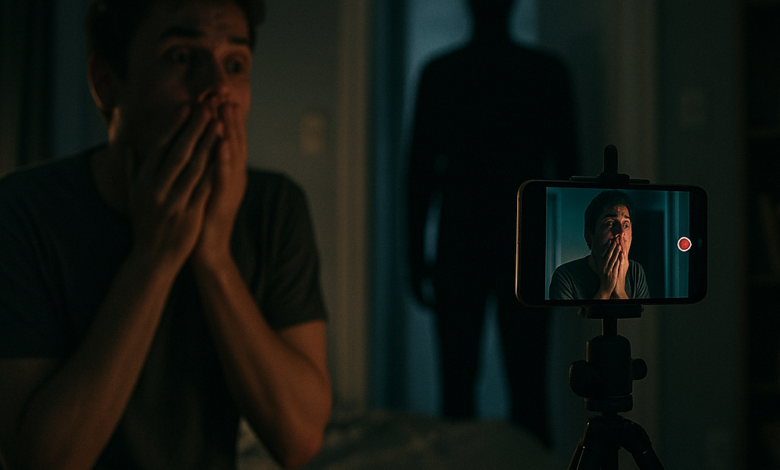
But this time, the trivial dread reached an apex when he heard the soft creak of his bedroom door opening. He bolted upright. The room wore a thick coat of darkness, every shadow stretching and twisting. He could’ve sworn he saw faint movement, a flicker of a figure darting past the edge of his vision.
“Stop it, stop, stop!” he yelled into the void, more pleading with his own weakness than to anything else. Silence, but then, a giggle—so very close, so dangerously inviting.
Desperate now, Lucas sprang from his bed and flung open the door to the hallway. A fleeting glimpse of pale hair danced down the stairs, and he sank into panic, rushing after it. Heart racing, he stumbled into the kitchen, catching his breath. The doll—he needed to destroy the doll.
As he returned to his room, he found it exactly where he had left it, but its expression had changed entirely. Fear mingled with disbelief, and before he could temper his actions, he knocked the doll from the desk. It shattered, porcelain shards cascading to the floor.
Immediately, a wave of frigid energy crashed against him, as the laughter returned. But this time, it morphed into cries—a cacophony of lost innocence layering the air. The lights flickered, and an unnatural force seemed to seep into the room; the air grew thick with dread. He stumbled back, only to feel an unseen grip tighten around him, pulling him toward the fracture between worlds.
The next day, the town awoke to terrible news. Lucas was missing. Disappeared without a trace, like so many had before him—each departure woven into the town’s fabric, laying the groundwork for the Unseen Challenge’s dark legacy.
While Emma and Jake mourned, whispers of the cursed doll began to circulate, brimming with new fear. “What if,” Emma mused one evening, “it wasn’t just a doll?” Each mention ignited nostalgia and trepidation, bonding the townsfolk in a shared tapestry of disbelief. Lucas had not merely vanished; a sliver of him remained tethered to the living, beckoning others to the same fate.
Months passed, but the tale only grew. Newcomers were warned. Young ones dared each other. The echoes of the challenge reverberated. Each time someone spoke about it, another fragment of Lucas flickered back into existence—an unrelenting reminder that in Eldermere, curiosity could sometimes lead to a haunting darkness.
And so, the legend thrived. In their ordinary lives, the townsfolk found comfort in retelling the tale, spinning it into a ritual that kept Lucas alive but forever lost. They clung to their stories, knowing full well that while fear could bring people together, it was the curse of the unseen that would bind them eternally.