The first thing Dr Imogen Vale noticed about the body was the smell.
Not death. She had spent thirteen years with death in all its stages and varieties, and it had a range: sweet, metallic, sour, greasy with old infection, clean as a butcher’s block after the blood dries. This smell was none of those. It was colder than the refrigerated slab under the corpse, faintly briny, like the inside of a sealed church crypt after a flood. It sat at the back of her throat and made her want to swallow.
The corpse lay on the stainless-steel table under the harsh light of the pathology suite at St Jude’s Hospital in South London. Male, late sixties, according to the paperwork. Clean shaven, hair clipped close to the scalp, hands folded at the waist as though someone had taken care to arrange him with dignity before bringing him in. No obvious trauma. No signs of struggle. The chart named him Lionel Barratt, former deacon, volunteer chaplain, and, according to the admitting note, “collapsed at home during evening meal. Pronounced dead on arrival.”
Imogen glanced at the time stamp. Three hours ago. The autopsy should have been routine.
“Postmortem interval fits,” said Daniel Price, the pathologist’s assistant, peering over her shoulder. He was younger than her by a decade, competent, dry, and currently trying not to yawn. “He’s already a bit stiff, but not much else. Want me to start with the external?”
“No.” Imogen adjusted her gloves and leaned closer to the body. “Tell me why the chaplaincy director rang the bereavement office before the police arrived.”
Daniel blinked. “Did he?”
“He did. Twice.”
She had not meant to be here. She was a forensic consultant, not employed by St Jude’s, and her own caseload was stacked high enough to make sleep feel indulgent. But the coroner’s office had asked her to review a cluster of unusual deaths in the borough. Then, an hour ago, a city councillor had phoned her personal number and used the wrong name for a dead man. It had seemed prudent to come.
Now she was regretting the decision in a very specific, professional way.
The dead man’s lips were parted just enough to show the edge of his teeth. Something pale sat at the back of his mouth, like a folded film of skin. Imogen frowned, took a forceps, and touched it.
The thing adhered for an instant, then slicked free and sank down the back of the throat.
Daniel jerked. “What was that?”
“Not sure.”
It moved.
Imogen froze, forceps hovering. The body’s throat gave a tiny, obscene pulse. Again. The skin on the neck tightened, then relaxed. Beneath the jaw, something rolled.
Daniel went pale. “That was a muscle spasm.”
“Dead men don’t do those.”
Before he could answer, the corpse’s eyes opened.
Not widely. Only enough to reveal milky, filmed irises and a strip of blackness round the pupils. The eyes fixed, not on Imogen, but somewhere behind her. The room’s fluorescent lights hummed. A trolley squeaked in the corridor. Then the body inhaled.
It was a shallow breath, dry and rasping, and the chest did not rise properly, but the sound was real enough to make Daniel stumble back into the instrument tray. Scalpels rattled. Imogen heard herself say, in a voice she barely recognised, “Shut the door.”
Daniel obeyed at once. The corpse tried to speak.
It was a cough, a gurgle, a mouthful of air. Then, in a voice that did not belong to the body, a whisper formed around the lips.
“Don’t open me.”
The eyes rolled towards the ceiling and the body convulsed once, violently enough to lift the heels from the table. Then it went limp.
Silence crashed back into the room. Daniel stared at the body, then at Imogen. “That was not possible.”
“No,” she said. She was aware of her own pulse banging against her ribs. “It wasn’t.”
The assistant made a nervous sound. “Should I call someone?”
Imogen’s gaze had gone to the body bag on a hook by the wall, and to the clipboard beside it. Barratt’s personal effects had been logged and sealed. She crossed the room, tugged the bag open and tipped the contents onto a clean tray.
Wallet. Watch. A folded prayer card. Keys. And a small, damp packet wrapped in a hospital glove.
Her stomach tightened.
She opened the glove carefully. Inside was a rosary made from dark beads, the string frayed where it had snapped and been tied again. Something had been wound into the knot: a tiny silver medallion of a saint Imogen did not know, the face worn smooth.
When her fingers brushed it, the lights above them flickered.
Daniel swore under his breath. “Was that you?”
Imogen did not answer. She had felt it too, a sudden pressure in the air as if the room had dipped underwater. The corpse’s fingers twitched. Once. Then the body began to weep.
Not blood. Clear fluid seeped from the corners of the eyes and the mouth, pooling in the hollows of the ears.
Daniel backed away. “Imogen.”
She could not stop looking at the rosary. The medallion was colder than anything in the room. On its reverse, beneath the grime, there were letters in a looped script. Not Latin, or not only Latin.
The corpse suddenly arched, cracking the restraint strap. Its head turned with a wet, unbearable slowness towards the rosary in her hand.
The whisper came again, thin as a breath through a keyhole.
“Close it.”
Then the body split open.
Imogen heard Daniel retch. She saw the sternum parting first, then the rib cage, not by force from within but as if the tissues themselves had softened and given way. The opening was too neat, too deliberate. Something pale and blind slid up from the chest cavity in a sheen of fluid and opened a mouth full of needle teeth.
Daniel shouted. Imogen snatched the metal basin from the tray and brought it down hard on the thing as it lunged.
It struck with the impact of a rat in a drain, all speed and wet bone. The basin caved inward. Imogen stumbled back, slipped on the fluid spreading across the floor, and hit the wall. Daniel grabbed her arm and hauled her upright. The creature writhed on the table, small and furious, its body half-formed, as though it had only borrowed the shape of a thing that might survive in air.
It made no sound. That was worse than a scream.
Then, as abruptly as it had emerged, it collapsed into a shrivelled grey knot and went still.
The corpse lay open around it like a shed skin.
Daniel was breathing hard. “What the hell was that?”
Imogen looked at the rosary in her fist, then at the dead man’s mangled chest. “I think,” she said carefully, “that it was in him.”
She did not sleep that night.
By dawn she had reviewed Barratt’s admission note, the death certificate draft and the hospital records she could access. No cause of death. No mention of trauma. One odd detail, though: a note from A&E saying he had arrived with “significant agitation” and had repeatedly asked, before he died, whether the chapel could be kept locked.
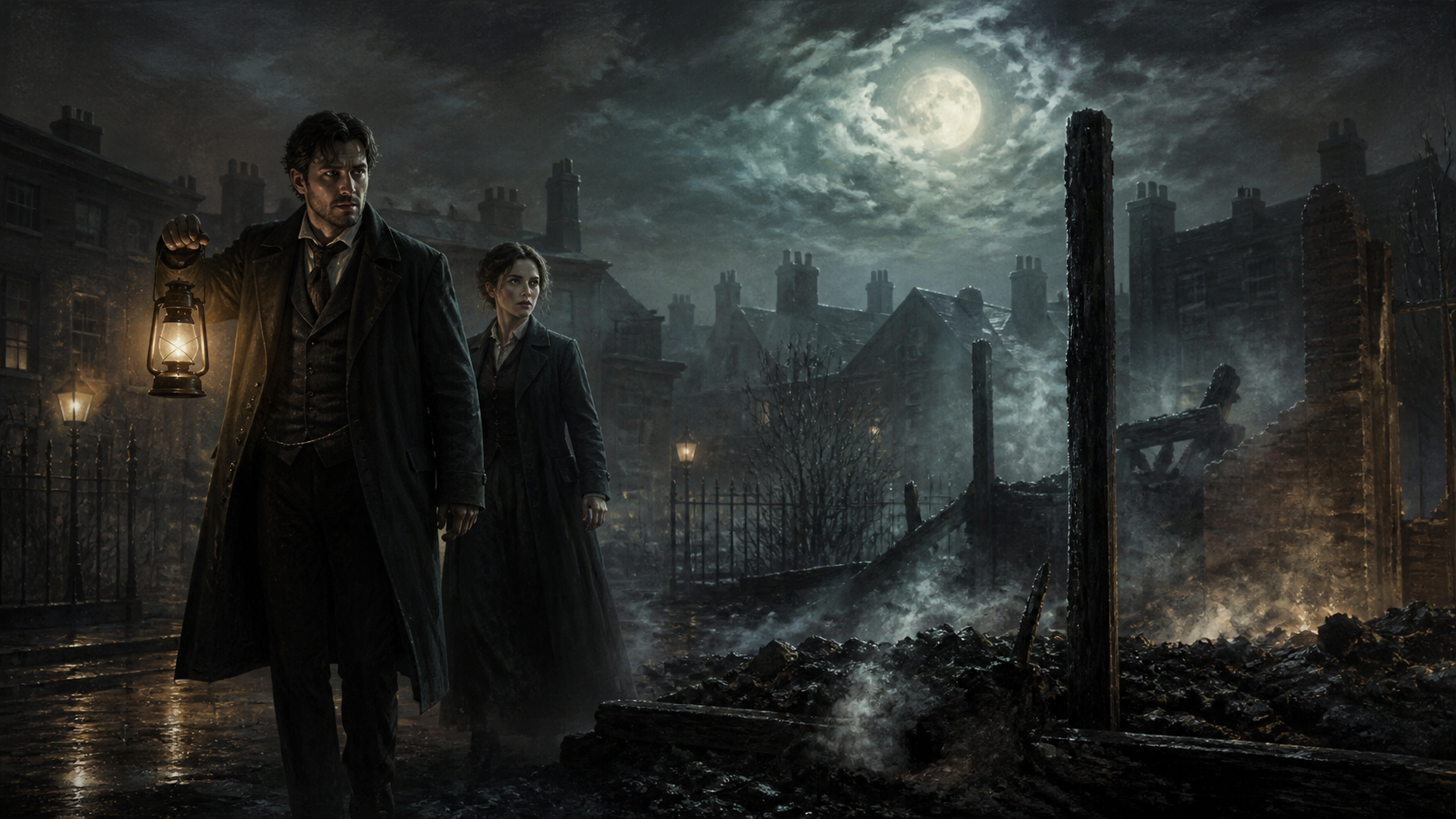
At eight-thirty, she drove to Barratt’s address in Lewisham. The house was a terraced brick place on a quiet road of identical homes with small front gardens and a shared smell of cooking and dust. A police car was parked outside. Two officers stood by the gate. One recognised her from the coroner’s office and let her through when she showed her ID.
Inside, the air was stale and unnaturally cold. No body. No blood. But the sitting room had been stripped as if in a hurry. A photo frame lay face down on the carpet. On the mantelpiece sat a stack of hymn books, each one open to the same page. Beside them, in a glass dish, was a heap of tiny black seeds.
Neighbourhood officers had found Barratt’s daughter, Pippa, on the floor in the kitchen when they attended. She was alive, if shocky, and had been taken to hospital. She had screamed that her father was already dead before he collapsed.
That was a problem for later.
Imogen studied the seeds, touched one with the tip of a pen, and felt it split under pressure. Inside was not flesh but something translucent and writhing, like a grub made of clear gel. She dropped the pen. The thing twitched on the dish and then died, shrinking to a dry flake.
A church key hung from a hook by the back door. On the tile beneath it, in a dark smear, was a partial footprint. Not a human shoe, and too many toes to be a dog.
She called DS Nia Harker from the front step. Harker had a reputation for being patient with inconvenient facts and intolerant of nonsense. Imogen had worked with her twice before and liked her for both reasons.
“I need you to come to Barratt’s house,” Imogen said. “Now. Bring anyone you trust and do not let them handle anything in the kitchen.”
There was a pause. “That sounds dramatic.”
“I’m standing in the hallway of a dead man’s house with something that does not belong in human anatomy on a tissue in my glove. I’m being modest.”
Another pause, then Harker said, “Give me twenty minutes.”
The church was St Bartholomew’s, a small Victorian building half-hidden behind plane trees, two streets from Barratt’s house. It was not locked when Imogen arrived. That was, in itself, enough to make her pause on the pavement with her hand on the iron latch.
The main door swung inward at her touch. The interior smelled of candle wax, damp wood and something faintly rotten beneath. The nave was empty. The side chapel light was on.
She went in slowly, one hand in her coat pocket around the rosary.
Barratt’s church was not grand. A local congregation, cheap carpets, a noticeboard crowded with rota sheets and notices for soup kitchens and choir practice. But there were signs of recent activity that did not fit the quiet weekday stillness. Fresh mud on the stone by the font. The side chapel door ajar. And on the altar rail, a line of salt scattered in an unbroken crescent.
Imogen had almost reached it when she heard the breathing.
A man was kneeling in the chapel, his back to her, shoulders shaking. Another shape stood over him, tall and bent, half hidden by the darkness.
“Hello?” Imogen said.
The kneeling man jerked round. It was not Barratt. Younger, perhaps forty, with a swollen eye and a split lip. He scrambled to his feet and stumbled into the aisle, hands raised.
“Don’t let it touch you,” he gasped.
The shape in the chapel moved into the light.
It wore a cassock, or something that had once been one. Its face was hidden by a veil of black fabric. One arm ended below the elbow in a mass of pale filaments that stirred as if tasting the air.
Imogen stepped back. The rosary in her pocket felt suddenly hot.
The man cried, “Father, she’s here!”
The thing in the cassock turned its veiled head towards Imogen, and the air thickened. A sound like water draining through pipes filled the church. The kneeling man made a choking noise and clutched at his throat. Something moved beneath the skin at the base of his neck, pushing up.
Imogen understood with a nauseating flash that this was the same thing she had seen in Barratt.
She snatched the church key from the hook and hurled it. It struck the veiled figure square in the chest. The thing recoiled, hissing wetly, and the pressure in the air snapped. The man gasped, collapsed to his knees and coughed up a gout of dark fluid that spattered the carpet.
Imogen ran to him, seized his shoulders and dragged him backwards out of the chapel. The black-veiled thing did not follow. It had retreated into the shadow near the altar, where something on the wall glimmered, a line of small brass hooks and a hanging brass vessel like an old holy water stoup.
By the time DS Harker arrived with two uniforms, the chapel was empty.
No body. No intruder. No sign of the veiled figure except a patch of damp on the floor and the smell of brine.
The man Imogen had dragged out was called Tomasz Bielski. He worked part-time as a groundsman and cleaner for the church. Once he had drunk water and stopped shaking, he told them that Barratt had been “keeping it contained” for years. That the chapel had been shut to visitors for months because “the saint in the wall” was hungry again.
Harker looked at Imogen. “Do you believe this?”
“No,” said Imogen. Then, after a beat, “I believe he believes it.”
Tomasz insisted on one thing: Barratt had been planning to open the crypt that night. He had talked about a relic buried beneath the chapel, a saint’s body brought from overseas long ago. A body that should never have been cut open. A body that had been “wrong before it died”.
That afternoon, while Harker arranged for forensic teams and an emergency warrant, Imogen searched Barratt’s study. She found the answer hidden in plain sight.
In the bottom drawer of his desk was a notebook wrapped in plastic. Inside, in cramped handwriting, were years of records. Names. Dates. Times. Symptoms. It was not a diary but a ledger, and every few pages Barratt had written the same phrase in different forms.
Do not let it learn the shape of the body.
A second book was thinner and older, with notes pasted over from a much older hand. The title on the first page was in Latin, but the rest was mostly English and fragments of another language Imogen could not identify. It described an “incorruptible relic” recovered from a monastery in Dalmatia in the 1890s, transported by a naval chaplain, then quietly lodged beneath St Bartholomew’s when the original abbey funding collapsed.
Not incorruptible at all, the notes suggested. Contained.
The relic had a habit of inhabiting the dead. It entered through the mouth, nose or any opened wound. Once inside, it could animate tissue, imitate reflex, and, if given time, hollow out and rebuild a body around itself. It learned by observation. The text compared it to a parasite, but crossed the word out and replaced it with “saint” in a shaky hand.
The saint who failed the autopsy.
There was a final page, newer than the rest, apparently written by Barratt.
It wakes when cut. It seeks closure in the body and opens the dead from within. Do not permit postmortem examination after onset of symptoms. If body must be opened, seal the cavity immediately with blessed wax and salt. The relic can be denied if kept from breath and choice.
Imogen read that twice.
“Choice,” she said aloud.
Harker, standing in the doorway, said, “That’s unsettling.”
“Very.”
Barratt’s notes also described an exception. In one case, years earlier, a priest had survived prolonged exposure by suspending himself in prayer and refusing to eat, speak or sleep until the thing inside him starved or migrated. The note was uncertain, but the implication was clear enough: the relic needed the body’s active processes. Breath. Swallowing. The wet machinery of being alive.
Imogen snapped the book shut. “Where’s the crypt entrance?”
Harker gestured towards the church. “If this is a serious question, I’m going to dislike the answer.”
“It is.”
The entrance lay beneath the side chapel, hidden under a carpeted hatch behind the altar rail. By late afternoon the church had been cleared and a small team assembled. Harker brought a locksmith, a paramedic, two officers and a firearms unit on the outer perimeter. Imogen insisted on being on the descent team, despite having no official reason to be there beyond the fact that the thing had responded to her more than anyone else.
She had also, she thought grimly, been the last person to touch the rosary.
The hatch opened onto stone steps damp with old seepage. The air grew colder as they descended. At the bottom was a narrow crypt with brick vaults and a low arched ceiling blackened by age. Someone had placed candles in niches. Some were fresh.
In the centre stood a coffin on trestles, lid removed.
Barratt was already dead when they found him.
He lay in priest’s robes, face slack, hands folded over his chest. But the chest had been cut open from throat to navel. Not slashed. Opened carefully, the sternum prised apart with surgical precision. His rib cage was full of wax, and in the wax, embedded like a preserved specimen, was the blackened shape of something small and human-sized with too many joints.
The smell hit them all at once. Brine and decay and damp earth.
The rookie constable behind Imogen gagged. Harker cursed under her breath. Imogen stared at the body and saw, to her horror, that Barratt’s eyelids were trembling.
He opened his mouth.
Something in the cavity beneath the wax moved.
Imogen lunged forward. “Back!”
The thing burst from Barratt’s chest in a spray of fluid and wax shards. Not large, but fast, white and blind, its body unfolding as it hit the air. One of the officers fired. The shot shredded half its side and ricocheted off the crypt wall. The thing hit the floor, writhing, then flung itself at the nearest sound.
It chose the paramedic.
She screamed, fell backwards, and the thing vanished into the open collar of her jacket before anyone could grab it. She arched on the floor, choking.
Harker shouted for restraints. One officer tried to hold the paramedic still while the thing moved beneath her skin in a sickening ripple. Her eyes rolled white.
Imogen tore off her gloves, seized the wax-coated mass from Barratt’s chest and felt it pulse once in her hand. She remembered the note. Closure. Breath. Choice.
“Salt!” she snapped.
No one moved fast enough.
The paramedic convulsed and bit through her own tongue. Blood sprayed hot across Imogen’s wrist. The thing inside her erupted, driving up through the mouth in a white blur. Imogen slammed the wax mass over the opening, pressing hard, and the two bodies met with a sound like wet glue tearing.
The creature bucked against her palms. It was stronger than it had any right to be. Harker dropped a metal tray from the equipment bag and brought it down on the thing’s back with a brutal clang. Imogen shouted for salt again.
The younger officer, shaking badly, finally tore open a spare evidence bag and hurled the contents. Salt burst across the floor and over the creature. It shrieked then, a raw thin sound that seemed to come from several mouths at once. The fleshy movement under the paramedic’s skin stopped.
The thing spasmed once more and then went still.
The woman beneath it was dead.
Nobody spoke for a long moment. The crypt was full of breathing, ragged and disbelieving.
Harker looked at Imogen. “Tell me what we’re dealing with.”
“I am trying to decide whether that’s a sensible question.”
“I’m past sensible.”
Imogen wiped blood from her wrist with a shaking hand. “An organism. Maybe. It behaves like a parasite with some kind of mimicry mechanism. It uses open cavities. It can survive in a body if the body keeps functioning.”
“You said saint.”
“That’s what the records call it.”
Harker stared at the corpse in the coffin, then at the wax-stuffed chest. “Why does it matter now?”
Because, Imogen thought, the relic was no longer where Barratt had kept it. Something had been carried out of the crypt before they arrived. She looked at the vault wall and noticed a fresh smear on the brick, as if a hand had been dragged down it from shoulder height. And next to the smear, in the dust, a line of wet footprints leading not back to the stairs but into the darkest recess of the crypt.
There was a second door there, iron-banded and half hidden behind stacked crates.
Barratt had written about a “holding room” used in past emergencies. It should not have been occupied.
Imogen followed the footprints, Harker behind her with a torch. The iron door stood slightly ajar.
Inside was a tiny chamber lined with shelves. Jars. Old cloth bundles. Candle stubs. And on a stretcher in the corner, a woman in her seventies, wrists bound with rosary beads.
Pippa Barratt.
Her eyes were open. She was alive, but barely. Her mouth moved around a gag of folded linen. The skin around her throat bulged with irregular movement.
Imogen went cold. “It’s in her.”
Harker’s face hardened. “Can you get it out?”
“Not safely.”
Pippa’s eyes moved to Imogen, desperate and lucid.
She was conscious.
A sound came from the doorway behind them. Not footsteps. A soft, wet dragging. Imogen spun.
The veiled figure stood at the threshold, head tilted. No longer hidden by its cassock. It had no face as such, only a smooth pale mask split with three narrow slits like a shellfish. Beneath the veil its body was wrong in ways the eye could not comfortably take in: a human torso with too many ribs, arms ending in jointed tendrils, the posture of something that had learned personhood from pictures.
Harker raised her pistol.
The thing moved first.
It did not rush them. It simply unfolded. One tendril flashed out and smashed the torch from Harker’s hand, plunging the room into near-darkness. Another struck the shelves and sent jars crashing. Imogen grabbed the nearest object, a heavy brass candlestick, and hurled it at the doorframe. It struck with a ringing clang and bounced at the thing’s feet.
The creature recoiled as if from a blow. Not the pain. The sound.
It hated noise. Or perhaps resonance. The notes had not said that, but Barratt’s margins were full of scratched references to bells, hymns, chanting and brass.
“Pippa,” Imogen snapped, crouching by the stretcher. “Can you hear me?”
The older woman’s eyes widened. She thrashed against the bindings. Imogen ripped the gag free.
“Don’t let it open me,” Pippa said, voice ruined to a whisper. “Father tried. He said the saint wanted the chapel. He said if it got out it would need people to carry it.”
The creature in the doorway surged towards them.
Harker fired. The shot missed the creature’s head and exploded a jar on the shelf behind it, releasing a cloud of powder and oil. The thing shuddered, retreating a fraction. Imogen seized on the reaction.
“Light,” she said.
“What?”
“Candles. Oil. Anything flammable. It doesn’t like the sparks or the noise.”
Harker fired again, this time into the floor near the creature’s feet. The ricochet screamed off the stone. The thing jerked back as though struck.
Imogen saw the brass vessel on the altar rail in Barratt’s notes, the saint’s stoup in the church above. She understood suddenly why the relic had endured. It had not been worshipped. It had been trapped in a ritual system of sound, salt and sealed body. But it was weakening the longer the church remained open, the longer the body opened and closed around it.
Pippa’s breathing grew ragged. The bulge in her throat shifted.
“Help me up,” she rasped.
Imogen stared. “You can’t walk.”
“I can. If I have to.”
The old woman’s hand closed around Imogen’s wrist with surprising strength. “It won’t leave me while I’m alive. It’s waiting for me to swallow.”
That was the final piece. The thing could delay itself in a body, but not indefinitely. If the host swallowed, breathed deeply, slept, or otherwise gave in to the ordinary rhythms of survival, it gained room to move. If the host starved itself of those choices, perhaps it could be contained. But not here, not now, not with the creature outside the door and the woman barely conscious.
Pippa looked at the rosary in Imogen’s hand and gave a tiny, bitter laugh. “He kept the saint’s chain. He thought that made him holy.”
The creature slammed itself against the doorframe again. One of the candles toppled. Harker swore, reloading with shaking fingers.
Imogen made a decision that felt like stepping off a ledge.
“Can you stand?” she asked Pippa.
“Yes.”
“Then do exactly what I say.”
They got her upright between them. Harker supported one side, Imogen the other, while the creature scraped and dragged its way closer, half in and half out of the doorway. The room was filling with the stink of wax and brine and blood. On the floor beside the stretcher lay a small oil lamp, cracked but intact.
Imogen grabbed it, found the wick, and held it up. “If we can get it to follow us into the church, the bells might drive it back.”
Harker’s eyes narrowed. “Might?”
“It’s better than staying here.”
The creature lunged.
Harker fired point-blank into the ceiling above its head. Stone chips burst down. The thing recoiled from the sound, veering aside. Imogen shoved Pippa forward through the side door and into the crypt passage. The older woman stumbled, nearly fell, then caught herself against the wall.
Behind them the creature shrieked again, horribly human now. It had learned the shape of protest.
They moved fast, half carrying, half dragging Pippa up the stair. Imogen could hear the thing following, not with footsteps but with the wet slap of its body against stone. It was damaged, but not defeated.
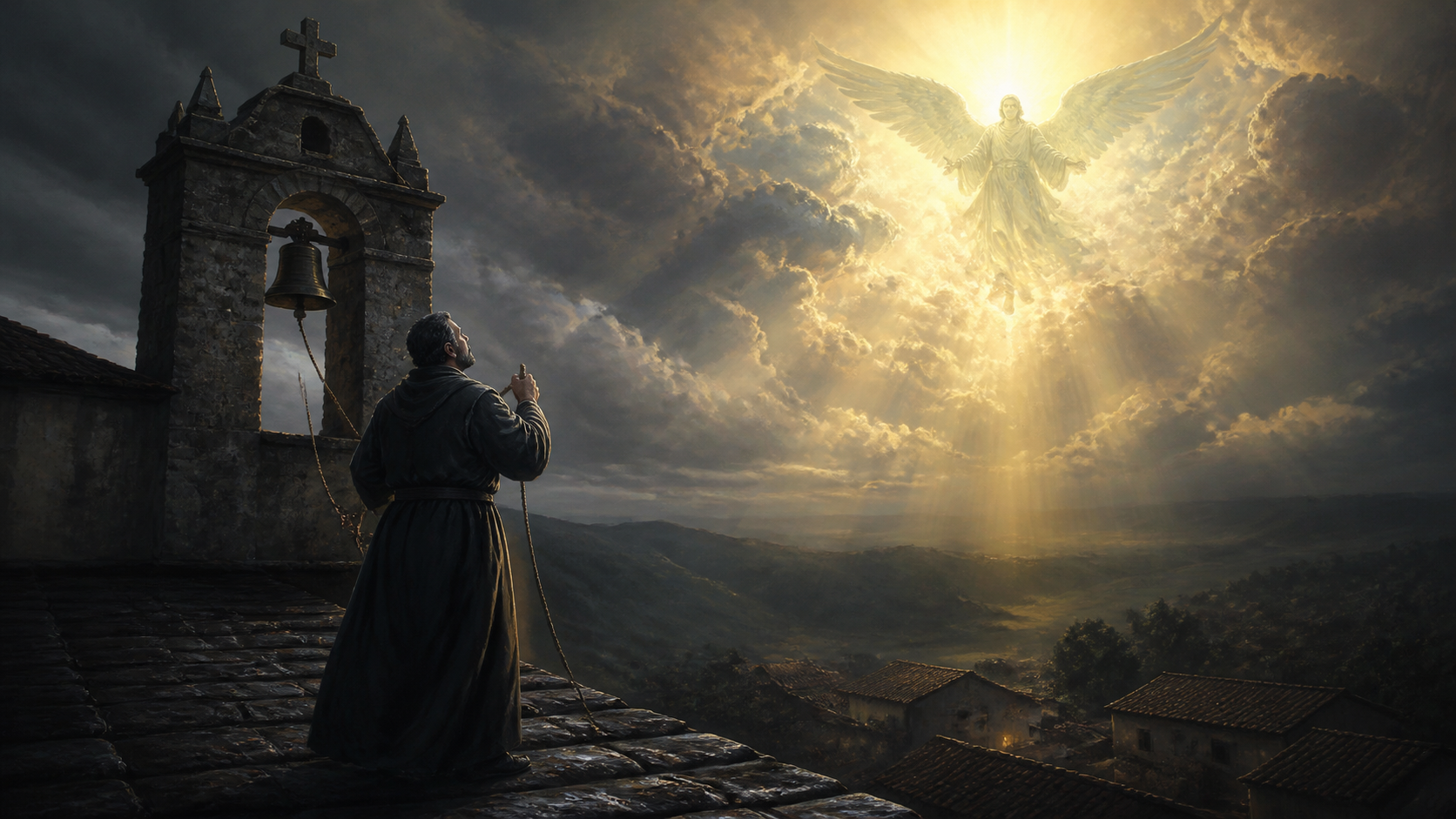
At the top of the stairs, into the side chapel, the church was dim and abandoned. The bell rope hung in the far corner. Imogen remembered from the ledger that Barratt had kept it oiled and ready.
“Can you ring it?” she shouted to Harker.
Harker looked at the rope. “You’re telling me to ring a church bell at a fugitive monstrosity.”
“Yes.”
“That’s a ridiculous sentence.”
“You’re free to reject it after the bell goes.”
Harker crossed the chapel in two strides, hauled the rope and brought the bell down with a deep, shuddering clang that vibrated through the floorboards. The sound hit the air like a physical force.
The creature screamed.
Not pain, precisely. Disorientation. Its body lurched in the chapel doorway, tendrils flailing. Imogen saw the veiled thing for the first time clearly in the bell light, and the sight was worse than any corpse. It was not one creature but several stages of one. A skin of saintliness stretched over hunger.
Pippa, gasping, tore the rosary from Imogen’s hand. Her fingers went to the medallion. “This one,” she whispered. “He wore this when he thought it was listening.”
The creature shuddered at the sound of the bell, then rushed forward despite it. Harker fired twice. One shot caught the veil, ripping it away. Underneath was a face that had no business being a face, a smooth pale surface with mouth-slits opening and closing in wet little breaths.
Imogen snatched the candle from the altar and smashed it against the floor. Oil spilled. She thrust the lamp into the pool and kicked it hard towards the doorway.
Flame caught with a whoomph.
The creature reared back, hissing. The bell rang again. Harker, understanding at last, kept pulling the rope until the chapel filled with violent sound.
Pippa stumbled to the altar rail and slammed the silver medallion down on the stone, then pressed both hands over it as if pinning something alive. Her mouth worked in silent prayer.
Imogen saw what she meant and lunged to help, though she did not know whether she believed in prayer or not. She did know the thing’s rules now. It needed a living cavity, a breath, an opening. It could be delayed, starved, blinded by shock and noise and flame. It could not stand interruption.
The creature crashed through the chapel threshold, half lit by fire, half hidden by smoke. It seized the nearest body in reach, which was Harker’s.
Harker’s cry was a bark of pain as the thing’s tendrils wrapped round her arm and neck. Imogen grabbed Harker’s coat and hauled backwards. The creature’s mouth-slits split wider. Something pale slipped out towards the officer’s throat.
Pippa, from the floor, made one hoarse sound that might once have been a hymn. The medallion under her palms flashed, not with light exactly but with a hard, metallic gleam that made the creature recoil as if struck. The pressure on Harker broke. Imogen dragged her free.
Harker fell against the pew, coughing.
The creature, now caught between fire and bell and whatever had been made of that medallion, made a final decision of its own. It lunged not at them but at Pippa, the nearest living, open throat. Imogen understood with a flash of terror that it wanted the old woman’s body, wanted her breath before she could deny it.
“No,” she said.
She seized the lamp stand from the floor and brought it down on the creature’s skull with all the force she had.
The head fractured with a sound like a shell splitting. Black fluid spurted across the altar cloth. The creature shuddered, then collapsed in a tangle of limbs and veils and wet, white tissue.
The bell rope went slack. Harker, panting, stared at the thing on the floor. “Is it dead?”
Imogen looked at the remains, at the way they were shrinking already, drying under the church heat and the pooling flame. “I think it’s finally unsure.”
The answer, apparently, was yes. The body convulsed once, twice, and then went still.
Pippa had slumped against the altar rail, the medallion still in her fists. She was alive, but the effort had emptied her. Imogen knelt and checked her throat. The bulge had gone. The skin was bruised, raw, but no movement remained beneath it.
Harker pressed a hand to her own neck and then laughed once, shakily, with no humour at all. “Right. We’re never discussing this again.”
“No argument,” said Imogen.
They did not keep the relic. By the time the fire brigade had been called to contain the church fire that started in the chapel and local officers had been briefed with a version of events that involved gas and an electrical fault, Imogen had already placed the medallion, the rosary and the creature’s remains into a stainless evidence drum with a thick layer of salt and wax. Barratt’s notebooks were sealed separately. The church crypt was flooded and locked behind a coroner’s order.
Pippa survived, though she spent three weeks in hospital and emerged with a voice that would never quite recover. Barratt’s daughter had no interest in the official story and even less in the church. She gave Imogen one final, tired look before discharge and said, “He thought he was saving us.”
Imogen nodded, because that was at least plausible.
Two days later, in the pathology suite at St Jude’s, she and Daniel stood over the evidence drum. It had been opened in a controlled environment and the contents laid out for examination. The remains inside were mostly ash-grey membrane, a few fibres, and a small calcified shape no larger than a walnut.
No movement. No breath. Nothing.
Daniel, whose face had not entirely recovered its colour since the first autopsy, looked at her with uneasy curiosity. “So what was it, then? A parasite? A fungal thing? Some weird environmental organism?”
Imogen stared at the calcified remnant. The thing had behaved like matter and motive both. It had reacted to sound, to blood, to ritual, to the choices made around it. Perhaps that did not make it holy. Perhaps it did not matter.
She set the rosary next to the evidence label, where it would be photographed and locked away. The silver medallion lay on the table, darkened now, its worn face impossible to read.
“It was something that learned to inhabit the dead,” she said finally. “And something people mistook for sanctity because they didn’t know what else to call it.”
Daniel frowned. “That’s not an answer.”
“No,” Imogen said. “It’s the closest one I’ve got.”
She placed the medallion back into the drum.
As she did, the overhead light flickered once. Daniel looked up automatically. Imogen did too.
Nothing happened.
The room remained still, sterile, ordinary. The kind of ordinary that could be trusted only because someone had worked very hard to enforce it.
Imogen drew a slow breath, then another, and hated herself a little for noticing it.
The dead thing in the drum did not move.
For the first time since the first whisper in the autopsy room, she believed they might actually have closed it.

Supernatural Thrillers