By the time the first message arrived, Daniel Hargreaves had already decided he would stop checking his mother’s voicemail.
He was standing in the narrow kitchen of his flat in Peckham, one hand braced on the counter, the other on a mug of tea gone cold. Outside, rain tapped at the sash window in a patient, needling rhythm. The room smelled faintly of damp plaster and the instant noodles he had eaten straight from the pot because he could not face washing another dish.
His phone buzzed again.
Unknown number.
He stared at it long enough for the screen to dim, then picked it up.
DON’T LET HER OPEN THE FRONT DOOR AT 9:14.
He read it twice. Then he looked at the time.
9:11 p.m.
A ridiculous prank, he thought. Some scammer had chosen the wrong night to bother him. He typed back, Who is this?
The reply came almost instantly.
YOU DO NOT HAVE MUCH TIME.
Daniel laughed once, a short dry sound that died in his throat. “Right.”
He had spent the last three weeks in a state somewhere between grief and exhaustion, ever since his mother, Elaine, had started forgetting small things and then large ones. Names. Dates. Whether she had eaten. The GP had used cautious words, then less cautious ones. Early onset dementia, though they were still running tests. At forty-six, she had gone from brisk, organised head teacher to someone who rang him because she could not remember whether she had locked the back door. He had taken leave from work, moved his laptop to her house in Leyton, and tried to keep the whole thing held together with supermarket food and routines written on sticky notes.
Tonight he had left her at home because his sister Asha was meant to sit with her while he went to the chemist for a prescription. Asha had texted at 7:30 to say she was stuck on the District line. Daniel had rung his mother from outside the pharmacy and she had answered in a bright, confused voice, asking why he sounded so far away.
Then the messages had started.
He looked at the clock again. 9:12.
The kitchen door opened behind him and he nearly dropped the phone. His mother stood there in her cardigan, one slipper half off her heel, hair unbrushed, her expression fixed in careful concentration.
“Danny?” she said. “Why are you in the kitchen in the dark?”
He had left the light on. He realised, absurdly, that the bulb was flickering.
“Mum,” he said. “You’re meant to be in bed.”
She frowned. “I was thirsty. Is that all right?”
He glanced at the phone. 9:13.
“No,” he said, too sharply.
Her face changed at once, a tightening round the mouth he had seen in clients across his career in emergency nursing and in his own family. Hurt first, then embarrassment. “I only wanted water.”
“It’s fine.” He moved towards her, then stopped because the next buzz hit his hand like a pulse.
SHE ISN’T ALONE.
A low sound came from the hall. Not a voice. More like someone dragging a fingertip slowly along wallpaper.
Daniel’s skin prickled. The hallway light, which had been on, went out.
His mother looked past him. “Who’s there?”
The house seemed to lean inward.
He took one step towards the door and something in the hall answered with a wet, delighted chuckle.
At 9:14 exactly, the front door handle began to turn.
Daniel grabbed his mother by the elbow and shoved her back from the kitchen threshold just as the bell rang.
One long, polite press.
Then another.
His mother made a frightened noise. “Danny?”
He did not answer. He was already moving, yanking the kitchen blind down and peering through a gap in the fabric towards the front hall. The small glass panel in the door showed only blackness, but something pale pressed close to it, not a face so much as a shape where a face ought to be.
The doorbell rang again.
Then, from the hall behind them, a second knock came.
Three measured taps on the kitchen door.
Daniel spun round so fast he nearly slipped on the tiled floor.
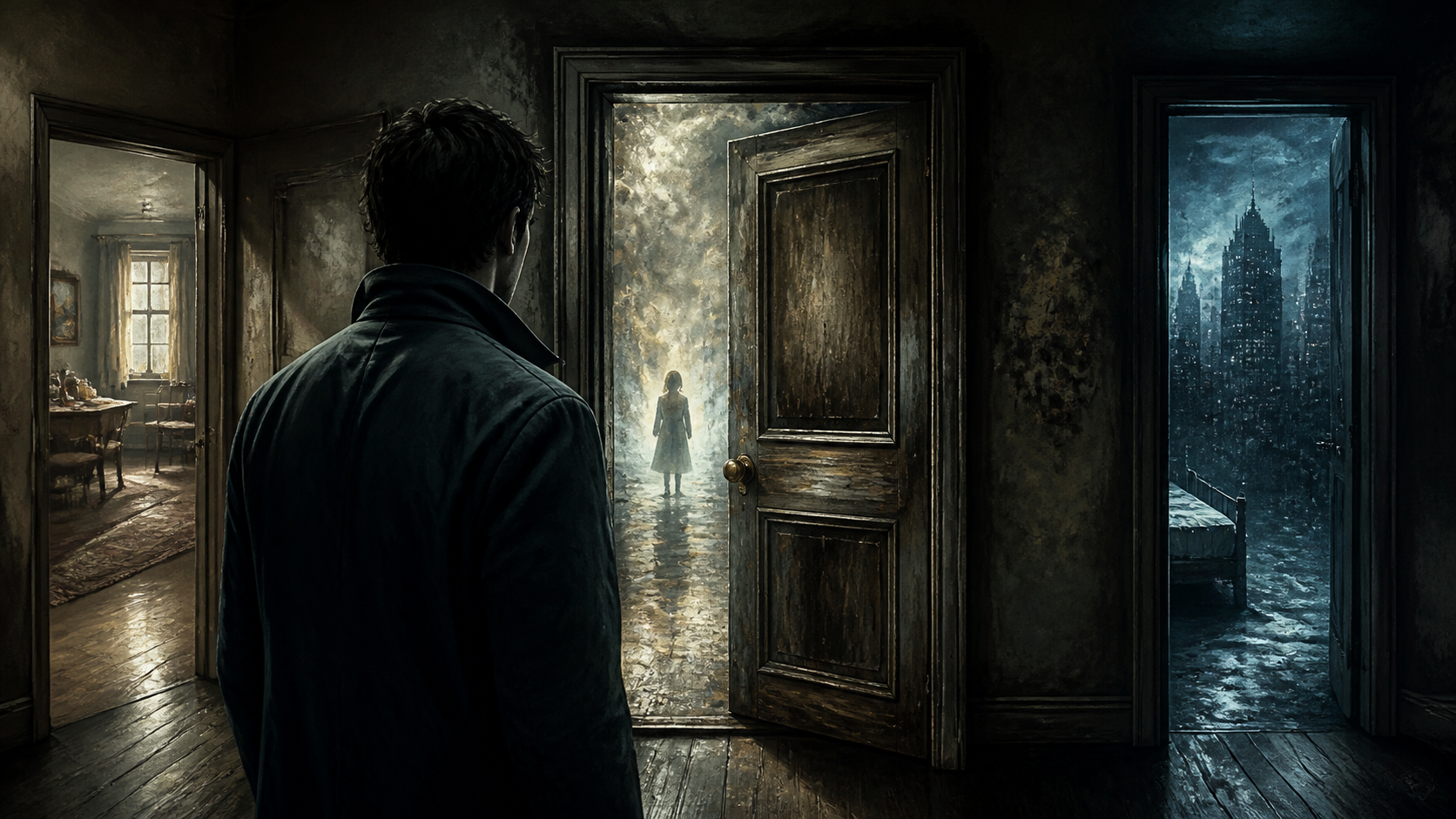
The kitchen door stood ajar. On the other side of it, in the dark of the corridor, someone was waiting.
“Elaine,” said a woman’s voice, soft and almost amused. “You left your appointment card on the seat.”
Daniel’s mother flinched as though struck. The voice was wrong, but it knew her name.
He crossed the kitchen in two strides and slammed the door shut. His fingers found the key in the lock. He turned it, then looked at the time on his phone.
9:15.
The doorbell stopped.
The knocking on the kitchen door stopped.
For a second there was silence so complete that he could hear his mother breathing, quick and shallow. Then, very lightly, something brushed the other side of the kitchen door, as though a fingertip were tracing the wood from bottom to top.
Up. Up. Up.
Daniel backed away.
His mother whispered, “What is it?”
He had no answer.
The phone buzzed one last time.
DON’T OPEN IT.
Then the screen went black.
By dawn the house smelled of bleach and boiled tea. Daniel had searched every room twice with the deadened, unsleeping patience of a man who no longer believed his own memory. The front door had been locked from the inside. The kitchen latch was intact. There were no footprints, no signs of forced entry, no explanation.
His mother remembered only fragments.
A knock. A woman’s voice. The front room clock stopping at 9:14 and then starting again with the wrong time.
She could not remember Daniel’s face for a few minutes after, and that was the worst of it.
By afternoon he had begun to wonder if the message had been sent by someone who knew exactly how to terrify a family already collapsing under the strain of illness. A sick joke. A scam. He told himself that while wiping the same worktop clean three times and checking the smart doorbell footage, which showed only static from 9:13 onwards. The recorder itself had not failed. It had simply captured a grey blur in the shape of a doorway for sixty seconds, then nothing.
At 2:40 p.m. Asha arrived with a paper bag of samosas and a face that said she had not slept.
“Tell me you’re not still in the middle of a breakdown,” she said, setting the bag down.
Daniel held up his phone. “Did you send me anything last night?”
She frowned. “No.”
“Did anyone else have access to Mum’s house?”
“Danny, what are you talking about?”
He showed her the message. She read it twice and her expression changed from irritation to unease.
“Is this one of those weird number spoofing things?”
“Maybe. But then the front door started.”
Asha looked towards the hall as if she expected it to move. “And Mum?”
“Fine, apart from the bit where she thought a stranger was at the door.”
She pressed the heel of one hand to her forehead. “You need to tell the police if someone is messing with you.”
“About what, exactly? A text from a phantom? Mum heard a voice, Ash. Something was there.”
She looked at him carefully. “You’re tired.”
He almost snapped at her, but the line of her shoulders stopped him. She was tired too, and frightened, though she hid it better. Daniel took a breath and said, more quietly, “I know how it sounds.”
Asha sat at the kitchen table. “There’s more. Mum mentioned a woman from school.”
Daniel frowned. “What woman?”
“She said someone came to see her after dark last week. She thought it was one of her old colleagues. When I asked her about it this morning, she started crying because she couldn’t remember whether she let her in.”
“No one came,” Daniel said automatically.
Asha gave him a look. “How do you know?”
He had no answer to that either.
His phone buzzed again.
Unknown number.
Asha saw his expression. “What?”
He opened the text.
CHECK THE BLUE BOX IN THE LOFT.
He looked up. “What blue box?”
The loft was above the front bedroom, reached by a hatch in the landing ceiling and a folding wooden ladder that had always felt one rung too short. Their mother had kept the box there for years, mostly because it contained old school records, family photographs and things she refused to throw away. Daniel had not thought about it since they were children.
The ladder creaked under his weight. Dust floated in the beam of the torch in his phone. The loft smelled of insulation and cardboard. He knelt, crawling past stacked Christmas decorations and a broken fan until he found the blue archive box tucked behind an old suitcase.
Inside were photos, certificates, envelopes tied with ribbon, and a bundle of exercise books from when Daniel and Asha were small. At the bottom sat a small leather notebook with no label.
Daniel opened it.
The first page was filled with his mother’s handwriting, cramped and deliberate. Dates. Times. Events.
3 March. 9:14. Someone at the door. No one outside when checked.
11 March. Voice in hall. Same woman? Said “you’re late”.
18 March. Phone rang. Number withheld. Said I had already answered.
The entries continued for six weeks. There were notes about clocks stopping, reflections lagging behind, and several references to dreams that were too exact to be dreams. In one margin, his mother had written: Daniel says I’m forgetting. Daniel insists I never left the house. But I am sure I met her by the gate.
He turned the page and saw a sketch. Not artistic, just practical lines from memory. A woman in a dark coat, head slightly bowed, face blurred out where the features should have been.
Underneath: She says she is my witness.
A chill went through him. He flipped further.
Do not let her inside after 9.14. The room changes.
If she is invited, she will ask for one thing. If given it, she returns with company.
The first time she appeared I remembered tomorrow before it happened.
I don’t know how to say this to the children.
Daniel sat very still. Something drummed once on the roof tiles above him. Just the house settling, he told himself. Yet every instinct said otherwise.
He found a loose envelope at the back of the box, sealed and marked in his mother’s hand: For Daniel, if I am confused. Inside was a slip of lined paper and a name, written in a younger, firmer script than the notebook entries.
Dr H. Mercer. St Bart’s Neurology. Ask about the witness incident.
Asha’s voice came from below. “Dan? What is it?”
He looked again at the sketch. The woman’s blurred face was not a blank. It was as though the eyes had been rubbed away with a wet thumb.
“I think,” he said slowly, “Mum’s been writing this for months.”
Asha’s face, when he climbed back down, had gone pale.
She read the notebook in silence, page after page. When she reached the final entry, dated four days ago, she looked up.
11:09 p.m. She told me the child would come first.
“My God,” she whispered. “What child?”
Daniel shook his head. “I don’t know.”
But the loft hatch behind him had begun to rattle gently, as if something on the other side were testing it.
Dr Helen Mercer’s office was in a converted townhouse behind St Bartholomew’s Hospital, where the polished floor and framed abstracts tried hard to disguise the smell of antiseptic. She was in her late fifties, immaculate, with silver hair clipped back and a voice that made questions sound like traps.
She listened to Daniel and Asha without interruption, only pausing once to glance at the notebook.
“When did this begin?” she asked at last.
Daniel gave her the dates. “We thought it was part of Mum’s condition.”
Mercer nodded once, as though confirming a suspicion. “And the woman at the door?”
“We never saw her properly.”
“Did your mother ever speak the name ‘Evelyn Fen’?”
Asha blinked. “No.”
Daniel said, “Should she have?”
Mercer stood and went to the window. “Your mother was part of a study seventeen years ago. Not the sort of research you’d usually think of when you hear ‘clinical trial’. It involved a small group of patients and a phenomenon we could never reproduce under controlled conditions.”
Daniel folded his arms. “You’re going to have to do better than that.”
Mercer turned back. “We called it temporal witnessing. An individual becomes able to perceive fragments of events before they occur. Sometimes minutes. Sometimes longer. It is not precognition as such. More like catching one end of a thread that already exists.”
Asha let out a disbelieving laugh. “You’re seriously saying our mother saw the future in a lab?”
“I’m saying she was exposed to a condition we did not understand. Most of the participants experienced migraines, dissociation, memory disturbance. One or two reported seeing people or hearing voices before significant events. The effects were unstable and almost always destructive.”
Daniel’s stomach tightened. “And this Evelyn Fen?”
Mercer hesitated. “She was the source. Or the catalyst. The exact term is still disputed.”
“Source of what?”
Mercer’s eyes did not leave his. “The witness.”
Silence settled over the office.
Then Asha said, “I’m not doing this. Not this. Our mother is ill.”
Mercer gave her a tired look. “Your mother has Lewy body features in addition to the memory loss. That was my working diagnosis as of six months ago. But there are details which do not fit a neurodegenerative process.”
Daniel remembered the notebook. The warnings. The wrong voice in the hall.
“What details?”
Mercer opened a drawer and took out a photocopied page, placing it on the desk between them. It was an old incident report with black bars over names.
Subject reported repeated visitation by unknown woman. Each encounter preceded by environmental anomalies: clocks stopping, electrical fluctuations, altered spatial perception. Subject’s account consistent over seven sessions. On final session, subject invited woman in. Catastrophic event followed.
Below that, in smaller type: No physical remains recovered. Entire east corridor inaccessible for eight minutes. Three staff injured.
Asha went rigid. “What happened to the subject?”
Mercer’s mouth thinned. “She disappeared.”
Daniel read the page again. “This is insane.”
“Yes,” said Mercer. “And yet your mother has been documenting the same pattern for months.”
She slid another sheet forward. A map of Leyton with several addresses marked in red pencil.
“The woman appears to return to places where there are witnesses already weakened by grief, illness, sleep deprivation, trauma, or obsession. She is drawn to instability. Your mother’s condition may have made her visible to it in a way others are not.”
Daniel stared at the map. “Why tell us now?”
“Because she’s expanding.”
Asha looked at Mercer sharply. “What does that mean?”
“It means the incidents are becoming less localised. Reports are appearing in adjacent streets. A school caretaker in Walthamstow described a woman who knew his dead brother’s nickname. A patient in Hackney swore the same figure spoke through his daughter’s recorded voice. Every account centres on the same instruction.” Mercer tapped the photocopied report with one finger. “To let her in.”
Daniel’s phone buzzed in his pocket.
He flinched, but pulled it out.
Unknown number.
A single message:
SHE IS IN YOUR HOUSE AGAIN.
He looked at Mercer. “How would anyone know that?”
Mercer’s face tightened. “Because the witness notices where it is being witnessed.”
Asha stood up so fast her chair scraped. “We are leaving.”
But Daniel was already thinking of his mother at home alone. He thought of the children’s exercise books in the loft, of the line that made no sense until now. The child would come first.
His phone buzzed again.
LOOK AT THE PHOTO ON PAGE 12.
He opened the notebook and found the photograph taped there. A faded picture of a school corridor. Two women standing by a trophy cabinet. One was his mother, younger, smiling. The other, in the background, was blurred by movement or camera fault.
Except now, looking at it from an angle, Daniel saw the blur wasn’t a fault.
Someone had scratched the face away.
Under the photograph, in small neat letters: Evelyn Fen, parent volunteer.
Mercer said quietly, “She worked in the school where your mother taught.”
Daniel looked up. “Why the hell was she in the study?”
Mercer’s gaze sharpened. “Because she wasn’t a volunteer. She was there before the school was built.”
They drove back together. Mercer insisted on coming. She brought a metal case from her office and, after some argument, a revolver in a padded holster that she said had been confiscated from an estate in Essex where similar phenomena had occurred. Daniel was too tired to ask how she had got it. Asha, in the back seat, said she did not believe in any of this, which Daniel suspected meant she believed too much to allow herself the comfort of disbelief.
The road home was clogged with evening traffic, red brake lights stretching under a low bruised sky. By the time they reached Leyton it was nearly 8:30, and Daniel’s nerves had sharpened into something brittle and humming.
His mother greeted them at the door wearing her coat over her nightdress.
“I thought I heard the gate,” she said.
Daniel saw at once that she had the notebook in her hand.
“Where did you get that?”
She blinked, as though the question had arrived too late. “I found it on the stairs.”
Mercer stepped forward. “Mrs Hargreaves. Do you remember me?”
His mother’s eyes fixed on her, then drifted away.
“I know I should,” she said softly. “You’re from the place where the lights go off.”
Asha made a small, choking sound.
Daniel took the notebook gently from her hand. “Mum, listen to me. Have you seen her tonight?”
“Not yet.”
Mercer’s expression changed. “Not yet?”
His mother turned her head towards the front room. “She likes when you make a choice.”
Before anyone could answer, the clock in the hallway struck once, though the hands showed 8:32.
Then the second hand halted.
The temperature in the hall dropped so quickly Daniel saw his mother’s breath turn white.
A shape stood at the far end of the corridor where the light from the sitting room failed to reach. A woman, perhaps, though “woman” seemed too ordinary a word for something assembled from shadow and the memory of a coat. Her face remained blurred, the features shifting when you tried to focus on them, like wet ink spreading on paper. She carried no sound except the soft click of shoes on the floorboards.
Daniel’s mouth dried.
Evelyn Fen stopped beneath the landing light. She did not look at Mercer, or Asha, or even at Daniel first. Her attention went to his mother, and when she spoke the voice was exactly the one from the kitchen the night before, warm and familiar enough to be unbearable.
“You shouldn’t keep it waiting, Elaine.”
His mother took a small step forward.
Daniel caught her wrist. “No.”
Evelyn tilted her head. “There you are.”
Mercer moved. “Don’t answer her.”
The woman’s blurred face turned towards Mercer. “You are not the witness.”
Mercer lifted the revolver. Her hand was steady. “Step back.”
Evelyn smiled, though the smile seemed to happen only around the place where a mouth might be.
The hall light flickered. Then every screen in the house came on at once. Daniel’s phone, Asha’s, the smart thermostat, the little digital timer on the oven, all glowing the same dead white. On each screen was a moving image of the hallway, but from a slightly different angle, as if the house were full of hidden eyes.
In every image, there was another figure behind Evelyn. Tall. Bent. Too close to the ceiling.
Asha saw it and cried out.
The thing behind Evelyn unfolded itself with a sound like wet paper tearing. Daniel did not look directly at it for long enough to understand what it was. He only knew that it was not human and that the room seemed to deepen around it, as though the corridor had become a well.
Evelyn said, very gently, “She invited me in once. Then she tried to close the door on what came after.”
His mother began to shake.
Mercer said, “What do you want?”
Evelyn’s blurred gaze settled on Daniel. “A witness.”
The phones went dark. The hall light blew. Darkness hit the house like a lid.
In the blackness something touched Daniel’s shoulder.
He lashed out, striking nothing but cold air, and heard Mercer fire once. The report was deafening. A scream rose from Asha, then cut off abruptly as the darkness shifted and he heard her stumble into the wall.
“Back,” Mercer snapped. “Back into the kitchen!”
Daniel grabbed his mother with one arm and groped for Asha with the other. They shoved through the doorway just as the front room behind them filled with the sound of footsteps. Too many feet. Pacing, circling, approaching from impossible angles.
Mercer slammed the kitchen door and threw the bolt. “Move!”
She shouted something Daniel could not hear over the pounding that started immediately on the other side. Not fists. Not quite. The impact was too deliberate, as if the door were being tested by the weight of a body that did not understand wood.
Asha had blood on her cheek. “What the hell is that?”
“Stay away from windows,” Mercer said.
His mother sat down hard on the kitchen chair, staring at the wall with an expression Daniel had never seen on her before. Not confusion. Recognition.
“It’s trying to come through the house by the one who notices it,” she whispered.
Daniel stared at her. “Mum?”
Her eyes found his. “I’ve seen it before. Not tonight. Later.”
Mercer looked at him sharply. “She’s slipping in and out of adjacent timelines. That’s the effect. Temporal witnessing can create overlap.”
Asha rounded on Mercer. “Can you translate that into English?”
“It means,” said Mercer, “that if enough of the event has been witnessed, it starts to happen in more than one moment at once.”
The pounding on the kitchen door stopped.
For a second all they heard was the rain against the back window.
Then the voice came again, from directly outside the door, too close to be comfortable.
“Elaine,” it said. “You promised the child.”
Daniel felt his mother flinch beside him.
“What child?” he demanded.
She swallowed. “I don’t know.”
But the answer did not sound truthful, only incomplete.
The door handle began to turn.
Daniel snatched up the bread knife from the counter because it was the nearest thing he could reach. Mercer raised the revolver. Asha grabbed his arm, nails digging in.
Then his mother stood.
“No,” she said, and her voice was suddenly clear, the old teacher voice that could still a noisy classroom. “I said no.”
The handle stopped.
Daniel turned to her. “Mum, what are you talking about?”
She was breathing hard. “She wanted me to carry it. That’s how it starts.”
Mercer’s face went very still. “What starts?”
His mother looked at them all, and for one terrifying moment Daniel thought she would collapse or begin making no sense at all. Instead she said, “The handover.”
The pounding returned, harder now.
“Elaine,” the voice coaxed. “You’ve had enough time.”
His mother stepped towards the back door, then halted as though pulled by a line no one else could see. “If I give her what she asked for, she’ll leave us alone.”
Asha whispered, “Mum, don’t.”
His mother looked at Daniel as if trying to place him in the right year. “I did it because I was frightened. I thought if I handed it over, everything would go back.”
Daniel’s heart was hammering. “Handed over what?”
She lifted one shaking hand and touched her own forehead. “The sight.”
Mercer sucked in a breath.
His mother gave a hopeless, bitter smile. “You think I’m ill. Some of it is illness. Some of it is me opening the wrong door in my head. But the rest.” Her gaze drifted towards the kitchen door. “The rest has been waiting.”
The house shuddered. Something hit the front of it from outside, hard enough to rattle the crockery.
Daniel made a choice then, though at the time it felt less like choice than necessity. If the thing wanted a witness, and his mother’s memory had somehow become part of it, then the only way to stop it was to break the exchange. He did not know what that meant in any practical sense, but he knew one thing that had been true all day: the creature could not be fought with ordinary caution. It was already inside the structure of their lives.
He looked at Mercer. “How do we get rid of it?”
Mercer met his eyes and, for the first time, looked fully afraid. “You don’t. You interrupt the witnessing. If no one accepts the exchange, it loses traction.”
Asha said, “What exchange?”
Mercer answered before his mother could. “Evelyn appears where a person can be made to notice their own future. She offers certainty. A promise. A warning. Something the witness wants badly enough to listen. In return, she takes a portion of the person’s time, memory, or identity. That loss allows her to persist.”
Daniel thought of the notebook, the dates, the missing patches in his mother’s memory. “And the thing behind her?”
Mercer swallowed. “The consequence. The remainder.”
Another blow hit the front door. This one sounded like a body thrown against it.
Asha backed away from the table. “That’s not a consequence. That’s a bloody monster.”
Evelyn’s voice floated through the door, closer than before. “You can still choose.”
His mother whispered, “Don’t listen to her.”
But Daniel already understood the trap. If he ignored the voice, Evelyn would keep pressing until someone weakened. If he opened the door, the exchange would complete. If he could force a contradiction, perhaps the thing would lose the shape it needed.
He remembered the notebook entries, the repeated mention of 9:14, the insistence on the door. The phenomenon was bound to an invitation, to being acknowledged in a specific moment. It behaved like a rule, not a spirit. Rules could be broken.
He looked at Mercer. “You said she appears where there’s instability. What if we give her too much of it?”
Mercer understood at once. “You mean confuse the sequence.”
“Can we do that?”
She thought for a fraction of a second, then nodded once. “Maybe.”
Outside, the voice said, “Elaine. Let me in.”
Daniel’s mother stepped towards the kitchen door, her hand shaking badly now. “No,” she said, but the word sounded less like defiance than a child refusing dark water.
Mercer handed Daniel the revolver. “If the door opens, shoot the centre of the blur. It worked once in the report.”
He stared. “You’re serious.”
“Deadly.”
Asha clutched the edge of the counter. “What are you going to do?”
Mercer shoved a chair under the kitchen door handle and took one of the iron candlesticks from the sideboard. “Create noise. And if I’m right, make it witness itself.”
She tore open the back door and flung it wide onto the garden.
Cold air rushed in. Rain slapped the threshold. Across the yard, where the fence should have been, there was only darkness and a faint suggestion of movement, as if the night itself had grown depth.
“Now,” Mercer shouted.
She struck the candlestick against the door frame, once, twice, three times. The sound rang through the kitchen and into the hall. Daniel’s mother gasped. The voice outside faltered.
Then Mercer yelled, very clearly, “Evelyn Fen. If you’re here, I see you.”
The air changed.
For an instant Daniel saw the garden beyond the open door not as it was, but as something half-formed in another time: the same rain, the same fence, and a woman standing at the gate with her head turned as if listening.
Evelyn’s blurred face appeared in the kitchen door glass, much too close. The creature behind her pressed in, a mass of limbs or absence or both. Daniel fired without thinking.
The shot shattered the glass and punched into the blur. Evelyn reeled back with a sound like a laugh strangled mid-breath. The thing behind her lurched forward, and for one sickening moment he saw that it was made of overlapping human outlines, each one thinner and more ruined than the last, all reaching from different instants.
Asha screamed. His mother made a sound of recognition so raw it seemed to tear her throat.
Mercer lunged to the open back door and struck the candlestick down on the threshold again and again.
“Here,” she shouted. “Here! Look at me!”
The corridor lights in the house burst all at once. Every room came alive with the hum of electricity. The clocks began to race, not forward, but in jerks and reversals. Daniel felt time lurch around him like a badly balanced train.
Evelyn’s figure split. One version in the kitchen doorway, one at the back door, one reflected in the black glass of the microwave. The creature behind her moved from place to place without crossing the space between.
His mother suddenly stood straight.
“I know you,” she said, and the certainty in her voice was terrible. “You were there before the school was built.”
Evelyn turned towards her.
Daniel saw his chance and fired a second shot.
This one caught the blurred shape square in the chest. There was no blood. Instead the figure folded inward as if the bullet had struck a pocket of liquid shadow. The scream that followed was not human. The kitchen windows vibrated. A plate shattered in the sink. Asha dropped to her knees, hands clamped over her ears.
The thing behind Evelyn surged, trying to come through with her. Mercer hurled the candlestick at the back door and then grabbed Daniel’s mother by the shoulders.
“Say no,” she yelled. “Say it now!”
But his mother had gone still. Her eyes were fixed on the space just beyond Evelyn, and Daniel realised with dawning horror that she was looking not at the monster but at something else.
At the child.
A small shape stood behind the blurred woman in the hall, barely visible through the distortion. A boy in a school jumper, head bowed. His face was hidden, but his posture was unmistakable.
Daniel stared. “There’s someone else.”
Evelyn’s head snapped up. For the first time her voice changed, losing its smoothness. “No.”
The boy raised his face. It was Daniel himself, or an impossible younger version of him, eyes wide with fright.
His breath caught. A memory erupted, sharp and sudden, of being seven years old and hiding under the stairs while his mother argued with someone at the front door. He had forgotten that completely.
The voice that came then was not Evelyn’s. It was his own, younger, frightened and absolutely certain.
“Don’t let her in.”
The blurred woman twisted, as if the image had struck her physically. Mercer saw it too. Her face went pale.
Daniel understood at once. The witness was not only a person who saw the future. It was also a place where that future could be anchored, fixed by memory. His mother had not merely seen Evelyn. She had carried an echo of a child-self into the thing, and Evelyn had used that uncertainty like a handhold. The answer was not to deny what had happened. It was to complete the memory and refuse the bargain.
He stepped into the doorway despite Asha’s cry and Mercer’s shout.
The air was cold enough to burn.
Evelyn leaned towards him, the blurred face trying to sharpen. “You remember now,” she whispered.
“Yes,” Daniel said. “I do.”
He did remember. Not all of it, but enough. Years ago, during a summer storm, a woman had come to the house asking for Elaine. His mother had opened the door a crack. Daniel, hidden behind the hall table, had seen a coat, a hand, a mouth too still. His mother had slammed the door shut moments later, white-faced and shaking. The next morning she had told him it had been a mistake, a stranger with the wrong address. But he knew now that something had passed between them.
Not a visit. An exchange.
His mother stepped beside him. Her hand found his wrist with surprising strength.
“She asked me to witness what came after,” she said. “I was going to say yes.”
Daniel looked at her. “Don’t.”
“I did say yes.”
The house lurched.
He understood then that the choice had to be made in the right direction. Not by him, but by her. She was the one who had originally opened the way, however unknowingly. She had to close it.
He put his hand over hers. “Mum. Say you refuse.”
Her eyes filled. “I’m frightened.”
“I know.”
Evelyn’s blurred figure began to thin. The thing behind her strained, but the doorway itself seemed to be collapsing into a narrower and narrower seam. The clocks began to slow.
Daniel’s mother drew a breath and said, very clearly, “I refuse.”
The word hit the hall like a slammed door.
Evelyn screamed. The sound tore through the house and into the garden, and the blurred face shuddered into a dozen impossible versions before collapsing into a smear of dark water on the wallpaper. The child-shaped memory vanished. The creature behind her convulsed once, then seemed to spill backwards through a crack that was no longer there.
Mercer shouted, “Now! Shut the doors!”
Daniel moved first, slamming the back door. Asha dragged herself upright and helped him catch the kitchen door shut. Mercer leaned all her weight against the front corridor door.
For a second nothing happened.
Then there came a sound from the hall, not a blow this time but a careful knocking from the other side, polite and patient as a neighbour.
Three taps.
Daniel held his breath.
Another three.
His mother came to stand beside him, trembling so hard he could feel it through her sleeve. “Don’t answer,” she whispered.
The knocking stopped.
Silence.
The house remained cold, but the pressure in the air had eased, as though a storm had moved on by a mile or two and left only its smell behind.
Mercer lowered the revolver. Her face was grey with shock. “That,” she said, in a voice gone raw, “should not have worked.”
Asha laughed shakily. “That is the least useful thing you could possibly say.”
Daniel stared at the front door. “Is it gone?”
Mercer did not answer immediately. At length she said, “It has been denied. That is not the same as gone.”
His mother slid down into the nearest chair, exhausted beyond words. Daniel knelt beside her, suddenly aware of the blood on his own hand from the shattered glass and the ringing in his ears. Outside, rain hissed against the windows. Somewhere in the hall, a clock ticked on, steady and ordinary.
Asha put a hand over her mouth, then said, very quietly, “What happens now?”
Mercer looked at the notebook on the table, at the gun in Daniel’s hand, at Elaine Hargreaves with her face drained of colour and years. “Now,” she said, “we keep the doors locked and the clocks in sight. And we learn what else has been touched.”
Daniel followed her gaze to his mother.
Elaine closed her eyes.
When she opened them again, there was something new in her expression, a terrible awareness and a kind of peace he had not seen on her face for months.
“I remember tomorrow,” she said.
Then, before anyone could speak, she began to cry, not from fear now but from grief for all the time she had lost and the time she might still lose. Daniel took her hand, and Asha sat on the floor by her knees, and for a while the three of them remained there in the kitchen, surrounded by broken glass, rain and the uneasy truce of a house that had almost let something else become part of it.
After a long time Mercer retrieved the notebook and tucked it into her case.
“What are you doing?” Daniel asked.
“Preserving evidence,” she said. “And making sure nobody else mistakes this for dementia.”
He looked at her. “You’ll keep it quiet.”
Mercer met his eyes. “I’ll do what I can. But if I’ve learned anything tonight, it’s that these things don’t stay buried because we want them to. They stay buried because people stop looking.”
Daniel thought of the blurred woman at the door, of the child-shaped memory, of his mother’s voice saying no with all the force of a life spent pushing back against fear.
He nodded once.
Outside, somewhere beyond the rain, a car alarm began and then stopped. Ordinary sounds resumed, hesitant and unimpressed. The house stood intact. The family would be damaged, changed, still carrying the edge of what they had seen. But the door remained shut.
For now, that was enough.