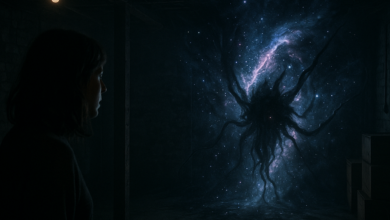
Eclipse of the Forgotten

The village of Eldershire had a long-held belief in taboos. Whispered tales seeped through the thatched roofs and cobbled streets, knitting a tapestry of fear that clung to the hearts of its residents. They referred to it as “The Eclipse of the Forgotten,” a phrase passed down through generations, a grim prophecy that warned of a time when the sun would fail to shine upon their world.
Local lore spoke of a creature, a shadow born from the sins of the past, that awoke with each eclipse, thirsting for the memories of those lost. Each time the moon concealed the sun, villagers locked their doors, shuttered their windows, and gathered in hushed circles, murmuring prayers for salvation. But the village had become complacent, and the stories of old morphed into mere entertainment—a frivolous distraction for the youth.
It was on the eve of such an eclipse that young Ada Blythe returned to Eldershire. She had spent years away in the city, pursuing education and independence, her heart swelling with the thrill of freedom. But her mother’s declining health had called her back home, back to the village she had once sworn to escape. The claustrophobic charm of Eldershire seemed different now; it was as if the cobbles had shifted, rearranging memories she had buried deep beneath the grime of nostalgia.
Ada’s arrival stirred whispers among the villagers—some regarded her as a beacon of hope, while others harboured resentment, claiming that her city-bred ways had made her forgetful of the traditions that bound them. Yet, she brushed aside their mutterings as she walked through the quaint streets, her mind filled with thoughts of her mother.
As the day of the eclipse approached, the anxiety in Eldershire swelled like the darkening sky. Old Mrs Turnbull, the village’s unofficial historian, paid a visit to Ada’s family home. She arrived with her shawl tightly wrapped around her frail shoulders, her eyes clouded with memories of yesteryears, fear etched deep into the creases of her face.
“Do you remember the tales, Ada?” she croaked, her voice a mere whisper on the crisp evening air. “About the Eclipse of the Forgotten? It’s coming again. You mustn’t let your mind wander too far. We’ll need to stay together.”
Ada nodded, pretending to invest in the conversation while secretly rolling her eyes—she was convinced that old Mrs Turnbull had allowed hysteria to overtake her reason. Until that night, when a strange chill wind began to howl through the village, weaving through the cracks in the walls, disturbing the very foundation of health and reason.
As the village prepared for the eclipse, residents bolted their doors tightly, minds clouded with memories of forgotten warnings. As night fell, the moon slipped into place, veiling the sun in a shroud of darkness. An unnatural stillness enveloped the village. It was as if the breath of the world had been snatched away, leaving only the pulse of dread echoing through the air.
The village square was deserted, save for a few brave adolescents who dared to mock the old tales, daring the shadows to show themselves. Ada sat inside her home, her mother asleep in the next room, and she felt a strange compulsion to step outside. Something drew her, a whisper in the air that slid through her mind like cold water. She wandered into the empty streets, the moon casting a ghastly luminescence that illuminated the cobblestones beneath her feet.
As she meandered through the village, Ada spotted movement in the shadows—a flicker of something dark and shapeless slithering through the alleys, retreating from the moonlight. A shudder ran down her spine. Trying to quell her fear, she rationalised that it was simply her imagination, a trick of the mind spurred on by the tales she had grown tired of hearing. Yet, as she continued her explorations, the feeling of being watched grew more intense.
As the eclipse deepened, she reached the village cemetery, swathes of mist curling around the headstones like gnarled fingers. The air was heavy with silence, an absence of life that felt suffocating. But then she heard soft whispers, as if the names etched into the stone were speaking to her. Names she recognised from her childhood—ancestors she had learned about in school, and the more recent ones who had passed in her absence. Feeling an odd compulsion, she knelt by the gravestone of her great-grandmother, the eldest of the Blythe lineage, who had been a pillar of strength for their family.
As Ada traced the letters of the name with her trembling fingers, she felt a stirring in the air, a response to her touch. Suddenly, the wind howled and she felt disoriented, her surroundings blurring and spinning. A deep sorrow washed over her, memories flooding her mind—visits to this very grave, tales told by her mother, stories that were meant to connect the living with the departed. With every heartbeat, the whispers intensified, merging into an indistinguishable cacophony.
Panic surged through her veins. She started to rise, but a shadow emerged from behind the tree—dark, hulking, its form shifting and pulsating like a mirage. The creature’s face was a blur of forgotten souls, eyes vacant as if searching, and it seemed to feast upon the very essence of those lost. It took a step closer, and Ada’s heart pounded violently against her ribs.
She turned to run, but the ground beneath her feet felt unstable as if it were a living entity conspiring against her. The dusk enveloped her, wrapping its tendrils around her limbs, dragging her down into the very earth where the forgotten had been buried. The weight of sorrow pressed against her, memories surfacing like bubbles in a darkened stream. Faces appeared before her, friends and family, each gazing at her with remorse, their silent pleas driving fists of guilt into her chest.
“Remember us!” they urged, despite their silence. In a moment of clarity, Ada understood that this creature was not merely a monster; it was a manifestation of loss, a reminder of those who had been neglected and forgotten. The eclipse had given it life—a hunger that could only be satiated by the relinquishing of memories.
Tears streamed down her face as she fought against the pull of forgotten legacies. “No, I won’t forget you!” she cried out, her voice piercing through the oppressive gloom. “You were my family, my friends. I will carry your stories with me!”
As her vow echoed through the darkness, the creature quivered, its form wavering like a flame flickering against the winds of despair. Memories surged within her heart, igniting her spirit: the warmth of her mother’s embrace, laughter shared over stories of the past, the safe haven of childhood friendships forged in the play of innocence. Each recollection sparked a defiance within her, a strength born from love and remembrance.
The creature recoiled, and Ada felt the grip of the earth loosen. She turned and fled back towards the village, the shadows retreating behind her. As she reached the open streets, she saw other villagers emerging from their homes, eyes wide with terror but drawn together by the same urgency. They formed a circle, hearts pounding in unison as if a pulse of collective memory anchored them against the shadowy fear threatening to engulf them.
Under the waning light of the eclipse, Ada gathered the villagers, her voice firm and resolute. “Listen! We cannot forget those who have come before us. We must honour our history, the lives that built Eldershire.”
Their voices joined in chorus, igniting a flame of remembrance that spread through the shadows like wildfire. The eclipse slowly began to fade, and the creature, weakened by their combined will, shrieked into the night like a wind unraveling. The darkness receded, allowing slivers of light to stretch across the land, a dawn reborn from the ashes of despair.
In the days that followed, the village forged a new tradition—each year during the eclipse, they gathered to share stories of those who had shaped their lives, recalling faces of love so they would never be forgotten. Ada reassured herself that the Eclipse of the Forgotten might never disappear entirely, but they could keep its darkness at bay through memory and community, binding their past to the present.
Eldershire would not be a place of fear; it would become a wellspring of stories—each tale a thread woven into the fabric of the village, a reminder that amid darkness, one can always find a flicker of light, and in remembrance, the shadows would have no dominion.