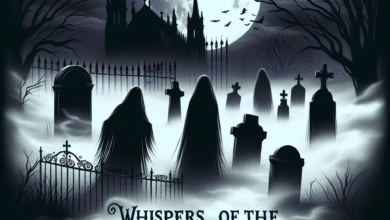
The village of Eldridge lay nestled in a valley where the sun seldom penetrated past the gnarled branches of ancient oaks. A thick mist enveloped the hamlet, and a sense of unease hung in the air like the heavy, damp fog. The only sounds that broke the silence were the distant croaking of frogs and the rustle of brittle leaves on the forest floor. However, it was the whispered legends of the Crimson Veil that kept the villagers in thrall—a creature so malevolent that even the bravest among them shivered at the thought.
The legend began generations ago, when a red silk scarf adorned the neck of a young woman named Elara. She was known for her beauty, her laughter echoing through the cobblestone streets, and her unmatched skills in weaving. Eldridge had prospered under her handiwork; her silks were coveted far and wide. Yet, with prosperity came jealousy. An old witch, blinded by envy, cursed Elara, transforming her vibrant scarf into a veil soaked in the essence of her sorrow and despair. From that day forth, Elara vanished from the village, nobody knowing what became of the enchanting girl.
Over the years, tales emerged of a spectral figure that roamed the woods surrounding Eldridge. Some claimed that Elara returned, trapped in her own veil, lurking beneath the trees, while others imagined her spirit twisted by bitterness, seeking to extract revenge on those who benefited from her loss. Whispers of the Crimson Veil spread like wildfire; it became a cautionary tale told to children to keep them close to home, a dark reminder that beauty could so easily become a curse.
One crisp autumn evening, a stranger arrived in the village. Oliver was a scholar, a man on a quest for knowledge, intrigued by the tales of the Crimson Veil. With a worn leather satchel slung over his shoulder and a notebook filled with sketches and accounts from other villages, he promised the locals he would uncover the truth behind the myth. At first, they were wary. Many advised him to steer clear of the woods, but Oliver was undeterred. What could a mere legend offer in the face of curiosity?
As dusk fell, he ventured into the forest, the dying light weaving shadows beneath the trees. The air grew chill, mist creeping around him as both a shroud and an invitation to uncover the secrets that lay hidden. He recalled the warnings: to tread lightly, lest he draw the attention of the creature with the veil—Elara’s fate intermingling with his thoughts.
As the night deepened, Oliver stumbled upon a clearing. At its centre, a circle of ancient stones, worn by time, stood sentinel. He felt a strange pull, as if the earth beneath his feet resonated with history. He began to sketch—the stones, the twisted branches, the oppressive stillness around him. And then, as if responding to his artistry, a chill swept through the clearing.
At first, Oliver did not see her; she appeared as a flicker—a subtle motion in the corner of his eye. But as he continued to sketch, the air thickened, and he felt the unmistakable presence of another being drawing near. He turned slowly, his heart racing.
The woman before him was ethereal, her form shimmering like a mirage. But it was the scarf—or veil—around her neck that caught his breath. It flowed like liquid crimson, hanging in the air, almost alive. Mesmerised, Oliver could see sorrow etched into her features. The beauty remained, yet there was something palpably tragic about her.
“Who are you?” he whispered, his voice trembling.
“I am Elara,” she replied, her voice a melancholic symphony that echoed through the clearing. “They call me the Crimson Veil.”
“The stories,” he stammered, “you’re… you’re the creature they fear.”
“Fear is a twisted reverence,” she said softly, the veil undulating with her every word. “I am the keeper of heartbreak—a reminder of what was lost.”
Oliver studied her, his fear waning as curiosity surged. “What happened to you?”
“The witch’s curse binds me,” she revealed, her fingers trailing the edges of the veil. “I wander these woods, searching for release, for those who may understand my story.”
As the night deepened, Oliver listened, enraptured by Elara’s tale. She spoke of love lost and dreams shattered by envy. Her laughter, once a beacon of joy, now echoed with a hollow resonance. “I was a weaver of silk, and now I am woven into this veil—the very fabric of my despair.”
“But your beauty persists,” he offered, though he felt it might not have been the right thing to say. “You’re enchanting even in this state.”
“Beauty is both gift and curse,” she murmured, looking away. “It can inspire love, but equally, it can breed hatred. I am adored yet feared.”
An eerie wind swept through the clearing, causing the leaves to rustle and the stones to creak. Oliver felt the weight of her sorrow pressing upon him. It was overwhelming and inexplicable. “How can I help you?” he asked, uncertain but determined.
“Take this veil and immerse yourself in the essence of my sorrow,” she implored, extending her arm. The veil billowed toward him, dripping with a crimson hue that seemed to pulse as if the fabric contained a heartbeat. “Only then will you understand the depth of my anguish and the truth behind my curse.”
As Oliver reached for it, the air crackled with energy, a magnetic surge that pulled him closer. Yet, terror gripped him. “And if I succumb to it? What then?”
Elara’s gaze fell, shimmering like a fading star. “Then you too may become a part of this legend—a symbol of the beauty intertwined with pain, destined to wander as I do.”
The choice weighed heavily on him. Fascination battled with instinct, but in that moment, he felt an overwhelming compulsion to understand. He took the veil, and as it touched his skin, a torrent of images flooded his mind:
He saw Elara dancing under the moonlight, laughter threading through the sound of rustling branches. He felt the sting of jealousy as others turned against her, shadows of betrayal creeping into her heart. He sensed heartbreak reverberating within the weave of the veil as love transformed into despair, leaving Elara trapped within her unending sorrow.
Gasping, Oliver stumbled back, dropping the veil. But it did not fall; it hovered around him as he wove through the memories, experiencing them viscerally. He felt the chilling fear of villagers who whispered and shunned what they could not understand. He felt Elara’s grief seeping into his very being.
When the vision faded, Oliver collapsed to the ground, panting. He looked up at Elara, who now seemed more ghostly, her essence flickering like a candle. “I understand,” he breathed, “I can feel your pain.”
Elara stepped closer, a hint of gratitude warming her ethereal features. “Then perhaps you can help me find peace.”
“What must I do?” Oliver asked, resolve hardening in his chest.
“You must return to the village and tell my story. Not the tale of a monster, but of a woman—one who loved, lost, and became trapped.” Her voice was softer now, as if burdened by the memories she had invoked. “Only then can I be freed.”
Determined, Oliver stood, gathering himself. He left the clearing, the air heavy with unspoken promises. The path back to Eldridge felt longer, fraught with the weight of his new understanding. He arrived at the village as dawn broke, casting a pale light into the alleys. The villagers, still enslaved by their fear, gathered to see him return.
“Have you seen her?” they clamoured, eyes wide with trepidation. “Did she come for you?”
“Yes,” he affirmed, his voice steady. “I met Elara, and she is not a monster.” He told them of her beauty, her sorrow, and the curse that bound her. He bared the truth of jealousy and heartbreak, forging a connection between them and the spirit that haunted their woods.
Gradually, fear transformed into empathy. The villagers listened, rapt and remorseful as they began to understand the heavy shackles of their own perceptions. Oliver’s words wove a new tale, resolutely vibrant with compassion rather than terror.
As he finished, the sun broke over the horizon, bathing the village in golden light. The veil that bound Elara released its grasp on Oliver, drifting away like morning mist. In that moment, he knew he had freed not only her spirit but also his own.
Victoriously, he returned to the woods. In the clearing, he felt a serene absence. The stones remained, sentinel as ever, but the air shimmered with tranquillity. Elara had found her peace. The Crimson Veil, once a vessel of despair, now faded into legend—the beautiful story of a woman’s sorrow told with love rather than fear. Eldridge had changed, too—its heart now woven with threads of empathy, a place where beauty and pain could coexist, no longer marred by jealousy but celebrated for the complexity of the human experience.