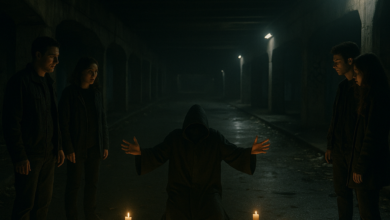
The Doll’s Last Whisper
In a quaint village nestled between rolling hills and thick woodlands, tales of the supernatural often drifted through the cobbled streets, weaving their way into the lives of its inhabitants. The most notorious of these tales was that of “The Doll’s Last Whisper,” a legend that had grown in the telling, becoming a focal point of hushed conversations in the corner shops and around firesides.
It all began in the attic of the old Burrows estate, a decaying edifice that had stood abandoned for decades. The elders of the village often spoke of its former glory, when the Burrows family had hosted lavish gatherings. But following a tragedy—rumoured to be some dark secret linked to the youngest daughter of the family, Eliza—everything changed. Whispers of madness, a doll’s eerie presence, and unholy pacts swirled around the estate, leading to its eventual abandonment.
Clara Hastings, fresh from university and eager for adventure, arrived in the village one autumn, drawn by the haunting echo of the legend. Clara was not one to dismiss the supernatural; her grandmother had often shared tales of the village’s rich history, and Clara had always felt a kinship with those narratives. Her interest piqued, she soon found herself drawn to the Burrows estate, a place teeming with enigmatic history.
On one particularly crisp day, the sun hanging low in the sky, Clara decided it was the perfect time to explore the ruins. Armed with a flashlight and a sense of trepidation, she pushed open the old wooden gate that creaked like a groaning spirit. Weeds choked the garden, and gnarled branches clawed at the air, but Clara pressed on, determination shining in her eyes. The door, battered and worn, shuddered under her push, revealing a dim corridor lined with peeling wallpaper and dust motes dancing in the beams of her flashlight.
The air was thick with silence, interrupted only by the faint sound of her footsteps echoing off the walls. She explored room after room, each filled with remnants of a bygone era—a cracked mirror, moth-eaten drapes, and furniture draped in sheets as if protecting them from an inevitable decay. Yet it was the attic she most looked forward to; it was there that the heart of the legend supposedly beat strongest.
Climbing the narrow staircase, Clara felt anticipation coursing through her veins. The attic door creaked ominously as she pushed it open, and a rush of stale air greeted her. Boxes lay scattered, some filled with old records, while others contained forgotten toys. Among them was something that caught her eye—a porcelain doll, its face seemingly untouched by time, though its dress was tattered and dusty.
As she reached out, a chill ran down her spine. The doll’s eyes, a deep, unsettling shade of blue, seemed to follow her. Clara picked it up, examining the delicate features that must have been exquisite in its youth. But there was something unsettling about it, something beneath the surface that stirred an inexplicable fear within her. Perhaps it was the village lore—or perhaps it was something more.
Ignoring the unease, Clara turned the doll over in her hands. That’s when she heard it—a faint whisper, almost inaudible, like the brushing of silk against skin. “Help me,” it seemed to say, carried on the wind that had somehow found its way into the attic. Clara froze, her heart racing. Was it her imagination? Or had the stories been true all along?
Compelled by a mixture of bravery and curiosity, Clara decided she couldn’t leave the doll behind. She cradled it against her chest, feeling an odd heartbeat of energy pulsing through her. With a newfound determination, she descended the staircase, whispering to herself that logic would conquer fear. She would uncover the truth of the legend.
That evening, she gathered with the villagers in the local pub, the warmth of the fire contrasting with the chill of the legend that hung in the air. Clara shared tales of her exploration, holding the doll delicately in her lap. The atmosphere shifted; laughter faded, and eyes widened as the villagers leaned in closer, captivated and horrified.
“Many years ago,” began Old Mrs. Thompson, her voice quavering, “young Eliza was given a doll just like that. It was said she could converse with it, that it even spoke back. But after her tragic accident, the doll was found holding onto a terrible secret, and whispers turned into curses.”
Mrs. Thompson recounted the night of the fateful accident, how Eliza had been playing near the pond, drowned under mysterious circumstances. It was rumoured that she had tried to take the doll with her, her last plea for help a desperate whisper carried on the wind. The legends claimed that, on certain nights, the doll would awaken, trying to seek out Eliza’s lost spirit, longing for companionship.
Clara shifted uncomfortably, feeling the weight of the doll grow heavier in her grasp. Had she made a grave mistake in taking it? The villagers warned her that the doll brought misfortune, and as the night deepened, Clara felt a sense of dread unfurling deep within her. When she finally retired to her small cottage, sleep eluded her like a shy child, hiding under the bed.
A night of tossing and turning gave way to visions that swept in like a tide. Clara dreamt of a little girl with flaxen hair and piercing blue eyes holding the doll tight. The girl’s face twisted in anguish as she whispered, “It’s not done. Find me.” Clara awoke, breathless, her entire body drenched in sweat.
The next day, shaken but resolute, she ventured to the village’s archives, convinced that there were secrets buried deeper than the whispers of the old women. Hours flew by in a blur as Clara pored over dusty records and yellowed parchments. She uncovered links to other families, tragic tales of loss and sorrow—all connected to the Burrows estate. Yet, signals of Eliza’s ultimate fate remained elusive.
The deeper Clara dug, the more the doll seemed to resonate with her. She could feel its presence, pulsating with a dark energy that began to gnaw at the corners of her mind. Shadows crept through her thoughts, whispering doubts and enticements. The villagers, once friendly, were now distant, their gazes wary. She had become an outcast, a harbinger of doom carrying the burdens of the past.
Then came the day when Clara found the final piece to unravel the mystery. A local historian had kept a collection of letters belonging to Eliza. Though some were smudged with tears, certain phrases leapt out at her: “the bond of whispers” and “a price to pay.” Clara’s heart raced as she deciphered the cryptic implications buried within the letters. Eliza had been searching for something to fill the void left by her family—something that would grant her companionship forever.
Clara, haunted by her dreams and the doll’s increasingly oppressive presence, realised she had become entwined with the history of the Burrows estate in ways she could not comprehend. One stormy night, as rain lashed against her window, Clara knew she had to break the cycle. She clutched the doll and repeated the words from Eliza’s letters, calling out, “I have come to help you find peace.”
In that moment, the room filled with an unnatural stillness. The doll vibrated slightly in her hands, the air crackling with an energy that felt both terrifying and intoxicating. Clara felt the world swirl around her, reality bending and distorting as she was drawn into a vision—a breathtaking landscape filled with vibrant colours before fading into darkness. From within, she heard Eliza’s whisper, pleading for release.
“I will free you,” Clara promised, her voice steady despite the chaos. “You do not have to linger in suffering.”
As the echoes of Eliza’s anguish filled the air, the doll’s eyes burned bright, and for a fleeting moment, Clara saw the girl’s face reflected within them. In that instant, Clara understood the weight of their bond. This was not merely a toy but a vessel of unfulfilled promise and pain—a connection to a soul trapped in limbo.
With an overwhelming surge of determination, Clara lifted the doll high, feeling its power course through her. “Be free!” she shouted, and in one heartbeat, a brilliant light enveloped the room, drowning out fear and despair.
The whispers ceased. The doll grew lighter, almost intangible, until its form flickered like a flame extinguished. A soft sigh—a release—filled the air, and Clara felt a profound sense of calm wash over her, as though a veil had been lifted.
When the dawn broke, Clara stood alone in the quiet attic of the Burrows estate. The doll had vanished, leaving only a spectrum of light shimmering in the morning sun. As news of the village’s dark legend ebbed into memory, Clara felt a deep connection to Eliza, a bond that spanned time and loss, echoing the reality of resilience.
From that day onward, the village reclaimed its tranquillity. Clara, forever marked by her adventure, would often walk among the hills, searching for those whispers that had once haunted her, but she found only the soft rustle of the wind and the sound of children’s laughter, echoing life rather than sorrow. The legend of “The Doll’s Last Whisper” transitioned from a tale of fear to one of hope, an enduring reminder of the delicate balance between companionship and the call of the unknown.