The Echoes of Hollow Street
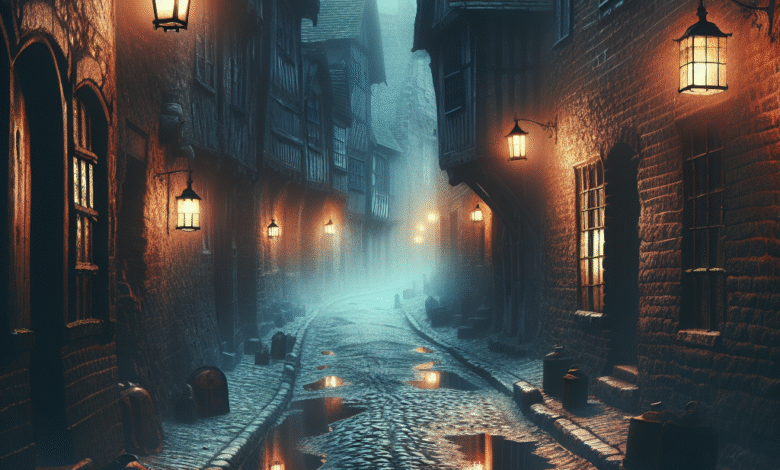
In the heart of an ancient city, where the cobblestones gleam under the glow of gas lamps, there lies a narrow passageway seldom trodden by any soul. Known as Hollow Street, it winds its way through shadowy alleys and crumbling buildings, a hidden vein pulsating at the edge of the old district. The locals speak of it in hushed tones, as if summoning its dark history might awaken the very spirits that linger there.
Legend has it that Hollow Street was once the bustling epicentre of life, a thoroughfare filled with market stalls, joy, and the boisterous laughter of children. It thrived for centuries, drawing traders from far and wide. But as time drudged on, the magic of the street waned, and whispers of a curse began to circulate among the townsfolk. It was said that a tragic event had befallen the area, one that would echo through the ages.
Many believe it happened during the winter of 1874, when a powerful snowstorm swept through the city. Snow piled high, sealing the doors of homes and shops, and the air was filled with a biting chill. A troupe of performers came to Hollow Street, known as the Nightingale Players. They brought with them a festive spirit, hoping to warm the hearts of the townsfolk with their jubilant plays. But the storm turned merciless, trapping the troupe and the curious onlookers inside the narrow street.
As the days turned into nights, the performers grew desperate. A single candle flickered in the window of the old inn at the end of the alley, its light a beacon against the blizzard. The townsfolk huddled together, laughing at the actors’ quips, but beneath their mirth lay a creeping dread. Rations dwindled, and the echoes of their laughter shifted to murmurs of fear.
Then came the fateful night, when the storm reached its zenith. The howling wind blended with the sound of shattering glass, and the candles cast monstrous shadows that danced along the walls. In a moment of sheer chaos, the inn’s roof caved in under the weight of the snow, and a cloud of dust fell upon the gathering as screams erupted. The Nightingale Players, once full of life and gaiety, were swallowed in the darkness.
In the days that followed, the townsfolk searched for survivors, but all they found were faded remnants of laughter mingled with sorrow. Bodies were recovered, but the spirits of the performers—those who were cut off from the world just when they had ignited its brightness—never found peace. The inn was abandoned, and Hollow Street slowly faded from map and memory.
For decades, the street lay in ruin, overgrown and haunted. Those who lived nearby began to notice inexplicable happenings. An unsettling chill swept through the passage even on balmy nights, and the echoes of laughter could still be heard, albeit distorted—mournful, almost pleading. Some claimed they saw shadows flitting at the corners of their vision, figures that moved with an ethereal grace, their expressions caught in a playful jest that belied their tragic fate.
As the years turned into centuries, these spectres became part of the urban fabric, and with them came the stories. Schoolchildren dared each other to venture down Hollow Street, swapping tales of the night of the storm. Half-formed phantoms lurked at the periphery of their imagination, children reaching back to a time they could barely comprehend.
Young Lydia, a girl of but ten summers, found herself enthralled by the stories. She lived in a nearby terrace with her father, a weathered man who painted images of the past in the ease of his embrace. Every evening, he would regale her with tales of a diversely woven city, wherein lay the enchantments and enchantresses of dare and demise.
With her heart pounding, Lydia ventured into Hollow Street one Saturday afternoon, emboldened by a group of friends who dared not follow her. The narrow passage felt alive, as if it breathed with a history that tugged at her spirit. The crumbling buildings leaned in as if sharing secrets; their walls, once adorned with laughter and joy, mourned a time long passed.
As she wandered deeper, a soft echo began to stir. A giggle, faint yet electrifying, danced through the air. Lydia paused, brushing her auburn curls from her face, her breath hitching in her throat. Was it true? Could the stories hold a thread of reality? Before she could dwell too long on the thought, she pressed onwards, drawn by an inexplicable force.
The snow had melted in her mind, replaced by shadowy apparitions and a longing she couldn’t quite define. Suddenly, from the corner of her eye, she caught sight of figures—a troupe adorned in costumes vibrant yet faded, their faces painted with emotion. They moved as if rehearsing, their laughter echoing, mixing joy with sorrow. Lydia’s heart raced as she stepped closer.
“Join us!” a voice beckoned, faint as a whisper yet rich with warmth.
The voice belonged to a figure clad in an ethereal dance of colours, a glowing presence amid the dimness of the alley. Would it be wise to answer? Fear tugged at her instincts, but curiosity propelled her forward. She stepped out, feeling the pavement beneath her bare feet damp with an unseen rain. The spectres paused, their smiles both welcoming and haunting, and the world around her dimmed into a haze.
As she entered their realm, the boundaries began to blur. Lydia could feel the weight of the street’s history pressing upon her. The ghostly performers reached out, their hands seeking hers, and as she grasped their transparent palms, an electrifying sensation surged through her, igniting her soul. Suddenly, she was swept into movement—a dance both joyous and mournful, a celebration of life intertwined with the grief of the past. Laughter erupted around her, now brimming with connection.
Yet, as the dance unfolded, the energy shifted. The laughter, once adorable, morphed into something deeper—a yearning for recognition, an understanding that the night would fade with the dawn. Lydia could feel the spectres’ longing for release, their spirits tethered to Hollow Street by the memories of the night they never escaped.
“No!” she shouted, “You must find your peace!”
The swirling dance stuttered as they clustered around her, their eyes shimmering with unspent tears—the sorrow of a life unresolved. “We are anchors of this street,” whispered the radiant figure, “fated to echo our laughter forever until someone remembers us not as spectres but as we once were.”
Fear gripped Lydia; to let them fade would mean relinquishing the joy of their memory. “I will remember!” she proclaimed fiercely, her spirit entwined with theirs, refusing to sever the connection.
In a heartbeat, the shadows encroached, enveloping her in warmth, and for an instant, the street erupted in colour—the performers twirled and swirled in kaleidoscopic delight, laughter ringing out as if the very air trembled with joy once more. But invisibly, the weight hung on the air, and realisation sank deep into her bones: their release hinged on her ability to remember, to share their stories with the world.
As dawn broke, the phantoms began to fade, yet their laughter echoed in Lydia’s heart—she would carry their story through every fragment of her being. She woke, gasping, back in her world, the echoes receding into silence. The shimmering figures faded into the ether of memory, yet their imprint lingered.
Whispers of Hollow Street transformed into reverence. Lydia became the conduit of their tale, riding the currents of memory with the power of her young voice, awakening a town and a street long forgotten. The echoes of the performances enveloped the passage once more, drawing in those who sought laughter and camaraderie. The history breathed anew, and in every storyteller’s heart lay a patience for the unremembered. Hollow Street would resonate as a tapestry of light and shadow, a reminder that even with fading spectres, life continues to intertwine.