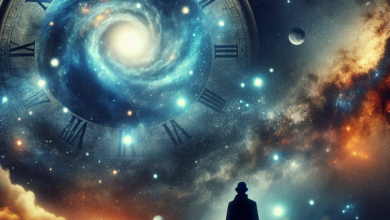
The Clockmaker’s Curse
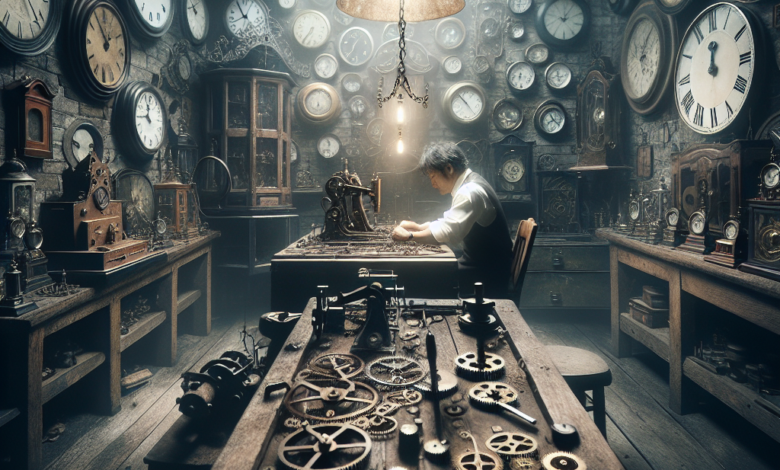
In a small, forgotten corner of London, where the cobblestones still glistened with secrets from centuries past, there stood a quaint shop nestled between two towering edifices. The sign above the door read “J. L. Hawthorne – Clockmaker,” though few dared to venture inside. Most whispered of a curse that befell those who sought his service, a tale spun with the strands of intrigue and fear.
Mr. Hawthorne was an eccentric man, with wild hair that stood like a thicket against his pale, gaunt face. His hands, stained with oil and grime, moved with the precision of an artisan, carefully tinkering with gears and springs, breathing life into broken timepieces. The shop was a treasury of clocks—some large and ornate, others small and intricate, each ticking in a rhythm of its own. But while the clocks enchanted with their tick-tock melody, an undercurrent of dread seemed to weave through the very air.
The legend of the Clockmaker’s Curse began long before Mr. Hawthorne took over the shop. It was said that his predecessor, a reclusive craftsman named Edwin Blackwell, had waded too deeply into the realm of the uncanny. Obsessed with time and its mysteries, he crafted a clock unlike any other—one that was rumored to possess the power to manipulate time itself. The townsfolk believed that Blackwell had fashioned the clock from the very bones of time, binding ancient magic within its gilded frame.
Blackwell’s ambition came at a grave cost. According to the whispers that lingered on the lips of the old and weary, the clock drew the attention of a darkness that loomed over the borough—a sinister entity that fed on the souls of the desperate. One fateful evening, the townsfolk heard a cacophony of chimes, each more haunting than the last, echoing through the streets. When they rushed to the shop, it was found in disarray, the clock shattered and Blackwell missing, lost to the unknown.
The legend spoke of strange happenings thereafter. Anyone who dared to have their clocks repaired or crafted by the hands of Blackwell’s successor would suffer a fate worse than death—a moment of intense joy, laughter, or triumph, only to be followed by profound despair. The townspeople learned to avoid the shop, their fingers curled tightly around their charms and talismans, whispering prayers to ward off the curse.
But legends have a way of attracting the curious. Among those who disregarded the warnings was Eliza Hartwell, a spirited young woman with a love for the eccentric. She had stumbled upon the shop while seeking shelter from a sudden downpour. Inside, the warm glow of lanterns illuminated the shining clocks, and the rhythmic ticking soothed her chaos-riddled mind. Despite the chill that clawed at her spine, her curiosity overruled her trepidation.
“Can I help you?” Mr. Hawthorne’s voice, strained and quavering, broke the silence as he emerged from a shadowed corner, his blue eyes glinting like precious stones. Eliza’s breath caught in her throat; there was a strange allure about him, an intensity that sent shivers dancing along her arms.
“I saw the sign outside and… I love clocks,” she stammered, her cheeks flushing in embarrassment. “This place is marvellous!”
“Most are drawn to the beauty,” he replied, a slight smile flickering on his lips. “But few can handle what lies beneath.”
Intrigued, Eliza took a step closer, examining the clocks, each one telling its own story. The sounds of the shop seemed to weave a spell around her, pregnant with history and mystery. “What do you mean?” she asked.
“Time is a fickle mistress,” he murmured, “and I am her servant. It can be your friend or your enemy, depending on how you choose to handle it.” There was a gravity in his tone that made her heart race, as if he were warning her of deeper currents that swirled below the surface.
Days turned to weeks, and Eliza found herself returning to Hawthorne’s shop. Each visit only deepened the pull she felt towards him, the strange man who seemed both haunted and wise. He shared stories of timepieces that held memories, artefacts that had traversed generations. As they spoke, a bond began to form amidst the ticking symphony, a connection forged in the dance of shadow and light.
But the more she learned about Mr. Hawthorne, the more the legend crept closer to the forefront of her mind. As her affection grew, so too did the whispers of the curse. She began to notice the subtle shifts in the world around her—a friend who laughed uncontrollably at a joke only to weep for hours after, a child born with an unusual gift of foresight but destined to suffer for it. Every tale seemed to echo the same truth: happiness led to grief, joy twisted to sorrow, and each tick of the clock promised a reckoning.
One evening, the ambiance inside the shop was particularly electric. Eliza had brought a small, family heirloom clock that had fallen into disrepair. “I’d like you to fix this,” she asked, placing it gently on the counter. “It belonged to my grandmother.”
As Mr. Hawthorne took the clock in his hands, Eliza felt a sudden heaviness in the air. “You must understand,” he cautioned, “there are consequences to our choices. The moment you decide to take on what is broken, you must also be prepared for what lies ahead.” His eyes fixed on hers, intensity replacing their gleam.
“I’m ready,” she replied, though uncertainty gnawed at her heart.
After the clock was repaired, the two sat in comfortable silence, the only sound the gentle ticking echoing in the background. In that fragile moment, Eliza felt the world around them fade away, leaving just the two of them, suspended in time. But as she smiled at him, a brief shadow crossed Mr. Hawthorne’s features.
“Such joy,” he whispered, almost to himself. “But all joys come at a price.”
That night, as darkness draped the city, Eliza returned home, her heart buoyant, her thoughts dancing around the clock that now ticked proudly on her mantelpiece. But her elation was cut short when she received the news: a close friend had been found unconscious at a party, the victim of an overdose, an accidental tragedy. Eliza’s heart shattered, an echo of despair crashing against her fragile joy.
In the following weeks, the dread deepened. Eliza could not shake the feeling that the clock was somehow linked to the curse. Each tick now sounded like a countdown, a foreboding reminder of the price she had unknowingly paid. Yet she found herself driven back to the shop, helpless to resist the pull.
On one cloudy afternoon, with rain dousing the streets, she burst through Mr. Hawthorne’s door, her heart racing. “This can’t go on!” she exclaimed. “You must help me understand this curse!”
Hawthorne’s expression shifted, a mix of pity and acceptance washing over him. “We are all tied to our choices, Eliza. And time… well, it is a merciless judge.”
“Is there any way to break the curse?” she demanded, desperation choking her voice.
Hawthorne sighed deeply, the weight of their intertwined fates hanging in the silence. “There is a way,” he finally conceded. “But it will cost you dearly. You might lose everything you hold dear, or worse yet, you may bind yourself to the curse forever. There is no guarantee when one dances with time.”
With her heart pounding, Eliza grappled with the gravity of the choice before her. The thought of succumbing to despair, or worse, losing even more, battled with her desire to free herself from the shackles of fate. “What must I do?”
He looked at her earnestly, his eyes bridging the gap between sadness and hope. “You must confront the clock that began it all. Find Blackwell’s original creation. Only then can you make your choice.”
Eliza’s journey took her deep into London’s forgotten corners, ancient places where remnants of past lives whispered through the air. She followed the trail of the legend as if it were a thread leading her to the heart of darkness.
After countless trials, she found herself standing before an abandoned warehouse overshadowed by crumbling walls. Inside, enveloped in shadows, she discovered the very clock that had started it all, its eerie ticks reverberating like a heartbeat. It was a magnificent monstrosity, gears gleaming with a sinister brilliance, every tick an invocation of the curse that had stolen lives and joys.
Taking a deep breath, Eliza approached the clock, her heart warring against her impulse to flee. “I wish to break the curse!” she cried, her voice filling the empty air. The clock responded with a shudder, gears whining as the hands began to spin wildly. Time around her warped and twisted, and she was swept into a vortex of memories, laughter mingling with cries of grief.
Visions of her life flashed before her—her joyful moments juxtaposed with heartbreaking scenes, each intermingled in a tapestry of light and darkness. In that chaotic swirl, she felt the weight of her choices and the effects they had reverberated through the lives of those around her. Time had given and taken in equal measure.
As the whirlpool settled, she found herself back in the warehouse, the clock now still. Eliza stood trembling, tears streaming down her face. “I accept that the choices we make shape us. I accept the joy intertwined with grief. Break the curse, but I will not run from either joy or despair!”
As the clock chimed midnight, its voice rang through the air, a final countdown that echoed through the depths of her spirit. The ticking slowed, synchronising with the rhythm of her heart. The oppressive weight of the curse lifted, leaving behind an ache, but also a clarity—the understanding that life was a dance of shadows and light.
Emerging from the warehouse, Eliza felt a fragile sense of peace. The burdens of the past remained, but her heart was now free to embrace them, no longer shackled to despair or dread.
Upon her return to Mr. Hawthorne’s shop, she was greeted with a smile that held a mixture of pride and sorrow. “You have embraced the essence of time,” he said, his voice low and warm. “And now you are free.”
Though shadows may still flicker on the periphery, Eliza learned to live within them, to find solace in the moments of joy and to accept the cycles of loss. The Clockmaker’s Curse had been transformed into a testament of resilience, proving that even time’s dark hand must bend in the face of indomitable spirit.