By the time I noticed the man at Platform Nine, I had already missed one train, bought a coffee I did not want, and spent twenty minutes pretending not to panic while my sister rang me three times from hospital reception.
It was a Tuesday in November, wet in that patient, needling way London can be when the pavements are dark before five. I was at King’s Cross with a rucksack full of clothes for Ellie, my younger sister, who had been admitted after what her doctor called a “collapse episode”, as if naming it carefully might make it less frightening. She had laughed at me on the phone that morning, weakly but still like herself, and told me not to bring anything ridiculous. So I had packed her pyjamas, a charger, two paperback novels and the oat biscuits she liked, and set off from my flat in Lewisham in a state of practical worry that felt almost manageable until the train from Blackfriars was delayed and then cancelled.
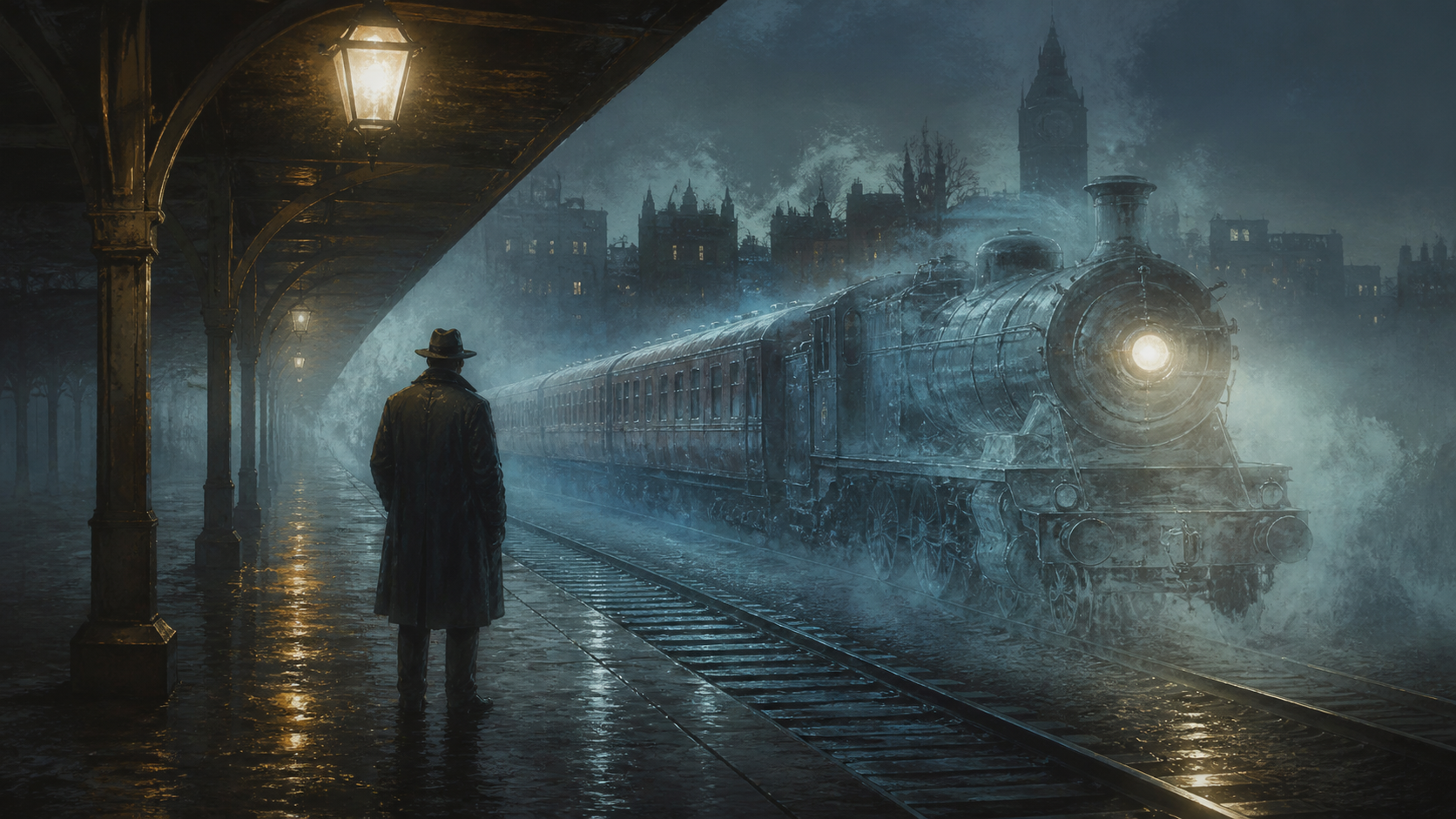
That was how I ended up wandering between platforms with a paper cup in one hand and a text from Ellie in the other: where are you? The sort of message that can mean I am bored, I am frightened, I am alone, please come quickly. I replied that I was on my way and looked up just in time to see a man standing at the far end of Platform Nine, where there ought not to have been a platform at all.
King’s Cross has its peculiarities, of course. Anyone who uses it regularly knows the place is a small city of departures, delays and half-remembered signs. But Platform Nine is not one of them. There is the famous joke about nine and three-quarters, the brass plaque tucked into the brickwork for tourists, and beyond that the usual collection of service doors, storage rooms and places staff politely tell you not to stand. Yet this was a proper platform, lit, tiled and numbered in the same black square as the others. It ran beside the outer wall where no passenger service went, a narrow strip I had never seen open.
The man was on it alone, near the edge, looking down the track as if expecting a train that did not exist. He was tall, narrow-shouldered, with a dark overcoat and a hat that might have been fashionable twenty years ago or simply old. The odd thing was that he seemed entirely at ease, as though he belonged there more than anyone around him. A suitcase stood beside his feet, one of those rigid black cases people take on business trips. He had his left hand laid on the handle and his right hand in his pocket. At first I thought he was waiting for someone. Then I noticed that no one else seemed to look at him.
That in itself should have made me turn away. Instead, because I was tired and irritated and already running late, I walked closer. I must have been staring, because he turned his head and smiled at me.
Not in a friendly way. Not in a way meant to reassure. He smiled as if he had caught sight of a coincidence he approved of.
“Excuse me,” he said, in a voice that was mild and perfectly ordinary, “would you be so kind as to tell me the time?”
I looked at my phone. 16:47.
When I looked up again, he was holding something between his fingers, a small square of paper cream-coloured at the edges. He had not taken his hand from his pocket to get it, or at least I had not seen him do so. He held it out to me.
“For your trouble.”
“No, thanks,” I said automatically.
He inclined his head. “You’ll want it later.”
I expected a joke. Or a scam. Instead he looked past me, towards the main concourse, and for the first time I noticed the smell around him. Not bad exactly, just wrong in a way I could not place, like damp wool stored too long in a drawer with old coins.
On the paper was written, in neat blue ink: Platform Nine, first carriage, keep your ticket visible.
I laughed then, because it was easier than asking what he meant. “Is this for some kind of stunt?”
He glanced at the paper in my hand, not at me. “You’ve already got one,” he said. “Do not lose sight of it.”
I had no idea what he was talking about until I looked down and saw that, somehow, I was now holding the note. My coffee cup had shifted in my other hand, but I distinctly remembered not taking the paper from him. There are moments when the mind tries to tidy away what the senses refuse to explain. I remember feeling embarrassed, as if I had made a fool of myself in public, and I remember that the note was cold, much colder than the air around it.
When I looked back up, the man had moved three paces away without a sound.
“Wait,” I said. “What platform is this meant to be?”
He did not answer. He only lifted two fingers from the handle of his suitcase, a small gesture almost like a farewell, and then stepped through the door at the end of the platform. It was one of those plain metal service doors with a bar handle and a warning label. I saw it swing inward, briefly showing a strip of tiled corridor beyond, and then shut. I ran to it a second too late.
The handle would not move. The sign on the door, which had not been there moments before, now read AUTHORISED PERSONNEL ONLY.
There was a small crowd nearby, commuters dragging cases and checking boards. I turned to ask one of them if they had seen the man in the coat, but the woman nearest me was speaking into her phone and the man beside her was studying the departure board with weary concentration. Neither appeared to have noticed anything unusual. I went to the nearest member of staff, a woman in a navy blazer with a headset and a face tuned to patient exhaustion, and asked about Platform Nine.
She frowned at me as though I had asked about a station in another country. “Platform Nine’s over there,” she said, pointing at the usual intercity lines. “Are you looking for a train?”
“No,” I said. “I just saw a man go through a door.”
She glanced towards the service corridor, then back at me. “If you’re not boarding, sir, please keep clear of the doors.”
I showed her the note. Her expression changed so slightly that I would not have noticed it if I had not been watching.
“Where did you get that?” she asked.
“A man gave it to me.”
She took the paper from me, but not before I saw that her fingers tightened on it as if she were bracing herself against a memory. She read it once, then folded it into a square so small it fit between her thumb and forefinger.
“Who gave it to you?”
“I don’t know. He was on the platform. He looked like he’d been waiting there.”
She swallowed, and in a low voice that sounded forced into calm, she said, “You need to go to Medical, just off the main concourse. Please. Right now.”
I must have stared at her in disbelief, because she added, more firmly, “Sir, if you received a paper from a man on Platform Nine, I need you away from the platforms.”
At that point I should have done as she said. I should have gone straight to the hospital, where Ellie was waiting, and let the station staff do whatever station staff do with impossible situations. But the note had said keep your ticket visible, and something about the woman’s reaction, the way she looked at the folded paper as if it were contaminated, made my concern snap into a sharper shape.
“Why?” I asked.
She hesitated. “Because if he spoke to you, he’ll know you’ve noticed him.”
That was when I realised my train had not simply been cancelled. On the departures board, the replacement service to Cambridge had appeared and disappeared twice in as many minutes, and the crowd around it had the distracted, uneasy look people get when a journey has become more difficult than it ought to be. My phone buzzed again with a message from Ellie: they moved me to a side room. please come.
“I have to get to St Thomas’s,” I said.
The woman’s mouth tightened. “Take the Underground. Do not use the platform. And if you see the man again, don’t speak to him.”
“What man?”
But she had already stepped away to answer a call on her headset, and the rest of the station went on as if our conversation had never happened.
I found the old ticket in my coat pocket after that. A proper paper ticket, creased and pale, printed for a journey from King’s Cross to Cambridge, dated that day. I had not bought it. The only explanation that presented itself was absurd, and yet there it was. I remember holding it and feeling a hard, stupid anger. It was not that I believed in ghosts or curses or any of the things people mention when they have nothing useful to say. It was that I had a sister in hospital and an unmarked platform and a man in a hat who appeared to be arranging events around me without asking.
So I decided, very sensibly in the manner of people who are not sensible at all, to keep the ticket visible and see what happened.
The first oddity came on the Underground escalator, when I looked back and saw the same man standing on the concourse below, only this time he was carrying my coffee cup. It was almost empty. He did not wave. He simply watched me with the same attentive expression one might give to an arriving parcel. I turned away so quickly that I nearly missed my step.
By the time I reached St Thomas’s, the note and the ticket were damp in my coat pocket from the rain. Ellie was propped up in a bed by the window, looking smaller than she had on the phone. She tried to smile when she saw me, but her eyes kept darting to the corridor as if she expected someone else to come in with me.
“You look dreadful,” she said.
“You’re one to talk.”
“Have you been crying?”
“Not unless you count the weather.”
I sat down and gave her the biscuits. She opened the packet, then paused and said, “Did you get here all right?”
“Why?”
She shrugged. “A man asked for you.”
My head came up so fast it hurt. “What man?”
She frowned. “I don’t know. He came to the reception desk just after lunch. Tall, dark coat, hat. I only saw him from the side. He asked which ward you were on. The nurse said relatives had to wait until visiting, and he seemed to take that badly.”
“What did he want?”
Ellie picked at the foil packet. “The nurse said he looked through the glass doors for a while. Then he gave something to the receptionist. She went pale.”
My skin had gone cold in a way no overheated hospital could explain. “What did he give her?”
Ellie shook her head. “I don’t know. She put it in her pocket, then said she’d seen enough for one day and went off to the staff room.”
I thought of the woman at King’s Cross folding the note so quickly. “Did anyone stop him?”
“No. Why would they?”
Because, I thought, perhaps the same rules did not seem obvious until they were already in force. I reached into my coat and pulled out the ticket. Ellie stared at it.
“That’s not yours.”
“I know.”
She sat up straighter. “Where did you get that?”
I told her as much as I could without sounding mad, and with every sentence her expression shifted from confusion to something sharper. She had the sort of face that did not give much away, but the idea of being frightened in front of her made me a better witness than I might otherwise have been. When I finished, she said, very quietly, “There was a man at the end of my bed this morning.”
I waited.
“He didn’t come in. He stood by the door. I thought it was one of the porters. He asked if I’d seen a case. Said a black suitcase had been left somewhere it shouldn’t be. I told him I hadn’t. Then he smiled, and I realised he was looking at the foot of the bed, not at me.”
I felt, absurdly, the urge to go and find someone official. Security. A doctor. Anyone. But the phone on Ellie’s bedside table started buzzing before I could stand up. It was her nurse, saying there had been a delay with the scan and that Ellie would need to move to a different room downstairs for an hour. Nothing urgent, the nurse said, though her tone suggested otherwise.
Ellie looked at me. “You heard that?”
“Yes.”
“Do I want to know why you’re making that face?”
“No.”
She dragged a hand over her hair. “I don’t like this.”
“Neither do I.”
“Then what do we do?”
I thought of the ticket in my hand, the note, the platform, the man who seemed to appear wherever a route was about to narrow. “We stay together,” I said. “We do exactly what we’re told by actual hospital staff, and if anyone not in uniform asks for anything, we don’t hand it over.”
She gave a short laugh. “That’s your plan?”
“It’s better than my other one.”
The nurse came for Ellie ten minutes later, a brisk woman called Priya who looked tired in the practical, competent way of people who have seen too many odd requests to be startled by them. She glanced at me, glanced at the ticket, and her mouth compressed into a line.
“Have you been in the station today?” she asked.
“Yes.”
“Did anyone give you this?”
I almost said no, because the answer seemed impossible. Instead I nodded.
Priya took a breath. “Then you need to listen carefully. There’s a corridor behind the old outpatient wing. It used to lead to the ambulance bay before they rebuilt. People keep finding it after they’re told not to use it. If you see the man again, do not let him near the lift. He comes in through places that shouldn’t be open. Once he’s inside, getting him out is difficult.”
“What is he?” Ellie asked.
Priya looked at her, and then at me. “I don’t know. But he likes carried things. Bags, cases, folders. Things that belong to someone and have somewhere to be. That is enough for me.”
She was not speaking as if she believed in monsters. She was speaking as if she had made a practical arrangement with one.
Before I could ask what that meant, the lights in the corridor beyond Ellie’s door dimmed and then steadied. Not a dramatic flicker, just enough to make everyone stop talking. Priya turned sharply towards the sound of a trolley in the corridor and said, under her breath, “No.”
The man in the hat appeared at the far end of the ward as if he had stepped from behind a wall that had never been there. He was still wearing the same overcoat. Now, though, he carried the black suitcase in his left hand, and beside him, rolling neatly on its own wheels, was a hospital case trolley of the sort used for linen. He did not look at the nurses. He looked at Ellie.
“Good afternoon,” he said. “I believe I have the wrong patient.”
Priya moved before I did. She blocked the doorway with one arm and said, in a voice so flat it was almost bored, “Not this one.”
He inclined his head, as if acknowledging a minor administrative issue. “I do apologise. There has been some confusion.”
He set the suitcase on the floor. The latch was already open. Inside, instead of clothes or papers, there were rows of folded cardboard tickets, all the same pale cream colour as the note he had given me. He reached into the case and drew out a handful, then extended them towards me.
“Your connection has changed,” he said. “You must take the next route.”
Ellie made a small sound, halfway between a laugh and a gasp. “Do not give him anything,” she said.
The man’s eyes moved to her, and for the first time his smile showed something impatient beneath it. “You are not yet due,” he said. “You needn’t make this difficult.”
That was when I understood, with horrible clarity, that the paper ticket in my hand mattered because it marked something, some kind of claim or passage. He was not after people in the abstract. He was collecting transit, movement, the obligation to go where he had arranged. The suitcase was not carrying belongings. It was carrying permissions.
Priya shoved the trolley at him hard enough to make him step back. “Now,” she said to me.
I grabbed Ellie’s hand. She was trying to swing her legs out of bed despite the nurse’s grip on her shoulder. The man opened the suitcase wider. The tickets inside lifted and rustled as if in a draught, though there was no wind. One slid free and landed on the floor between us. On it was printed my name.
For one idiotic instant I froze at the sight of it. Then Priya swore, seized the ticket, and tore it in half. The man made a sharp, angry exhale, the first sign of emotion he had shown. He lunged for the pieces, but Ellie, who had apparently decided fear could wait until later, threw her water jug at his hand. The jug hit the suitcase instead. Water splashed over the open tickets, and several of them clung together in a wet, useless clump.
He looked at the ruined papers with an expression not of outrage but of concentration, as if recalculating. “That was unwise,” he said.
“Leave,” Priya snapped.
He took one step towards me, and I had the very distinct impression that if he touched my coat or my wrist or even the ticket in my hand, I would not be the same person at the end of it. I do not know how to describe that feeling without sounding melodramatic. It was simply certain.
Then a corridor alarm began to sound somewhere far below us, a short, repeating note. The noise did not scare him; it distracted him. His eyes shifted towards the door behind him, and in that moment Priya slammed it shut with a crash that set the glass panel rattling in its frame. She shoved the bolt home.
“Move!” she shouted.
We ran. Not elegantly, not in any way that suggested courage. Ellie half-stumbled in her socks, still tethered to the drip stand until I yanked it free. Priya kept us moving through the side corridor and down a service lift that smelt of bleach and wet coats. Twice, I looked back and saw the man farther behind than he should have been, standing at the end of the corridor without hurrying, as if distance itself were being negotiated rather than crossed.
At the lower level, the corridor opened towards what had once been the ambulance bay. It was a broad, unfinished space with stacked chairs, a vending machine, and a set of double doors propped open for deliveries. Beyond them lay the rain-slick road outside and ordinary traffic and the promise of not being in that place any longer. Priya pushed us through and said, “Get across the road and keep going. Do not look back.”
“What about you?” I asked.
“I’m working,” she said, and shut the doors behind us.
Ellie and I made it to the opposite pavement just as the hospital alarm rose into a sharper, more urgent wail. We did not look back until we had crossed to the railings. Then, because we were both human and stupid in equal measure, we did.
The ambulance bay doors stood open on darkness and fluorescent light. Priya was there with another security guard, and the man in the hat was between them, perfectly calm again, one hand on the handle of his suitcase. For an instant, even from across the road, I thought he might simply walk out with the flow of people. Instead he turned his head and met my gaze.
He lifted the suitcase slightly, as if in acknowledgement of a completed transaction, and then stepped backwards through the service doors. They swung shut. When Priya reached them and yanked them open, there was only a narrow, tiled corridor and a locked metal barrier at the far end. No man. No suitcase. No track of wet footprints.
That should have been the end of it. In a practical sense, it nearly was. Ellie was moved back upstairs. Her scan, delayed and then rescheduled, showed nothing immediately catastrophic, only something doctors would continue to monitor, which is perhaps its own kind of sentence. I gave statements to three different staff members who all pretended not to know exactly what I was talking about and then, in the same breath, asked if I had “encountered anyone unusual” in the station. Priya was nowhere to be found after that night. When I asked about her, a receptionist told me she did not think anyone by that name had been on shift.
I kept the ticket for three days before I noticed what had changed.
At first it was only a fold in the corner where it should not have been, as though it had been in a wallet. Then I saw that the destination had altered. Cambridge had been crossed out in thin blue ink and replaced with PLATFORM NINE, FIRST CARRIAGE. My name was still printed neatly at the top.
I left it on my kitchen table and told myself not to be ridiculous. But the next morning there was a second ticket beside it, damp at the edges, with Ellie’s name on it too.
I took both to King’s Cross in daylight, in the company of my sister, who insisted on coming because she wanted to know what on earth I had been keeping from her. We asked for the station manager and were shown to a small office near the side entrance. It was the sort of office where lost property is stored in labelled boxes and tea is brewed too strong.
The manager was a woman in her fifties with excellent posture and a look of permanent containment. She listened to us without interrupting, then took the tickets and examined them with a face that did not change once.
“You should not have these,” she said at last.
“We know.”
“They’re not for passengers.”
Ellie gave a short, humourless laugh. “Whose are they, then?”
The manager set the tickets down and folded her hands. “There are places in this station that are not used anymore. Occasionally, people find their way to them. Most come back. Some do not. We do not keep records of such things.” She paused, then added, “We used to put warning notices up. They vanished.”
“Who was the man?” I asked.
She looked at me for a long moment, and for the first time I understood that she was afraid in a way she had spent years learning to conceal. “A collector,” she said. “Or something like one. He asks for time, names, directions. If you answer him, he marks the exchange. If you take what he offers, he assumes you’re willing to travel.”
“And if you don’t?”
“Then he still keeps trying.”
Ellie slid her ticket across the desk. “Can you get rid of these?”
The manager did not touch it. “Yes,” she said. “But not by shredding them.”
She stood, took a key from a drawer and led us through a side corridor into a small maintenance room lined with dead radios and spare signal equipment. At the far end was a plain metal bin with a slot in the lid. She dropped the tickets in one by one, then put a hand over the lid for a second, as if counting to herself.
When she removed her hand, the room smelled faintly of wet paper and hot dust. That was all.
Ellie exhaled shakily. “That’s it?”
“For now,” the manager said. “If he has your name, he will remember it. But he should not be able to collect on it here.”
We left the office and walked back through the station in silence. I was relieved in the ordinary way people are after narrowly escaping something they do not fully understand. Ellie was quieter than usual, and when I asked whether she was all right, she nodded and said, “I think so.” We took the escalator down to the Tube.
At the bottom, on the tiled wall beside the barrier line, someone had chalked a neat black square and, inside it, a number. Nine.
Beneath it, in small letters, were the words KEEP YOUR TICKET VISIBLE. No one else seemed to notice them. A cleaner pushed a mop past the wall and the water from it darkened the tiles, but the writing remained. Ellie stopped beside me, then tucked her hand into my coat pocket and held my ticket stub, which had somehow appeared there again, warm and dry.
We were both looking at it when the announcement boards changed.
Platform Nine, they read, service delayed.
And from somewhere beyond the barriers, in a part of the station where no platform should have been at all, a man in a dark overcoat called my name in a voice that was perfectly polite, and unmistakably certain of where I would be going next.

Urban Legends