The first time the ashes moved, Rina thought it was the ventilation.
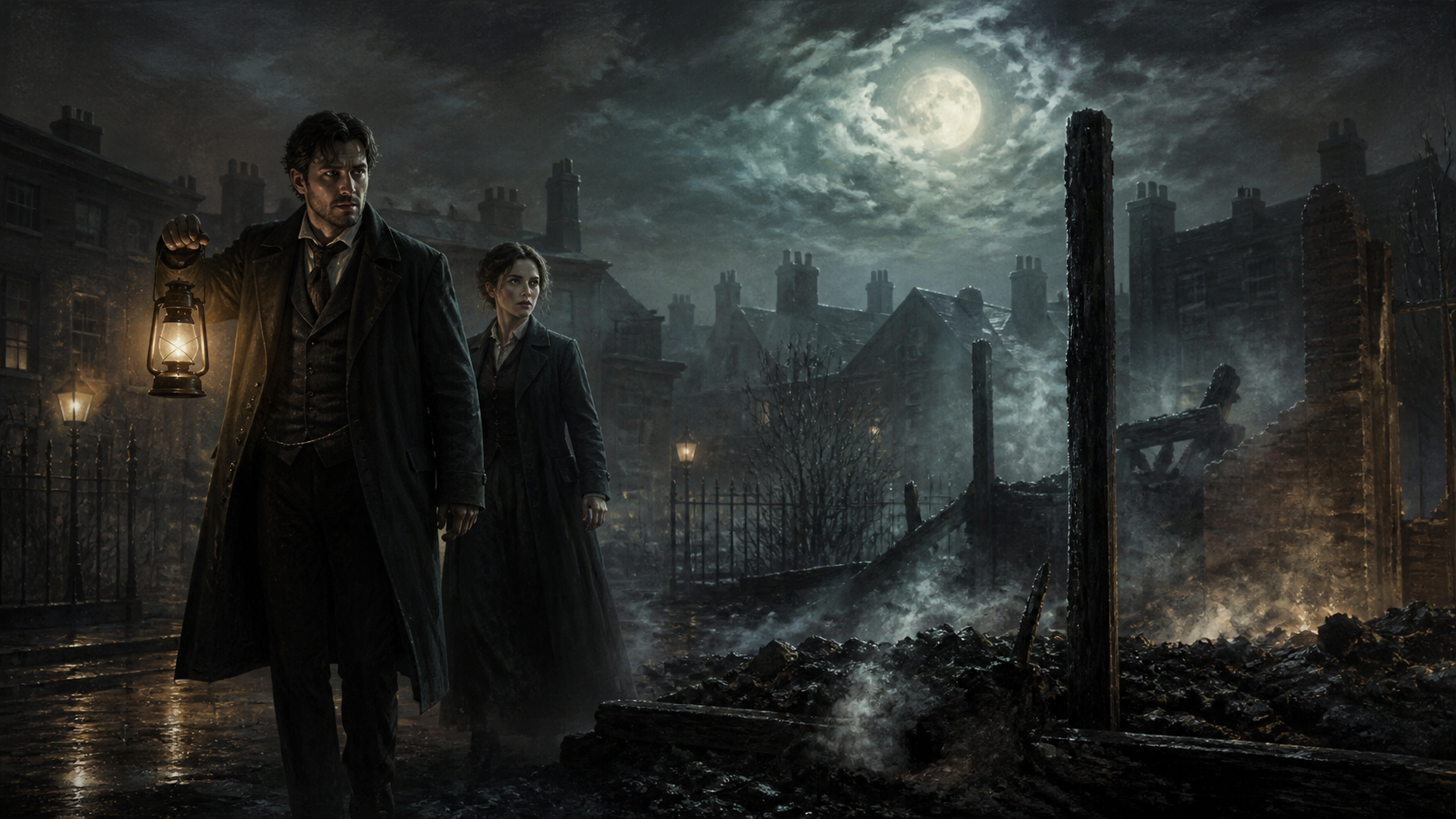
She was alone in the archive room beneath St Bartholomew’s Chapel, a squat sandstone building on the edge of Fremantle, where the church’s old records were kept in filing cabinets that smelled faintly of mould and polished metal. Outside, evening traffic hissed along High Street and a bus groaned past the corner. Inside, everything was still except for the paper rustle of her gloves and the scratch of her pencil as she copied a name from the burial ledger.
Then the grey powder in the brass dish on her desk drew together in a narrow line.
Not much. Just enough to suggest intent. A dark thread lengthened across the dish, as if some unseen fingertip had brushed through it. Rina looked up at the small window, at the closed door, at the bare bulb hanging over her head. Nothing moved. The archive room remained exactly as it had been for the last four months of her volunteering. Dust, shelves, old invoices, a box of memorial cards tied with twine.
The ashes lifted again, this time enough to form three letters before collapsing.
V E R.
Rina did not say anything. She had learned, since arriving in Fremantle after her father’s funeral, that naming odd things aloud gave them weight. She stared until the letters broke apart and the powder settled. The page in front of her showed the same name she had been tracing all week: Reverend Thomas Verity, buried in 1926, no known relatives, no epitaph beyond the usual promises.
She turned the ledger page. Beneath the burial entry someone had written, in a cramped hand different from the clerk’s, Ashes for the Unseen Council.
Rina pressed her gloved fingers against the paper. The note had not been there yesterday.
She had not come to the chapel because she believed in ghost stories. She had come because her father, before he died, had left her a locked biscuit tin and a blunt instruction: when you are ready, take this to the chapel and ask for Mr Shaw. He had sounded embarrassed, as if asking for help were a private failing. He had never explained what was inside. When she finally opened the tin after the funeral, she found a tarnished key, a folded slip with the chapel’s address, and a packet of grey ash wrapped in waxed paper.
The ash had no smell at all.
On the third day she brought it to the chapel, and on the fourth the archive room door was found unlatched though she had locked it herself. On the fifth the ash had shifted into a ring around the dish. On the sixth the names in the ledger began to appear in the margins of the paper, written and erased in a hand she had not seen before.
Now, as the letters in the ash vanished, she heard footsteps outside the room. Measured. Unhurried.
Mr Shaw entered without knocking. He was a narrow man in his sixties, with a clerical collar tucked beneath a dark jacket and the weary, watchful face of someone who had spent years pretending not to notice how the world leaned at odd angles. He set a thermos on the desk and looked at the dish.
“So,” he said. “It has started to answer you.”
Rina closed the ledger. “You could have told me that before I brought it here.”
“I was hoping it would not choose you.”
“That’s a comforting thought.”
“It isn’t meant to be comforting.”
His tone was plain, but his eyes were fixed on the ash with the attention of a man watching a dog he did not trust. Rina took the biscuit tin from her satchel and pushed it towards him. “My father said you’d know what this was.”
Shaw did not touch the tin. “I know enough to dislike it. Your father came to us ten years ago and asked for protection. We gave what we could. He paid in advance and asked no questions.”
“Protection from what?”
“From being noticed.”
That, more than anything, made her impatient. “By whom?”
He rubbed a hand over his mouth. “By the Council.”
“The Unseen Council?”
At that he glanced at her sharply, and she knew the note in the ledger had not been a mistake. “You have seen the phrase.”
“I can read, yes.”
Shaw drew a long breath. “Then I’ll be plain. The Council is not a club, not a cult in the popular sense, and not a conspiracy in the way newspaper columnists like to use the word. It is a gathering of people who have kept a bargain with something beneath this chapel for a very long time. They meet unseen because if they are seen in the wrong way, the bargain weakens. When it weakens, things come through.”
Rina almost laughed, but there was no humour in his face. “And the ashes?”
“A receipt. A warning. Sometimes a request.”
“What do they want with my father’s ashes?”
He looked away at last. “Not your father’s. Yours.”
Her irritation turned at once to anger. “My father is dead.”
“Not all of him.”
The archive room seemed to contract around her. She had not slept properly in days, and grief had made every practical thing feel slightly unreal, but this was too coherent to dismiss. “What did you do to him?”
“Nothing he did not choose.”
She stood up so quickly the chair legs screeched. “If this is your idea of comfort—”
The dish on the desk chimed softly. Not from being struck. From within.
A thin shape rose from the ash, no larger than a moth. It had no clear body, only a suggestion of folded wings made of soot and a pale centre that might have been an eye. It hovered between them for one impossible second, then darted to the ledger and settled on the page beside the burial entry.
Rina’s mouth went dry.
Shaw reached for a heavy stamp from the desk drawer and slammed it down over the thing. The paper buckled. There was a smell then, brief and sharp, like singed hair and wet stone. When he lifted the stamp, the page was marked with a dark ring and the moth-shape had gone.
“You see why I was reluctant,” he said.
Rina stepped back. “What was that?”
“A listener. Or a hand. It depends on how much attention you grant it.”
“Does my father know about this?”
“He knew enough to be frightened. He asked me to keep you away.”
“Then you’ve failed.”
He accepted that without protest. “Yes.”
For the first time, she saw fatigue crack through his composure. Not weakness. Consequence. “Listen to me, Rina. Your father was part of a small group that helped seal the Council’s chamber fifty years ago. They used ash taken from the dead and from the living. He gave them part of himself then. It allowed him to hear when the Council stirred. When he began to fail, he asked that the remainder be destroyed, but he died before the sealing could be completed.”
“You’re saying his ashes are in this tin.”
“A portion. Enough to let the Council find a path to you.”
She wanted to reject the whole thing, yet the note in the ledger, the moving ash, the moth in the paper, and the fact that her father’s last instruction had sent her here all refused to fit into ordinary explanations. “What does the Council want?”
“To open what it has been feeding.”
“And if it succeeds?”
Shaw did not answer immediately. He took the thermos, poured tea into two chipped cups, and handed her one. His hands were steady enough, which made her trust him a little less and a little more at the same time.
“It uses memory,” he said. “Not as a metaphor. It takes the structure of a person’s remembering. People who make bargains bring it ashes because ashes are what remains after the body has finished making decisions. The Council keeps itself unseen by making itself difficult to remember. In return, it offers guidance, wealth, influence, absolution. The city has pockets of influence because people have fed it over generations. The bargain is fraying. It wants a living witness to reinforce it. Your father refused. You have been brought in because you are next of kin and because the ash recognises you.”
Rina stared into the tea. The surface trembled once, then went still. “And you tell me this now because…?”
“Because tomorrow at midnight the Council meets in the crypt under the chapel, and if we do nothing it will attach itself to the only living line left from your father.”
“Us?”
“Primarily you.”
The practical part of her mind took hold of the situation then, the part that had organised her mother’s medications and her father’s hospice paperwork, the part that knew panic was useless. “What do you need from me?”
Shaw hesitated. “Courage would be helpful. But more precisely, I need you to help me burn the ledger and take the ash back to its source before the meeting begins. If we can return enough of your father’s ash to the urn in the crypt, the Council loses its anchor.”
“And if we can’t?”
“Then it will use you to replace him.”
It would have been easier if he had lied. Instead, he gave her the truth with such practical bleakness that she believed him.
They spent the next hour in the archive room, sorting the old ledgers and copies of vestry minutes that Shaw produced from a locked cabinet. Names appeared in the margins whenever Rina touched them: councillors, rectors, civic donors, a magistrate from 1947, a shipping heir, a woman who had been described only as “benefactress”. The pattern was ugly in its ordinariness. Not monsters, not a cabal in robes, but people who had exchanged parts of themselves for discretion and advantage, then hidden the price in church records and funerary gifts.
Her father’s name appeared once, pencilled in beside a notation about the “ash rite”, and beneath it, in the same hand, Not suitable for final offering.
“That was him refusing,” Shaw said quietly. “He was meant to be used as a witness at the last sealing. He declined.”
“Why?”
“He had just had a daughter.”
The words sat between them. Rina looked at him, but he did not continue. He did not need to. Whatever bargain had been offered, her father had chosen her over obedience, and that choice had shaped the last decade of his life, the distance around him, the careful silences.
Near eleven, they descended into the chapel crypt with flashlights and the tin wrapped in a scarf. The steps were worn and damp. The air below held the smell of candle wax, old limestone and something metallic that clung at the back of the throat. The crypt was not large, only a low chamber with a central altar slab and rows of family vaults sealed in brick.
At the far end stood a stone urn on a pedestal, its lid engraved with a pattern of interlocking circles. Rina recognised her own ash packet immediately from the faint smear on the lid, the same dull grey as in the dish upstairs, but now mixed with a darker line that pulsed when she looked away.
Shaw spoke in a low voice. “We need to get your father’s ash back into the urn before the Council arrives. Do not let it touch your skin.”
“That advice would have been better an hour ago.”
He gave her a thin smile. “Understood.”
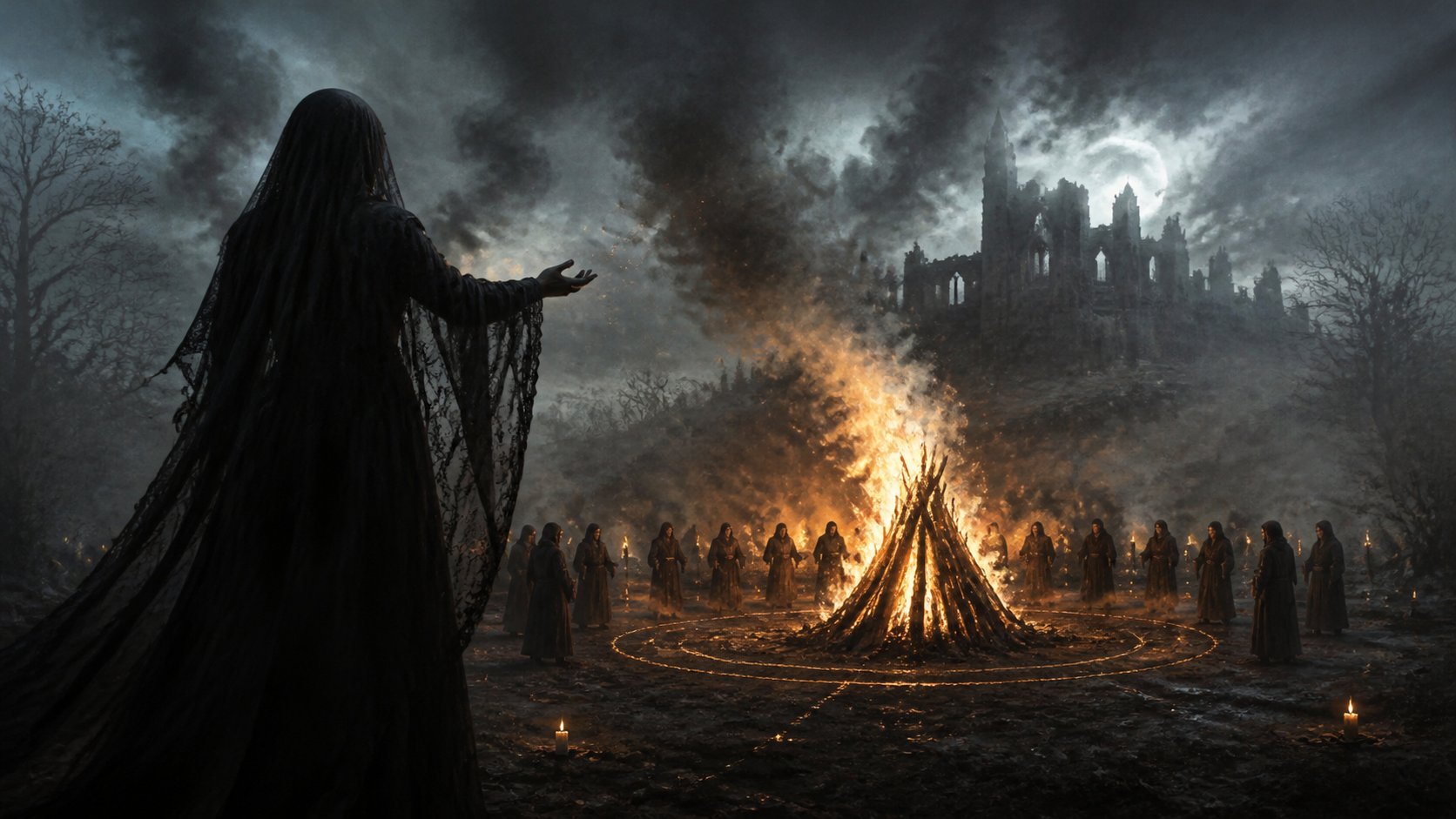
As they crossed the crypt, the candles already lit along the walls guttered once, then steadied. Rina saw the first signs of the Council not as bodies, but as absences: indentations in the dust where feet should have been, a pressure in the corner of the eye, the sense that the room was arranging itself around hidden observers. Then the figures emerged, not out of shadow but into it, six people in dark coats and chapel blacks, their faces blurred as if seen through steamed glass. She could not hold their features long enough to describe them, yet she knew there were men and women among them, and that each carried a small vessel of ash at the throat or wrist.
One of them spoke in a voice that seemed to come from the altar stone itself. “The line is restored.”
Shaw lifted the scarfed tin. “No.”
The figure inclined its head. “You are late, Thomas.”
“You should have stayed buried.”
A faint murmur passed among the Council members. Rina found she could not track who moved and who did not. It was as though attention slid away from them unless she forced herself to focus. The figure at the centre took one step forward. The air sharpened. Her father’s ash in the tin stirred under the scarf.
“Give her over,” said the figure. “The debt is old.”
Rina opened the tin with shaking fingers. The ashes inside were not loose now. They had packed themselves into a thin, dark cord coiled at the base, a shape that recoiled from her touch. For one panicked second she understood what Shaw meant by the ash recognising her. It wanted to remain with the living. It wanted purchase.
The Council began to speak together in low, overlapping phrases, not a chant exactly, but a set of remembered permissions. Rina could feel the crypt leaning towards them. The stone urn at the pedestal answered with a hum she heard in her teeth.
Shaw moved first. He hurled a handful of salt and church ash across the floor, breaking the edge of the circle the Council had begun to form. Several figures flinched, their outlines wavering. One stumbled back, and suddenly its face became visible: not monstrous, only a tired woman in her fifties with an expensive raincoat and tears at the corners of her eyes. The sight shook Rina more than a mask would have done.
“Now,” Shaw said.
He struck the urn with a wrench from his pocket, cracking the lid. Rina reached past the fear and tipped her father’s ash into the opening. The cord of it resisted, twisting like a live thing, and one of the Council members lunged towards her. Shaw intercepted it, taking the blow on his shoulder and driving the intruder sideways into a brick vault. The impact rang through the chamber. Rina slammed the lid down with both hands.
The urn answered with a burst of sound like a hundred fingernails dragged over slate. The Council members reeled. One of them began to fade at the edges. Another clutched at its own face as if trying to keep it in place.
Rina felt the ash in the urn tugging at her thoughts, pulling up scraps of memory she had not expected to lose: her father laughing in the kitchen, her mother singing over the washing machine, the smell of cut grass outside the old house in Joondalup. The power of the thing was not force but erosion. It took by making everything else seem less real.
She understood then what had to be done.
The urn needed a witness to finish the sealing, but the Council was using her as a witness already. If she surrendered the memory of her father to the thing, it would bind her. If she held on to him, it would fail to settle. Her hand trembled on the lid.
Shaw, bent and breathing hard, saw her hesitation. “Rina,” he said, and there was no instruction in his voice, only trust. “Choose.”
She closed her eyes and let herself remember the worst honest thing: the hospital corridor, the smell of antiseptic, her father’s hand cold in hers, his failure to say what he wanted because he was afraid she would be burdened by it. Then she remembered the biscuit tin, the key, his last attempt to make an ending that belonged to him. She spoke his name aloud into the crypt.
The urn shuddered. The dark cord inside snapped tight, then loosened, as if a knot had finally given way.
The Council’s leader let out a sound of dismay that was almost human. The blurred outlines broke apart. For an instant Rina saw the room clearly: six ordinary people in expensive dark clothes, faces stripped of their borrowed certainty, each suddenly aware of what they had fed and what it had cost. The sense of unseen pressure collapsed. Several of them dropped to their knees. One ran for the stair, stumbling over the broken circle.
Shaw grabbed Rina’s arm. “Out. Now.”
They climbed the steps as the crypt behind them filled with the sound of cracking stone and frantic voices. At the top, in the chapel, the bell rope swayed though no one touched it. The front door stood open to the night. Cool sea air came in from the street, carrying the ordinary smell of petrol and salt water, and Rina nearly wept at the simplicity of it.
They did not stop until they were in the churchyard, under the dim lamp by the gate. Behind them, the chapel windows remained dark. No blaze, no dramatic collapse. Only silence, and after that a long shudder through the foundations that made the iron railings tremble.
Shaw sat on the stone curb and held his injured shoulder. “It’s done,” he said, though his voice was thin.
“For how long?”
He gave her a tired look. “Long enough for other people to make new mistakes.”
She almost smiled at that. Almost.
In the days that followed, the archive room reopened. The ledger no longer wrote in the margins. The brass dish held only dust. Shaw never explained where the Council had gone, only that those who survived would not speak of it in any recognisable way for some time. Three of them resigned from boards and foundations within a fortnight. One left the country. The woman in the raincoat came to the chapel twice, once to return a set of keys and once to ask, very quietly, whether there was any way to be forgiven for a bargain made in ignorance. Shaw told her no one in that crypt had ever made one in ignorance, and she had bowed her head as if struck.
Rina stayed.
Not because she had been converted, or because she wanted to hunt the rest of the conspiracy. She stayed because there were old records to sort and because Shaw needed help carrying damaged boxes from the basement, and because the chapel had become the place where her father’s last act made sense. On the shelf behind the desk she kept the biscuit tin, now empty, though once, in the middle of a rainstorm, she found a faint grey dusting in its base and knew better than to touch it.
A month later, while cataloguing a donation from a demolished house in South Fremantle, she found a single ash-marked card tucked inside a prayer book. On it, in the same cramped hand as before, were three words.
Still listening. Noticed.
She turned the card over. The back was blank.
When she looked up, Shaw was standing in the doorway with his coat on, waiting for her to notice him properly, as if the work of being unseen had become the only thing keeping the world from tipping again. Rina set the card in the drawer, locked it, and went to help him carry the boxes inside.

Supernatural Thrillers