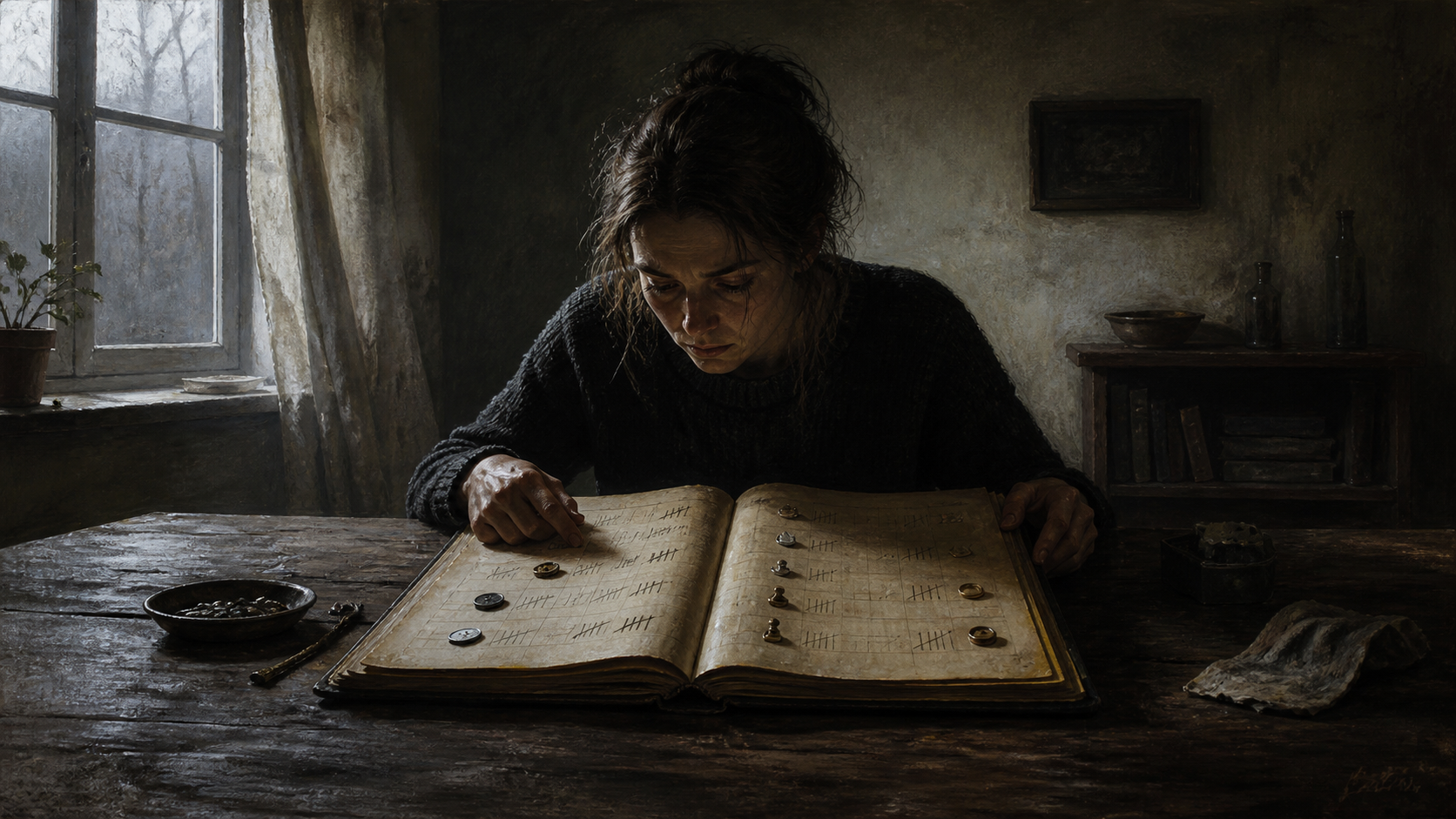
By the time I found the first jar, I had already spent three months arguing with my mother about the smell in her kitchen.
It was not a smell in the ordinary sense, not of spoiled milk or old grease or the damp rot that settles into cheap cupboards. It was sharper than that, metallic and briny, as if someone had cracked the sea open beneath the lino. It came and went, strongest near the sink and the windowsill, where my mother kept her herbs in clay pots and her tea tins lined up with military neatness. She laughed when I mentioned it.
“You’ve lived in Sydney too long,” she said, and went back to sorting dried chamomile with her long, brown fingers. “City people get nose-fine. Everything smells like something to them.”
I wanted to believe her. I had come home to Newcastle because she had stopped answering my calls with her usual brisk impatience and started answering them with silence. When she did speak, her voice was flatter, as if she were reading from a page she could not quite see. She had not forgotten my birthday. She had forgotten to come to the hospital when my sister Leanne gave birth to her second child, and Leanne, who had never forgiven anyone for anything, took that as proof that something was wrong.
“Just stay a few weeks,” Leanne said. “Find out what she’s on. Or what cult she’s joined.”
That was the joke in the family, the kind people make when they are frightened of appearing stupid. My mother was a pharmacist before she retired. She was the sort who checked labels twice and locked the back door even on hot afternoons. There were no cults in her life, only church on Sundays, supermarket receipts, and the local women’s group at St Brigid’s hall where she sold slices and argued about council rates.
Still, the kitchen smelled of salt.
The first jar turned up when I was clearing her pantry. It was squat and dark green, tucked behind packets of rice and tins of tomatoes. I almost missed it because the label had been turned inward. It was full of black ink, thick as treacle, with grains of salt settled at the bottom like silt. There was no brand name, only a square of paper tied round the neck with kitchen string. On it, in my mother’s neat blue handwriting, were the words: FOR THE MOTHERS WHO KEEP.
I showed it to her at breakfast the next morning. She did not look surprised. That frightened me more than if she had thrown the jar into the sink and told me not to be ridiculous.
“You’ve been snooping,” she said.
“Answer the question.”
She took her tea without looking at me. “It’s for a working group.”
“Working group?”
“At the hall. Women talk. They bring things. We write things down. It’s nothing to concern yourself with.”
The jar sat between us, heavy and wet-looking in the morning light. My mother had a way of making silence into a door she could close in your face, and she was doing that now. I had not been home long enough for the old habits to feel safe again, so I pushed harder than I should have.
“Why ink? Why salt?”
Her eyes sharpened for the first time in weeks. “Because ink should remember what we tell it. Because salt keeps insects out. Because some things are useful.”
She drank her tea, and I realised she was done speaking.
I should say, because it matters, that I was not a child then. I was thirty-eight, divorced, teaching art part-time at TAFE, with a mortgage on a flat in Marrickville and a daughter, Tess, who stayed with me one week in two. I had come north because the school term had broken me in the ordinary way of all broken things, and because my mother’s silence had begun to sound too much like my father’s before he died. If she was unwell, if she was sinking into some private grief or dementia or madness, then I wanted to be the one who noticed in time.
Instead I found more jars.
They were everywhere once I knew to see them. One in the linen cupboard wrapped in a tea towel. One in the garage among paint tins and rat traps. One under the bed in the guest room where I slept, its lid screwed so tightly my fingers hurt. Every one was filled with black liquid threaded through with salt, and every one carried a label in my mother’s handwriting. The wording changed, but never much.
FOR THE BABY WHO WOULD NOT SLEEP.
FOR THE CHILD WHO TAKES TOO MUCH.
FOR THE MOTHER WHO HAS NOTHING LEFT.
FOR THE MOTHER WHO BITES HER LIP UNTIL IT BLEEDS.
I took the jars to the kitchen and lined them up on the table. When my mother came in from the back garden, she stopped in the doorway and looked at them with an expression I can only describe as tired.
“You’ve no right,” she said.
“Then tell me what they are.”
Her mouth tightened. “Words have to go somewhere.”
That sounded mad. It sounded worse than mad, because she said it with complete calm. I moved one jar and the glass left a damp ring on the table.
“Whose words?”
She sat down across from me. Her hands were chapped from garden work, though she wore her wedding ring even though my father had been gone for eleven years. “Women’s. Mine. Other women’s. You’d be amazed what people will hand over if they think no one will use it against them.”
I stared at her. “You’re collecting confessions?”
“If you like. Promises. Worries. Things they can’t afford to carry in their heads. The ink takes them.”
“The ink takes them where?”
She looked at the window. A gull screamed over the road outside, a harsh, ordinary sound.
“Into the salt,” she said.
I laughed then, because it was either that or feel the first real fright of my life. “Mum, what are you talking about?”
She rose and took my wrist in one hand. Her grip was unexpectedly strong.
“You asked me why I smell like the sea,” she said. “Because I make it. Because if I don’t, they’ll come back.”
That was the moment I should have called a doctor, or Leanne, or someone from church. Instead I let her lead me to the shed.
It stood at the bottom of the yard behind a camellia hedge, and from the outside it looked no different from any old fibro garden shed in a north-coast suburb, though my mother had painted the door black some years earlier and hung a horseshoe over the lintel. Inside, the air was close and sweet with dried rosemary and candle wax. On the workbench sat bowls of salt, bundles of twine, a small brass scale, and rows of jars like the ones in the house, all neatly labelled.
There was also a book.
It was not old in the theatrical sense. No cracked leather or curling parchment. It was an exercise book with a plastic cover, the kind children use for school, filled front to back with my mother’s compact handwriting. Between the pages were pressed leaves, receipts, scraps of ribbon and, sometimes, small dark stains that had bled through from another time. I opened it and saw names.
Not proper names. Fragments. “The one who won’t latch”. “The girl in the red jumper”. “The husband with the knife block”. Beside each were dates and short notes, written as if my mother were keeping records for a shop.
She watched me read.
“Years ago,” she said, “a woman taught me. Not a witch, not in the story-book sense. A widow from Wickham who had the knack. People came to her when they had things in their mouths they couldn’t spit out. She used ink and salt and whatever else she needed. Nothing fancy. She said salt was for preservation, and ink was for speech. Words rot if you leave them in the throat.”
“And the mothers?”
Her jaw flexed. “That was the business. Women with children. Women with babies who screamed all night. Women whose husbands read their minds like newspapers. Women with boys who cut themselves on purpose and girls who swallowed bleach tablets and no one in the family would look at the real thing because it made dinner awkward. She took what they gave her and made it hold still.”
I turned the page. There were diagrams sketched in blue biro, not circles and stars like the rubbish sold in tourist shops, but kitchen vessels, salt lines, shallow bowls, a hand holding a pen above black liquid. I saw my own mother’s hand in the drawings and wanted, suddenly, to throw the book into the yard.
“What does it do?”
Her face changed. For a moment she looked old enough to be my grandmother.
“It makes people listen,” she said. “It makes what’s written settle into the right place.”
That night, while she slept in her chair by the television, I took one of the jars into the bathroom and opened it. The smell hit me at once, not sewage or decay but something more human and more obscene: the sourness of old tears, blood on a cut finger, iron and brine and the faint sweet stink of spit. The ink inside was not uniform black. It moved when I tilted the jar, folding over itself in thick ropes. At the bottom were grains of salt, but there were other things there too, pale flecks like skin.
I slammed the lid back on and nearly dropped it.
The sound woke her. She stood in the doorway, barefoot, her nightshirt hanging from one shoulder.
“Don’t open them,” she said.
“What is in there?”
“People’s carryings-on. Fear. Rage. Things they said because they couldn’t help themselves.”
“Good God.”
She stared at the jar in my hands. “You think that’s the worst of it? It isn’t the ink that’s dangerous. It’s what it lets through.”
I was too angry to be sensible. “You expect me to believe you’ve been brewing witchcraft in the shed?”
“Not brewing.” Her mouth hardened. “Keeping. There’s a difference.”
She took the jar from me with hands that did not tremble. “Some women brought me salt and words and asked me to bury things that ought not to come out. At first it was harmless. A bad thought made solid. An insult that could be contained. Then they wanted more. They always want more.”
I thought she meant gossip, or malice, or the petty cruelties women sharpen against one another when life has worn them thin. But she was looking past me, at the bathroom mirror.
“There are mothers,” she said quietly, “who have no room left inside themselves. They hand over what they cannot bear and the ink holds it for them. Then, if the bowls are kept fed and the salt is renewed, it stays quiet.”
“And if not?”
She did not answer.
Leanne called the next day to say that Mum had missed her GP appointment and refused to answer the door to the Meals on Wheels volunteer. I told her, perhaps too sharply, that she was fine. I regretted it within seconds, but pride is a stupid engine and keeps running long after the fuel is gone.
By evening, Leanne had come round herself with her husband, Craig, and Tess in tow because childcare had fallen through. Tess was ten and at the age where she watched adults for hidden weakness, not because children are cruel but because they need the world to make sense. My mother smiled at her with more warmth than she had shown me in days.
“Come and help me with supper, love,” she said.
Tess stood at her elbow in the kitchen, peeling carrots with the concentration of a surgeon. I watched my mother move about the room and saw, to my irritation, how steady she was with my daughter. She set the table properly, with napkins folded, and said to Tess in a low voice, “You’ve got your father’s hands. He was good with tools.”
Tess looked at me, puzzled. She had never known my father. He had died before she was born.
“You never knew him,” I said.
My mother’s knife stopped halfway through a pumpkin.
“What did I say?” she asked.
We all heard it. The old woman at the far end of the kitchen, my mother’s neighbour Dot, had been sitting in the back room all evening and had somehow crossed the hall without a sound. She was ninety if she was a day, with a face like creased paper and a cardigan buttoned incorrectly. She held one of my mother’s jars in both hands.
“Don’t ask me who I was,” she said to the table. “I’ve forgotten the proper order.”
Leanne stood up so quickly her chair scraped the tiles. Craig muttered, “What the hell?”
Dot opened the jar. No one had seen her do it. Her fingers were bare and trembling, but she lifted the lid as if she had opened it a hundred times before. A smell spread through the kitchen so swiftly that Tess gagged. The liquid inside rippled.
Dot spoke in a voice that was not her own, flattened and dry as paper left in the sun. “We took too much.”
My mother went white.
The jar began to steam. Not smoke. Steam, as from a kettle left to boil dry. Dark strings rose from it, twisting in the air in slow, deliberate coils. Leanne shouted and backed into the sink. Craig grabbed Tess, who started to cry. Dot’s mouth opened wider and wider until I could see the false teeth glinting in the soft light, and something black and wet climbed out over her lower lip.
Then my mother crossed the kitchen in three strides, seized the jar with both hands and flung it into the sink.
The glass shattered. The ink hit the steel basin and spread like spilled paint. The steam thickened. Dot gave a single animal noise and folded at the waist.
Everything happened at once after that. My mother tore open the salt tin and threw handfuls into the sink, where they hissed and sank. Leanne dragged Tess out of the room. Craig, to his credit, did not freeze; he grabbed the dish towel and shoved the broken pieces together with the heel of his hand until a shard sliced his palm open. The blood dropped into the black liquid and it seemed to wake, swelling and crawling along the basin walls.
My mother saw the blood and swore, a hard old word I had never heard her use.
“Not that,” she said.
But the ink had already touched it.
What came next was not a ghost rising, no elegant shape or floating silhouette. It was worse because it was smaller, busier, and more intimate. The ink split into thin black threads that raced over the steel and leapt, one after another, onto the cut in Craig’s hand. He screamed and tried to shake them off. They sank under his skin like worms going through mud.
He dropped to his knees. His fingers bent wrong. Not broken, exactly, but pulled. He began to write on the tiles with his injured hand, making sweeping strokes in blood and ink that formed no word I knew and yet made my teeth ache.
My mother lunged for him, and Dot, who had been silent again, reached out and caught my mother by the throat with surprising force. Her eyes were milk-pale and wet. “You kept them hungry,” she rasped. “You fed them on other people’s mouths.”
Leanne screamed for me to do something. Tess was crying against the hallway wall. I had one instant of useless terror and then the practical part of my mind, the one that repairs school displays and finds lost consent forms and once fixed a jammed window with a butter knife, took over.
There was salt in the pantry. There was a bag of plain flour beside it. There was the book in the shed.
I ran.
The shed door stuck in the humidity. I slammed my shoulder against it and stumbled inside. The notebook lay where I had left it, open on the workbench. Half the pages were covered in those same recipes for containment and keeping. One section, which I had not noticed before, was headed in my mother’s hand: RETURNING. Beneath it was a line so small I had to lean close to read it.
What is given can be called back if the giver remains named.
I heard my mother scream from the house. Not a frightened scream. A sound of pain and outrage, the voice she used when she caught the cat on the kitchen table, only stretched beyond recognition.
I snatched the book and the brass scale and the nearest jar, then ran back inside.
The kitchen looked as if a storm had passed through a butcher’s shop. Glass glittered on the floor. Salt was everywhere, white and grey in clumps. Craig lay by the sink, jerking faintly, his mouth working as though he were chewing a word he could not swallow. Dot had collapsed against the fridge. Leanne held Tess in the doorway, both of them crying. My mother was on one knee by the oven, one hand at her throat, the other braced on the tiles.
The black writing on the floor had begun to move towards the skirting boards.
“Read it,” she gasped when she saw the book in my hands. “Read the names.”
I turned the pages with shaking fingers. Names, dates, women’s names, children’s names, nicknames, fragments, all the things my mother had held in the ink. As I read them aloud, the liquid on the floor shivered and drew back, as if each name were a hook.
Then I saw, near the back, my own.
Not my full name. The name my mother had called me when I was small and feverish. The one only she used.
I nearly stopped there.
“Read yours,” she said.
I did. The moment the word left my mouth, the black threads on Craig’s hand slackened. He made a choking sound and collapsed flat. The writing on the floor broke apart in a smear. The air in the kitchen, which had felt thick enough to chew, came loose all at once.
Dot began to sob, not in relief but in fury. “You should have let it keep us quiet,” she said to my mother. “You always wanted to hear them. Every damned thing. Every complaint, every shame.”
My mother, still on the floor, looked older than I had ever seen her. “I wanted them safe,” she said.
“Safe from what?”
Her gaze flicked to the notebook in my hand. “From being known by the wrong thing.”
I did not understand then. I think I understand now only a little. The women had not been binding ordinary thoughts. They had been writing down what they could not afford to speak, and by writing it into salt-ink my mother had given those fears, griefs and hungers a kind of shape. A place to live. A listening place. But things that live in listening do not always stay obedient. They learn the house.
The final act was simple, grotesque and small enough to be insulting. My mother told me to bring the jars outside. We carried them one by one into the garden while the light failed over the houses beyond the fence. She opened the notebook to the last page, wet the tip of her finger in the basin where she had rinsed the broken glass, and wrote a single name across the bottom line.
Her own.
The ink in the jars answered.
It climbed the glass in black veins, as if recognising its maker. My mother set the notebook on the paving stones, placed the jars round it in a rough circle and tipped the salt bag over the whole arrangement. Leanne stood in the doorway, supporting Dot, while Tess watched with a fixed, horrified stillness that I pray she has never quite lost. My mother did not look at any of us when she said, very softly, “When I’ve gone, don’t keep what I gave you.”
Then she struck the match.
I had expected flame. Instead there was a flat, wet report, like a box of fireworks going off under a pillow. The jars split. Black liquid shot up in sheets and threads, and for one impossible moment each strand seemed to carry a mouth, opening and closing soundlessly. Salt burst white through the air. The notebook curled in on itself, pages blackening at the edges. My mother stood with her hand still extended, and I saw the skin across her knuckles wrinkle and split as though her own words were drying her from within.
The fire did not spread. It simply consumed the circle and then went out, leaving a stinking patch of glass, ash and wet salt.
When it was over, my mother was sitting on the garden step with her head bowed, breathing hard. Craig vomited in the grass and did not remember any of it afterwards. Dot died two nights later, though the doctor said it was her heart and her age. Leanne never spoke to Mum again, except once at the funeral, when she hissed, “You nearly took my daughter with you.”
My mother smiled then, faintly, as if she had heard a private joke.
She is still alive, last I heard, though I have not gone back since. I live with a jar of salt on my own kitchen windowsill now, not because I believe it will save me, but because my hands need something to do when I remember the sound of ink moving under skin. Tess has never asked why I keep it there. Sometimes she comes to stay and sits at the table doing homework while I cook, and I catch her watching my face in the same careful way I once watched my mother.
A fortnight after the fire, I found a line written in the margin of my sketchbook, in blue biro, in my mother’s hand.
For the mothers who keep.
No one had been in my flat. No window was forced. No door was open. I tore the page out and burned it in the sink, but even now, sometimes, if I sit too long in a quiet room, I taste salt at the back of my throat, and I know with a certainty deeper than reason that somewhere, in some cupboard or shed or kitchen I cannot see, there is black ink waiting for a name.

Horror Stories