Marta used to say there were two kinds of late-night people in Valencia: those who were still hoping the city would forgive them, and those who had already stopped asking.
She worked the ticket office at Àngel Guimerà station on the green line, on the last shift before the overnight cleaners came through with their rubber gloves and their wheeled buckets that smelled of bleach and stale rain. She was thirty-four, divorced, and stubborn in the quiet way that made strangers think she was cold. In truth she was simply tired. The station took the shape of her mood. By one in the morning its tiled walls looked pale and sickly, the electronic boards blinked like tired eyes, and the few passengers who drifted through seemed to have stepped out of the city by mistake.
On the night it began, a storm had parked itself over the whole of the coast. Rain battered the gratings above the station entrance and turned the pavements outside into black glass. Marta watched the clock over the ticket window while her colleague, Dani, made himself coffee in the back office and complained about his girlfriend’s brother, who had borrowed his scooter and returned it with a cracked mirror.
“People treat your things as if they are communal property,” Dani said, stirring sugar into a paper cup. “Especially when they’re too cheap to replace them.”
“You should put a lock on the scooter box.”
“I did. He broke it.”
Marta smiled without looking up. “Then you should put a lock on your brother-in-law.”
Dani snorted. He was twenty-two, still young enough to believe his life was an argument he could win if he made the right joke. He leaned in the doorway and listened to the rain pounding above the tracks.
“Nothing tonight,” he said.
“Don’t tempt it.”
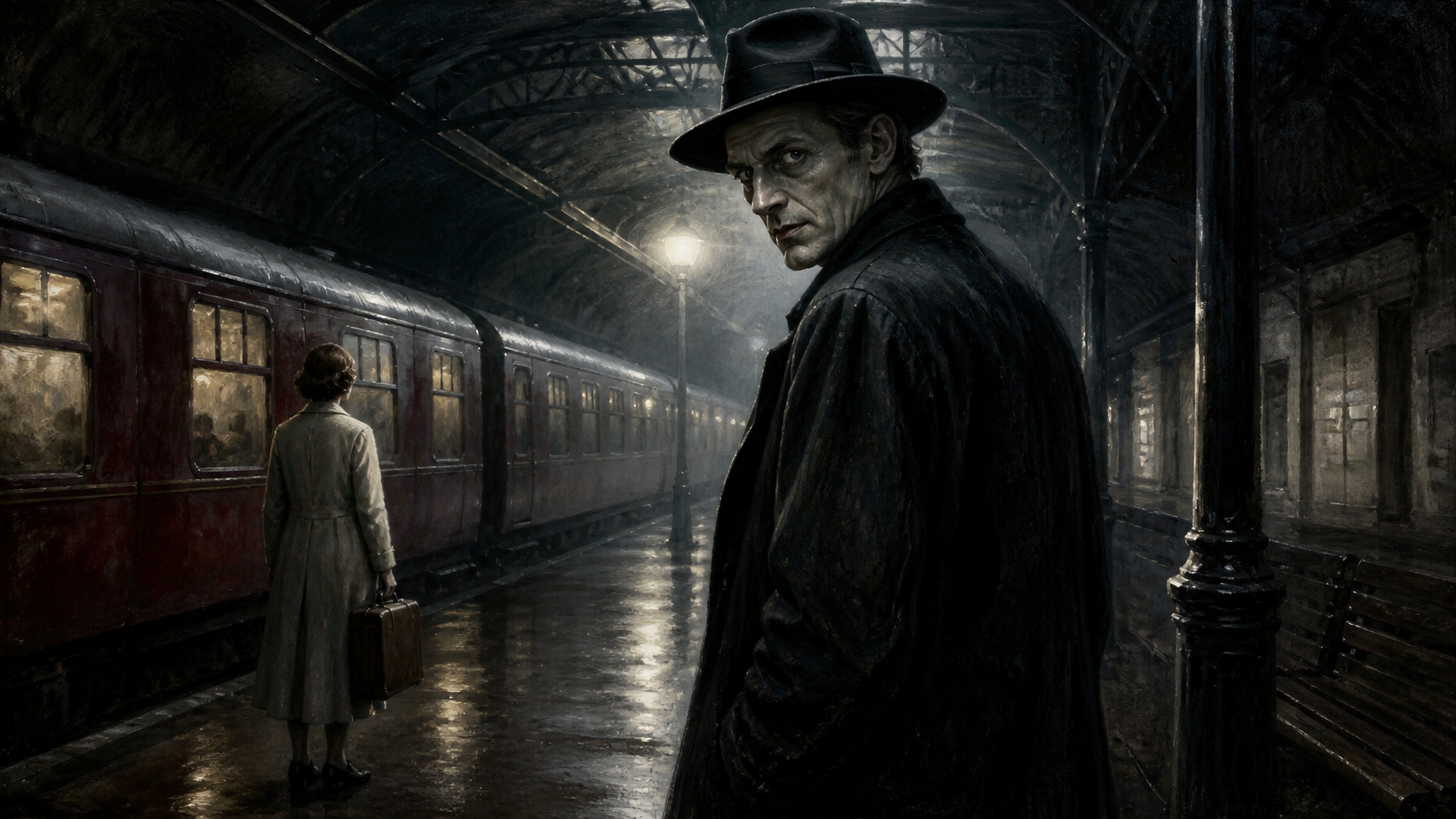
At 1:17 a.m. the platform camera feed on Marta’s monitor flickered. One frame showed the empty platform. The next showed a man standing beneath the yellow line, though he had not been there a moment before.
Marta frowned. She tapped the screen with one finger. The image stabilised. The man was still there.
He wore a dark overcoat and carried an old leather briefcase in his right hand. His face was turned towards the tunnel mouth, not the station, as if he were waiting for something he had no interest in seeing. He stood very still, and because of the harsh white lighting overhead his shadow lay behind him in a clean black shape, too sharp to belong to a man in a wet city at night.
“Dani,” she called. “Platform two.”
He came over with his coffee and grimaced at the monitor. “He’s asleep on his feet.”
“He’s standing on the line.”
Dani took the microphone and spoke the usual station announcement, the cheerful woman’s voice piped through the speakers. “Attention, passengers. For your safety, please stand behind the yellow line.”
The man did not move.
Marta reached for the radio. “Security?”
Static answered, then a burst of someone laughing far away.
“Again,” she said.
Dani checked the CCTV controls. “Camera’s fine. Maybe he’s waiting for a friend.”
“At this hour?”
“People wait for strangers at this hour all the time.”
The train due at 1:19 was running late because of flooding further down the line. The board read DELAYED in bright amber letters. Marta watched the man and had the unpleasant sensation that he was not waiting for a train at all, but for the exact moment when waiting would stop being necessary.
Then he turned.
Not fully. Just enough for the camera to catch the side of his face. His skin looked grey in the monitor light. His eyes were shut.
Marta straightened. “He’s blind.”
“Maybe.”
“Or drunk.”
“Or both.”
The platform loudspeaker crackled. A different voice came through, not the usual calm announcement but a man speaking quickly and low, as if from the end of a tunnel.
“Do not let it stop here.”
Marta stared at Dani. “Did you hear that?”
He blinked. “Hear what?”
Again the voice, distorted with static. “Do not let it stop here.”
Marta grabbed the radio and switched channels. “Control, this is Àngel Guimerà ticket office. We’ve got a male passenger on platform two, possible intoxicated. Also, we’re receiving an unknown transmission on the PA.”
Nothing.
Then a woman answered, far too softly. “What platform is that?”
Marta’s mouth went dry. “Control? Say again.”
Silence, then a burst of interference, and the radio went dead.
Dani looked at her. For the first time all night he had stopped smiling. “Tell me you heard that.”
She didn’t answer because the platform lights had begun to dim in pulses, like a heartbeat struggling under the station roof. The monitor image warped, then steadied. The man in the overcoat was gone.
Only his briefcase remained, upright on the wet tiles beneath the yellow line.
“Right,” Dani said in a strained voice. “That’s enough of that.”
He stepped towards the doors leading to the platform. Marta caught his sleeve.
“Wait.”
“For what?”
She didn’t know. For common sense, perhaps. For someone from the night shift to say the world still worked in ordinary ways. But even as she hesitated, the lights died.
The station dropped into darkness so complete it seemed physical. The emergency strips along the floor came on a second later, casting everything in a greenish bruise-coloured glow. Somewhere in the tunnel, metal shuddered against metal.
Marta’s breath caught.
Then, from far down the track, came the sound of a train approaching.
It was too fast.
Dani said, “That’s impossible.”
The tunnel brightened with a blunt silver glare. The air began to move. Marta could smell hot brakes and electricity. The train did not emerge from the darkness so much as tear through it, a blur of windows and rainwater and lit carriages rushing into the station with a scream of steel.
But the electronic board still said DELAYED.
The train was visible for only a second before it entered the platform. Marta saw faces behind the windows, all of them staring straight ahead. None of them moved. The driver’s cab light was on.
And then the train vanished.
Not departed. Not passed through. Vanished.
The sound cut out mid-roar. The platform was empty. The lights snapped back on. The board still said DELAYED.
Dani had gone white.
Marta’s hands were shaking so badly she nearly dropped the key ring. “Did you see it?”
He nodded once, then looked at the tunnel as if expecting it to open its mouth again.
The briefcase was still there.
Neither of them wanted to be the first to step out, but the station rules, the cameras, and the old reflexes of their jobs pushed them forward. Marta unlocked the platform gate. Dani went first, because he was younger and because he had made the mistake of pretending bravery was a personality.
The tiles were wet. The air smelled of ozone. There was no sign of the man.
The briefcase sat exactly where it had been, black leather with brass corners and a worn handle softened by years of carrying. Marta crouched and touched it with one finger. Cold. Bone-cold, as if it had been left in a freezer.
Dani whispered, “Don’t open it.”
“I wasn’t going to.”
But the latch clicked at her touch, very lightly, and she felt something inside shift. She stood too quickly and nearly slipped.
In the tunnel entrance, just beyond the reach of the platform lights, something moved.
It was not a person. It did not have the shape of a person. It was a thin vertical motion, like a hanging coat tugged by a draft, except the station had no wind. It paused. Then, slowly, it retreated into the dark.
Dani saw it too. He made a small sound in his throat and stepped backwards until his shoulder hit the wall.
Marta heard footsteps coming down the stairs from the concourse above. Heavy, rushed, multiple. Relief flooded her so quickly she almost laughed.
Security, she thought. Maybe police. Someone.
Three figures appeared at the top of the escalator. Not security. Not police.
One was an elderly woman in a red raincoat carrying a shopping bag from Mercadona. Another was a teenage boy in school uniform, soaked through, with one earbud in. The third was a man in a business suit, carrying a briefcase identical to the one on the platform.
Marta looked down.
The briefcase at her feet was gone.
Dani said, “No.”
The man in the suit was already descending the stairs. He looked straight at Marta with a face that emptied her mind of every sensible thought she had ever had. His expression was not angry or afraid. It was apologetic, like a neighbour knocking at the wrong door.
The woman in the raincoat called out, “Is this line running?”
Her voice came with a faint metallic echo, as if spoken from inside a tunnel.
Marta realised, with a coldness that spread from her stomach into her limbs, that the station speakers were not playing the sound of her own voice any more. They were playing something else.
A train announcement, distorted beyond certainty.
Then: “Stand clear of the doors.”
The man in the suit stopped at the foot of the escalator. The teenage boy behind him frowned at his phone and said, “Mum, this place smells weird.”
The woman took one more step.
Marta shouted, “Don’t come down!”
All three of them froze.
For an instant everything held. The rain hissed outside. Somewhere overhead, thunder rolled. The station lights flickered.
Then the elderly woman looked past Marta, beyond the ticket office windows, and whispered, “There are people on the platform.”
Marta turned.
The platform was full.
Not crowded, exactly. It was worse than crowded. It held the impression of presence, rows and rows of figures standing shoulder to shoulder under the fluorescent lights. Men in coats, women with handbags, children with school satchels, a bicyclist with helmet tucked under his arm, a nurse still in pale blue scrubs. Their faces were blurred by distance, then by something else, as if each one had been rubbed out and redrawn too quickly.
Every single one of them faced the tunnel.
The train announcement hissed again.
“Do not let it stop here.”
Dani grabbed Marta’s arm so hard it hurt. “We need to get out.”
Too late.
A sound came from the tunnel, not of approaching metal this time but of brakes locking on a long slope, shrill and desperate. The line of figures on the platform all began to sway together, ever so slightly, like wheat in a wind that did not reach the station floor.
The young boy on the stairs started down in a trance. Marta lunged for him but the business-suited man caught her wrist with a hand that was ice-cold and impossibly strong.
His mouth opened.
For a moment she thought he would speak to her. Instead a train ticket slid from between his lips and fluttered to the floor.
Marta tore free and snatched the boy by the collar. “Upstairs, now!”
But the stairs behind them had changed. She knew this before she saw it. The tiles were the same, the handrail the same, the advertising posters the same, but the route did not lead back to the concourse any longer. It rose into a dim corridor lined with doors that had never existed in the station layout. Their glass panes reflected no one.
The woman in the raincoat began to cry.
Dani backed away so fast he knocked over a metal stand of free newspapers. The pages spilled across the floor, all of them blank.
“Help me!” he shouted towards the ticket office window, though whether he meant Marta or God or the cameras she could not tell.
The platform figures stepped forward as one.
Marta did the only thing she could think of. She reached over the desk, slammed the manual emergency brake switch, and then hauled the heavy red lever for the track power.
Nothing happened.
Then, from deep in the tunnel, something answered.
The platform lights went out again. In the blackness there came a sudden sound of doors opening all around them, the pneumatic sigh of a train preparing to receive passengers. Cold air rushed over Marta’s skin.
The emergency strips glowed faintly green.
And there, where the tunnel mouth should have been, stood the train.
Not arriving. Waiting.
Its front lights were on, but there was no driver in the cab. The windows were full of darkness and motion. In the nearest carriage, faces pressed to the glass, too many faces and none of them right. Some looked normal for a fraction of a second before their mouths stretched too wide or their eyes receded into shadow.
The doors opened.
The figures on the platform began to walk.
Marta dragged the boy backwards, but the suited man wrenched free and took a step towards the train with a grateful, obedient little nod, as if someone had finally called his number. The elderly woman in the raincoat followed, still weeping. Dani stumbled after them, horrified at himself, as if his legs had made the choice without asking him.
Marta shouted his name.
He turned, and his expression broke her heart more than fear would have. He was still himself in the face, still Dani, still young and appalled. But behind him in the train window she saw another Dani reflected, standing in the carriage with his hands at his sides, staring out with eyes that were already empty.
“No,” she said.
He seemed to hear her.
Then the platform lights flickered on for one final second, and she saw the whole station as if from very far away. The train. The waiting figures. The open doors. The tunnel behind, breathing dark air like a throat.
She understood, suddenly, that this had happened before. Not here, not to her, but to the station itself. To the line. To the city. A thing that did not want to be seen had found a way to borrow the shape of departure. To make leaving into a trap. To turn the last train into a promise and then refuse to honour it.
Marta grabbed the boy and hurled him towards the stairwell that had become the corridor. “Run!”
He ran.
She ran too, but only for two steps before she turned back because Dani had disappeared into the train. The doors were beginning to close. His hand was still visible for a second, pressed to the glass from the inside. She threw herself forward and got her fingers between the doors just as they shut with a sound like a snapped bone.
Pain lanced through her hand. She screamed.
The train did not move. The doors remained closed on her fingers, cold and wet. Inside the carriage Dani was staring at her, face pale with shock. Then his expression changed. The fear drained away as if a plug had been pulled.
He smiled.
It was not Dani’s smile. It was too patient.
Marta yanked her hand free, stumbling backwards. The train began to move without a sound. The doors stayed shut. The windows blurred. In the nearest one Dani raised a hand in a small, formal wave, and then the carriage interior went dark.
The train slid into the tunnel and was gone.
So were the figures on the platform.
So was the man in the suit, the woman in the raincoat, the boy.
The station lights returned with a snap. The blank newspapers lay scattered across the tiles. Marta’s hand was bleeding where the doors had caught her. The only sound was the rain, falling far above.
From the stairwell came a shout.
Marta ran up into the concourse, expecting police, rescue, anything. The boy was there, doubled over and gasping. The ceiling lamps buzzed overhead. The corridor to street level was open, wet air drifting in from outside.
But there was no sign of the woman or the man in the suit.
There was no sign of Dani.
Marta called his name until her throat hurt. She searched the back office, the toilets, the storage room, the staff exit, the platform again. She found the briefcase on the ticket desk, though she was certain it had gone with the train. It was warm now. Not hot, exactly. Warm as a body after sleep.
When she opened it, her stomach turned.
Inside were train tickets. Hundreds of them, maybe more, all old and yellowed, all punched with the same destination stamp: A destination code she did not recognise, followed by a time that kept changing when she tried to read it. Beneath the tickets was a paper timetable printed on thin brittle sheets. Most of the lines were crossed out. One was not.
At the bottom, in blue ink, someone had written in careful block capitals:
LAST SERVICE. DO NOT BOARD. DO NOT LET IT ARRIVE.
Marta folded the paper and put it in her pocket with hands that would not stop shaking.
They never found Dani.
The station cameras, reviewed the next day, showed nothing useful. At 1:17 the feed glitched. At 1:19 the image went black. At 1:21 the platform was empty, except for one frame in which a blurred crowd seemed to be standing at the edge of the tunnel. The recording ended with a burst of static that sounded, to Marta’s horror, almost like laughter.
The boy from the stairs was identified by his school, and his mother came to collect him in tears. He said he had no memory of the station beyond hearing a train coming and feeling that he ought to get on it. The old woman in the raincoat was not found. The man in the suit, according to every record anyone could find, had died six years earlier on another line entirely.
Marta resigned three days later.
She told her manager she had personal reasons. He asked if it was because of the assault, the missing colleague, the stress. She said yes to all of it because there was no point trying to explain the rest. Who would believe that a station could remember a train that had never arrived, and that every so often, if the rain was hard enough and the hour late enough, the platform still went cold?
For weeks afterwards she woke at 1:19 a.m. with the sensation of brakes screaming in her ears. Once, on a bus crossing the river, she saw her own reflection in the window wearing a dark overcoat she did not own. She did not look at windows after that unless she had to.
And yet people talk.
They say that if you are waiting alone at a quiet station in Valencia on a stormy night, and the board changes to DELAYED when no train should be due, you must leave at once. If you hear a train coming from the wrong direction, do not look at the tunnel. If a stranger stands by the yellow line holding a briefcase, do not answer if he asks what time it is.
Most of all, they say this: if the last train arrives and the doors open for you while the station lights go out, do not step forward just because everyone else seems to be going.
Because the last train that never arrived is still looking for passengers.
And it is very patient.

Urban Legends