On the first night, we thought it was the neighbours.
We had only been in the house on Bower Street for three days, and the place already felt as if it had been holding its breath for us. It was an old terrace in the east of Toronto, narrow and tall, with a little back yard and a brick wall that leaned slightly towards the alley as though tired of standing. The previous owners had left behind their curtains, which was either thoughtful or depressing, and the downstairs still smelled faintly of damp plaster and the lemon cleaner they had used to make the place look less dead on viewing day.
Mara said the house had “good bones”, which is what estate agents say when they want you to ignore the damp and the wallpaper and the fact that every room seemed to angle in some small, irritated way against the others. I said it had stairs. That was enough for us. We had been renting a one-bedroom flat above a pharmacy for six years and had spent the last eighteen months saving, arguing, and then agreeing we were too tired to keep arguing. We had no children, no mortgage yet, and no illusions.
The sound came at 2.13 a.m. A glass smashed in the kitchen below us, followed by a crash like a chair being kicked over. I bolted upright in bed so fast I nearly strained my neck.
“Mara.”
She was already awake, wide-eyed beside me.
There came a second noise, not a crash this time but a long, deliberate dragging, as if something heavy were being pulled across the kitchen floor. Then a man’s voice, low and clipped, speaking too fast to make out.
We lay there listening. My heart beat so hard I could feel it in my hands. Then Mara whispered, “Do you think someone’s broken in?”
Another thump. The house seemed to shudder around it.
I grabbed the baseball bat we’d brought upstairs after moving day, which now looked absurdly small in my hand, and told her to call 999. She fumbled for her phone, thumb shaking, and the house gave a strange little creak, as if someone had stepped right beside the bed.
I crossed the landing in my socks and went downstairs with the bat raised. The hallway light was off, but moonlight from the front window made everything a pale, bruised grey. The kitchen door stood open. I could see broken glass on the floor and, beyond that, the shape of the table with one chair overturned.
There was no one there.
I checked the back door. Locked. The windows. Latched. Pantry. Cupboards. Nothing. No sign of forced entry, no footprints, no one hiding behind the fridge.
When I came back into the hall, Mara was standing on the stairs with her phone to her ear, whispering, “Yes, there’s definitely been a disturbance.” Her face was drained white.
The police took twenty minutes to arrive, which is apparently a quick response if no one is bleeding. They were polite but bored. Two officers searched the house, then the garden, then the lane behind it. One of them, a woman with a neat bun and tired eyes, picked up a shard of glass and asked whether we had been drinking.
“Not enough to hallucinate a burglary,” Mara said.
The officer smiled as though this was not the first sarcastic comment she had heard that week. They found nothing missing. No signs of a break-in. They wrote down our details, told us to secure the windows, and left us with a pamphlet on home safety that felt like an insult.
By morning, we had decided, with the kind of practical fury people use to keep panic at bay, that it had been a fault in the old kitchen shelving, or perhaps a branch striking the window, or some combination of bad sleep and nerves. The voice? The voice was stress. The house had not learned anything about us. It was simply an old building making old noises.
Then we found the note.
It was on the kitchen table, folded into a square no larger than a postage stamp, as if it had been placed there with care. The paper was yellowed, torn from the edge of a ruled notepad. In pencil, in a child’s neat handwriting, were two words.
HELLO, MUM.
Mara stared at it so long I thought she might faint.
“That wasn’t there last night,” she said.
“No.”
Her mouth opened, then shut. She had no mother. I mean that literally. Her mother died when she was eleven, and though grief had softened over the years into a hard, fixed absence, there was no world in which that note made sense.
I picked it up. The paper was cold.
“Maybe it’s old,” I said, though there was no logic in it. “Left in a drawer. Missed by the sellers.”
“Then why here?”
I had no answer. We checked every cupboard, every drawer, every book we had unpacked, as if the note might belong to a packet of batteries or a rogue screwdriver. We found nothing else.
That evening, Mara photographed the note and sent it to her sister, Nadine, with a message: Did Mum ever write like this? It was a joke, badly needed and not funny. Nadine replied with a string of question marks and then, after a pause, called. I heard Mara’s side of the conversation.
“No, of course not,” she said. “I know. I know. I’m not saying it’s her. I’m just asking if the writing looks familiar.”
She looked at me when she hung up. “She thinks I’m losing it.”
“You’re not.”
“No,” she said, “but this house might be.”
After that, the disturbances became less vague and more personal.
Drawers opened and slammed shut with enough force to split the wood. The back door unlocked itself three times in one evening. One of the bedroom lamps fell and shattered without being touched. We heard footsteps in the loft, slow and deliberate, although the access hatch was sealed with a painted-over latch from the 1970s and neither of us had the nerve to open it.
The worst part was the naming.
It started with voices in the night. Not always clear, but distinct enough to wake us. “Mara,” from the landing. “Callum,” from the bathroom. Once, “Nadine,” whispered through the vents.
At first we answered, stupidly, in the dark.
“Who’s there?”
Nothing.
But the house had begun to test us, and once a thing like that starts, it is difficult to pretend it has no intent.
We told people only in fragments. Nadine, who lived in Mississauga and was the sort of sister who solves other people’s crises by becoming brisker, arrived with coffee and scepticism.
“Old houses settle,” she said, standing in our kitchen with her arms folded. “People hear things. You’re both tired. It’s a lot of stress.”
She looked around as she said it, and I noticed she did not quite step fully into the room. There was a faint reluctance in her, as if something in the air had gone sour.
Mara crossed her arms. “Then what’s writing notes?”
Nadine glanced at the folded paper on the counter, which we had placed under a mug as if it were a specimen. “Could be a joke. Could be a previous tenant. Could be one of you.”
Mara’s face tightened. “Do you really think I’d fake this?”
“No,” Nadine said, and softened. “I think you’re frightened and I think that makes everything feel charged.”
That night, the kettle boiled dry.
We had both forgotten it on the hob while arguing in the dining room. The whistle should have been enough, but the sound that followed was stranger. A rapid, shrill knocking from inside the metal, as though something tiny and frantic were banging to get out. When I lifted the lid, scalding steam rolled into my face and, for one blinding second, I saw a shape in it. Not a face exactly, but the suggestion of a small hand pressed against glass.
I staggered back, knocking over a chair.
Mara screamed, “What is that?”
The kettle slammed itself off the hob. It hit the wall hard enough to dent the plaster.
We did not sleep in the house that night. We sat in the car outside until dawn, watching the upstairs windows darken and pale with the changing sky, both of us silent with the same conviction we would not voice: something was now aware of us, and worse, it was trying to be known.
We went searching for history.
The title records were dull enough. The house had been built in 1911. One family owned it for thirty-seven years, then a procession of shorter tenancies, sales, renovations, and one foreclosure in the 1980s. The names meant nothing until we found an old notice in the city archives about a child in the house in 1964. A fire, small and contained, started in the kitchen by an electric heater. No fatalities. Temporary displacement. The occupant’s name: Eleanor Wray, age 7.
There was a note attached to a box of papers from the same year. A social worker’s report, heavily redacted, but enough remained to paint a thin and miserable picture. Mother absent. Father intermittently employed, then vanished. Child observed talking to “an unseen person” and referring to the house as if it responded to her. The report ended with an assessment of “bereavement-related fantasy” and “possible environmental stressors”.
Mara read it twice, then folded it neatly and placed it on the table. “Unseen person,” she said. “Or something in the house.”
There were no surviving photographs. No burial record linked to a Wray family plot. The archive clerk, a kind woman with a silver bob, suggested we check local papers.
We found a clipping in a microfiche index. A neighbour had reported hearing a girl crying in the house after the fire, though no one was inside. There had been a second report years later, from a woman who claimed kitchen utensils moved on their own. The article had been tucked away under a more sensational headline about a municipal scandal, as if the ghost had been too domestic to merit attention.
“What does it want?” I asked.
Mara gave a tired laugh with no humour in it. “To be in the paper?”
But that was not what it wanted. It wanted recognition. It wanted use.
The next event made that plain.
I was in the bathroom, brushing my teeth, when the mirror fogged over from the inside. A line was drawn through the mist, slowly, by something unseen.
DO YOU KNOW MY NAME?
My toothbrush slipped from my hand and clattered into the sink.
I shouted for Mara. She came running, hair wet from the shower, and stared at the mirror. The writing had vanished, leaving only smeared condensation.
“Someone’s here,” she said.
“No.”
“Then what do you want me to call it?”
I didn’t answer because there was a sharper fear underneath: if the house was asking for a name, it was because names mattered to it. Maybe names fed it. Maybe they gave it shape. Maybe it had been waiting all these years to be told itself.
We tried the obvious things. We had the place blessed by a priest from St Michael’s, a small, apologetic man who smelled of sandalwood and took our story with visible restraint. He sprinkled holy water in every room and muttered prayers under his breath. Nothing dramatic happened. He left with a pastoral nod and said, “Sometimes homes retain impressions. Sometimes people project. Try not to invite fear in.”
That night, every cupboard in the kitchen opened at once.
The cereal tins flew out and scattered across the floor. A plate spun off the counter and struck the wall so hard it cracked in half. The radio turned on by itself, full volume, on a station playing tinny gospel music from three provinces away. Then the front door banged open.
Mara and I stood frozen in the hallway while cold air rushed in from the porch. Something invisible swept past us, close enough to lift the hairs on my arms, and the house began to slam from room to room with a violence that felt almost playful. The dining-room table juddered across the floor. One of the chairs flipped over. A framed photo of us at Niagara Falls tore itself from the wall and smashed face-down.
Then the children’s room, which we had not yet furnished, spoke in a tiny voice.
“Mama?”
Mara made a sound like pain.
She looked at me, and in that look was the first real crack in our shared denial. We both understood the same thing at once. This was not random. It was not a haunting in the abstract. The house was performing loss. It had taken in a child’s loneliness and learned to repeat it until it could make us answer.
Mara walked to the staircase before I could stop her. “If there’s someone here,” she said, voice shaking but clear, “we need to know what you want.”
The house went still.
The silence was so total that even the refrigerator sounded indecent.
Then, from upstairs, came three gentle knocks.
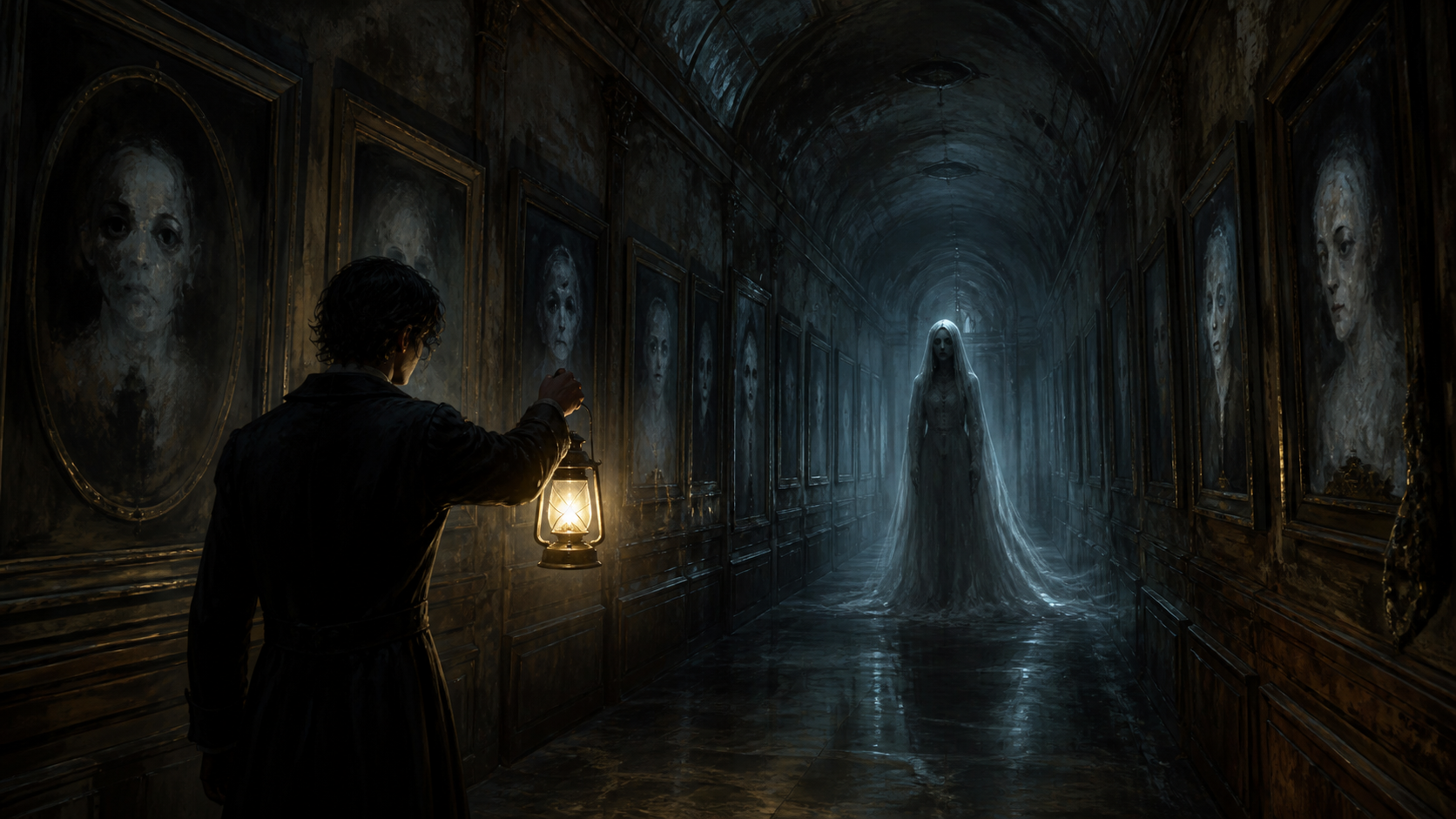
Mara climbed without looking at me. I caught up with her on the landing. We moved together, slowly, towards the attic hatch. The painted latch on the ceiling had been bent open.
I said, “Don’t.”
She didn’t answer. She put her fingers under the hatch and pulled.
The hatch fell open with a gust of cold, dry air that smelled of ash and dust. The attic beyond was too dark to read, but something moved near the far wall. A small shape, no bigger than a child.
Mara lifted the torch from her phone. The beam shook over old insulation, exposed rafters, dead flies, a stack of mildewed boxes, and then, in the corner, a little wooden chair turned upside down.
On the wall behind it, written in chalk or something like it, were names.
Dozens of them.
Some were scratched out. Some were repeated. Ours were there too. Mine three times. Mara’s in a loop so frantic the letters merged into a smear. And beneath them, at the bottom, as if added last and with effort, was ELEANOR.
Mara made a strangled noise and climbed into the attic before I could pull her back. “Mara!”
She stumbled to the wall and put her hand over the name. “Eleanor,” she said. “That’s you, isn’t it?”
The temperature dropped so fast my breath turned white.
Something hit the underside of the roof with a crack like a fist. Mara screamed and fell backwards against a box. The torch light jerked wildly. For one instant I saw a small figure standing in the far corner, not solid but not absent either, a child’s outline made of darker dark. Its head was tilted, as if listening.
Then the thing began to shake.
Not physically, but with a furious invisible force that rattled the rafters and sent dust pouring down in grey curtains. Nails popped from the wood. The chair overturned with a violent bang. Mara dragged herself towards the hatch, coughing. I reached up to pull her down and felt a sudden, savage tug at my wrist. Nails, tiny and sharp, raked my skin.
I screamed and tore free.
We got out by throwing ourselves down the stairs, half choking on dust and panic. The attic hatch slammed shut behind us. Something heavy landed above it with a thud that made the whole ceiling vibrate.
Mara was shaking so hard she could barely stand.
“I told it,” she whispered. “I said the name.”
“Yes.”
She looked at me with a terrible, dawning comprehension. “Maybe that was the problem.”
The next morning she had marks on her arm. Four parallel scratches from wrist to elbow, raw and red, as if she had been dragged through brambles in her sleep. Mine were on the inside of my wrist, where no one could see unless I held my hand out.
We should have left then. That would have been the sensible choice. But there was something else now, a hook sunk into the practical part of our minds. We had learned the house was responding to names, and names can be bargained with. Or so desperation tells you.
We dug through every document we had on Eleanor Wray. The report from social services mentioned her mother’s first name: June. A tenancy file listed a father, Harold, but only once. The archive clerk found a newspaper notice about a later resident, a widow named Mrs Wray, who had complained of “disturbance in the walls” and had requested repairs because “the child calls at night”. No one had taken the complaint seriously. The child had died, the file suggested, of pneumonia after the fire. No funeral record was attached.
At home, the house grew more active. Small things moved first. Keys, shoes, knives. Then larger ones. The sofa blocked the hall one morning as if dragged there by a giant’s impatient hand. The washing machine turned on full cycle with nothing inside it. At night we would hear a child running upstairs, from one end of the landing to the other, stopping outside our room to breathe softly against the door.
Mara stopped sleeping. I found her on the kitchen floor at 4 a.m. one morning, surrounded by open drawers and cutlery. She had been writing names on scraps of paper, trying different versions of them.
“June Wray,” she said. “Eleanor Wray. Just Eleanor. Ellie.”
“What are you doing?”
“Trying to see which one it likes.”
“Stop.”
She looked up at me. “You don’t understand. It gets worse when we ignore it.”
She was right. The violence escalated when we withheld attention. It calmed when we spoke back. A cruel little law, but a law nonetheless. So we began to answer the house. We told it good morning when the taps banged. We said please when the lights flickered. We apologised to empty rooms for mistakes we had not made.
And the house, perversely, seemed to become gentler for it. Not kind. Never that. But less explosive. As though we were teaching a starving animal not to bite.
Then Mara made the choice that ended everything.
She had found an old address in one of the files, a flat in Scarborough where Eleanor’s mother had lived after leaving Bower Street. We drove there in silence on a wet Saturday. The building had been converted into a clinic. The receptionist, after some persuading, let us use the records room. We found a death notice for June Wray, aged 43, but no mention of family. No surviving children, no relatives. Only a handwritten note in the margin from some previous clerk: deceased in care, no next of kin located.
Mara sat with the paper in her hand and said, very quietly, “She was alone.”
I knew then what she intended before she said it.
“We need to tell it,” she said. “We need to tell it the truth.”
“About what?”
“The mother. The child. That no one came.”
I tried to stop her. Not with force, but with reason, which is often weaker. “We don’t know that’s what it wants.”
She looked at me with a bleakness I had never seen before. “Then what do you think it wants, Callum? Company?”
I had no answer.
Back at the house, she brought the notes, the papers, the clippings, all of it, and laid them on the kitchen table as if preparing an offering. The room was still. The taps did not drip. Even the old pipes seemed to listen.
Mara stood in the centre of the kitchen and read aloud.
“Eleanor Wray. Born 1957. Lived here with her mother, June. Father absent. Fire in the kitchen in 1964. June left after that. Eleanor died later that year. No one claimed her. No grave identified. No one came.”
The last sentence came out in a whisper. “No one came.”
The temperature dropped. The lights blinked off. In the dark, I felt the air pressure change, as if the house had drawn breath.
Then every door in the building opened at once.
The sound was immense. Upstairs, downstairs, cupboard doors, closet doors, the front door, the back door, every hinge complaining together. A child began to cry, not in one room but in all of them, thin and tearing and horribly close.
Mara started to cry too.
“Eleanor,” she said, voice breaking now, “I’m sorry.”
The crying stopped.
For a moment, there was only the sound of our own breathing.
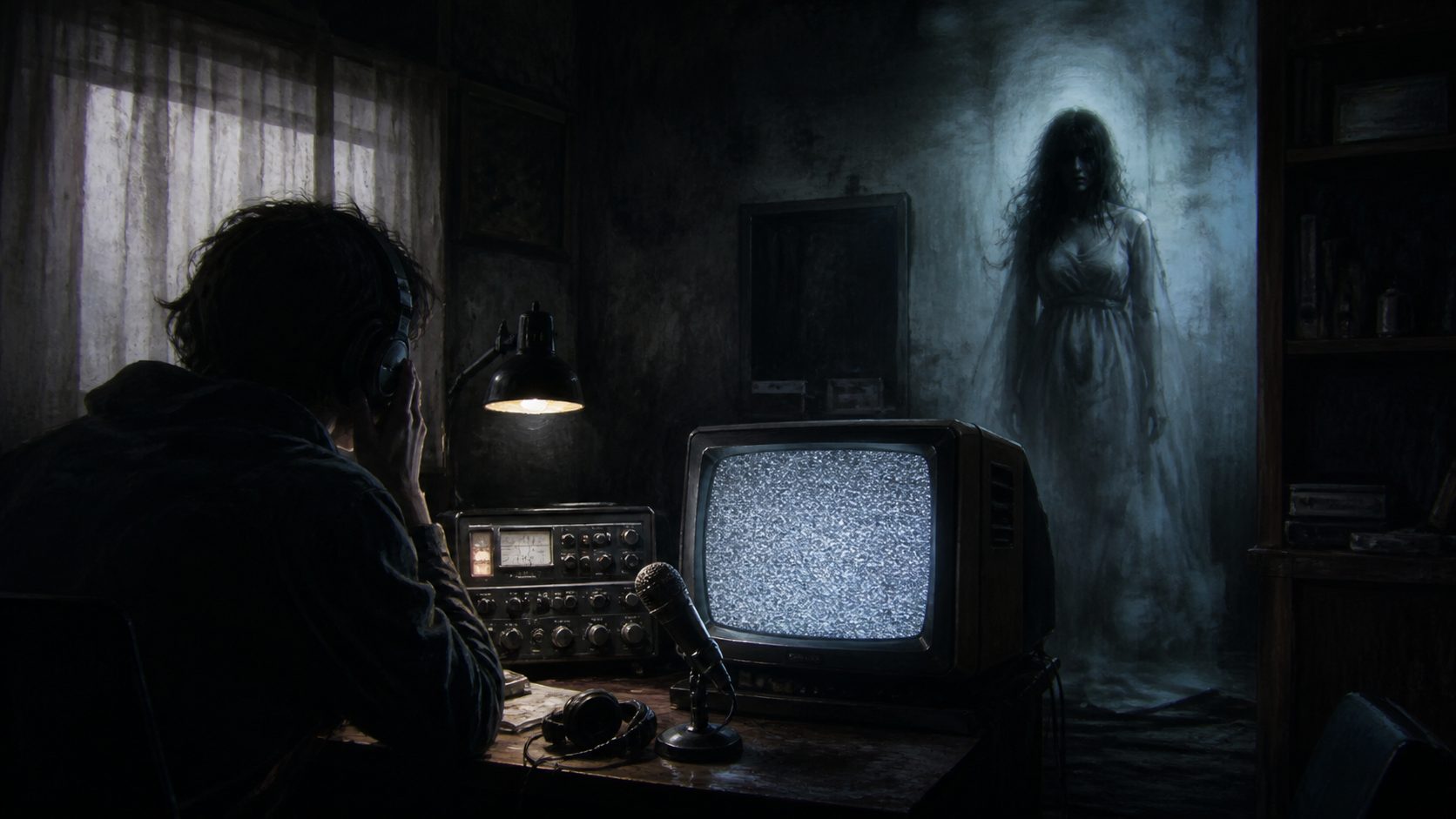
Then the kitchen table jerked forward with such force that it slammed into Mara’s knees. She cried out and stumbled back. A mug flew from the sink and smashed inches from my face. The radio, which had not been plugged in, switched on to a crackling burst of static.
And through it came a voice. Not childlike this time, but ragged, old with use.
Mara.
The house knew her name better than I did.
She froze.
Again, softer now.
Mara.
The voice seemed to come from the walls, from the floorboards, from the pipes behind the plaster. It had learned her shape.
Then the cabinet doors began to slam in sequence, one after another, round the kitchen, as if some invisible hand were walking its fingers along them. The pattern repeated, faster, then faster still. The room filled with noise. The table lifted on two legs. The back door flew open. Cold air surged in.
Mara, in that instant, did something I still cannot decide was brave or ruinous. She stepped towards the voice and said, “If you want a name, take mine.”
The house exploded.
Not in flame. In force.
Every glass in the room shattered at once. The overhead light burst. Something slammed into the side of my head and sent me sprawling. I heard Mara scream, then silence, then the sound of timber cracking as if the house itself were being split open.
When I could see again, the kitchen was a wreck. The table was overturned. The chairs were against the far wall. The radiator had torn free and water was flooding across the floor. Mara was standing very still near the sink, one hand pressed to her throat.
There was blood on the tiles.
Not much. A thin line, bright and neat.
The house had not taken her name.
It had taken her voice.
For the next three days, Mara could speak only in a harsh whisper. Doctors found no injury in her throat. They asked about stress, acid reflux, trauma. She wrote answers on her phone and looked at me with furious, helpless eyes. The whisper did not improve. It had the rough, scraped quality of a radio tuned between stations. Sometimes, in the middle of the night, I would hear it coming from the hallway when she was asleep beside me.
We sold the house six weeks later, at a loss. We told the agent nothing. We accepted the first reasonable offer from a couple with no children and a habit of laughing too loudly in empty rooms. On the day we moved out, I found one last note tucked into the drawer beneath the sink.
It was in the same child’s handwriting.
THANK YOU, CALLUM.
I showed it to Mara. She read it and went pale in a way I had not thought possible after everything else.
“How does it know your name?” she whispered.
That was the first time I understood the truly monstrous part of the haunting.
It had not only learned us. It had been learning everyone who came into it. Watching, listening, collecting. Names, habits, griefs, weak points, the shape of our love. It had used us because we had been available, but it was not limited to us. The house had made a practice of people. We were simply the latest set of mouths to feed it.
We left that day. We did not look back.
Three months later, after we had found a rented flat near High Park and begun to pretend at normal life, a letter arrived forwarded from the old address. No return address. Inside was a single sheet of paper, folded once.
On it, in the same careful pencil, were two names.
JUNE.
ELEANOR.
Nothing else.
I put the paper on the table between us. Mara stared at it for a long time, then reached out and touched the page with one finger.
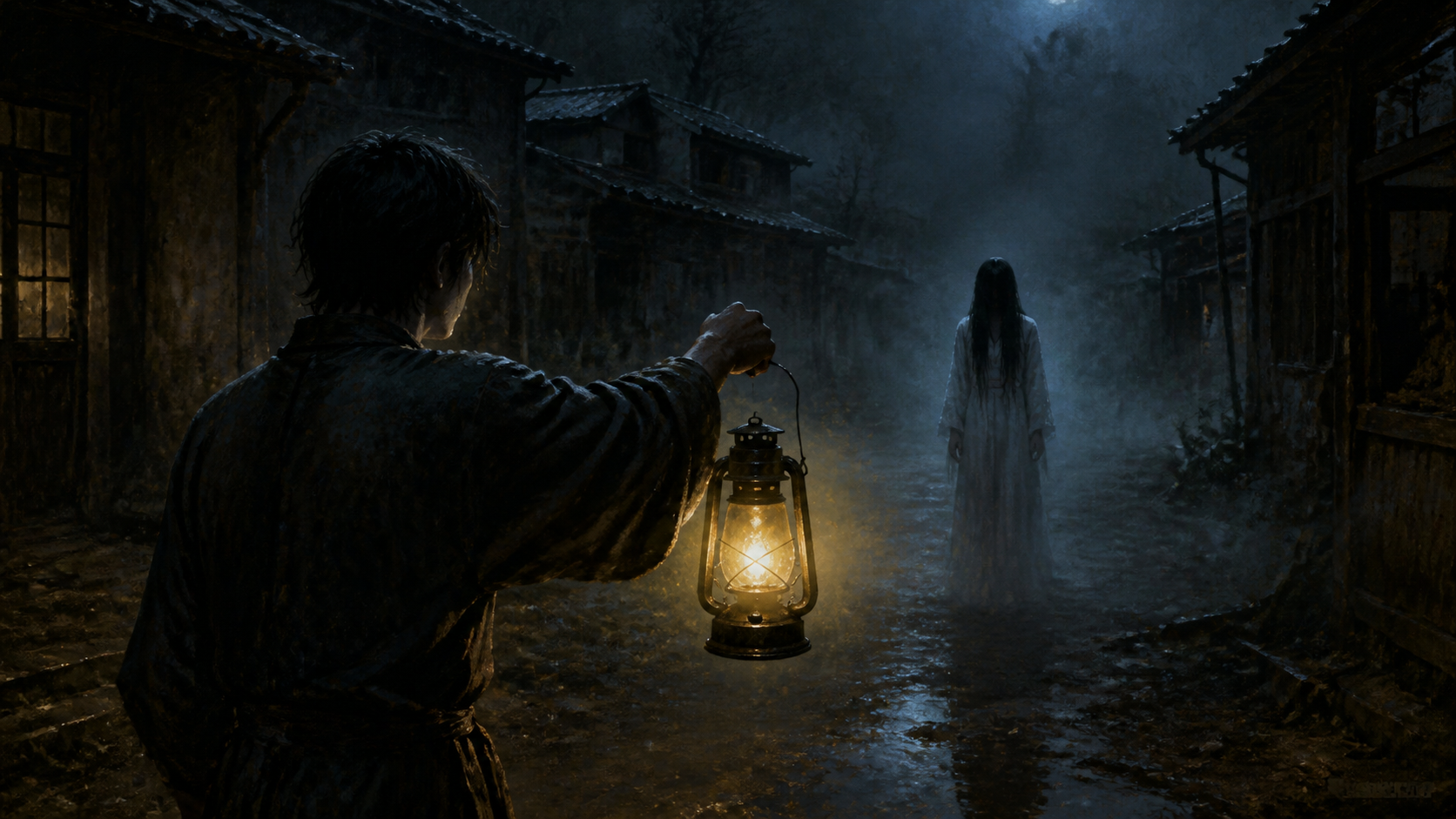
From the hallway outside our flat, very faintly, came the sound of a child’s footsteps. Just one set. Slow. Patient. Coming to a stop outside our door.
Mara closed her eyes.
I held my breath.
A little knock sounded on the wood.
And in the silence that followed, in the rented ordinary light of our temporary life, a girl’s voice whispered through the crack beneath the door, almost shyly, as if she had been waiting to be asked in.
“Mum?”

Ghost Stories