The draugr is one of the most unsettling figures to emerge from the medieval North: a dead person who does not stay buried. In Old Norse and later Icelandic tradition, the draugr is a revenant, a walking corpse or restless dead man who returns from the grave with its body, strength and grudges intact. Unlike a simple ghost, it can be physical, violent and stubbornly material, which is part of what makes it so enduringly disturbing. It belongs to the world of saga literature, grave mounds and feud, but it also reaches far beyond Iceland and Scandinavia, helping to shape later ideas about the undead in horror fiction and popular culture.
What a Draugr Is
The word draugr appears in Old Norse texts and is usually understood to refer to a revenant, particularly one associated with a burial mound. In broad modern usage, especially in English-language fantasy and games, the term has come to suggest a Nordic undead creature, but the medieval sources are less tidy than that. Some undead figures in the sagas are called draugar, while others are described by different terms such as troll or aptrganga, and the labels are not always interchangeable. That ambiguity matters. It shows that the draugr was part of a wider cluster of beliefs about the unquiet dead rather than a single fixed monster with a standardised rulebook.
In many modern retellings, the draugr is presented as a kind of Viking zombie. That is not a bad shortcut for atmosphere, but it is too simple for the older tradition. The saga draugr is usually more cunning than a mindless corpse and often retains something of the dead person’s personality, rage or possessions. It may guard a burial mound, defend treasure, haunt a district or physically assault the living. In some stories it is swollen, dark, heavy or corpse-like. In others it is simply recognisable because it has returned in bodily form and is no longer properly human.
Origins in the Medieval North
The draugr belongs to the religious and literary world of medieval Scandinavia, especially Iceland. Iceland converted to Christianity in the year 1000, but many of the sagas that preserve draugr stories were written down later, in the thirteenth and fourteenth centuries. That distance matters. The texts do not give us a direct, transparent record of pre-Christian belief. They are literary works shaped by Christian authors, oral tradition, storytelling conventions and the social concerns of the age in which they were written. Even so, they preserve a vivid and coherent imagination of the dead as dangerous, embodied and difficult to contain.
Scholars of Old Norse literature generally treat the draugr as an ancient concept, though not one that was handled in exactly the same way in every text or period. It appears in a culture where the grave mound could be imagined as a place of continued power. The dead might remain near their buried wealth, their land or their grudges. Disturbing a mound was therefore not just an act of grave robbery but a provocation. The burial mound was not only a tomb; it was also a threshold, a storehouse of power and a site of danger.
This is why draugr stories often begin with someone entering a grave mound, stealing treasure or otherwise violating the dead. The revenant then emerges to punish the trespasser. Such episodes are not random horror scenes. They reflect a world in which the boundary between the dead and the living is fragile, and where greed, disrespect and social disruption can wake something old and angry.
Appearance and Behaviour
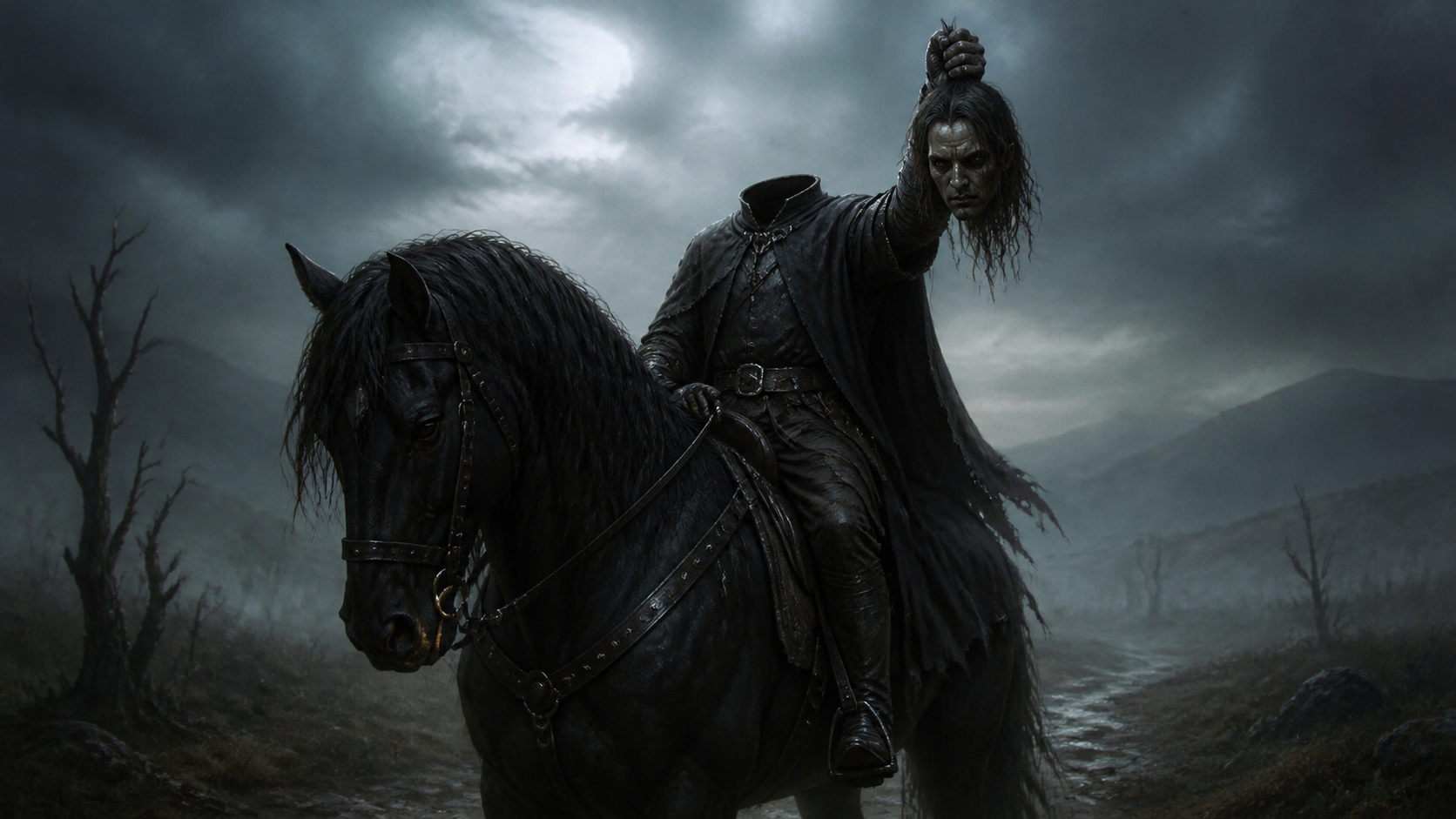
There is no single authoritative visual description of a draugr, but the medieval sources do provide recurring traits. It is commonly associated with an altered corpse, one that has not decayed in the ordinary way. Some saga figures are described as black or dark, some as corpse-pale, and some as unusually large or heavy. The important point is not a fixed silhouette but the sense of a body that should be inert and yet is not. The draugr is dead flesh in motion, and the contradiction is the horror.
Behaviourally, the draugr is often aggressive, territorial and hostile to the living. It may attack people, strangle them, crush them or drive them mad. Some haunt homes or farmsteads. Some remain fixed to a mound. Some roam by night. In saga literature, they can also be linked to bad weather, sickness, fear and a general contamination of the social environment. Their presence is not merely personal but communal, affecting households and whole districts.
One of the most important traits is that the draugr often has to be dealt with physically. It is not enough to pray at it, ignore it or fear it from afar. Heroes may need to grapple with it, decapitate it, burn it, or otherwise destroy the body so that it no longer walks. This bodily conflict is part of the creature’s distinctiveness. The draugr is frightening precisely because it blurs the line between spirit and corpse, between haunting and hand-to-hand violence.
Famous Saga Encounters
Spoiler notice: the following section mentions key events from medieval saga narratives.
Some of the best-known draugr episodes come from the Sagas of Icelanders. In Eyrbyggja saga, Þórólfr bægifótr, known as Thorolf Twist-Foot, becomes a dreaded undead figure after death. His return is associated with violent unrest, death and the corruption of the land around him. The story is one of the clearest medieval treatments of a revenant tied to a burial site and an increasingly dangerous household.
In Grettis saga, the encounter with Glámr is perhaps the most famous draugr episode of all. Glámr is a powerful and fearsome dead man whose return leads to a terrible confrontation with the hero Grettir. The encounter is memorable not only for its physical violence but also for its psychological effect, as Glámr leaves Grettir cursed and haunted. The episode has remained one of the most influential images of the Icelandic undead because it combines brute force, supernatural menace and lasting consequences.
Laxdæla saga also contains a notable revenant in the figure of Víga-Hrappr, whose restless afterlife exemplifies the threat posed by the dead who are not properly settled. Such figures are significant because they are not decorative monsters inserted for colour. They interact with property, honour, inheritance, family conflict and local power. The draugr is embedded in social life. Its violence often mirrors the unresolved tensions of the living.
These saga revenants are not always called draugar in every text, and the terminology can vary. That does not weaken their importance. If anything, it shows that the concept was flexible enough to be expressed in different ways while still remaining recognisable to medieval audiences.
How the Draugr Works in Folklore
The draugr is frightening because it is both familiar and wrong. It is not an alien monster from outside the human world. It is one of us, or rather what one of us becomes when death fails to end the story. This makes it especially potent in folklore. Many cultures imagine the dead returning, but the North Atlantic tradition gives the revenant a particularly physical, intimate form. It does not merely appear in dreams or whispers. It gets up.
In some traditions, the draugr is linked to the grave mound and the treasures buried there. That association is important. The mound is not only a place of death but also a store of wealth and memory. The draugr stands guard over both. In that sense, the monster is a kind of anti-ancestor: instead of protecting the family line through blessing or memory, it protects the grave through hostility. To disturb it is to invite retaliation.
The creature’s behaviour also reflects older ideas about the dead needing proper treatment. Funerary customs, burial mounds and the handling of grave goods all mattered. A dead person who was not settled correctly, or who remained too attached to worldly concerns, could become a source of danger. The draugr embodies that failure of separation. It is death with unfinished business, but with teeth and hands.
Relation to Other Undead Figures
The draugr should not be confused too quickly with the modern vampire, although the two are often compared. There are similarities. Both are dead figures that return bodily, both are dangerous to the living, and both can be linked to burial, contamination and the disturbance of the grave. Yet the draugr is not simply a Scandinavian vampire. The medieval sources do not present one neat equivalence, and later vampire lore developed along different lines, especially in eastern and central Europe and then in nineteenth-century fiction.
It is also useful to distinguish the draugr from the ghost in the narrow modern sense. Ghosts are often imagined as insubstantial, spectral and tied to memory or unfinished emotion. The draugr, by contrast, is often materially dangerous. It can break things, bruise bodies and physically occupy space. That emphasis on bodily menace gives it a different kind of horror. It is less a visitation than an intrusion.
At the same time, the term has shifted over time and across regions. In later Scandinavian folklore, especially in Norway, related ideas survive in different forms, sometimes more like a restless spirit of the sea or a harbour ghost than a grave-bound corpse. Modern popular usage tends to flatten these distinctions, but the older traditions were more varied. The draugr is best understood as part of a family of undead beliefs rather than as a single universal monster.
From Saga Monster to Modern Horror Figure
The draugr gained new life in modern fantasy, role-playing games, television and video games, where it is often redesigned as a blue-grey, armoured or corpse-rotted undead warrior. These versions borrow the name and the broad idea of the Nordic dead rising again, but they often simplify the older folklore into a standard enemy type. That is especially common in games, where the draugr becomes a reusable monster with predictable abilities, weaknesses and levels of threat.
Even in these modern forms, however, the creature retains something of its original force. It still tends to be associated with tombs, treasure, old power and the dead refusing to stay dead. Popular culture may streamline the folklore, but it has also helped keep the draugr visible. For many audiences, the word now immediately suggests a cold, ancient and hostile undead thing beneath the earth.
That modern afterlife has also encouraged comparisons with other fantasy undead and with the wider horror tradition. The draugr shares traits with zombies, mummies, vampires and grave-haunting spirits, yet it remains distinct because it is rooted in a specific medieval northern tradition. Its strength in modern fiction comes partly from that pedigree. It feels old because it is old, or at least because it seems to rise from a deep historical imagination of the dead.
Why It Still Disturbs
The draugr remains effective because it presses on one of horror’s most basic fears: that death may not be final, and that what returns may return in the wrong form. It is not just a corpse but an angry, aware, bodily dead thing. That combination makes it especially nasty. It takes the intimacy of burial and turns it into a threat.
It also carries a strong sense of place. The draugr is bound to Icelandic farms, burial mounds, shorelines and isolated landscapes, where the dead feel close at hand and the land itself seems capable of remembering. That rootedness gives the creature weight. It is not a generic monster dropped into a story for effect. It grows out of a particular historical imagination of the grave, the household and the dead.
For modern readers, that is what makes the draugr linger. It is ancient, but not abstract. It is bodily, but not merely mindless. It is a revenant with cultural memory behind it, and that is why it still feels so cold, so heavy and so hard to bury.