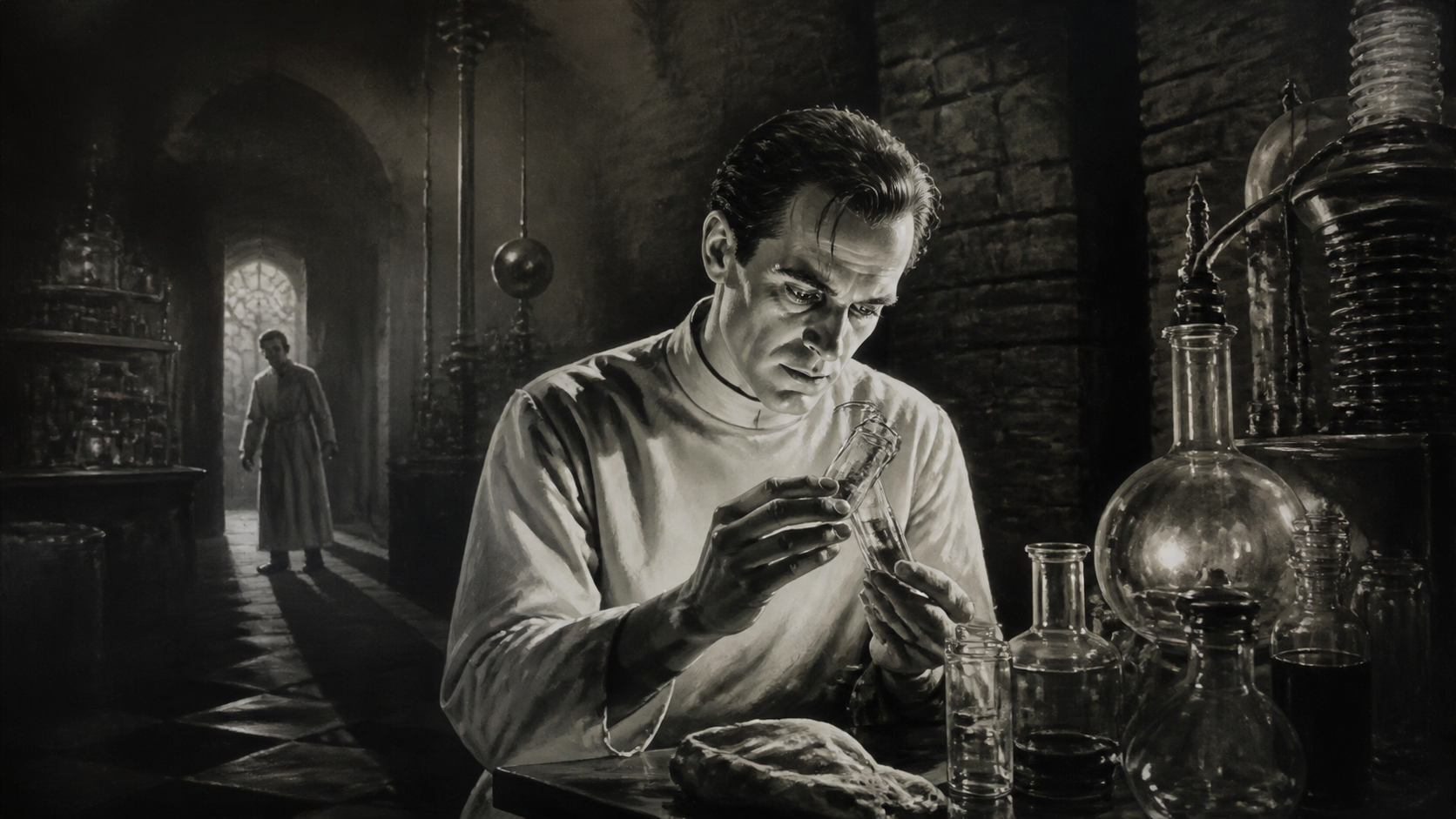
The Curse of Frankenstein is the 1957 Hammer horror that gave British Gothic cinema a new, bloodier commercial identity. Directed by Terence Fisher, it recasts Mary Shelley’s story as a sharply focused tale of obsession, class arrogance and scientific overreach, with Peter Cushing’s Baron Victor Frankenstein at the centre and Christopher Lee as the malformed Creature. It belongs to the Gothic horror tradition, but its distinctive appeal lies in how it swaps romantic melancholy for colder, more physical menace, letting ambition, guilt and grotesque spectacle drive the tension.
The Film File
- Original release year: 1957
- Director: Terence Fisher
- Credited writer: Jimmy Sangster, based on the classic story by Mary W. Shelley
- Principal cast: Peter Cushing as Baron Victor Frankenstein; Robert Urquhart as Paul Krempe; Hazel Court as Elizabeth; Christopher Lee as the Creature; Melvyn Hayes as young Victor Frankenstein; Valerie Gaunt as Justine
- Approximate runtime of the version discussed: 83 minutes
- Country of production: United Kingdom
- Relevant horror subgenres: Gothic horror, mad scientist horror, body horror, science-fiction horror
Behind the Screams
The Curse of Frankenstein was Hammer’s first colour horror film and a decisive break from the studio’s earlier output. The project grew from a period when Hammer was looking for a new angle on familiar material, and Jimmy Sangster’s screenplay deliberately streamlined Shelley’s novel into a tighter, more cynical melodrama. Instead of treating the source as a sprawling philosophical tale, the film puts almost all of its energy into Victor Frankenstein’s moral collapse and the practical consequences of his experiments. That choice mattered. It made the film easier to stage on a modest budget, but it also gave Hammer a more direct, contemporary-feeling horror engine.
The production is also important because it established a lasting Hammer formula. Fisher’s direction, Cushing’s controlled intelligence and Lee’s physical presence became part of the studio’s identity almost at once, and the film helped confirm that audiences would respond to a Gothic approach that was more explicit, more colour-saturated and more overtly carnivalesque than the black-and-white monster films that preceded it. The familiar story is present, but the mood is not literary reverence. The picture is brisk, ruthless and opportunistic in the best sense, shaping a 19th-century tale into something commercially alert and tonally severe.
One useful point of clarification is that the film is not a close adaptation of Shelley’s novel. It takes the broad premise of a scientist assembling life from dead matter, but it reworks character relationships, compresses the material and gives Frankenstein himself far more dramatic centrality than the book does. That is not a flaw in this case; it is the film’s organising decision. The source text is less important here than the new shape Hammer gave the material, and that reshaping is exactly what made the film so influential for the company’s later horror cycle.
Into the Dark
The story begins with Baron Victor Frankenstein awaiting execution while a priest listens to his account of how he arrived at this point. As a young man, he is already intellectually restless and disdainful of ordinary restraints. He brings the learned Paul Krempe into his household as a tutor, then draws him into increasingly ambitious experiments as their work expands from respectable scientific enquiry into the deliberate creation of life. Victor does not merely want to understand nature. He wants to master it.
As his experiments escalate, so does his recklessness. He becomes obsessed with producing a perfect being, but the results of that obsession are patchy, morally ugly and increasingly dangerous. The film keeps the focus on Victor’s choices rather than on the Creature as a tragic innocent. The Creature is important, of course, but the more interesting horror lies in the Baron’s willingness to sacrifice other people, and even his own reputation and relationships, in pursuit of a private triumph.
Spoilers ahead: the following paragraphs discuss major plot developments.
Victor’s conduct grows more predatory as he tries to perfect his creation and then conceal the damage. He manipulates those around him, exploits the vulnerable and becomes responsible for several deaths and acts of betrayal. The Creature, meanwhile, is not a misunderstood philosopher in a stitched body. He is a blunt instrument of the film’s violence, a figure who becomes even more dangerous because Victor refuses to take meaningful responsibility for him. The ending matters because it makes clear that Frankenstein’s downfall is not merely the result of scientific error. It is the outcome of pride, secrecy and a total failure of ethical imagination. The priestly framing device turns that collapse into a confession, but the film never lets Victor off the hook. He has done this to himself, and to others.
What Gets Under Your Skin
The film’s strongest quality is its ruthless clarity. Fisher and Sangster do not waste time pretending this is a story about noble curiosity gone astray in the abstract. It is about a man who likes power, likes control and likes the idea that his intelligence excuses everything else. That gives the horror a nasty, direct charge. The film does not need elaborate shocks every few minutes because the central idea is already corrosive: if Victor wins, he destroys everyone around him; if he fails, he still destroys everyone around him. That moral pressure gives the narrative real bite.
Peter Cushing’s performance is crucial to that effect. He plays Frankenstein not as a ranting madman but as a composed, socialised predator. The polish makes him worse. He is articulate, self-possessed and capable of appearing reasonable even when he is behaving monstrously. That performance choice gives the film a sharper edge than a more flamboyant reading would have done. Christopher Lee’s Creature, by contrast, is all physical fact. The make-up and presentation emphasise deformity, suffering and brute force, creating a stark contrast between creator and creation. The film’s horror therefore comes from both intellect and flesh, which is one reason it feels so foundational to later Gothic horror.
The visual design is another major reason the film lasts. Hammer’s colour Gothic style is not just decorative here; it is part of the threat. The production design, costumes and laboratory apparatus create a world where scientific aspiration looks beautiful, expensive and morally rotten at the same time. The film’s restraint in runtime is also a virtue. At barely over an hour and twenty minutes, it moves with purpose, allowing the story to gather force rather than dispersing it across subplots. That economy helps the atmosphere stay concentrated and avoids the static quality that can weaken older Gothic pictures.
Sound and music are used with a similar discipline. The film does not rely on a dense barrage of sonic shocks. Instead, it lets dialogue, silence and the mechanics of Victor’s work carry much of the tension. That keeps the horror grounded in action and consequence rather than in constant noise. The result is less about frenzy than about accumulation. Each step in Victor’s project makes the next one harder to excuse, and the film understands that a steady moral descent can be more unsettling than a parade of effects.
If there is a limitation, it is that some viewers may feel the film’s compressed storytelling leaves certain emotional possibilities underdeveloped. The material is so tightly arranged around Victor’s actions that other figures can seem functional rather than fully explored, especially when measured against later, more psychologically expansive horror dramas. But that is also part of the film’s design. It is not trying to distribute sympathy evenly. It is trying to isolate the Baron and make his selfishness the engine of the piece. Within that aim, the concentration works very well.
The Film’s Afterlife
The Curse of Frankenstein was a commercial and critical breakthrough for Hammer, and its reputation has remained strong because it effectively announced a new model for British horror. The film established Peter Cushing and Christopher Lee as key genre figures, launched Hammer’s colour Gothic cycle and helped define the studio style that would dominate so much of its later output. It is also routinely treated as one of the pivotal post-war horror films, not because it invented Frankenstein on screen, but because it showed how much the story could change when filtered through sharper pace, stronger melodrama and more graphic physicality.
Its legacy is therefore less about isolated imitation than about tone and approach. Later Hammer horrors borrowed its balance of period setting, moral extremity and vivid production design. For viewers coming to it now, the film still feels substantial because it is not simply “old horror done well”. It is a confident re-engineering of a familiar myth into something leaner, harsher and more commercially alive.
Horripilations Verdict
A lean, stylish Hammer landmark that turns Frankenstein into a fierce study of ambition, cruelty and consequence. It is not the most emotionally expansive version of the story, but its discipline and visual force make it exceptionally effective.
What works
- Peter Cushing's controlled, chilling central performance
- Christopher Lee's imposing physical presence
- Economical direction and vivid Gothic design
What holds it back
- Some supporting characters feel more functional than fully developed
- The compressed adaptation leaves little room for deeper emotional shading