On the first evening my daughter mentioned her grandmother, I assumed she meant the dead one.
It was a wet Thursday in November, the kind that darkens by half past three, and I was in the kitchen making pasta while Lena sat at the table with a pile of colouring sheets she had already stopped colouring. She was seven, all knees and opinions, with her dark curls tied into a lopsided knot by an elastic she kept losing. The rain worried at the windows. The washing machine thudded in the utility room. Our house, a narrow Victorian terrace in south London, always seemed to hold too much sound and too little warmth in winter.
“Daddy,” Lena said, without looking up, “Grandmother says I shouldn’t eat the yellow bits.”
I turned from the hob. “Which grandmother?”
She shrugged. “The old one.”
Her real grandmother, my mother, had died eighteen months earlier in a hospice in Croydon. Lena had been four then. She remembered her in flashes, mostly fragrance and posture. Lavender talc. Rings clicking against mug china. The hard, neat way my mother folded napkins and spoke to waiters. But Lena did not talk about her often, and certainly not as if she were in the room.
“Your nana used to say that,” I said carefully. “She didn’t like overcooked cheese.”
“No, not Nana Priya.” Lena frowned as if I were slow. “The one who lives in the wall.”
A fine chill ran over my scalp.
I looked at the dining-room wall, the one shared with next door. “What do you mean, sweetheart?”
“She’s in the wall by the fireplace.” Lena pushed the colouring sheet away and lowered her voice, though there was nobody else in the room. “She says she’s my grandmother too.”
I tried to smile. “Perhaps it’s a story from school.”
“It’s not a story.” Lena stared at me with a patience that made her seem older. “She knows my name.”
The pasta boiled over then, and the hiss was loud enough to break whatever else I might have said. I dealt with the hob, wiped the spill, and by the time I returned to the table Lena was swinging her legs and asking if we could have ketchup.
I let it go. Children collect phrases from everywhere. They borrow fears and fantasies from classmates, cartoons, overheard adult nonsense. Grief can also make the mind go peculiar, and after my mother died, Lena had gone through a strange phase of asking whether dead people could still see the telly.
But that night she refused to sleep in her own room.
She stood at her doorway in her pyjamas and said, “She’ll be cross if I shut it.”
I had already tucked her in once. “Who will be cross?”
“The grandmother.”
I felt a dangerous little irritation, the sort that comes from being tired and frightened at once. “There is no grandmother in the wall, Lena.”
Her face folded, not into defiance but into hurt. “You don’t know. She says you don’t listen.”
I went cold at that. “Who says?”
“She does.”
I sat on the edge of the bed and pulled the duvet up over her. The room was dark except for the landing light. Her face was pale on the pillow. She watched the corner by the wardrobe.
“What does she look like?” I asked.
“Old.” Lena thought for a moment. “Very old. She smells like the church when it rains. And she has a red mark here.” She touched the side of her neck beneath her ear.
I did not sleep much that night. By morning, I had convinced myself that she had invented the entire exchange. Or perhaps not invented, exactly, but built it from scraps. There were old stories in the family. My mother had said once, in a moment of bitterness after a row with my father, that there was a grandmother I had never known, one who had lived with them briefly in East Ham and then “vanished from the house” before I was born. I had never heard details. My father had always shut down the subject with a shake of the head and the sort of silence that means a door has been locked for years.
Two days later, Lena drew her.
She was sitting at the kitchen table after school, chewing the end of her pencil and making a serious work of it. I was at the sink washing a pan. When I saw what she had done, I asked, “Who’s that?”
She held up the page, proud. The figure was squat and grey, with long fingers and a small, severe face. It stood beside a bed. A woman’s face. Not smiling. The neck was marked with a red line across the skin.
“Her,” Lena said.
“Why is she in the bedroom?”
“She says it’s her room.”
“Whose room?”
Lena looked at me as though I had become very stupid indeed. “Mine, now.”
The room seemed to tilt. I gripped the edge of the sink.
“Lena,” I said, and my voice came out tighter than I meant it to, “what exactly has she told you?”
“She says she was always here.” Lena pointed to the drawing. “She says she used to live in the house when she was alive. She says she’s waiting for someone.”
“Did she say her name?”
“Evelyn.”
My mother had been called Priya. My father’s mother, the one I knew only as a sour photograph in a drawer, had been called Kathleen. Evelyn meant nothing to me. Still, I felt the first tug of real unease. It was the name she had used, not Lena. It had a weight to it.
That evening I took a photograph of the drawing and texted it to my father, Suresh, asking if he knew anyone called Evelyn in the family.
He phoned within two minutes.
“Where did Lena get that name?” he demanded.
I stepped into the back garden so she wouldn’t hear. The rain had eased to a mist, and the brick walls glistened under the security light. “She says a woman told her. Why?”
There was a pause. Too long.
“Dad?”
“I thought that old business was finished,” he said at last.
My skin prickled. “What old business?”
Another pause. Then, in a voice I had only heard once before, when he had been told his brother was dying, he said, “Your grandmother had a sister called Evelyn. She disappeared before I was born. My mother never spoke of her.”
“Disappeared how?”
“I don’t know.” He swallowed. “There were rumours. Drink. Violence. Some story about her being taken away after a fire. It was all a mess. No one in the family liked to discuss it.”
I stared at the dark wet lawn. “And you never told me?”
“I was nine when my mother died and then we never saw that side of the family again. There was no point.”
“No point,” I repeated.
He heard the edge in my tone. “Look, perhaps Lena has overheard something. Or perhaps children invent names.”
“Dad, she says the woman is in the wall.”
He said nothing.
When he finally spoke, his voice was small. “Has anything else happened?”
I almost told him no.
Instead, I looked through the kitchen window at the back wall, where the old chimney breast jutted into the room. “Not yet.”
That was the wrong answer.
On Saturday morning Lena woke screaming.
I reached her room before fully opening my eyes. She was sitting bolt upright, drenched in sweat despite the cold, with her hands clamped over her ears.
“Daddy,” she sobbed, “she came out.”
I gathered her against me. “Who came out?”
“The grandmother.” She was shaking so violently her teeth clicked. “She came out of the wall and stood at the bed and she was angry.”
I held her until the shaking eased. My own heart was hammering hard enough to hurt.
“What did she do?”
Lena lifted her head. Her face was blotched and exhausted. “She said I must open the room. She said she’s been waiting years.”
“Open what room?”
“The little one.” She pointed, trembling, towards the box-room at the end of the landing.
The box-room had once been a nursery in Victorian days. It was too small for anything but storage now. We kept outgrown clothes, spare duvets, suitcases, Christmas decorations. The door was usually shut, and for a ridiculous instant I was glad of that. There was a sense, irrational and undeniable, that something was behind it.
“Stay with me,” I said.
I checked the room first in daylight, with every light on and my phone torch ready. There was nothing unusual. Dust, boxes, a cracked laundry basket. But I noticed something I had missed before. The skirting board beneath the window had a gap in one corner, as if someone had taken a screwdriver to it and never finished the job. An old water stain had discoloured the wallpaper near the floor. And on the inside of the door, low enough that a child might touch it, there were several shallow scratches in the paint.
Not enough to explain anything. Enough to make me feel watched.
I rang a builder friend, Nabil, who lived two streets away. He arrived before lunch with his tool bag and a frown, listened to my awkward version of events, and shrugged in the brisk practical way of someone who does not want to be drawn into family nonsense.
“Could be mice,” he said, kneeling to inspect the gap under the skirting. “Could be water damage. This place is old enough to cough at you.”
He prised up a loose strip of wood. Behind it was a narrow void between wall and brick. Dust, plaster, old cobwebs.
Then he reached in and pulled out a child’s shoe.
It was black leather, tiny and stiff with grime, the buckle green with age.
Nabil turned it over in his palm. “Bloody hell.”
My stomach lurched. Lena, peering round the doorframe, made a small surprised sound.
There was more in the gap. Not much. A button, yellowed and worn. A scrap of fabric so rotten it came apart when Nabil touched it. And then, tucked behind the shoe as if deliberately hidden, a flat packet wrapped in oilskin.
I took it from him. The paper inside was damp but intact. A stack of folded sheets covered in tight brown handwriting.
My hands began to shake before I even opened it.
There were letters. Dozens of them. Each one addressed to “My dear Evelyn”, all in the same hand, written by someone called C. H. The first was dated 1958. The last, 1961. They were not love letters. They were pleading, then accusatory, then desperate in a way that made my mouth dry as chalk.
I read the first lines aloud without meaning to.
“If you have any pity left in you, you will return the child at once. I will not be made to bear this alone. You said it was only for a night.”
Lena was staring at me now. Nabil stood very still.
The next letter was worse.
“You locked her in the back room. I heard her through the wall. Do not tell me she is quiet. She is never quiet. You know what you have done. You know what she calls from the brick.”
I stopped. My throat had closed.
Nabil glanced at me. “What is it?”
I kept reading because I could not bear not to.
“In the name of God, let me take the child and go. If you will not, I will force the door myself.”
The final sheet had only a few lines.
“She says she has a grandmother now. She says the old woman comes when the fire is lit. If I leave, she will leave with the child. I can endure it no longer. Tomorrow.”
There was no signature I could make out, only the initials C.H.
I looked at the shoe in Nabil’s hand and thought, with a horrible lurch of certainty, of a child in this room. Not a ghost exactly. Something far worse. A child hidden in a wall, or a child who had died there, or a child who had been made into a reason for all of this.
Lena touched my sleeve. “Daddy?”
I folded the letters with care I did not feel. “Where did these come from?”
Nabil answered before I could. “This old gap behind the skirting. It’s been patched over and opened again, probably more than once.”
“Can you tell how long ago?”
He looked at the shoe. “Decades. Easily.”
I phoned my father back, but he did not answer. I rang again and again until voicemail picked up. The signal in the box-room was poor, so I moved to the landing. On the third attempt he answered breathless, as if he had run for the phone.
“What have you found?” he said.
I told him about the letters.
There was a sound like someone sitting down very heavily. “Don’t let Lena near that room,” he said.
“Why?”
“Because my mother used to say there was a woman in our family who heard things in the walls.” His breathing had grown uneven. “Aunt Evelyn. She was not right. People said she could tell when children were sick before anyone else knew. Then one day my mother came home and Evelyn was gone. No one ever explained it to me.”
“Dad, what does this have to do with my daughter?”
“I don’t know.” He sounded close to tears, or anger, or both. “But if she is saying the name, then you must get out of the house.”
I looked at the wallpapered landing, the closed box-room, the framed prints my mother had hung years ago. “This is our home.”
“It was hers before it was yours,” he said.
The line went dead.
That night the smell started.
Not a general old-house smell. Something specific, unmistakable, and deeply wrong. Smoke. Not fresh smoke from a fire, but the stale oily stink of something burnt long ago, soaked into plaster and timber. It seeped through the upstairs corridor and gathered outside Lena’s room.
She would not sleep alone. I let her stay in my bed, though I did not intend to tell her that I was frightened too. She fell asleep clutching my wrist. I lay awake in the dark, staring at the ceiling, until just after midnight when I heard a movement in the hall.
At first I thought it was one of the pipes. Then I heard the tiny scrape of a shoe against wood.
Lena sat up beside me with a jerk. Her eyes were open, but unfocused.
“She’s here,” she whispered.
I switched on the bedside lamp.
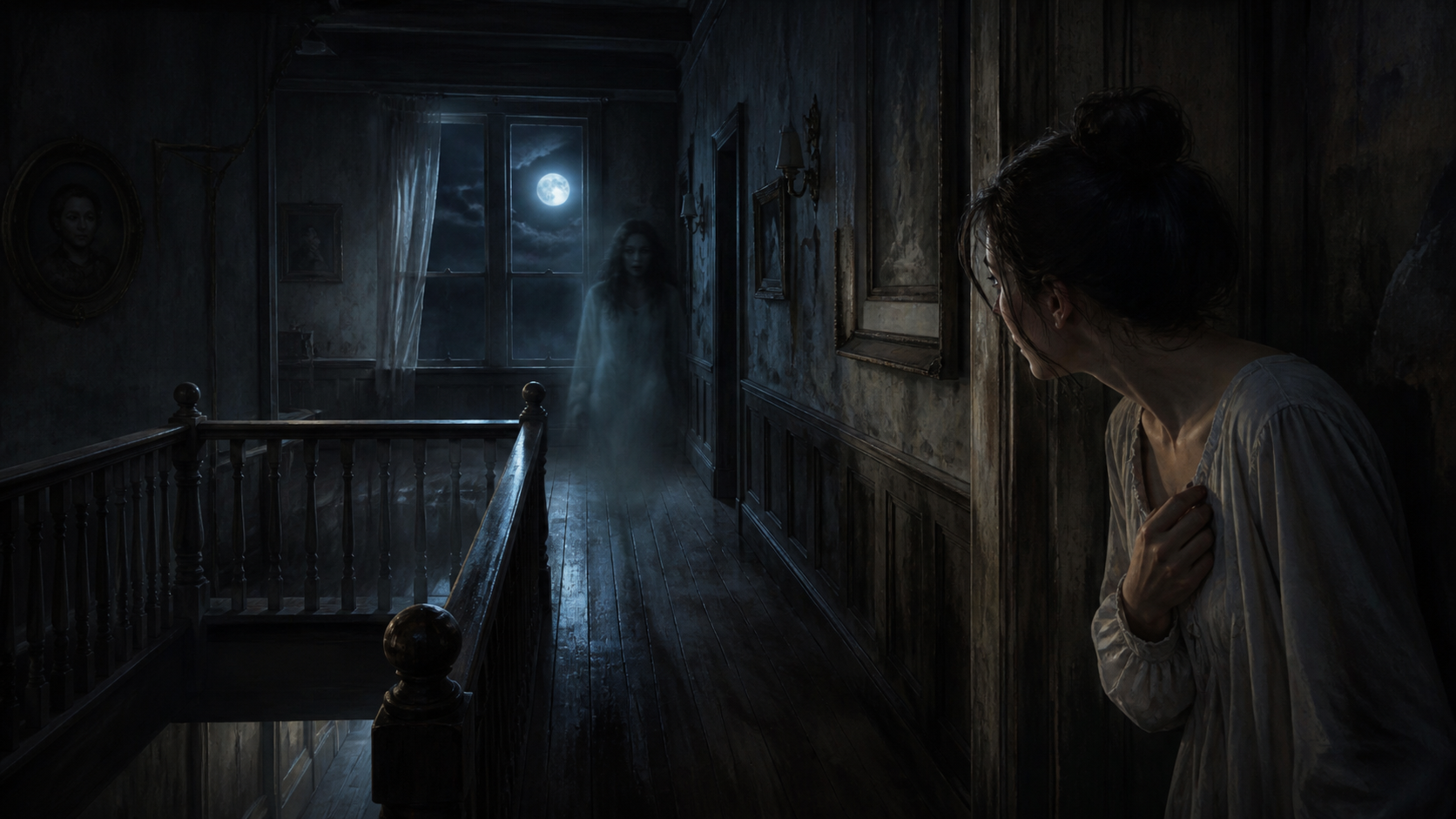
The bedroom door stood ajar. The landing beyond was black, except for the little strip of light under the bathroom door. And in that gap, moving slowly from left to right, was the faint shadow of a woman’s legs.
Not a proper shadow. A dimness with shape. The hem of a dress. The line of ankles.
Lena made a strangled noise and burrowed under the covers. I swung my legs out of bed so fast I nearly tripped. The lamp light in the room seemed suddenly weak. I called out, “Who’s there?”
The thing outside stopped.
A voice answered from the hall.
“Open the little room.”
It was a woman’s voice, but not a voice from the throat. It sounded as if spoken through cloth packed in a wall cavity. Dry. Old. Pressed thin.
Then the smell of smoke intensified, and the landing light flickered once, twice, then went out completely.
I fumbled for my phone. The screen lit the bedroom in a cold blue wash. Lena was crying silently beneath the duvet. The door was moving. Not swinging. Breathing. In and out by inches.
I did the one thing I could think of. I threw open the door and lunged into the hall with the phone raised.
Nothing stood there.
Only the dark corridor, the shape of the banister, the bathroom door half open, and the little room at the end with its closed white panel.
Then something ran across the landing behind me.
I spun round just in time to see a small figure dart into the box-room.
For one mad second I thought it was Lena, but she was still behind me, sobbing into the mattress. The figure was too small and too fast and too pale. I charged after it, heart thudding painfully, and yanked open the box-room door.
The room was empty.
But the air inside was warm, and under the musty smell of cardboard there was another scent, faint and terrible. Burnt hair.
I did not sleep after that.
At dawn, I took the letters and the shoe to my father’s flat in Lewisham. He opened the door in his dressing gown with his face as grey as wet paper. He had aged ten years in the night. On his table lay his mother’s old Bible, which I had not seen in decades, and a key ring with the brass keys to the family house in East Ham, where he had been born.
“I went there before,” he said, before I could speak. “After your call. I needed to know.”
“Know what?”
He looked ashamed. “The house is empty. Been empty for years. The new owners only rent the front rooms. But there’s a back section boarded up. I found a man who remembers the old family. A neighbour. He said there was a fire in 1961. Small, but enough to kill a child if she was trapped.”
The world narrowed to a pinprick. “A child?”
My father nodded. “My aunt’s daughter. Elaine.”
I stared at him. “You said Evelyn was the aunt.”
“She was.” He shut his eyes. “But there was also a little girl. My mother never spoke her name.”
I sat down hard on the chair by the hall.
He went on in a rush, as if afraid I would stop him. “The neighbour said Evelyn had a way of talking to children. Soothing them. Getting them calm. He remembered because, after the fire, the old woman next door said she had heard a child crying in the walls for weeks. Said the family pretended not to hear. People stopped asking questions after that.”
“And you think that ghost is in my house?”
“I think,” he said, staring at the Bible, “that something in your house has called to it.”
Lena had not wanted to come. She was pale and cranky from no sleep, but she refused to stay with my father when I explained we were going out.
“I’m not leaving,” she said.
“You might be safer with Grandad.”
“No.” She crossed her arms. “The grandmother said I belong with you.”
My father’s expression altered when she said that. Fear, plain and naked. He crouched to her level and told her very gently, “If anything says that again, you must not answer.”
Lena looked at him with grave contempt. “I’m not daft.”
The house on Claremont Road, in East Ham, sat among brick terraces like ours but older, narrower, with a front garden choked by ivy and a padlocked side gate. The current tenants let us in after some awkward explanations. They were a Polish couple in their fifties, bewildered but polite, and clearly delighted not to be involved in whatever family drama had arrived on their doorstep.
The back section of the house was indeed boarded up. A cupboard-like extension built half into the narrow yard, its windows long painted over. The tenants said they used it only for storage. The man, Marek, produced a hammer and crowbar from the shed after I asked, with no convincing reason, whether we might inspect the boards.
When the first plank came away, a gust of air pushed out of the gap. It was stale and cold and smelled of ash.
Lena shrank behind me. My father made the sign of the cross with fingers that trembled.
Inside was a cramped room, almost closet-sized, with a bare floor and blackened plaster. Someone had once tried to paper over the walls. The paper had blistered and peeled away in strips, leaving a pattern of old scorch marks beneath. In one corner was a narrow hatch in the floor, shut with rusted bolts.
The room itself felt wrong in a way I could not explain. Not haunted in the theatrical sense. Claustrophobic, yes, but also expectant, as though something had remained here and waited a very long time for a door to open.
Marek stood at the threshold. “You want me to leave you?”
“Yes,” I said at once.
He was happy to go. So was his wife. They retreated to the front room with the kind of exaggerated politeness used by people who have decided not to ask questions because the answers may damage their day.
My father stared at the hatch. “This wasn’t mentioned to me.”
“No one wanted to mention it to anyone,” I said.
We prised up the bolts with the crowbar. The hatch opened with a splintering sigh.
A staircase went down.
I should say now that I did not believe, even then, in anything as simple as ghosts. I believed in memory. Trauma. Suggestion. Houses that breathe damp through old brick and make human beings into fools. But when I pointed the phone torch into the stairwell and saw the steps descending into darkness, the hair at my neck lifted.
Lena gripped my hand so tightly her nails hurt.
“It’s cold,” she whispered.
It was. Not merely cool. Cold like a cellar or a grave.
My father refused to go first. “You’re younger,” he muttered in a strained voice, which was his way of admitting he was terrified.
I went down.
The stairs led to a low brick chamber under the extension. A kind of undercroft. Bare earth in places, concrete in others. There was an old copper boiler, long disconnected, and a pile of rotten sacks. At the far end, half hidden behind a collapsed shelf, was another small room made of brick and timber, separated from the cellar by a narrow passage. A room within a room. The walls were lined with soot.
The smell hit me first. Smoke and something far worse. Sweetness gone rotten.
Then I saw the bed.
It was not a bed now, only the remains of one. Rusted iron frame, a stained mattress collapsed into springs. On the wall above it, scratched into blackened plaster with something sharp, were names. Many names. Some too faded to read. One large one, repeated over and over, was EVELYN.
Lena made a strangled noise.
She was pointing at the far wall.
At first I could see nothing there. Then the torch beam caught a face pressed into the brick from the other side.
Not a face exactly. A pale oval in the mortar, eyes and mouth sunk into it as if someone had been buried alive behind the wall and had pushed their features through the gap before suffocating. The mouth opened.
A sound came through the brick, thin and wet.
“Lena.”
My daughter screamed.
The wall bulged.
I grabbed her and shoved her backwards at the same instant a hand burst through the mortar. Not flesh, not entirely. A grey hand, knotted and blistered with soot, thrust through the bricks and clawed at the air. Another came after it. The wall cracked with a sound like bones breaking.
My father shouted something and seized the crowbar. Marek, hearing the scream above us, came pounding down the stairs two at a time.
The brick face split open.
What emerged was not a woman in any ordinary sense. It was the shape of one, horribly thin, dressed in shredded black fabric caked with ash. The skin showed through in patches, grey and leathery, with one side of the neck marked by a dark raw groove, as if the flesh there had been cut or burned. Her hair hung in strings, and from her mouth came the reek of a fire long extinguished. She moved with a jerking certainty, not like a person climbing out but like something that had been waiting in the wall all these years and now had room to stand.
Marek froze at the bottom step, saw it, and bolted backwards so quickly he struck the stair rail and tumbled up screaming.
The thing’s eyes fixed on Lena.
“She’s mine,” it said.
The voice was no longer muffled. It was clear, furious, and horribly intimate.
I flung myself between them.
The creature moved with shocking speed. Cold air lashed my face. Its fingers closed around my arm. I felt the touch through my sleeve, icy and hard, and then a pain like a brand. I cried out and drove my elbow into its throat, or where its throat should have been. The thing did not recoil. It merely smiled with a mouth that held no warmth at all.
Then my father hit it with the crowbar.
The blow rang through the cellar like striking iron. The creature staggered back into the wall, and for one split second its face changed. Not in shape, but in expression. I saw grief there. Not humanity. Something like it. A ferocious, bottomless mourning twisted into rage.
Lena was screaming for me. The room seemed full of smoke though there was none. My father swung again, and this time the crowbar went through the thing’s shoulder and into the brick behind. Dust exploded. The wall began to crumble.
The creature turned its head slowly towards him.
“No,” it whispered.
And then the house answered.
A deep, old crack sounded overhead. Plaster fell in a powdery shower. Somewhere above us, on the ground floor, a door slammed hard enough to rattle the stairs. The undercroft windows, tiny and filthy, suddenly glowed orange.
“Fire!” Marek shouted from above. “There is fire!”
I smelt it too, sharp and immediate. Not imagined now. Real.
The boarded room had caught. Whether from old wiring, fallen dust, or something else, I never knew. Flames licked through the slats at the top of the stairwell. Smoke was rushing down towards us.
The thing in the wall laughed.
It made a sound like paper burning.
I seized Lena and pushed her towards the stairs. My father grabbed the crowbar from the floor and began smashing at the brick around the broken opening, not in attack now but in fury, as if trying to unmake the wall by force. The creature lunged after us. Its hand caught my father’s coat and ripped it almost from his shoulders. He stumbled. The crowbar flew from his grasp.
The thing leaned close to him, its face inches from his.
“Where is the girl?” it asked.
My father stared back, blood on his cheek, and for a mad instant I thought he would answer some hidden truth. Instead he spat in its face.
The creature shrieked and struck him across the mouth with such force that he fell against the cellar wall. Blood sprayed from his lip. The sound broke whatever spell had held me. I yanked Lena up the stairs, half carried her, and we burst into the burning room above. Marek had already ripped away enough boards to make a gap to the yard. Smoke poured through the opening. I shoved Lena first, then scrambled after her as flames began licking the ceiling joists.
Outside, the air was bright and wet and shocking after the cellar stench. Lena fell on the wet paving stones coughing. Marek dragged his wife back from the side passage. My father emerged last, clutching his face, and behind him the extension roared as if the house had exhaled a furnace.
No one moved for a moment.
Then, through the broken boards and smoke-blackened gap in the cellar hatch, I saw a shape standing at the bottom of the stairs.
It was the old woman.
She stood utterly still in the orange light, one hand raised, and the fire did not touch her. It flowed round her as water flows round a stone.
She was looking at Lena.
The child gave a choked whimper and pressed herself against my leg.
The woman’s expression changed. Not to kindness. Not exactly. But to something like satisfaction.
“You found her,” she said to no one and everyone.
Then she was gone.
The fire brigade came quickly, but not quickly enough to save the back section. The extension burned through the upper floor and collapsed into the cellar. The rest of the house was smoked and waterlogged but salvageable. The police asked questions. The tenants were displaced. There was talk of fault in old wiring, of historical alterations, of a tragic accident waiting decades to happen. My father and I said as little as possible. The letters were turned over to the authorities, though I doubt anyone took their contents seriously. The shoe, the old room, the names in the wall, all of it sank into the usual bureaucratic fog that swallows the inconvenient dead.
But the haunting did not end with the fire.
That night, in the hotel where we stayed because neither my father nor I could bear to return home, Lena woke just after midnight and sat straight up in bed.
I was in the chair by the window, still dressed, with my shoes off and my head in my hands. The room was quiet except for the noise of traffic outside and the humming of the radiator.
“Daddy,” she said.
I stood at once. “What is it?”
She pointed to the dark glass of the wardrobe door.
At first I saw only our reflections: me thin and haggard, her small and dishevelled in the bed. Then the reflection thickened, as if another figure had stepped into the room behind us.
My breath stopped.
There, in the glass, stood a woman in old-fashioned black. Not burnt now, not smoky. Grey-haired, severe, almost elegant in outline. A red mark circled the side of her neck where a scarf might have hidden it once. She did not look at me. She looked at Lena.
The child did not scream. She sat very still.
The woman raised one hand and beckoned.
“No,” I said, louder than I meant to.
Lena turned her face to me. “She says I’ve done enough.”
I was too frightened to speak. My mouth felt full of cotton. In the glass, the woman waited with a strange patience.
“Lena,” I whispered, “what do you mean?”
“She says the little room is open now.” Lena’s eyes were bright with unshed tears. “She says she’s not in the wall anymore.”
The hotel room seemed to shrink. I crossed to the bed and knelt in front of her, taking her hands.
“Listen to me. Whatever that is, it is not your grandmother.”
Lena stared at me with a solemnity far beyond her age. “She never said she was my grandmother.”
The wardrobe reflection flickered.
The woman in black was no longer alone.
Something small stood beside her.
A child. Barely visible, pale and thin, with a scorched hem around the nightdress. It clung to the woman’s skirt and looked at us with blackened, pleading eyes.
Lena saw it too. Her face crumpled.
“Is that the one?” she whispered.
I could not answer.
The woman in the glass lowered her head, almost as if in acknowledgement. Then, slowly, she guided the child backwards, and both figures receded as if walking away through a long corridor I could not see.
The reflection cleared.
The room was only a room again.
Lena was shaking. I gathered her into my arms and held her while she cried until dawn. After a while, the smell of smoke that had followed us since the cellar began to fade. By morning it was gone.
We moved out of the house on my father’s insistence. I agreed without argument. He never spoke again of the East Ham place except once, when he said very quietly that some families keep their dead by forgetting them, and some keep them by naming them wrong.
Lena never drew the woman again. She never mentioned the one in the wall. But months later, when we were unpacking in the new flat in Battersea, she found an old photograph of my mother that had somehow survived the move. It was from a birthday years ago. Priya was sitting in an armchair, smiling into the camera with a hand over her throat as if to adjust a necklace.
Lena studied it for a long moment.
“That’s not her,” she said.
“Who?”
“The one who came.”
I felt the blood leave my face. “What do you mean?”
Lena traced the edge of the photograph with one finger. “She was older. Meaner. And sad.”
I took the photo from her before my hand began to shake too badly.
On the back, in my mother’s neat slanted writing, was a date I had never noticed before, and beneath it, a single name.
Evelyn.

Ghost Stories