By the time the road reached Blackwater Abbey, the daylight was already going. Winter dusk lay flat over the fields, turning the hedgerows to black stitching and the marsh beyond them to a single bruised smear. My headlights caught puddles full of dead leaves, a ditch glazed with ice, and the white shard of a sheepbone before the lane buckled under roots and opened at last on the abbey itself, square and dark on its rise above the water.
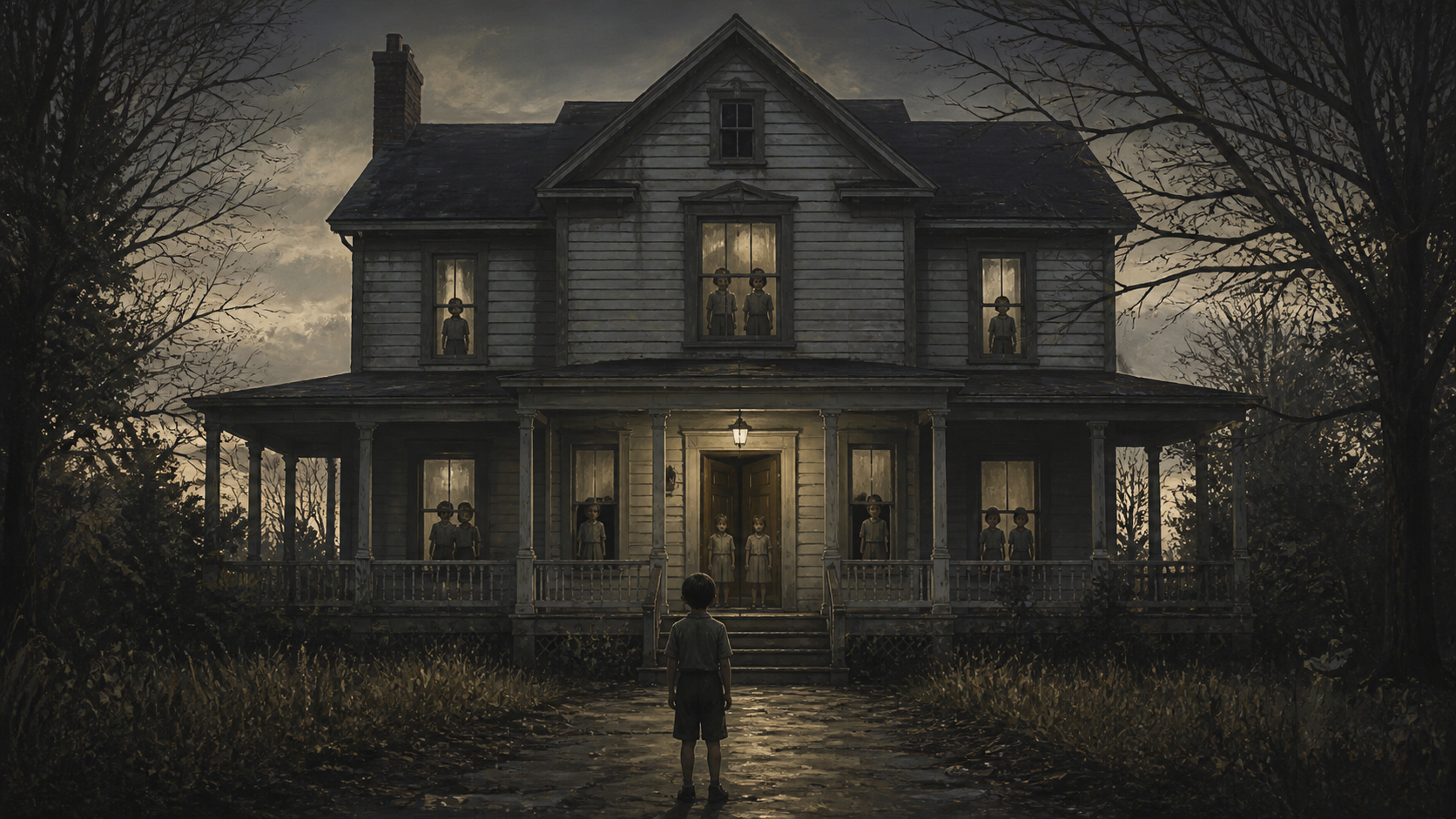
There was no village clustered round it, no tourist boards, no café selling little biscuits with the name printed on the wrapper. Blackwater Abbey stood alone, a fortified house of old stone with narrow windows and a chapel tower broken off halfway up, as if something had taken a bite from it. Ivy had climbed one wall in thick ropes. The rest looked stripped, watchful, and very cold.
I had taken the post because it was winter work and because I was tired of living hand to mouth in Cork, taking whatever proofreading job the agency sent me. The advert on the heritage trust website had been almost laughably plain: caretaker and night cover for Blackwater Abbey, six weeks. Accommodation provided. Duties included fire checks, opening and closing for small tour groups, reporting damp ingress and unauthorised access. Pay better than anything I had seen in months.
No mention of a haunting. No mention of why the previous caretaker had left with one day’s notice and would not speak to anyone afterwards.
Eileen Marr met me at the door, brisk as a forewoman, in a blue coat and work boots, a torch in one hand and a set of keys in the other.
“You made good time,” she said. “Road all right?”
“Clear enough.”
“That’ll change if the fog comes in off the marsh. It always does.” She looked me over in the torchlight. “You’re Gareth.”
“Yes.”
“Come inside. You’ll want the fire up before it goes proper dark.”
The inside smelled of peat smoke, damp stone and polish. The abbey had been made domestic centuries ago, but its bones were still monastic. Long corridors. Thick doors. Arches where straight lintels ought to have been. In the hall a row of portraits stared from cracked gilt frames, men in severe black coats, women with pale throats and jewelled hands, all of them dead so long their names were almost decorative.
Eileen took me to a small suite in the west wing, once a guest chamber, now furnished with a narrow bed, an electric heater and a kitchenette cobbled together from sink, hot plate and kettle. The windows looked over the yard and the marsh beyond, where evening mist was already laying itself down in thin silver sheets.
“You’ll be alone here at night,” she said, handing me the key ring. “Sensors on the outside doors and the public rooms. If anything trips after closing, ring me first. If it’s a person, ring the gate guards.”
“Do people break in often?”
“Not often. But they come.” Her mouth tightened. “Teenagers. Urbex sorts. People who’ve read too much online. We’ve had a few incidents.”
“What sort of incidents?”
She paused long enough to make the question awkward. “Enough to make me advise you not to wander after midnight. The east stair is out of bounds. The old chapel tower, too. If you hear someone moving in the passages, don’t go chasing them. Call me.”
“That bad?”
She met my eye. “You’ll see.”
There was more she wanted to say, and chose not to. Instead she showed me the alarm panel, the cupboard of torches and batteries, the logbook where every inspection, every door, every visitor would be written down neatly because, as she put it, “We have inspectors.” Then she gave me the usual history in the tone of someone reciting weather. Franciscan house. Private estate. Restored badly. Some sections unstable. Some stories worse than others.
After she left, I unpacked, made tea, and had a look round the sitting room and library. There was a framed plan of the house with the old alterations marked in red. The original cloister had gone, but the footprint remained. A passage beneath the east wing was labelled vault access, private, locked.
I poured myself a whisky, sat listening to the building settle, and tried not to feel as if it were listening back.
At first there was only the normal machinery of an old house. Pipes ticking. A loose slate worrying overhead. Wind tugging at the chimney pots. Then, just after nine, as I crossed the hall to check the lights, I heard a small metallic clink.
A lantern bell.
It was faint, twice repeated, like a finger touching glass. It seemed to come from the corridor leading towards the chapel. I stood still, then went to the end of the passage with my torch. The chapel door, a heavy oak thing bound in iron, was shut. Nothing moved behind it.
I listened again.
Silence.
I told myself it was pipework or some fitting in the walls. I checked the door anyway. Locked. In the logbook I wrote: faint metallic noise from east corridor, possibly pipework.
At half past ten it came again, closer this time. Not quite a bell, more a careful footstep softened by carpet, followed by the same light chime of brass and glass. Another step. Then a pause outside my bedroom door.
I opened it with my torch up and said, “Who’s there?”
No answer.
The handle turned.
I yanked the door open. The corridor was empty. The air there was colder than in the room, and beneath the stone smell I caught, unmistakably, wet wool and lamp oil. The passage stretched both ways into darkness. At the far end, by the stair, something small glimmered for a second and was gone.
I checked every door, every bolt. The alarm panel showed nothing. By the time I got back to bed the smell had faded.
I slept badly and woke with the sense that the house had spent the night standing over me.
In the morning I opened the logbook and found I had written, in my own hand, bell heard from east passage, 22.10, no source found. I did not remember writing it.
Eileen came by the next day with groceries and paperwork. She dropped milk, potatoes and a folder on my kitchen table with the air of someone who disliked the need for practicality.
“Any trouble?” she asked.
“Not unless the building is trying to get my attention.”
Her head lifted. “What do you mean?”
So I told her. I expected the usual smile, the usual old-house explanation. Instead she went very still.
“Describe it.”
“It was a small bell. Brass, maybe. And footsteps.”
“Did you smell anything?”
I stared at her.
She nodded once. “Lamp oil. Sometimes damp cloth. Sometimes smoke.”
“You knew?”
“I knew enough to ask.” She looked towards the window, out over the marsh, before she answered. “There’s a story here. Tobias Vale. Lantern keeper, under-porter, servant to the Darraghs in the seventeenth century. He knew every passage in the place. During the siege, when the abbey was being used for refuge and storage, he carried a lantern through the house at night and rang a little bell on his belt.”
“And?”
“And then there was a fire in the east range. And a priest hiding in the vaults. The family handed him over to save the house, or they handed over someone else to save the priest, depending whose version you read. Tobias was involved. Or blamed. Or both.”
“So the ghost is him.”
“People say that. People say it’s the priest. People say it’s a monk with a lantern who never left his post. Most of what people say is rubbish.” She set the folder down. “But you’re not the first caretaker to hear the bell.”
I laughed, because that was easier than anything else. “What happened to the others?”
“Two quit in under a week. One lasted three months, then refused to come back after a night in the chapel. Said someone was walking behind him, matching every step. Another found the east stair open when he knew he’d locked it. Packed his bags before dawn.” Her face tightened. “You’ll do better if you don’t try to be brave.”
“Do you believe in it?”
“I believe men can do dreadful things and leave their sorrow in walls.” She slid the folder towards me. “Records, if you want them.”
That evening I read until the heating gave up and the library went cold enough for my breath to show. Eileen’s papers were copies from local archives, an old estate map, an inventory, and a typed deposition from 1649. Tobias Vale appeared only briefly in the inventory as lantern keeper and under-porter. The deposition described the surrender of the abbey during a military campaign, the hiding of a priest in a vault beneath the east wing, and the disappearance of a servant boy after the fire.
One line stayed with me.
The keeper was heard to cry out from the passage under the chapel, yet no man saw him come forth.
I was still staring at it when the lights failed.
No warning. No flicker. One moment the room was amber-lit, the next black, and in the silence I heard a scrape behind me, shoe on stone. I reached for my torch, fumbling. Then, near my shoulder, came the lantern bell once more.
I spun round and struck the chair.
My torch beam swept the room. At first there was nothing but shelves and table and the gilt edges of old books. Then the light caught a hand at the far side of the room, pale and grey, holding a lantern.
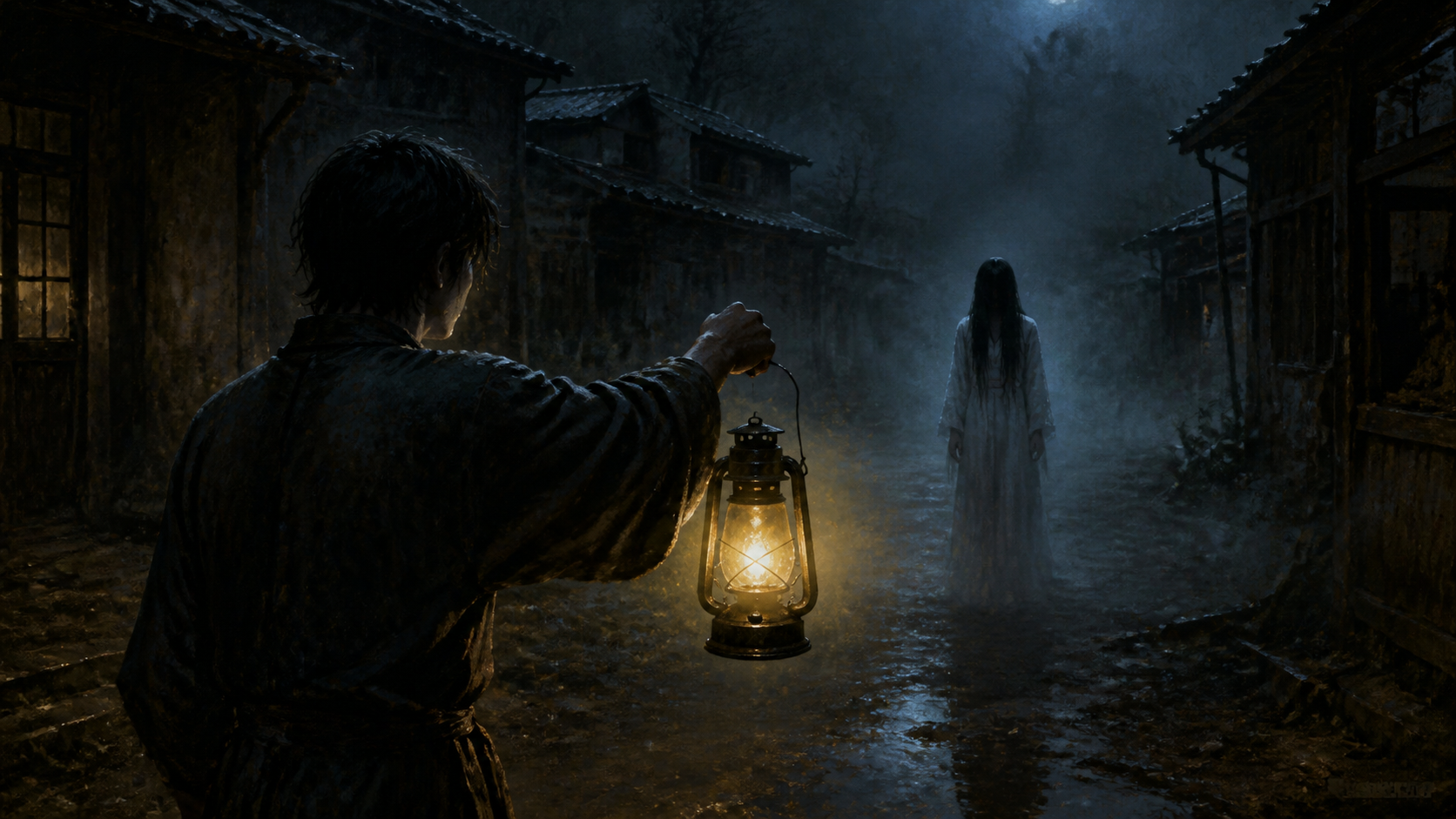
The glass was dirty. The flame within did not behave like fire. It shivered with a green core. The hand lifted, very slowly, and the lantern came further into the room. Behind it stood the outline of a man in a long dark coat, the shoulders narrow, the head slightly bowed, as though listening for something below the floor.
His face showed in fragments. A wet gleam of cheekbone. A mouth too thin to be healthy. One eye catching my torch in a white point. The clothes were not quite clothes, more stains in the shape of them, as if the body wearing them had long since been pressed out and left the fabric behind.
He did not speak.
He looked at me the way a clerk might look at a man who has mislaid a document.
Then he stepped back into the passage and the lantern light vanished with him.
I was running before I was properly aware of it, down the corridor and into the chapel passage, where the chapel door now stood open a hand’s breadth. The air beyond was bitter cold. At the far end a second door I had never noticed stood half open on a blackness that seemed to sink instead of recede.
From below came dripping water. Beneath that, a human breathing, slow and patient.
My phone had no signal in that part of the house. I should have turned back, fetched Eileen, locked everything and waited. Instead I pushed through into the chapel.
The room was stripped bare, with a stone altar and shattered stained glass high above. Moonlight through the lancet windows laid pale bars across the floor. Dust shone like ash. At the far end, beneath the altar rail, I found the second door, little more than a hatch fitted with a rusted iron ring.
My hands were shaking so hard I could barely hold it. I pulled.
The hatch opened on a stair.
Cold air rose from below. Something brushed my ankle. I nearly fell back and found it was only the end of an old rope, frayed and wet, but for one absurd second I thought something had reached up from the dark to seize me.
I shut the hatch and stood panting in the chapel. No bell now. No footsteps. Only the smell of lamp oil, stronger than before, as if the walls had soaked it in.
I told Eileen everything in the morning. She did not interrupt once.
When I finished, she said, “Show me.”
We opened the hatch together in daylight. The stair descended into the foundations, narrow and slick with age. A modern padlock had once been fitted, but the hasp was rotten. Eileen swore under her breath.
“This should have been sealed.”
“By whom?”
“I don’t know.” She took a torch from her pocket. “Come on.”
The stair led to a low chamber beneath the east range. We heard groundwater dripping and, somewhere beyond the stone, the distant rush of the marsh tide against the embankment. There were shelves cut into the wall, a broken barrel, old storage debris. In one corner lay a bundle of mouldering cloth. Beside it, a blackened iron lantern frame with no glass.
In the centre of the floor was a patch of fresh earth.
I knew at once what it meant. Someone had disturbed the floor recently. Eileen saw it too.
“No,” she whispered.
She knelt and scraped the soil aside with her fingers. Wood showed beneath. A trapdoor.
“This was supposed to have been cleared years ago.” Her voice had gone thin.
“Cleared of what?”
She had already prised at the boards with the blunt end of her torch. The nails resisted, then gave with a groan. When the lid came up, the smell was not merely damp or rot, but old trapped air stale with human closeness.
There was a chamber below, not deep, but enough to crouch in. My torch struck bare stone, a broken crucifix, and the skeleton of a man seated against the wall.
He had been there a long time. The skull had collapsed on one side, the ribs were furred with mould, and one hand still clutched a rusted lantern handle. Around his neck hung a strip of leather with a tiny brass bell dangling from it.
Eileen made a noise I can only call a strangled whimper.
Then the breathing started.
Not ours. From below us.
I would like to say I understood at once how a dead man could breathe, but all I knew was that the sound was real: a wet inhalation, a pause, then another. Eileen stumbled back and struck the wall. Her torch beam swept wildly over the remains, and in that movement I saw the second thing.
There was another opening in the rear wall of the chamber, a gap just large enough for a person to crawl through.
From it came a hand.
Thin. Grey. Wet-looking.
Then a face, bent low, peering through the dark. It was the same face from the library, but closer now and worse. The skin hung in folds as if soaked too long. The eye sockets were deep and empty except for pinpricks of reflected light. The mouth opened, not in a snarl but in a kind of exhausted obedience, as if the thing had been summoned to duty and disliked being late.
Eileen screamed and dropped her torch. It rolled away into blackness.
The chamber filled with movement. I grabbed her arm and hauled her towards the stair, but something clamped round my ankle with shocking strength. I went down hard, shoulder cracking against stone. The grip was cold and slick, and beneath that I felt bones, human and jointed.
The thing in the opening gave its bell a tiny shake.
At once there was movement below us. Not one figure, but several. Hands sliding over stone. The scrape of nails. The shuffle of bodies in a space too small for them. Voices too broken to form words, only breath and a sound like a drowned man trying to speak.
Eileen kicked wildly, caught something, and I felt the grip on my ankle loosen just enough to wrench free. We scrambled up the stair half blinded, slammed the hatch behind us, and I jammed my shoulder against it while she found the rotted bolt and drove it home with such force I thought the metal would split.
For a moment there was silence.
Then, from below, very softly, came the bell.
After that, there was no ordinary way to deal with anything. Eileen phoned the police, then the trust, then a contractor. By afternoon the chapel area was cordoned off. The remains were removed. Questions were asked with clean hands and careful faces. Age. Cause of death. Whether the body had been hidden. Whether anyone had entered the chamber recently.
No one could explain the second set of remains the contractor found in the crawlspace beyond the wall. They were older, partly mummified in dry earth, a man and perhaps a boy, fused by time and collapse, with a lantern hook still fixed in the masonry beside them.
The official conclusion was that some of the bones were seventeenth-century and others later, and that accidental entrapment in the vaults had probably caused the deaths. The local paper wrote about historical remains uncovered at Blackwater Abbey and did not mention the bell.
But the haunting did not stop because the paperwork was tidy.
That night the alarms in the west wing went off at one twenty-three. The gate guard found the main entrance standing wide open and the hall lights blazing. No intruder was seen. In the chapel the floor was wet end to end, as though somebody had dragged a river through it. In my room the mirror over the sink was smeared from inside with a handprint the size of a child’s.
Eileen stayed late, sitting in the kitchen with a mug of tea she never drank. She looked exhausted. There was guilt in her face now, stripped of pretence.
“I should have told you,” she said.
“About what?”
She stared at the table. “The last caretaker wasn’t the first to go missing.”
I waited.
“There was a girl in the nineties. Part-time guide. Found in the east stair with a head injury. They said she’d fallen. Before that she said there was a man in the chapel asking her to help him. Said he had a lantern and wanted her to open the hatch. They called it a panic attack.” She swallowed. “A year later a volunteer vanished for three hours. Came back soaked through though it hadn’t rained. Said he’d followed someone below. Wouldn’t say who.”
“Why keep it open?” I asked. “Why not shut the place until every wall’s checked?”
“Because people don’t want history to be inconvenient,” she said bitterly. “And because every time we thought it was over, it wasn’t. We sealed one passage and another door showed up. We filled a well and the water found the crypt. We locked the chapel and it started using the corridor. This place has always had spaces to hide bodies, whether living or dead.”
She rubbed her eyes.
“I think Tobias Vale was trapped down there,” she said quietly. “Maybe by the priest, maybe by soldiers, maybe by the family. He knew the passages. He may have been made into the very thing that betrayed him. Or he may have betrayed others and been buried alive for it. I don’t know. But the lantern keeper keeps looking for a way out.”
“And the bell?”
“Servant bell. He probably wore it while keeping watch. It marked him out in the dark. Helper. Traitor. Easy to recognise. Easy to blame.”
We sat quiet after that, listening to the house. Somewhere in the walls a slow drip counted seconds.
At midnight I heard the bell again, this time from the corridor outside the kitchen.
Eileen heard it too. We looked at each other, and the choice between us was plain enough. If we stayed in the light, we might survive the night. If we ran, whatever had woken in the abbey might follow. If we opened doors, it would learn the way out. If we sealed ourselves in, it would still be there, waiting in the walls.
She stood and took the brass key ring from the table, putting it in my hand.
“There’s one thing we haven’t done,” she said.
I stared at her. “What?”
“The north gate. It leads to the marsh path. If the dead man is bound to the house, maybe the house is the chain.” She took a breath. “If we let him leave, perhaps he’ll go.”
“That’s not how ghosts work.”
“No,” she said. “But it might be how guilt works.”
The bell rang again, closer now, from the hall.
We went together, torch in hand, carrying as little courage as possible. The hall was empty. The portraits stared down. Frost had formed in a pale strip along the threshold. At the end of the corridor where the north gate opened on to the yard, the air was colder than winter had any right to be.
I can still see the moment the door unlatched.
It happened without touch. A click, a gentle movement, as if a careful hand had lifted the catch. Then the door swung inward and lantern light appeared low to the ground, approaching from outside.
We could have fled back into the kitchen and locked ourselves in. Instead we stood where we were, because it is one thing to know a story and another to be inside it.
The figure came through the doorway slowly, with the patience of a man used to rules. The lantern was in one hand. The other held the bell by its cord. He wore the same dark coat, rain-sodden at the hem. His face was unmistakably human in outline, though the features shifted when I tried to focus on them, as if time itself could not settle on one version.
He looked first at Eileen, then at me.
And then, with an exhaustion so deep it seemed to belong to the stone, he raised the lantern and pointed it not at the door but down the corridor towards the chapel.
He wanted us to follow.
“No,” Eileen said, her voice barely more than breath.
The thing inclined its head, almost politely, as if acknowledging refusal.
Behind it, the corridor darkened and a second presence moved. A shape at first, then another. Not one dead thing but a crowd of them, narrow-limbed and bent, as if they had been crowded together in the dark for years and had only now found room to move. The house had kept more than one.
One had the face of a boy. Another wore a rag of clerical white at the throat.
The lantern man turned slightly, and I understood with a nauseating lurch that he was not leading them. He was trying to hold them back.
He shook the bell once.
The sound was tiny and sharp, and the corridor filled with cold so sudden the portraits rattled on the walls. The front door flashed white with frost. Eileen gasped and clutched my sleeve.
Then the lantern flared.
Not brighter, but higher, as if the flame drew breath. The figure in the doorway seemed to thin, to pull itself taut around the light. The other shapes surged. I saw hands, mouths, the suggestion of a face split with mud and water. A pressure hit me like a wave. The old house groaned.
Eileen shoved the key ring into my hand. “The chapel,” she said. “Now.”
We ran.
Behind us something was moving through the hall with the speed of water let loose from a dam. We reached the chapel and slammed the door just as the first blow struck it. The hinges screamed. Dust poured from the ceiling. I jammed the key into the hatch beneath the altar and turned it with both hands.
The door gave.
Under us, from the chamber, came the sound of a man sobbing into his own hands.
Then silence.
When the police and fire crew arrived in the morning, they found the chapel door intact and the vault dry. No one believed what we told them. The report mentioned an electrical surge, a structural shift, and a possible trespasser. Blackwater Abbey was closed for repairs. Eileen resigned before the week was out.
I left before Christmas.
I did not sleep properly for months. At odd moments I would smell lamp oil in places where there should have been none, or hear the tiniest bell from another room. Once, in a hotel in Limerick, I woke to find my shoes neatly placed beside the bed and the curtains open on to a courtyard I did not recognise. I left the next morning.
Years later, I still know the sound of that bell. Not because I hear it often, though I do. Because I know what it means.
It is the sound of a keeper checking a lock.
And once, after midnight, I heard it from inside my own hallway, followed by the careful tread of someone who knew the house better than I did, stopping just beyond my bedroom door as if to listen for whether I was awake enough to be useful.
I did not open the door.
The bell rang once more, almost gently. Then the footsteps withdrew down the corridor, and the house went quiet.
In the morning there was a damp footprint on the floor outside my room, and beside it a smear of old mud, dark as dried blood, leading away towards the stairs.