By the time I agreed to spend the summer at Hollingrove House, I was already in debt to the point of stupidity.
The nursing agency had cut my hours after a client died in hospital and her family decided they no longer trusted strangers in the house. My rent had gone up. My mother’s heart medication had not. When the solicitor called about an elderly woman in Northumberland who needed live-in care after a minor stroke, I said yes before he had finished the sentence. The money was better than anything I could earn in the city, and the arrangement included room and board in a large old property with a private lane and no nearby neighbours to disturb.
I arrived on a wet afternoon in May, the sky low and pewter-coloured over the moor. Hollingrove House sat back from the road behind a wall blackened by lichen, its windows deep-set and blind in places, as if the building were half asleep and half watching. It was not a grand house any longer, though it had once pretended to be. Part of the west wing had been sealed off after a chimney fire, and a newer extension at the rear had the plain, practical look of charity and compromise.
The woman I was meant to care for, Agnes Hollingrove, met me in the hall with a stick in one hand and a cigarette in the other, though she put the cigarette out when she saw me looking at it.
“You’re smaller than I expected,” she said.
“And you’re fitter than I expected,” I told her, trying to smile.
That seemed to amuse her. She was thin, sharp-faced and still formidable at seventy-eight, with a cropped silver head and eyes that missed nothing. Her speech had the clipped impatience of someone who had spent a lifetime being obeyed by servants, relatives and contractors. She showed me the kitchen, the back stairs, the room I was to sleep in, then the sitting room where she took tea and watched the rain go down the windows. Everywhere there was a faint smell of polish, damp stone and old wood. The place had a settled, patient rot to it.
There was another person in the house: Agnes’s grandson, Daniel, who had been staying on and off since the stroke. He was in his early thirties, broad-shouldered and handsome in a careless way that suggested he expected things to come easily and resented them when they did not. He had the air of a man trying to look temporary in a place that no longer wanted him. He told me he worked in property development in Leeds, though Agnes snorted when he said it.
“Between jobs,” she corrected. “Like a ferry that’s lost its schedule.”
Daniel smiled without warmth. “I’m here because you frightened the actual nurses away.”
“Only the incompetent ones.”
He looked at me then, as if checking whether I had already decided whose side I was on.
Hollingrove House had its rules. Agnes did not like doors left open. She did not like the radio after dark. She did not like anyone going into the west wing, which was fine with me because the corridor to it had been boarded off by a temporary wall of grey timber and warning tape that looked more theatrical than practical. There were nursery things in the house too, though not displayed openly: a box of chipped wooden animals in the drawing room cupboard, a low chair with a cracked leather harness in the upstairs hall, a row of little glass marbles in a scalloped dish on the mantelpiece. Daniel said they were from the family’s past. Agnes said they were clutter, and if I asked about them again she would throw them out.
On my second evening, while I was washing tea things in the sink, I heard a child laugh from somewhere above me. Not a television. Not the radio. A real child’s laugh, brisk and delighted, as if someone had just been tickled. The sound came from the floor above, where the bedrooms were.
I dried my hands and went to the foot of the stairs. The house was silent.
“Did you hear that?” I called.
Agnes answered from the sitting room, “Hear what?”
Daniel came out of the hall a moment later, phone in hand. “Hear what?”
I told them. Daniel frowned. Agnes went still in a way that made the room seem to contract around her.
“A pipe,” Daniel said, too quickly.
Agnes gave him a look of weary contempt. “In the nursery, perhaps. Not in the bedrooms.”
“House settles,” he muttered.
Agnes set her cup down. “You’ll excuse my grandson. He has a modern mind, which is another way of saying a vacant one.”
I laughed then, partly because the alternative was to admit my skin had prickled with a sensation that was not exactly cold but more intimate than that, as though some damp small hand had touched the nape of my neck and withdrawn. I slept badly, with the room seeming to breathe around the edges of my wakefulness. Several times I woke to the impression of footsteps passing my door, slow and cautious, though when I listened there was only the creak of timber and the far tick of the downstairs clock.
On the third night, the house kept the children.
I knew something was wrong before I saw it. I had gone downstairs for water and found the sitting room door ajar, a strip of light across the hall. Inside, Agnes was sitting very upright in her chair, one hand knotted around the armrest. Daniel stood by the fireplace, pale and angered, staring at the window as if someone beyond it had insulted him.
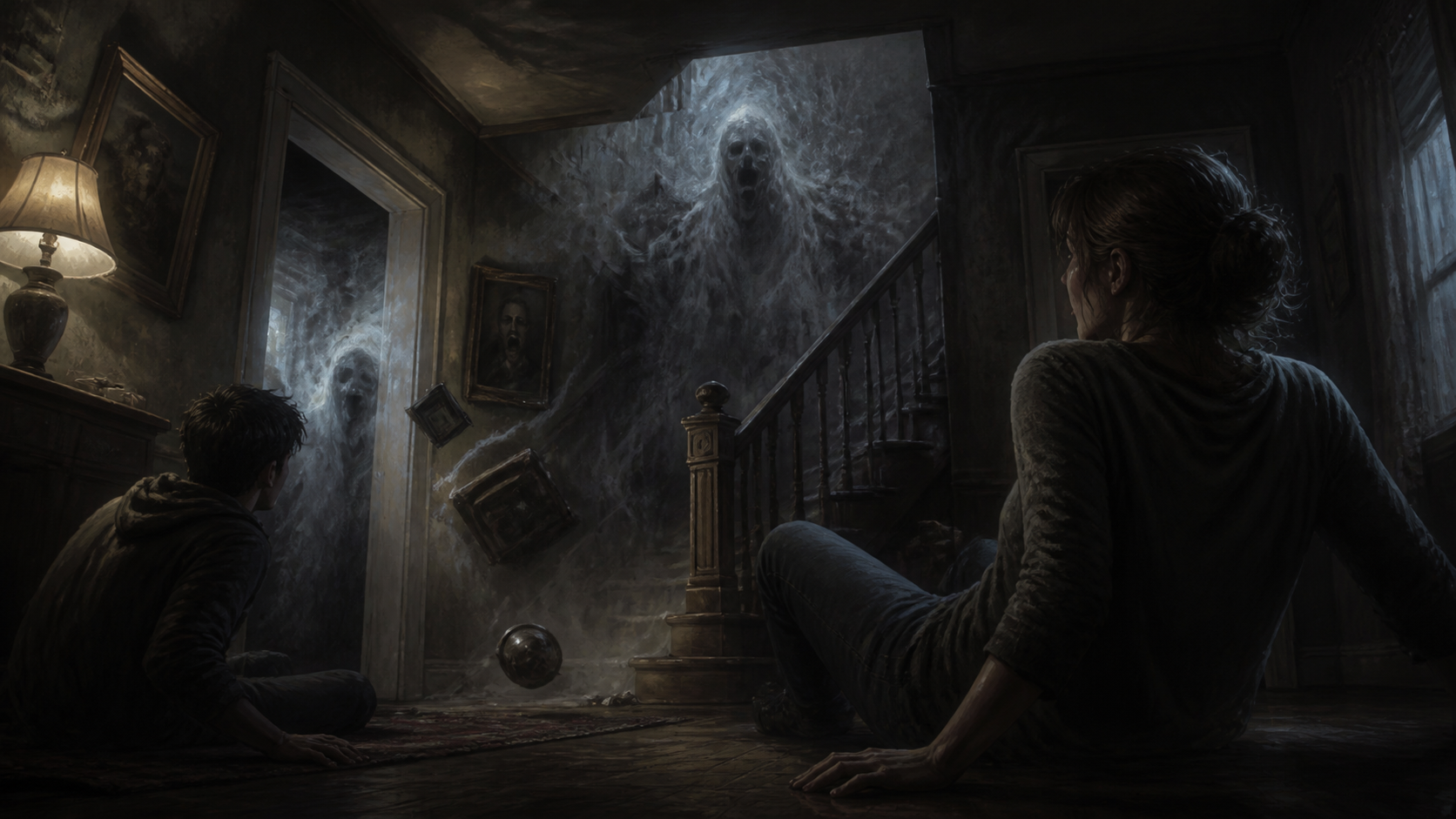
In the glass, reflected between them, stood three children.
They were behind Agnes’s chair, close enough to touch the worn back of it. Two girls and a boy, all in nightclothes the colour of bone, their faces grey in the lamplight. They were not transparent. That was the worst part. They looked solid and exhausted, like children made to stand too long after a church service. The boy had one shoe on and one bare foot. The younger girl held a length of ribbon in one hand. The eldest, perhaps ten or eleven, gazed not at us but down at Agnes’s lap with intense, appraising concentration.
No one spoke. The room had the dense, airless quality of a place where every sound might provoke a worse one. Then the eldest girl reached out and laid her hand on Agnes’s shoulder.
Agnes made a strangled noise and lurched forward. Daniel swore and rushed towards her. The children vanished at once, not fading but simply no longer occupying the space, like furniture removed in a blink. Agnes had collapsed over the side of the chair, one hand clamped over her chest. Daniel caught her before she hit the floor.
Her face had gone the colour of wet paper. “They’ve come back,” she whispered.
Daniel was already dialing for an ambulance, cursing when the signal failed. He hauled her upright and shouted at me to fetch water, then medicine, then anything I could think of. When I reached her with a glass, she grabbed my wrist with astonishing force.
“Don’t let them take another,” she said.
Her eyes were fixed on the empty corner behind the door. I looked there and saw nothing.
The ambulance eventually came, though not before Agnes had recovered enough to spit at the paramedics and refuse hospital. The paramedics, used to stubborn old people, left with the impression she was merely anxious. Daniel told them she’d had a spike in blood pressure. He made a spectacle of competence after they were gone, pacing the hallway and swearing at receptionists, doctors, the entire shoddiness of the world.
That night I was woken by a sound like a child dragging a chair across the floor above my room. It went on and on, a slow scraping that seemed to travel in a circle around my bed. I switched on the light and listened. The sound came from inside the walls, from under the floorboards, from somewhere too close to bear. Then, with a distinct little click, one of the fitted cupboards in my room opened by itself.
Inside, on the bottom shelf where I had left only spare sheets, there was a line of muddy little footprints.
They were not visible in the sense that an adult foot might be, but distinct all the same, damp patches in the dust no bigger than a child’s hand, leading from the back of the cupboard to the edge of the shelf and stopping there as if the thing that made them had climbed down and gone elsewhere.
I did not sleep after that. At dawn I found the print of a small wet palm on the mirror above my basin, even though no one had been in my room. There was a faint smell of pond water, stale and green.
I tried to leave on the excuse of calling in sick. Agnes stopped me at the kitchen door with one bony hand on my arm.
“You can leave if you like,” she said. “But if you do, they’ll keep looking for someone else.”
“Who are ‘they’?” I asked, though I already knew she was not speaking of the living.
She glanced towards the ceiling, as if listening to the upper rooms. “The children this house keeps.”
Daniel overheard that and gave a short humourless laugh. “There aren’t any children.”
Agnes’s stare made him look away. “Not now,” she said.
He left the kitchen with the look of a man escaping a conversation he had spent his life refusing to have.
Later, when Agnes was dozing in her chair and Daniel was out driving into town for more groceries, I cleaned the back stair landing and found a panel in the skirting board that had been recently lifted and nailed back into place badly. Behind it was a shallow space where someone had once hidden things. In the dark cavity I found three small shoes tied together with pink ribbon that had rotted to brown threads, and a tin box with a rusted latch. Inside the tin were baby teeth, a silver thimble, and a lock of hair tied with black thread. There was also a photograph, softened by age, of three children standing in the garden outside the house. The eldest girl stared straight at the camera with the severity of someone already burdened by too much knowledge. The boy beside her had one shoe on and one bare foot, just as I had seen him in the sitting room. The youngest girl had a ribbon at her throat.
On the back of the photograph, in a hand I could not read, someone had written: Keep them indoors when the bell rings.
The bell rang just after six that evening, though I had not heard it ring before and could not tell where it had been. It was a single, clear note like the strike of a small brass handbell. Agnes jerked awake in her chair. Daniel, who had returned, looked around in irritation, then saw our faces.
“What?”
The bell rang again.
This time the children came all at once.
They were not in the hallway first or at the stairhead. They simply were there, in the room with us, standing with their backs to the fire. The youngest girl held her ribbon between both hands, stretching it until the fabric trembled. The eldest looked at Daniel. Her expression was not angry. It was appraising, almost clinical, like a clerk taking stock.
Daniel backed against the mantel. “What the hell is this?”
Agnes was breathing hard. “Don’t answer them.”
The boy lifted his bare foot. There were red marks around his ankle, as if something had been tied there very tightly for a long time.
The eldest girl spoke. Her voice was clear, ordinary, and dreadful because of it. “Who’s keeping us now?”
No one answered. The room seemed to fold inwards. The marbles on the mantel began to rattle against the dish. Daniel made a move towards the door, but the handle was already turning, back and forth, as though someone on the other side were trying to get in and could not decide whether to use force.
Agnes shouted at me, “Lock it.”
I crossed the room and threw the bolt. At once there came a pounding from the other side, not like fists but like several small bodies striking the wood together. Daniel seized the poker and lifted it. The youngest girl tilted her head, studying him with bright, blank curiosity. Then the pounding stopped. Something low and heavy scraped along the floorboards outside the door, not in the hall but under it, as though the house had grown a throat and was swallowing.
The children looked at Agnes.
“You promised,” said the eldest girl.
Agnes’s face had changed. The stern mask she wore for everyone had cracked to reveal something raw beneath it, something close to terror and shame. “I did what I could.”
The boy began to cry without sound. Tears slid down his face and fell in thick drops onto the carpet. Wherever they landed, the fibres darkened, then stiffened, as if soaked in very old water. The scent of the room changed. I smelled mud and river weeds and the bitter, metallic reek of stagnant floodwater.
Then the house itself answered.
From somewhere within the sealed west wing came a crash so violent that dust fell from the ceiling. A second later, one of the boarded doors at the end of the corridor slammed inward with a sound like a coffin lid splitting. Daniel rushed to the window and looked out.
“There’s water,” he said.
“What?”
“Outside. In the courtyard. It’s not raining that hard.”
He meant the gravel yard behind the house, though there had been no courtyard in the house’s original plan. We all heard it then: the slow, sucking sound of water moving where there should have been only stone. Agnes stood unsteadily and said, in a voice made thin by fear, “They’re opening it.”
The west wing door, the one that had been nailed shut for years, bent outwards as if pressed from within by a shoulder no human body could have held. Again and again it struck, and with every blow the sound of water rose louder behind it. Daniel lunged for the door, but Agnes caught his sleeve.
“No. It isn’t for you.”
The eldest child turned to me, and for a moment I understood that she had been waiting to be noticed. “You can still keep them,” she said.
Something moved in the hall outside the sitting room. Not a person. A shape like a child formed from damp darkness and old wallpaper paste, pressing itself flat beneath the crack under the door. Then another. And another. Fingers, too small and many, scratched at the wood.
Daniel dragged Agnes towards the rear exit. I followed, pushing her wheelchair from the alcove where it stood folded. We got her into the kitchen just as the sitting room door burst open. The room behind us filled with a sound like children splashing in deep water.
Through the kitchen window I saw the western wall of the house bulge and split. Black water tore through the boards and into the corridor beyond, carrying with it pieces of plaster, splinters of wood and something pale that struck the floor and rolled once before I understood it was a child’s tooth.
Daniel swore and tried the back door. It would not open. Not locked, but held. The handle twisted under his hand while something on the other side leaned against it with patient force.
Agnes began to laugh. It was a broken, ugly sound. “It’s remembered,” she said. “Of course it has.”
There was no time to ask what she meant. The kitchen window had started to fog from the inside, though the room was already warm. On the glass, tiny damp handprints appeared one after another, as if children were climbing upwards unseen. Beneath them, a line of water ran along the sill and dripped to the floor. The smell from the hall had become unbearable: weed-choked river water, wet wool, human waste, the sweet decay of something that had stayed submerged too long.
I found the iron key for the garden gate in the drawer by instinct more than memory. While Daniel braced the back door with his shoulder, I pulled Agnes towards the pantry and out through the narrow side passage that led to the utility room. We were halfway there when a small figure stepped out of the dark by the coat hooks.
It was the youngest girl, ribbon hanging from her hand. Her face was no longer childlike. It had the smooth, bloated look of a body left too long in water. One eye had clouded white. She reached for Agnes with a gentleness that was almost worse than violence.
Agnes screamed then, the sound stripped of all pride. Daniel swung the poker and struck the figure across the head. The blow landed with a fleshy thud. The girl’s face split at the temple, not bleeding so much as weeping dark river muck. She turned her ruined gaze on Daniel, and something in the room shifted. His mouth opened in a silent gasp. Both hands flew to his face. He staggered back, clawing at his eyes, and when he pulled his hands away, his fingers were streaked with blood.
I got Agnes through the utility room and out into the rain-drenched yard. The gate key slipped twice before it found the lock. Behind us the house shuddered with another impact. A child was screaming now, high and continuous, from somewhere inside the walls. Daniel shouted my name from the kitchen, then cut off abruptly.
Agnes stumbled when we reached the lane. I turned and saw her looking back at the house with a terrible, astonished expression.
The upper windows were alive with movement. Not ghosts drifting behind glass. Small hands against the panes. Faces appearing and vanishing. The west wing, split open by floodwater, seemed full of children standing shoulder to shoulder in dark water up to their waists, all of them looking out as if waiting to be let into the dry world we occupied. Then the front door opened by itself and a figure stepped into the doorway.
At first I thought it was Daniel. Then I saw it was too small, and too stiffly upright. It wore a child’s nightshirt plastered to its body, and its head hung at an angle no living neck could bear. It moved one step onto the threshold, then another, not stumbling but compelled, as if the house behind it were pushing.
Agnes made a sound that was not quite speech. “No,” she said, and now I understood she was not speaking to the thing in the doorway, but to the house itself.
I did the only thing that came to mind. I shoved Agnes down behind the low stone wall by the lane and ran back to the house.
The front hall was full of water up to my ankles and climbing. Something brushed past me in the dark, cold and soft as drowned cloth. I found Daniel in the sitting room, crouched against the wall with his hands over his blinded face, sobbing and gasping. He was alive. That was all I had time to know.
The children stood around him in a rough circle. Some were clear enough to see; others seemed made of mud and reflections. The eldest girl looked at me with dreadful patience.
“You’re not one of ours,” she said.
“No,” I whispered.
She considered that. Behind her, the boy with one shoe lifted his foot and pointed at the ceiling. Water dripped down in a steady rain.
There was a cracked brass bell on the mantel, half hidden behind the marbles. I had not seen it before. I snatched it up, and the moment my fingers touched the cold metal the children all turned their heads together. It was not a clever impulse. It was panic. But the bell was clearly important, and from the way Agnes had reacted to its sound I knew it was part of whatever had bound them here.
The eldest girl’s expression altered. For the first time she looked frightened.
I rang the bell.
The sound was small, clean and fierce. The room seemed to lurch. The children recoiled as if struck. The figure in the doorway, the one that had stepped out of the house, stopped moving and began to shake, not with life but with the effort of resisting some command.
“Out,” I said, though I had no idea whether I was speaking to the children, the house or the water.
The bell rang again in my hand, though I had not struck it twice. The sound jarred through the flooded room and the children broke formation. The boy dissolved first, his outline breaking into running water that soaked into the carpet. The youngest girl opened her mouth in a silent wail and was gone. The eldest remained, staring at me with a look that was almost pity. Then, slowly, she took hold of the child-shaped thing in the doorway and pulled it back across the threshold. The moment they crossed into the hall, the front door slammed shut of its own accord.
The water began to recede at once, not draining so much as withdrawing in visible reluctance. By the time I got back outside, the lane was empty save for Agnes, sitting in the rain with her hair wet against her skull and her face turned towards the house like a woman listening for a verdict.
Daniel never came out. The police found him later, drowned in the flooded west corridor, though there was very little water left by then. They said he must have slipped and hit his head. Agnes gave them her consent to anything they wanted and then refused to speak again. She died two nights later in hospital, her hand clenched so tightly around mine that the nurse had to prise her fingers open after the end.
I did not return to Hollingrove House. The solicitor called to ask about belongings, and I told him to send whatever he thought was mine. The house was declared unsafe after the flood damage, though the contractor who inspected it reportedly refused to work there after spending ten minutes in the west wing. The local paper used words like “tragic” and “family dispute”, as if the place itself had not devoured a man and tried to keep the rest of us too.
Months later, in a second-hand shop in Alnwick, I saw a child’s shoe with a pink ribbon tied round it. It was the sort of thing one might ignore if one had not spent a night in a house where children stood in the corners of rooms waiting to be counted. The ribbon was damp. When I touched it, my fingers came away smelling faintly of river mud.
I left it where it was.
Even now, when I close my eyes, I can feel the shape of that bell in my palm and hear the first clear note it made in the sitting room, as if the house were answering a call it had been waiting to receive for years. What it wanted from Agnes, from Daniel, from me, I never knew in any tidy human sense. Perhaps it wanted children to remain in it because it had once made them stay. Perhaps it simply knew how to keep what was given to it, long after the living forgot the bargain.
I only know that houses remember. And this one remembered children best.

Ghost Stories