At first, the ad looked like a joke.
Imogen saw it while she was waiting for the delayed Victoria line at Seven Sisters, thumb half numb from scrolling and the platform smelling of wet coats and overheated metal. A bright square image, a caption in a cheery sans-serif font:
YOUR CHILDHOOD BEDROOM FOR SALE.
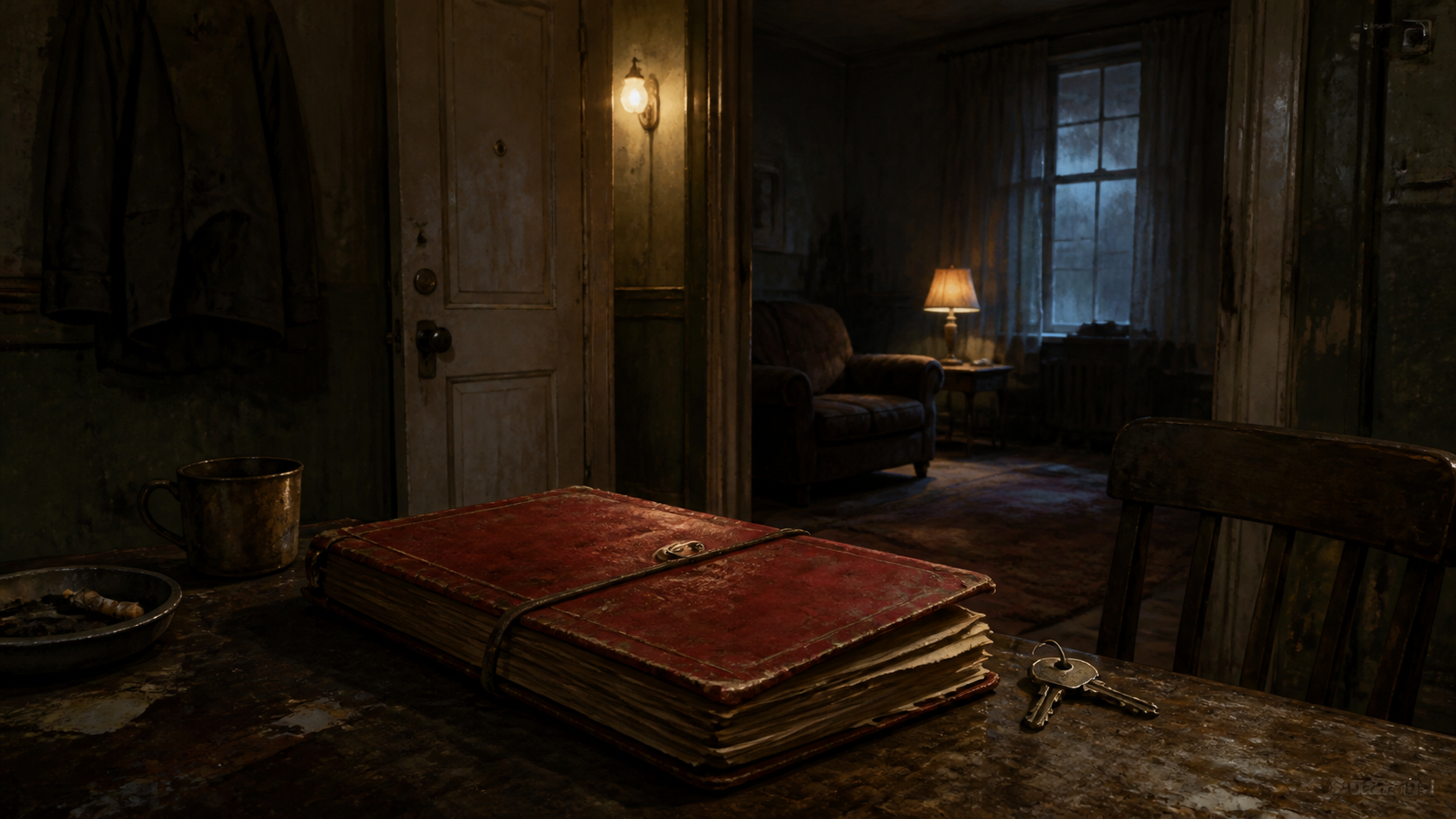
She stopped on it because it was a silly phrase, the sort that hovered between nostalgia and creepiness. The photo underneath showed a small room with a single bed, shelves, a pinboard, pale curtains, and a laminate desk pushed beneath a window. There was a basketball poster on the wall, sun-faded to almost white. A row of books and plastic action figures. A green reading lamp with a bent neck. The kind of room every child had once had and later buried under years of adulthood.
Then she noticed the details.
The duvet was the same blue she’d had at ten. The shelf held her old Goosebumps books in exactly the same order. A chipped Lego X-Wing sat on the desk. On the wall above the bed was the faint square where she had taken down a poster of a girl band because she’d decided, at twelve, that it was babyish.
Imogen felt her mouth go dry.
She zoomed in with her thumb so sharply the image blurred, then sharpened. There was the scratch on the desk leg from when she’d dragged it across the floor to hide a dead spider. There was the crack in the windowsill from the day her brother Ben had slammed it too hard in a tantrum. There was the name she had carved, with childish concentration, into the back of the wardrobe door behind the one open shelf.
Not because she remembered doing it.
Because no one else would know it was there.
The listing text was short.
Compact furnished room in family home, ideal for professional or student. Quiet street, excellent transport links, shared use of kitchen and bathroom. Viewings available from Friday.
Price on application.
Below it, in the comments, people were laughing. One wrote, This is properly cursed. Another: Hope they’re not selling my nan’s room too. Someone else had replied, No honestly, search the seller. Loads of these popping up. They all look like someone’s old bedroom.
Imogen should have closed the app. Instead she tapped the seller profile.
The account name was a random string of letters and numbers. No face, no bio, only a bank account symbol and several listings she recognised instantly and did not want to. A childhood bedroom from Bristol. Another from Leeds. A box room with a bunk bed and a glow-in-the-dark star ceiling, tagged as “single occupancy”. A pink room with pony stickers on the wardrobe. A navy room with football trophies. A room with a bunkbed and a little desk and a ring of pencil marks on the doorframe.
All different. All familiar in the same unbearable way.
Her train arrived. She got on, moved mechanically with the crowd, and stared at her reflection in the black window until Finsbury Park. Then she called her brother.
Ben answered on the third ring. “If this is about Mum’s birthday, I’ve already sent the flowers.”
“It’s not that.”
“Then I’m driving. Which means if the tube’s cancelled again you’re doomed.”
“Do you remember the room at Priory Close?”
There was a pause. “What room?”
“Our room.”
“We had two.”
“You know what I mean.”
Another pause, this one longer. She could hear road noise, his indicator clicking, the radio faint under it. “Ims, why are you asking?”
“Just answer.”
“Yeah. Of course I remember it. Why?”
“Did you ever see the wardrob…”
She stopped. Her own voice sounded foolish in her ear, thin and middle-aged and over-reactive. “Never mind. I’ll call you later.”
“Imogen.”
But she’d hung up.
By the time she got home to her flat in Leyton, she’d convinced herself it was some horrible niche content farm. Photos from estate agents, probably stolen from old family album scans, arranged to look uncanny and sell clicks. The internet was full of tricks that made your skin crawl if you let them. She made tea, did not drink it, and sat at her kitchen table until Ben called back.
He sounded irritated now, as if she had interrupted a meeting. “I asked Mum. She said not to be dramatic.”
“She’s seen it?”
“She saw the screenshot I sent. She says it’s not our room. Says the bed was on the other wall.”
“It wasn’t.”
“Imogen, she’s got a better memory than you think.”
“Then ask her about the wardrobe door.”
He went quiet.
“Ben?”
“I’m not asking her that.”
“Why not?”
“Because she went funny. That’s why.”
Imogen stood up so abruptly the chair legs squealed on the lino. “What do you mean, funny?”
“She said, ‘Don’t go looking.’ Then she told me to stop sending her nonsense and hung up.”
That should have been enough. It was not. The line had already lodged in her mind: Don’t go looking. It sounded less like annoyance than instruction, the kind given to a child standing too close to a road.
“Did you check the seller profile?” she asked.
“Yes.”
“What else is on it?”
“Loads of rooms. It’s weird. Why?”
“Because mine was on there too.”
Ben laughed once, but there was no humour in it. “Your what?”
“My room.”
“You’ve lost your mind.”
“I’m serious.”
He exhaled sharply. “Listen, I’ve got a job thing. Send me the link and I’ll look at it properly later. Don’t spiral.”
“It’s already too late for that.”
She ended the call before he could answer.
Imogen lived alone in a one-bedroom flat above a barber’s that stayed open too late and blasted music through the floorboards. She worked from home for a local housing charity, mostly writing reports and answering complaints about mould, damp and illegal subletting. She had spent enough of her life in grim buildings to know the difference between ordinary neglect and something else. By midnight she was still awake, laptop on her knees, watching the listings get reposted and shared in local Facebook groups, then disappear, then reappear elsewhere under different names.
By morning there were dozens.
Not all of childhood bedrooms, exactly. Some were clearly too stylised, too staged. But enough were real to disturb. One in Hackney showed a bedspread with the same cartoon rockets Imogen had once had. A room in Peckham had the exact orange wall sticker of a cat climbing shelves that she remembered from her friend Shazia’s bedroom. A room in Birmingham had a stain in the carpet in the same shape, eerily, as a spilled bottle of nail varnish her cousin had ruined with one summer afternoon.
The comments divided between mockery and panic.
This is a fetish thing.
Got to be AI now, surely.
Why’s my old address in one of these?
Anyone know a solicitor who handles data theft?
The one that mattered came at 8:13 a.m. from a user called @kieronstaples.
My sister says don’t contact the seller. They’ll know you remember. I thought she was joking. Then I saw mine. The room with the blue wallpaper and the crack in the ceiling. It was mine. If you get a message from them, do not answer. They can only sell what you look at twice.
Imogen read it six times.
She clicked on the profile. It had already been deleted.
At 10:27, her phone rang from an unknown number.
She didn’t answer.
It rang again. And again. On the fourth call, she put it on speaker and let it go to voicemail.
A woman’s voice said, softly and in an oddly breathless cadence, “We can keep the room as it was, if you like.”
The message ended.
Imogen did not move for a while. Then she called Ben.
He answered after a minute. “I’m in a meeting.”
“You need to listen.”
“No, I need you to calm down. I sent the link to a mate at work. He said it’s probably a scrapersite pulling old estate agent photos.”
“Then why did they leave me a voicemail?”
“What voicemail?”
She read it out.
Ben was silent. In the background she heard a keyboard, then the muffled sound of someone saying his name. When he spoke again his voice had changed, thinner around the edges. “Did you say anything to it?”
“No.”
“Had you looked at it twice?”
She closed her eyes. “Yes.”
His breath made a harsh noise in her ear. “Right. Fine. Great. I’m coming over after work.”
“You don’t sound fine.”
“I’m not fine. Just, for Christ’s sake, don’t open any more messages from them.”
“Them?”
“I’ve got to go.”
He hung up.
For the rest of the day, Imogen found herself glancing at her phone as if it had started to twitch. She shut off notifications, checked under the radiator, and was ashamed of herself for doing it. In the afternoon she forced herself out to buy milk and a packet of paracetamol, though she did not need either. On the High Road, she noticed a woman standing by the station entrance with a sandwich board that read:
WANTED: ROOMS FOR RENT. FAIR CASH. NO QUESTIONS.
The woman was middle-aged, wrapped in a long dark coat despite the mild weather, face pale and expressionless. Not a single leaflet or card visible. Just the board and a thermos at her feet. Imogen slowed, because the wording looked too much like the listings and because the woman’s eyes were fixed on her with a familiarity that felt indecent.
“Looking for a place?” the woman asked.
Imogen said nothing and walked on. Behind her, after a pause, she heard the woman call, not loudly but clearly enough to carry in the street noise: “If it’s yours, it’ll still fit.”
That night, someone let themselves into the flat upstairs and began moving furniture around at 2 a.m. The barber’s shutter rattled from a gust of wind. Imogen lay rigid in bed, listening, until the sounds stopped and the building settled.
Then her phone lit up on the bedside table.
A new listing.
Room available in former family home, north London. Recently vacated. All original features.
The photo showed her childhood bedroom.
Not the one from the ad exactly, but the room as she had last seen it when her father sold the house three years after her mother died. Same wallpaper. Same window. Same bedframe, though stripped now and made to look more neutral. The only difference was the wardrobe door, ajar in the photograph, revealing the back panel where her carved name had once been.
There, in fresh white paint, someone had covered it over. Beneath the paint, the outline of the letters still shone through like a bruise.
A message appeared beneath the image.
YOU HAVEN’T LOOKED AT ALL OF IT.
Imogen dropped the phone.
She slept in the living room that night with the lamp on. At half past three, she woke with the sense of someone standing close to her face. The room was dark but not quite dark enough. On the television screen, turned off, her own reflection seemed to have shifted away from her body. She sat up, heart hammering.
The wardrobe from her bedroom stood in the corner.
Not a wardrobe-shaped shadow. The actual wardrobe, tall and chipped and painted cream, with the brass handle missing from the lower door.
She screamed once, loud and short, and the wardrobe door jerked open.
Inside was the narrow cavity of hanging space, but it looked deeper than it should, the back receding into a dark that swallowed the lamp’s reach. Her old school jumper hung from a single broken hook. Beneath it, on the floorboards, were little things laid neatly side by side.
A conker. A blue marble. A plastic dolphin with one eye missing. The tiny silver bracelet her nan had given her on her eighth birthday, the one lost after a summer by the canal. Her front tooth in a folded square of tissue, fossil yellow. The key to the diary she’d hidden under the mattress. A burnt match. The penny her mother had glued into the lining of her coat when she was worried she’d lost it for good.
Imogen stared, unable to breathe.
Then something shifted at the back of the wardrobe and a hand pushed through the darkness.
Not the whole hand, at first. Just the fingers, curled as if feeling for the edge of the world. Pale. Child-sized. A little dirty beneath the nails.
It withdrew before she could move.
She scrambled backwards so hard she struck the coffee table and nearly tipped it over. The wardrobe door stayed open.
From inside came a small voice, not a child’s exactly, but made to sound like one. “You left me in here.”
She fled the flat in her socks and ran three streets before she stopped, bent double in the rain, gasping like an idiot on a front path.
The neighbour who answered her knocking was an elderly Nigerian man named Mr Adeyemi, who wore a fleece and a puzzled expression. He let her in without question when he saw her face. She sat at his kitchen table while he made tea and listened without interrupting, which only made her feel worse.
When she finished, he was quiet for a moment. Then he asked, “Did your family ever move a bedroom without moving the room?”
She gave him a flat stare. “No.”
He nodded as if that confirmed something. “My wife knew about this sort of thing. She said houses keep what children lose. Especially if the child was unhappy.”
Imogen laughed shakily. “That is not reassuring.”
“It was not meant to be.”
He asked her which house. When she told him Priory Close in Tottenham, his face changed.
“I know that road.”
“It’s just a normal road.”
“It is now. But thirty years ago there was a row of terraces there with attic conversions. One burned down in the nineties. The council rebuilt. The old layout was never quite right after that.”
“My house wasn’t burned down.”
“Perhaps not yours exactly.”
He saw her expression and held up a hand. “I know how this sounds. But there is a reason people say not to take things you find in someone else’s house. Sometimes the house decides what it is owed.”
She should have left then. Instead she asked, “How do I stop it?”
He looked unhappy. “What did it ask for?”
“It didn’t ask.”
“That is worse.”
Imogen slept on his sofa for an hour and woke to his wife’s scarf draped over the back of the chair, though he had said she was visiting her daughter in Leeds. He gave her paper and pen and told her to write down every item she had seen in the wardrobe. When she finished, he frowned at the list.
“There is one thing missing,” he said.
“What?”
“You said your mother gave you a penny sewn into a coat. What about the room itself? Did you ever hide something there that no one knew?”
She thought of the back of the wardrobe door. The carved letters. Not a secret exactly, but private enough to matter.
Then she remembered the strip of carpet under the bed, where she had once tucked a photograph of herself at seven, angry and crying, because her father had laughed at her during a family meal and she had wanted to erase the feeling by burying it somewhere impossible. She’d forgotten the picture entirely.
“No,” she said automatically. “I don’t think so.”
Mr Adeyemi watched her carefully. “Think harder.”
And there it was, the room in memory opening like a hand.
The photograph. The one thing her mother had never seen.
“Under the bed,” she whispered.
He nodded once. “Then you must retrieve it.”
Imogen stared at him. “From the wardrobe?”
“From where it is now.”
She almost said no. Then her phone, sitting on the table between them, lit up by itself.
A new message from an unknown number.
WE HAVE THE ROOM. DO YOU WANT YOURS BACK?
Beneath it was a photograph.
Her bedroom, shot from the doorway, but altered in a way her mind refused at first to understand. The walls had been widened. The bed stretched larger than any single room allowed. The window showed a sky she knew was not the one over Leyton. At the far end, where the wardrobe should have been, there was only a deep opening into darkness.
Standing at the edge of it was a child.
Imogen nearly dropped the phone.
The child had her hair, her eyes, the same small cowlick at the crown. But the face was too still, as if copied by someone who had only once seen a human being through glass. In its right hand, it held a folded photograph.
Underneath the image the message continued:
COME AND COLLECT WHAT YOU LEFT.
She did not remember leaving the flat after that. One moment she was in Mr Adeyemi’s kitchen, hands cold around a mug she was no longer drinking from. The next she was on the night bus north with a rucksack slung over one shoulder and a kitchen knife in the side pocket, because he had insisted she take it though neither of them had believed it would help.
The bus was nearly empty. Two teenagers at the back, a man asleep with his mouth open, a nurse in scrubs rubbing her eyes. London slid past in rain-slick pieces. Imogen sat rigidly in her seat, watching her own reflection tremble in the glass. Every few minutes she felt the pocket where she had put the old house key from Priory Close, the one her father had handed back to her after the sale with a shrug and a joke about sentimental rubbish. It had no obvious use now. It felt unbearably heavy.
At the stop near the old estate, she got off into damp cold and streetlight glare. The terraced houses were here, though changed, the fronts refaced and the windows replaced. Priory Close itself had been partly demolished and rebuilt into a row of narrow modern homes with black cladding and tiny front gardens no wider than doorsteps. But the old shape remained in the street plan if you knew how to look for it. The far end, where the Victorian terrace had once stood before a fire, was now a blank patch behind hoardings.
Her childhood home was the third house from the corner.
A faint light showed upstairs.
Imogen stood at the gate longer than she intended. The house looked wrong in a way not caused by paint or new windows. It seemed to be remembering another form beneath the present one, a more tired and solid version, as if the building’s skin were stretched over something older and inward-facing.
When she stepped onto the path, the key in her pocket grew warm.
The front door was unlocked.
Inside, the hallway smelled of damp plaster and something faintly sweet, like old cardboard left in a closed loft. The house was too quiet. No television, no fridge hum, no human movement at all. Yet she knew, with the certainty of a migraine beginning, that she was expected.
The living room had been stripped of furniture. Wallpaper peeled in strips from the walls. On the floor lay boxes of clothes, some labelled in Ben’s handwriting and some in her own mother’s, though the date written on one was from two years after her mother died. A half-packed mug rested on the mantelpiece as if someone had set it down and been called away.
Upstairs, the landing carpet was the same thin brown one she remembered, though the pattern beneath the wear looked fresher in places, as if new under old. Her bedroom door stood open.
“Hello?” she called, and hated how much she sounded like a child.
No answer. But from the room came the soft scrape of something moving over wood.
She edged forward and pushed the door wider.
Her childhood bedroom had been recreated with sickening accuracy. Not simply furnished, but returned. The books on the shelf. The green lamp. The cracked windowsill. The walls still marked with pinholes from posters long gone. She could almost have believed she was twelve again, if not for the horrible precision of the details. On the bed lay the folded duvet, untouched.
And the wardrobe stood open.
The cavity inside was no longer small. It opened into a depth that made the room feel suddenly mis-sized, as though the walls had widened by an inch in every direction to make room for it. The air coming from within smelled of dust, fabric, and a weak medicinal odour she couldn’t place.
There was a child sitting inside.
It wore her old yellow pyjamas with the stitched rabbits on the knees. The feet were bare and muddy. Its hair was too long and tangled. It was bent over something in its lap, head down, as if concentrating on a task. When it heard her, it looked up.
The face was her face at seven, but altered by something that had been waiting too long. The eyes were too deep-set. The mouth too narrow. The skin had the waxy pallor of a photograph left in the sun.
“You came back,” it said.
Imogen could not move.
The child tipped its head. “You forgot where I was.”
“I didn’t.”
“Yes, you did.”
It held up the folded photograph. Imogen saw, with a rush of revulsion, that it was the one she had hidden under the bed. The one of herself crying at seven, cheeks red, fist clenched, humiliation still raw on her face.
“I wanted to keep it,” the child said. “You left it with me.”
“I didn’t leave you.”
The thing smiled, and it was not a child’s smile at all. “You did when you grew up.”
A movement behind her made her whirl. In the doorway stood another figure, a man in a dark coat with his head slightly bowed. His face was obscured by shadow, but she recognised the shoes at once. Her father’s brown brogues, the ones he wore to weddings and funerals and never polished properly.
“Dad?” she said, before the impossible registered.
The figure lifted its head.
The face was her father’s and not his. Older than when he had died, the cheeks hollowed, the eyes filmed over with a patient blankness. One side of the mouth seemed stitched by habit rather than scar. He carried a cardboard storage box in both hands.
“Don’t frighten her,” he said mildly, and his voice was exactly his voice, down to the dry humour that used to irritate her. “She’s only trying to sort things out.”
Imogen backed away until the bedframe hit the backs of her knees.
“What is this?”
Her father looked past her at the child in the wardrobe. “A misunderstanding, mostly. A poor arrangement. Your mother never liked to talk about it.”
“Don’t lie,” said the child.
He smiled, almost apologetically. “I’m not lying. I’m simplifying.”
The kitchen knife in Imogen’s bag suddenly felt ridiculous. She thought of the comments online, the rumours, the warnings: don’t look twice, don’t answer, don’t go back, don’t let it know you remember. All those flat internet sentences, and none of them had prepared her for the terrible domesticity of this. The tidy room. The familiar voice. The smell of old carpet. A family dispute carried forward into something unclean and patient.
“What do you want?” she asked.
The child in the wardrobe folded the photograph carefully and put it to one side. “Everything that was left behind.”
Her father sighed. “That is not an answer. You make it sound greedy.”
“We are greedy,” said the child.
Imogen’s eyes moved to the storage box in her father’s arms. Through the open flaps she saw objects packed around folded clothes. A school report. A broken hair clip. A conker. The silver bracelet. A packet of Polaroids. Her mother’s wedding ring, which had gone missing before the funeral. The box looked endless. It contained more than its dimensions could possibly allow.
“You’ve been taking things,” she said.
“Keeping them safe,” he corrected.
“From what?”
“From being forgotten.”
It was then she understood, not cleanly, but enough to feel sick. Not every lost object in the world. Only the objects of a childhood, the pieces attached to a house and to the versions of herself that had lived there. Trinkets, scraps, private humiliations, proof of having been small and helpless and unobserved. The things people mislay and stop searching for because adulthood requires letting them go.
The room had made a collection of them. Or something in the room had.
“No,” she whispered, though she did not yet know what she refused.
Her father stepped closer. “You’ve been unhappy for years, love. I know you don’t like hearing it, but you have. That’s the trouble with rooms. They remember the shape of unhappiness longer than people do. They keep it. When the house was sold, it didn’t leave everything behind.”
“You’re not him.”
A pause. “No,” he said. “Not entirely.”
The child in the wardrobe began to laugh. It was a small laugh, almost pleased. “He said that after Mum died.”
Imogen felt the floor tilt a fraction beneath her. “What?”
Her father glanced at the child with annoyance, as if scolded by a badly behaved relative. “We do not need to re-open all of that.”
“What did you do?”
The room seemed to tighten around the question. The lamp on the desk flickered. Outside, somewhere beyond the wall, a car passed with a hiss of tyres on wet road. The child stared at her with enormous, unblinking eyes.
Her father set the storage box carefully on the bed.
“When your mother was ill,” he said, “the house began to behave oddly. You were small, Ben was in and out, and she was too tired to notice much. Things that went missing did not always stay missing. Once, she found your brother’s school shirt hanging in the airing cupboard six months after we’d donated it. She became very upset when she saw your old drawings in the loft in a box she’d never packed.”
Imogen said nothing. The room was too still.
“She thought it was grief,” he continued. “Or stress. But it was the house, in the end. It was always the house. The rooms take the shape of the people in them. If a child feels abandoned enough, if they leave enough of themselves behind, the room learns the rest.”
He looked at the child then, almost tenderly.
“She started sleeping in here,” he said. “Your mother. Just an hour at first. Then longer. It helped, she said. She’d wake feeling less thin. Less forgotten.”
The child’s face twisted. “She lied.”
“Perhaps.”
Imogen swallowed. “What happened to her?”
The answer came from the child. “She took too much back.”
Her father’s shoulders sagged. “The room doesn’t like theft.”
Imogen shook her head, trying to anchor herself in the ordinary. “This is insane.”
“Yes,” he said. “But only after we made it so.”
Then he reached into the storage box and took out a small key ring.
Imogen knew it instantly. The spare key to her bedroom drawer. The one her mother had hidden and later told her was lost. Its metal had gone green with age. Dangling from it was a paper tag in her mother’s neat handwriting:
IMOGEN, AGE 7
Her vision blurred. “That’s not possible.”
“No,” said the child, and in its voice now there was something older than mockery. “But it is mine.”
It sprang from the wardrobe with astonishing speed. Imogen recoiled too late. Cold hands seized her wrist and dragged her towards the open cavity. She hit the edge of the wardrobe hard enough to jar her teeth. The inside was no longer empty space. There were walls within walls, room after room repeating at a slight angle like reflections off a cracked mirror. Her own bedroom stretched away in impossible perspective, each version dimmer than the last. In one, she could see herself standing at the door. In another, a younger version of her crouched under the bed. In another, a bed neatly made, as if the room had been unoccupied for years.
Hands pulled from the dark. Small hands, then larger ones, then dozens of hands in mixed sizes and ages, all reaching through the hanging clothes, through the back panel, through the places where the room had not quite ended.
Imogen screamed and kicked. Her heel struck the wardrobe frame. Something cracked.
Her father lunged. For a moment she thought he was coming to help her, but his face had gone blank with urgency. “No,” he shouted, not to her but to the child. “Not her. Not yet.”
The child looked at him with sudden hatred. “You promised.”
“I promised later.”
It turned, and in that movement Imogen saw the true shape of it, the skin of a child over something that had grown patient and communal, assembled from remembering itself too long. A face made from a daughter’s face, a son’s face, a mother’s mouth, the line of a grandfather’s brow. As if the room had learned personhood by borrowing from everyone who had once slept in it.
Her fingers closed around the bedroom key in her pocket. She had no idea why she did it, only that her hand found it as instinctively as breath. The key was warm, almost hot.
The child saw.
Its expression changed to alarm, then to hunger.
“Don’t,” it said.
Imogen jammed the key into the lock on her old desk drawer. She had not even noticed the lock before, only the familiar shape of it beneath decades of paint. The key fit with a smoothness that made her stomach lurch. She turned it.
The drawer sprang open.
Inside lay a stack of schoolbooks, two pens, old sweet wrappers, and the photograph she had hidden under the bed, but now flattened and dried as if it had been there for years. Beneath it, folded into thirds, was a sheet of notebook paper in her own childish handwriting.
She snatched it and read in the room’s filthy light.
IF YOU ARE ME, DON’T LET HIM KEEP THE ROOM.
Below it, in smaller writing added later and shakier, were four words.
HE MOVES IN IT.
Imogen’s head came up. Her father stood frozen, one hand outstretched, his face altered by recognition.
The child made a low, wounded sound. “She found it.”
The room shuddered.
In the wardrobe, the reaching hands withdrew all at once, as if tugged from the other side. The dark behind them deepened. A draft rolled through the bedroom carrying the smell of mildew and old rain. The walls emitted a faint creak, not unlike a house settling after heavy footsteps.
Her father whispered, “No.”
Imogen looked from him to the child and back to the note in her hand. Something clicked into place with brutal clarity. Not all at once, but enough. Her father had not simply died and returned. He had stayed with the room. Or the room had kept a version of him. Whenever the house changed hands, whenever it was listed, whenever someone looked twice, the room offered itself again. It sold a version of childhood because childhood itself was the bait. It called to the people who had once belonged there, and when they came, it took a little more of them. Enough to keep the room furnished.
The child smiled at her, and for the first time she saw terror in it. “He tells stories,” it said. “He makes people stay.”
Imogen looked at her father. “You’ve been selling this.”
He said nothing.
“You put it online.”
He shut his eyes briefly, like a man in a chair avoiding a sermon.
“That’s where he learned,” the child said. “From buyers.”
The room jolted as if something heavy had struck the house from the outside. Dust drifted from the ceiling.
Imogen didn’t wait for explanation. She grabbed the note, the old photograph, and the key ring from the bed where it had fallen. Then she ran for the wardrobe and yanked the door open as hard as she could. The dark inside surged towards her like water.
A hand caught her ankle. She kicked blindly and felt bone or wood or something else give beneath her heel. There was a shriek, high and wet, and her leg came free.
She lunged into the wardrobe on instinct, half stumbling, half diving, and found herself not in wood and fabric but in a narrow corridor of rooms stitched end to end. Doors on both sides. Old carpets. Familiar wallpapers in different patterns. The houses of childhood arranged like a throat.
Behind her, the bedroom shrank to a rectangle of light. Her father was standing there, face slack with fury and fear. The child was already half gone into shadow, reaching after her.
Then the room behind him folded.
Not metaphorically. The wall buckled inward, the ceiling dropped a hand’s breadth, and the doorway narrowed as if a giant palm were pressing the house flat. Her father turned, too late, and his body jerked as though snared by invisible hooks.
He shouted once, and Imogen had never heard such raw panic in him. Not in all the years of his careful irritation and procedural grief. He reached for the bed, for the box, for the edge of the room, but the room had taken hold of him.
And then, with a sound like canvas tearing wetly, he was dragged backwards into the wardrobe darkness.
The bedroom vanished.
Imogen fell hard onto a floorboards that were not hers. She slid on her side, hit a wall, and lay gasping in a dark cramped space smelling of dust and old paint. Around her were ordinary things. A coat rack. A shoebox. A broken umbrella. She had come out, somehow, into a narrow cupboard under someone else’s stairs.
Above her, footsteps began.
Rapid. Multiple. Not one person but several, moving with purpose through the house overhead. A door opened. A woman’s voice called, “Hello?” Then, more sharply, “Who’s there?”
Imogen staggered to her feet and pushed the cupboard door open.
She stood in the hallway of a new-build home on a different road entirely. Bright white walls. Grey carpet. A family photo on the side table. The front door stood ajar, as if she had been expected to come through it. In the living room, the television was on with the sound muted. On the screen was the listing photo she had first seen.
Her childhood bedroom.
The couch across from the television was occupied by a teenage girl, perhaps seventeen, with dark hair tied in a sloppy knot. She was staring at her phone, face blank with horror. When she looked up and saw Imogen, she screamed.
“Get out,” Imogen said, though she had no idea why.
The girl’s mother appeared in the doorway, took one look at Imogen, and went white.
On the television, the bedroom listing refreshed by itself.
The photo changed.
Now it showed the current house’s upstairs landing.
And at the end of the hall behind Imogen, where there had been a blank wall a moment before, a door handle slowly began to turn.
Imogen did not wait to see what opened it. She grabbed the girl by the sleeve, shoved the mother aside in a daze of motion, and ran for the front door. Behind them came a low, furious sound from inside the walls, like several voices speaking at once through a blocked drain.
They spilled out onto the street, the three of them half dressed, shoeless, crying. Neighbours opened curtains. Someone shouted. A man across the road began filming. Imogen kept running until her lungs burned and the houses blurred.
Only then did she stop.
She was in a cul-de-sac she didn’t recognise, under a sodium lamp that made everything look jaundiced. The key ring was still in her hand. One key had snapped off cleanly in the lock of the last house, and she could not remember which lock it had been.
The teenage girl bent over, panting. “What the hell was that?”
Imogen looked back.
The house they had come from was dark. No sound. No open door. Just a perfectly ordinary front elevation in a row of perfectly ordinary homes.
Then the upstairs window lit briefly.
A silhouette stood there, one child-sized, one adult.
The adult raised a hand.
Imogen flinched, but the figure did not wave. It pressed a palm flat against the glass, and beside it the smaller hand mirrored the gesture, fingers splayed like a child trying to match a grown-up.
Then all the lights in the street flickered.
When they steadied, the window was empty.
The mother was crying into her hands. The teenage girl kept saying, “Mum, who was that man? Mum, who was that man?” over and over, as though repetition might make the question answer itself.
Imogen did not answer. She was staring at the key ring.
There was only one key left on it now, the old bedroom key, and attached to the brass ring was a small paper tag she had never seen before. In her mother’s handwriting, precise and slight, it said:
FOR THE NEXT BUYER.
Imogen felt something cold spread through her chest.
A car slowed at the end of the street. For a second its headlights swept over them, and she saw, in the windscreen’s reflection, rows upon rows of lit windows where there should have been only darkness. Not one street. Many. All at once. A city of houses overlapping like memories.
The car passed on.
The teenage girl sobbed. The mother stared numbly at Imogen, then at the key in her hand. “What did you bring here?” she whispered.
Imogen looked down at the tag, at her mother’s hand still visible in the ink, at the neat certainty of the words.
Then she heard, very faintly, the sound of a listing notification from somewhere nearby.
Not her phone.
The mother’s.
The teenager’s.
Then every phone on the street, one after another, lighting up in pockets and hands and through kitchen windows.
Imogen looked at the dark houses all around them.
And, from somewhere very close, perhaps from the wall behind her, perhaps from inside the nearest upstairs room, a child’s voice said in a perfect imitation of her own:
“Show me what I was.”
Imogen closed her fist around the key until the metal bit into her palm, and this time she ran back towards the house.