The Weeping Portrait
In the quaint village of Eldershire, nestled between rolling hills and thick woodlands, there lay an old manor that had long since fallen into disrepair. Ravenscroft Hall, with its ivy-clad stone walls and cracked windows, stood as a silent witness to decades of neglect. Villagers often spoke in hushed tones about the manor’s last resident, Lady Evangeline Ravenscroft, whose tragic story had woven itself into the very fabric of Eldershire’s folklore.
Lady Evangeline was a beauty of her time, celebrated for her grace and intelligence, but she was also notorious for her penchant for solitude. After the untimely death of her beloved husband, Lord Asher Ravenscroft, she retreated from society, locking herself away within the manor’s gloomy confines. Many claimed to hear her weeping echoing through the halls during long winter nights, a mournful sound that sent shivers down the spines of those brave enough to live nearby. The townsfolk speculated endlessly about the cause of her sorrow; some believed it was heartbreak over her lost love, while others insisted that it was the burden of a dark secret.
Years passed, and as time eroded the once-grand estate, the legend of Lady Evangeline grew stronger. After her death, the locals swore that her spirit lingered in the manor, forever bound to the world of the living. It was said that those who ventured inside would catch sight of a ghostly figure draped in a flowing white gown, her face obscured by cascading curls, as she wandered the halls with tear-streaked cheeks. Whispers of encounters with the Weeping Portrait began to stir curiosity in the hearts of the adventurers and thrill-seekers that occasionally visited Eldershire.
One overcast afternoon, a young artist named Thomas decided to explore the manor. The stories had both intrigued and haunted him since childhood, and he saw the decayed grandeur of Ravenscroft Hall as a source of inspiration for his next masterpiece. He packed his canvas, brushes, and paints, and set off with excitement mingled with a hint of trepidation. As he approached the manor, the wind howled through the broken windows, creating a symphony of eerie whispers that danced in the air.
Crossing the threshold of the ancient wooden door, Thomas stepped into a world suspended in time. Dust motes floated lazily in the dim light that filtered through stained-glass windows, casting kaleidoscopic patterns on the floor. As he moved deeper inside, the air turned colder, and the oppressive silence wrapped around him like a shroud. He explored room after room—each ornate but tattered, filled with remnants of grandeur—until he stumbled upon a grand salon, its intricate mouldings barely visible beneath layers of grime.
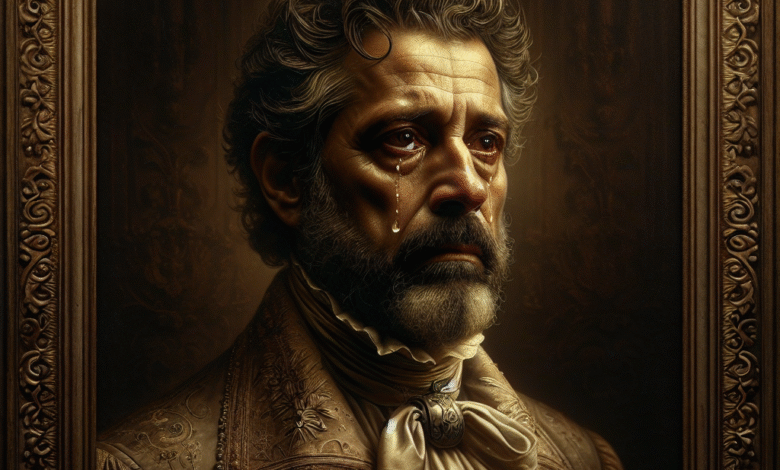
In the centre of the room hung a portrait of a woman, her expression both tragic and hauntingly beautiful. The artist instinctively felt drawn to her. Lady Evangeline’s emerald eyes seemed to follow him, a glimmer of life trapped within the painted canvas. Her tear-stained cheeks and sorrowful smile sent a chill down his spine. Though the portrait was faded, he could see the depth of emotion captured within it.
Thomas decided that this would be the heart of his new painting. He set up his easel and began to recreate the ghostly image of Lady Evangeline. Hours slipped by as he lost himself in the process, painting not just the likeness of the woman but also trying to encapsulate the tragic aura that enveloped her. As the shadows lengthened, the sun dipped below the horizon, and darkness began to seep into the room.
It was then that he first heard it—the sound of soft weeping echoing through the halls. He paused, brushes poised above his canvas, straining to discern the source of the sound. The chilling sensation of being watched enveloped him. Swallowing hard, he reminded himself of the legends; surely it was just the wind playing tricks. Yet, the sound persisted, growing louder and more distinct. It was as if the very walls of Ravenscroft Hall were lamenting their lost mistress.
Determined to uncover the truth, Thomas rose from his stool, reluctantly leaving his painting behind. Following the sound, he wandered through the shadowy corridors, the artistry of the manor revealing itself bit by bit—the once-beautiful chandeliers now dangling precariously, dust-laden furniture draped with white sheets. The weeping led him to a dimly lit chamber, where a fireplace sat cold, its mantle adorned with faded trinkets of a life once lived.
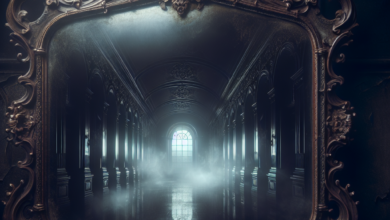
In the corner stood an old, full-length mirror, its surface marred by age. Drawing closer, Thomas’s heart raced; the weeping intensified. It came from behind the glass, a sorrowful, yearning cry that tugged at his very soul. He reached out tentatively, pressing his palm against the cool surface. The reflection shimmered, and for a fleeting moment, he saw her—a glimpse of Lady Evangeline, her eyes filled with an unfathomable sadness.
“Help me,” she seemed to whisper, her voice a fragile echo. As the words hung in the air, Thomas stumbled back, his pulse racing. Was this a trick of the mind, or had he truly encountered the spirit of the legendary lady?
He shook his head, attempting to dispel the growing unease and retreated to the salon to gather his thoughts. The portrait hung silently, but now it felt different, more alive. He picked up his brush and tried to focus, but every stroke seemed heavier than the last. Lady Evangeline’s expression morphed under his gaze, her sorrow transforming into a desperate plea. The artist could feel her pain in the pit of his stomach, a slow burning that was both captivating and terrifying.
Determined to finish the painting, he worked into the night, the sounds of the manor becoming a haunting melody in the background. But as he painted, shadows flickered in the corners of his vision, and whispers drifted through the air like smoke. Each stroke felt as if it was pulling him deeper into the legend, binding him to the spirit of Lady Evangeline.
Suddenly, the room temperature plunged, and a gust of wind swept through, extinguishing the flickering candlelight. Thomas stumbled back, heart racing, as the whispers crescendoed into a cacophony of despair. The portrait’s eyes glowed with an ethereal light, emanating an intensity that wrapped around him, grounding his resolve.
“Why do you weep?” he called out into the darkness, his voice trembling. The weeping stopped, and an otherworldly quiet settled over the room. Yet, in that silence, he felt her sorrow as a tangible force, a history of longing and loss.
“I cannot leave,” her voice echoed in his mind, clearer than ever. “Bound to the sorrow of my secrets, I am trapped within these walls. The love I lost, the choice I made…”
In the grip of fear and fascination, Thomas realised he had uncovered more than he bargained for. He had unearthed not only her grief but the dark truth that had tethered Lady Evangeline to Ravenscroft Hall. With each passing moment, he felt compelled to help her, to learn the truth behind her tears.
As dawn broke, casting pale light through the dusty windows, he returned to the portrait and began to paint anew. This time, he infused her image with strength, with resilience. He poured every bit of emotion into the canvas, transforming her sorrow into a symbol of hope.
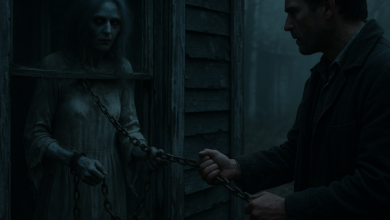
“Release me,” she whispered again, but now the tone was different—urgent yet softened, as if she could feel her spirit beginning to lighten. With every stroke, he could sense the weight lifting, the chains of despair slowly unbinding her ethereal form.
As he painted the final stroke—a glimmer of light in her eyes—everything grew still. The room pulsed with an energy he could scarcely comprehend. In that moment, Thomas witnessed the spell of sorrow breaking as a brilliant light enveloped the portrait, illuminating the room. The weeping faded into a melodious harmony, a sigh of relief escaping the walls of Ravenscroft Hall.
In the years that followed, the villagers of Eldershire reported seeing a flickering light emanating from within the manor on calm nights. Instead of whispers of despair, tales of a radiant figure dancing amidst the shadows now replaced the chilling stories of the past.
Though Ravenscroft Hall remained abandoned as ever, the legacy of Lady Evangeline transformed from one of sorrow to a powerful reminder of hope and redemption. The Weeping Portrait became a symbol of love unbound, of a spirit finally free to embrace the skies. And Thomas, inspired by the experience, found a renewed sense of purpose as he painted, forever changed by the lady who had once wept within the walls of the manor. As he embarked on his journey as an artist, he carried with him the tales of Eldershire—the beauty of love, the weight of sorrow, and the strength found in letting go.