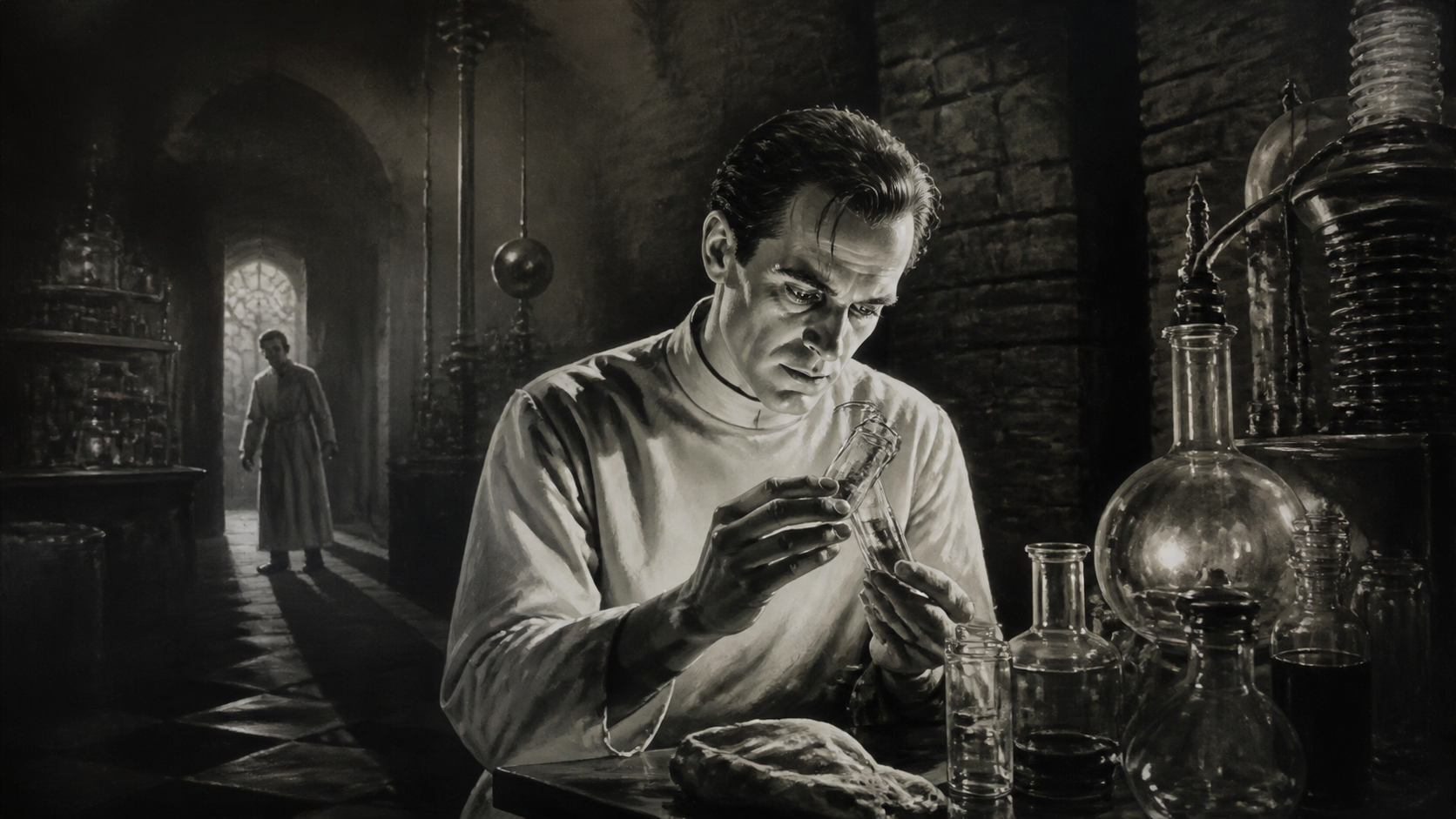
Cat People is a 1942 American horror film directed by Jacques Tourneur. At once a Gothic romance, a psychological horror story and a study in repressed desire, it follows a newly married woman who believes an ancient curse will turn her into a killer when passion takes hold. The film’s lasting distinction lies in how little it shows and how much it leaves hanging in the dark, turning suggestion, jealousy and sexual anxiety into the engine of the dread.
For horror fans, this is one of the key early examples of the haunted, off-screen style that Val Lewton’s RKO unit made famous. It is not a monster movie in the usual sense, even though it has one foot in that tradition. Instead, it is a tense, adult-minded thriller that treats fear as something intimate and psychological, then wraps that unease in noirish shadows, urban settings and an unsettlingly unstable love triangle.
The Film File
- Original release year: 1942
- Director: Jacques Tourneur
- Credited writer: DeWitt Bodeen
- Principal cast: Simone Simon as Irena Dubrovna; Kent Smith as Oliver Reed; Jane Randolph as Alice Moore; Tom Conway as Dr. Louis Judd; Alan Napier as Mr. Carver; Elizabeth Russell as the Cat Woman
- Approximate runtime of this version: 73 minutes
- Country of production: United States
- Relevant horror subgenres: psychological horror, Gothic horror, supernatural horror, psychological thriller
Behind the Screams
Cat People was the first film produced by Val Lewton at RKO, and it began as exactly the sort of assignment that could have gone either way: the studio gave him a lurid title, a strict budget of about $150,000 and relatively little room to manoeuvre. Lewton responded by building an elegant, suggestive horror film around DeWitt Bodeen’s screenplay and Jacques Tourneur’s direction, rather than trying to outdo Universal’s monsters or rely on elaborate effects. The production was fast, lean and resourceful, with principal photography beginning in late July 1942 and the finished film coming in under budget.
The film is usually linked to a story idea Lewton had developed from an earlier tale, “The Bagheeta”, published in Weird Tales, though the finished screenplay is not a direct adaptation of a single prior source. What matters most is how the material was reshaped into something contemporary and psychologically charged. The story centres on Irena, a Serbian immigrant in New York who fears that she descends from a line of women cursed to become panthers if they give themselves over to desire. That premise sounds extravagant, yet the film keeps returning to practical settings, professional routines and ordinary social tensions, which gives the supernatural idea a troubling plausibility.
Several creative choices shaped the film’s identity. Lewton preferred ambiguity and unease over clear-cut spectacle, and the production built its scares around suggestion rather than visible transformation. Tourneur’s handling of darkness, Nicholas Musuraca’s photography and Roy Webb’s score all support that approach, while the film also makes striking use of existing studio sets to stretch the budget. The famous Central Park and zoo material, as well as the apartment and street sequences, feel more expensive than the film’s means would suggest because they are arranged with such confidence. There is a well-attested story that studio management wanted more explicit monster material, which led to the inclusion of a real cat in one attack sequence. That anecdote matters because it helps explain the film’s most famous technique, but the broader artistic strategy is clearer than any single production legend: Lewton and Tourneur made a horror film in which what is withheld becomes the point.
Into the Dark
Irena Dubrovna is a fashion illustrator living in New York when she meets Oliver Reed, a marine engineer who is immediately drawn to her. They marry, but Irena is burdened by a legend from her homeland and by a fear that her feelings will unleash something violent within her. She resists intimacy, seeks explanations in folklore and tries to live with the possibility that emotional surrender may be fatal. Oliver, meanwhile, wants a conventional marriage and gradually grows frustrated by the distance she keeps between them.
The tension widens when Oliver turns for comfort to Alice Moore, a colleague who is kind, practical and increasingly central to his life. Irena’s jealousy is not played as a simple tantrum. The film treats it as part of her terror and alienation, as if the same force that makes her fearful of passion also makes her vulnerable to suspicion. A psychiatrist, Dr. Judd, enters the story and tries to diagnose what he sees as illness rather than curse, but his confidence is not especially reassuring. The film steadily moves between possible explanations, never letting the viewer settle too comfortably on folklore, madness or malice alone.
Spoilers ahead: the following paragraphs discuss major plot developments.
As Irena’s jealousy intensifies, the film pushes her towards a fatal confrontation with the possibility that she really is becoming what she fears. The most famous sequence involves Alice being stalked in the dark, with the film relying on sound, shadows and sudden interruption rather than a full reveal of an attacking beast. Later, the story turns tragic when Dr. Judd, attempting to prove he can master the situation, is killed in the dark by what appears to be a panther. Irena then goes to the zoo and releases the cat she has been linked with symbolically throughout the film, only to be mortally wounded herself. The ending leaves Oliver and Alice with relief, but not triumph. The film’s final effect is less about solving the curse than about showing how fear, shame and desire have already done their damage.
What Gets Under Your Skin
The film’s atmosphere is its greatest weapon. Tourneur does not overstate the supernatural, and that restraint gives the story a particular kind of pressure. New York is not treated as a glamorous escape from the Gothic, but as a place where private dread can thrive in ordinary spaces: apartments, offices, streets, a park path, a pool. That matters because the film’s terror comes from domestic vulnerability rather than from a remote castle or an overtly monstrous presence. The horror feels bodily and emotional at once, especially in the way the script connects desire, shame and fear of change.
Simon gives Irena a fragile, watchful quality that prevents the character from becoming merely symbolic. She can seem remote, hurt and defensive in the same scene, and that instability is essential to the film’s success. Kent Smith and Jane Randolph are also important because the triangle between Oliver, Alice and Irena works best when all three are recognisably human rather than types. The film gains power from that balance: no one is simply a victim, a seducer or a villain, and the emotional conflict is allowed to remain messy.
Visually, Cat People is superb at making darkness active rather than merely decorative. Musuraca’s low-key cinematography does not just hide the monster, it creates an unstable world in which certainty keeps slipping away. The film’s best-known scare, often associated with the so-called “Lewton Bus”, is effective precisely because it trains the viewer to expect one thing and then replaces it with another. That trick could have dated badly in lesser hands, but here it belongs to a larger pattern of misdirection, where sound, movement and the viewer’s own anticipation become the real sources of threat.
The sound design also deserves emphasis. The film frequently lets off-screen noise carry the emotional burden, whether it is footsteps, a hiss, a startling interruption or the noises of an urban environment suddenly becoming hostile. Roy Webb’s music is important too, though never in the overbearing way some later horror scores are. It supports the mood without telling the audience how to feel. Together, these elements create a film that is less interested in shocks than in sustained unease, and that distinction is crucial. It is a horror film that understands fear as a state of mind, not just a sequence of incidents.
What the film may lack, for some viewers, is the muscular momentum of later, more overt horror pictures. Its pace is deliberate and its central conflict is emotional before it is physical. But that is not a weakness in relation to its own aims. The film is not trying to build towards a spectacle-heavy payoff. It is trying to make anxiety itself feel contagious, and it succeeds by staying close to its characters’ private damage. That is why the film still feels disciplined rather than merely old-fashioned.
The Film’s Afterlife
Cat People was met with mixed reviews on release, but it quickly proved popular with audiences and was a major success for RKO. That commercial success mattered beyond box office totals: it helped establish Lewton’s unit and gave the studio confidence to continue backing his distinctive brand of psychological horror. The film was later selected for the National Film Registry in 1993, a strong indication of its cultural and historical standing. Its reputation has only grown with time, not because it is the loudest or most elaborate horror film of its era, but because it helped define a subtler vocabulary for cinematic fear.
Horripilations Verdict
A lean, intelligent horror film that turns repression into suspense and suggestion into dread. Its emotional triangle is strong, its visual design is haunting, and its restraint is exactly what makes the film so effective.
What works
- Shadow-drenched atmosphere
- Sharp psychological tension
- Elegant use of off-screen horror
What holds it back
- Deliberate pace may feel understated to viewers expecting overt scares
- The central premise is more compelling than the mystery it gradually unfolds