The first time I heard the place called Salt Debt Camp, I thought it was a joke.
“It’s a worksite, not a holiday park,” Ruth said, not looking up from the ledger spread across the breakfast table. “Try to sound less offended when you say no. They’re offering hazard pay.”
I was not offended. I was ashamed.
Three months behind on rent, two months behind on the credit card, and with Mum’s hospital bills still arriving in brown envelopes that made my stomach seize whenever they landed on the mat, I had become the sort of person who answered texts from unknown numbers if they promised money. The message on my phone had been from a contractor I’d done wiring work for years ago. A short-term salvage job on a decommissioned salt-evaporation camp on the edge of the Gulf Coast. Fourteen days. Good pay. Accommodation provided. No family. No questions.
“Why would they need a sparkie out there?” Ruth asked.
“To keep the generators from catching fire, maybe.”
“Or to make sure the camp keeps running.”
That was the first thing I did not like. The second was the way she said camp, as if it belonged to some category of place best avoided. Ruth had gone quiet the day before, and when I looked up, I saw the same old tired calculation in her face, the one that had been there since Dad’s stroke took away the shop and the house and whatever confidence she had left in other people.
“They’re desperate enough to pay in advance,” she said. “You need to decide if that means they’re honest or dangerous.”
In the end, I went because I was twenty-eight and frightened of becoming permanently dependent on my sister. That, more than the money, was the shame. So on a damp Monday morning I drove three hours south through flat, grey country until the road left the trees behind and the air turned salty and metallic, and the camp appeared on the horizon as a scatter of low buildings and scaffold towers set among salt ponds that reflected the sky like sheets of dull tin.
There were eleven of us in total. Most were men in their forties and fifties, hard-faced labourers who seemed to know one another already. There was a cook named Denise with tattooed forearms and a blunt expression, a wiry medic called Tom who looked too young for the job and too old to be frightened by it, and two women, myself and a radio tech named Priya, who smiled as if she had long ago decided not to trust the smile back. The foreman, a broad-shouldered man called Wade, shook my hand without meeting my eyes and showed me to a shipping-container dorm with six bunks, a chemical toilet, and a window that looked out over the evaporation pans. The whole place smelled of brine, diesel and old metal.
I asked Wade what exactly had happened to make the camp “decommissioned”.
He gave me a look that suggested I’d asked a question I could have spared him.
“Ownership dispute,” he said. “Salvage rights. Supply chain collapse. Pick one. Doesn’t matter. The salt out there’s still worth money. So is the gear left behind.”
That evening, at dinner, I learned the camp had once processed seawater into industrial salt for shipping upriver. The pans were long shallow basins divided by concrete walls. Windmills and pumps had fed the water from the inlet, then the summer sun had done the rest. Now the whole operation was in the process of being stripped: copper cables, motors, pipework, control panels. We were here because someone, somewhere, had decided the scrap still had value.
“You’ll hear the pumps sometimes,” said Denise, ladling out stew that tasted of tinned tomatoes and pepper. “Don’t worry about them.”
No one laughed.
I slept badly. The dorm walls creaked in the wind, and from beyond the camp came a low, continuous sound that I had trouble naming at first. Not machinery, exactly. A dragging, granular noise, like someone pouring a sack of coarse salt across concrete very slowly. It stopped and started at irregular intervals. By dawn I’d convinced myself it was a rat problem, though the camp had the still, overworked feel of a place where even the rats had made their own arrangement and gone elsewhere.
On my first full shift I was sent with Priya and two of the labourers, a red-faced man called Davy and a younger one named Ben, to cut and coil the copper from the old control shed by Basin Seven. The shed stood near the outer edge of the camp, where the salt flats gave way to a strip of brittle mangrove and then the inlet itself. The air there was brighter, more open. Gulls sat on the roof and screamed at us as if we were trespassing on their private grievance.
Priya was practical to the point of rudeness. “How long are you here for?” she asked while checking her meter.
“Two weeks, if no one dies,” I said.
“Don’t joke.”
“I wasn’t.”
She looked at me then, properly, and I saw she had the same habit I had of counting exits without meaning to.
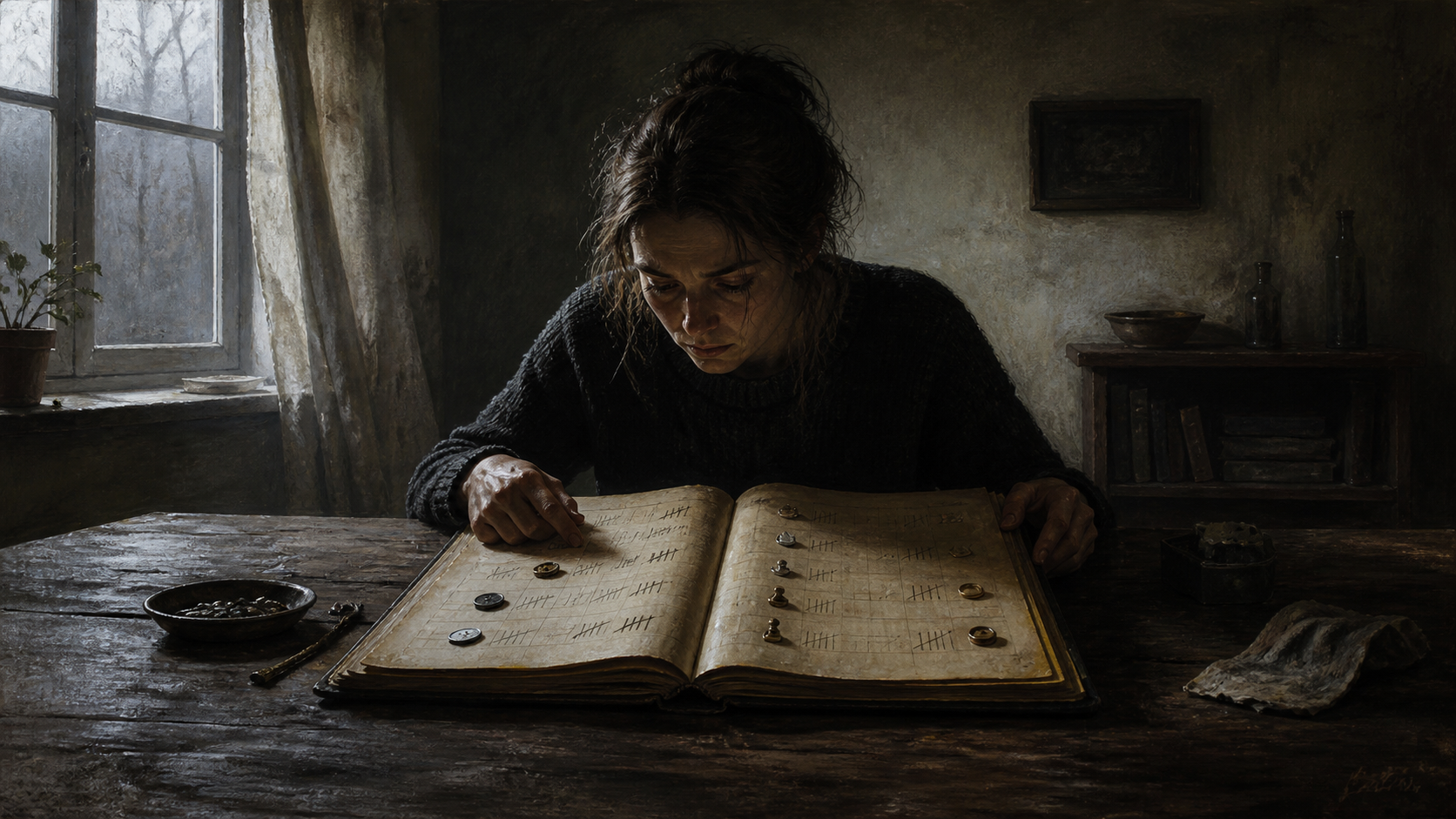
Inside the shed, the equipment had been left in a rush. Stacked helmets. Clipboards. A kettle full of rust. Along one wall, someone had chalked numbers on the concrete, not the neat arithmetic of a foreman but a sequence of tally marks and crosses. Davy saw me noticing and shrugged.
“Debt counts,” he said.
“Whose debt?”
He spat into the dust. “You’ll find out.”
A few hours later, while we were cutting cable from the switchboard, I heard it again: that granular dragging, close this time, just outside the wall. Ben swore and stepped back.
“Rats,” Davy muttered, but he had gone pale around the mouth.
Priya went to the door and looked out. Then she shut it and slid the bolt home with a sharp, unnecessary force.
“What?” I asked.
“Keep working,” she said.
But she did not look at me. She looked at the floor.
Around lunchtime, Wade called everyone to the canteen. He was holding a sheaf of papers and had the strained, flushed look of a man trying to remain in charge of a problem that had already grown too large for him.
“Listen up,” he said. “There’s been a breach in one of the pans. Basin Four’s lost containment. We’re rerouting staff. Nobody goes near the south causeway after dark. If anyone sees movement out on the flats, you report it, you do not go looking.”
Davy muttered something under his breath. Wade heard him.
“Say it out loud.”
“Just say who’s paying the debt this week.”
The room went still. I looked from one face to another and saw not surprise but a kind of exhausted familiarity, as if the phrase had been used often enough to lose all novelty and only keep its menace.
Wade’s jaw flexed. “You want your wage, you do your hours and keep your mouth shut.”
Denise banged a spoon down hard enough to make everyone jump. “Don’t start this in front of the new one.”
“New one” turned out to be me.
That night the generators failed twice. The first time, Priya and I got them back online in ten minutes by swapping a relay. The second time, the lights in the canteen dimmed and went yellow for a moment, and while Tom was making a joke about running the place on prayer, a howl came from outside that made every head turn.
It was not an animal sound. It had strain in it, the sound of a throat forced open past what it could bear. Then came a clatter, a body striking the outer wall, followed by the same granular dragging, closer than before, as if whatever had made the noise was being pulled away over rough ground.
No one moved.
Wade stood up so abruptly his chair fell over. “Stay inside.”
“Who’s out there?” Tom said.
Wade did not answer. He opened the side hatch and went out with a torch in one hand and a bolt-cutter in the other.
Denise swore under her breath. Priya looked at the floor again. It occurred to me, with a dull and nauseating certainty, that they were all waiting for something specific, not just afraid of the dark.
Wade returned ten minutes later alone. There was salt crust on his boots and one sleeve of his shirt was wet and dark to the elbow.
“No one leaves,” he said. “Nobody opens the main gate. If you hear anything on the outside, you ignore it.”
“What happened?” I asked.
He fixed me with a look that was meant to close the conversation and failed by a mile. “You want to keep your bonus? Then you don’t ask questions like that.”
After midnight, the camp was so quiet I could hear the salt drying in the pans. I was lying awake when a wet, scraping noise came from the corridor outside the dorm. Not footsteps. Not quite. More like bare skin dragged over corrugated metal, punctuated by small, clicking impacts. I sat up, every muscle rigid, and watched the line beneath the door.
Something stopped there.
It stayed for a long time. Then a voice whispered through the crack, thin and ruined and horribly familiar.
“Tom?”
I knew the voice. It was Ben’s.
Tom, in the bunk opposite mine, made a small choking sound. “Don’t answer it.”
The voice came again, closer somehow. “Tom, I can’t feel my hands.”
There was a soft thump against the door. Then another, as if someone had leaned their weight on it and slid down.
Tom began to cry without making a sound. I wanted to speak, to ask what was happening, but my throat had shut itself. The thing outside started making a low, conversational murmur, not words so much as a mimicry of them, and then the whole corridor filled with the smell of brine and rot, as if someone had opened a tank of dead fish.
By morning Ben was gone.
Wade gathered us in the yard and announced that he had “broken quarantine”. He would not say what that meant. Davy folded his arms and looked mutinous. Denise stared at him with a grief so hard it seemed to have calcified.
Tom said, “You’re telling us he walked out into the flats?”
Wade took a long, ugly breath. “I’m telling you he didn’t leave his bunk empty by choice.”
That was when I realised the camp was not simply abandoned. It was being used. The salt pans were not just a landscape; they were a mechanism. Each basin had drains, sluices and channels that could be opened or shut from the control shed. At low tide, brine was drawn inland and trapped. At the right concentration, it crystallised. At the wrong concentration, it did something else.
I did not know what, exactly. But I knew now why the camp’s lights, pumps and pipes had not been stripped completely. Something required the system to keep functioning.
Priya found me in the generator room that afternoon. Her face had taken on a grey, rubbed-down look.
“You should leave,” she said.
“Can I?”
She gave a humourless laugh. “Not if they think you know enough to cost them money.”
I stared at her. “Know what?”
She hesitated, then pointed through the open service door towards the salt pans.
“They’re paying down a flood debt,” she said. “Not money. People.”
She told me that the camp had once been run by a private operation owned by a consortium, one of those faceless firms that changed names every few years and left the same mess behind. There had been an accident years earlier, a breach in the outer seawall during a storm. Saltwater poured into the storage works and took people with it. Three men drowned in the lower conduits. Two more disappeared trying to shut the drains. After that, the camp was closed, but not before the old management had discovered the brine pools behaved strangely after the flood. If certain pans were over-saturated and the outlet gates held, the water thinned, then thickened, then seemed to move under its own skin. It pulled at anything organic. Not like suction. Like appetite.
“They test it on the scrapped stock,” she said. “Dogs at first. Then vagrants. Then workers who’d signed the wrong paper and thought they were doing security. When the salt took them, it left enough of them behind to keep moving.”
My mouth had gone dry. “You’re lying.”
“I wish I was.”
She held out her forearm. Under the skin near her wrist were faint lines, white and shallow, as if something had traced them from the inside. “It gets into you through cuts. Through old injuries. Through the mouth if you breathe it long enough. The salt does not kill straight away. It makes a record.”
I did not understand that then. I understand it now.
That evening I watched Wade and two of the labourers drag a hooked chain toward Basin Four. Something was moving at the far end of the chain, low and stubborn. It was the shape of a man on hands and knees, but the limbs were wrong in the way they bent, and its back gleamed with a hard glitter, as if the skin had been varnished with white crystals. It hit the causeway and slumped, and for one awful moment I saw the face.
It was Ben’s.
Not intact. Not really his. But recognisable enough that my stomach turned over. The mouth was full of salt, packed so tightly between the teeth that the jaw had been forced wider than nature would allow. The eyes were open but milky with crust, and every breath came in through the nose as a wet, rasping effort. He was alive. If that could be called life.
Tom made a sound behind me. Wade turned and shouted for him to stay back, too late. The figure on the chain jerked violently and one of the labourers lost his footing. The hook tore free. Ben lurched towards Tom with an inhuman burst of speed, not running exactly but dragged by momentum and hunger.
Tom froze. I remember his expression, the appalled certainty that this was not something any sensible person had trained for.
I had a crowbar in my hand. I do not know why. Perhaps I had been carrying it since the generator room. I struck Ben across the side of the head with all the force I had. The impact hurt my arms and barely slowed him. He slammed into me, and where his cheek pressed against my neck the skin felt grainy and hot, like damp plaster. He opened his mouth and exhaled a breath so full of salt dust that I gagged.
Wade and the others hauled him back with the chain. Tom stumbled away retching. When Ben’s body hit the stones, one of his hands came apart at the fingers. Not torn. Crumbled. The flesh had been turning to crust for hours, perhaps days, while still moving.
“Get him to the shed,” Wade said.
“No,” Tom cried. “No, you can’t keep doing this.”
Wade swung on him. “You think I asked for this?”
“You’re feeding it!”
Wade hit him. Hard. Tom fell against the causeway rail and went still.
That was the moment the camp stopped being a bad job and became a trap. I understood then that leaving had been possible only as long as the people in charge believed the salt debt could be managed by sacrifice. Now that I had seen what they were doing, I had become part of the expense.
We spent the next hour in chaos. Priya and I got Tom into the infirmary while Denise packed gauze around the gash on his temple. His breathing had gone shallow. Wade locked the outer gates and sent the labourers to fetch the emergency cache from the old admin block. When he returned, he had a rifle slung over one shoulder and a look of decision I did not trust at all.
“We’re finishing the cycle tonight,” he said. “Basins Three and Four, then the south sluice. If the levels don’t equalise, everything goes.”
“What does ‘everything’ mean?” I asked.
He looked at me as if I were very slow. “It means the flats flood. It means we lose the camp.”
“And the people?”
His face did not change. That was worse than if it had.
Priya dragged me aside while Wade shouted orders. “He’ll open the sluice and run,” she said. “The lower pans will drain through the old outflow. Whatever is down there will follow the brine path inland. Not far, not fast, but enough.”
“To where?”
She gave me a bleak look. “The road. The houses on the ridge. Anywhere the salt can find a cut.”
I thought of Ruth. Of my hands on the steering wheel every day. Of Mum’s skin papering over her veins. Of how easily damage spreads when it is allowed to keep working.
“What do we do?”
“Stop the outflow.”
At the back of the admin block stood a pump house built over the main gate valves. It was a concrete room with a rusted ladder down to the manual release and a panel that still held power from the emergency generator. If I could force the valves closed before Wade opened the sluice, the brine would back up in Basin Four. It might burst somewhere else, or it might not. But it would buy time.
That was all survival ever is, I think. Enough time to make the next mistake.
Priya came with me. She had a length of pipe as a weapon and the calm, fixed face of someone who had already decided how much pain she was willing to accept. We reached the pump house through the dark service route while the camp rumbled behind us. I could hear the clank of chains, the shout of men, the sudden crack of a gunshot that made Priya flinch but not stop.
Inside, the air was hot and damp. The valve panel was marked with old grease pencil symbols and a handwritten warning: DO NOT OPEN BELOW 12 PSI. Below that, a second note had been added in a different hand: NOT BLOOD. KEEP AWAY FROM MOUTH.
I had no time to wonder what it meant. I got the panel open, jammed the override, and heard the motors strain.
Then someone came down the ladder behind us.
Wade. One hand on the rail, the other bleeding from the knuckles. His face was spattered with white grit. “Move aside,” he said.
Priya raised the pipe. “No.”
He laughed once, short and ugly. “You think you can stop it? You’ve seen the basin. It’s already in the pipes.”
“What did you do?” I asked.
His expression shifted, just for a second, into something like disgust, but whether with me or himself I could not tell. “I kept the place alive. You should be grateful.”
He came at me fast, grabbing for the override. Priya swung the pipe into his forearm with a crack that made him howl. The rifle went off, deafening in the cramped room, and the bullet punched through the panel beside my head. Sparks spat over my shoulder. The lights went out.
In the dark I heard Wade breathing hard, then the wet scrape of his boots on concrete as he lurched for the ladder. Priya caught him by the coat and they went down together, battering against the wall. I struck at whatever part of him I could reach. My hand hit salt-crusted skin. His shirt was stiff where brine had dried on it. He bit me through the sleeve, not like a man in rage but like an animal trying to tear a piece free.
The override finally caught. Somewhere below, deep in the machinery, a sequence of valves slammed shut one after another with heavy metallic thuds.
Wade made a noise then, not a shout but a sob of pure fury. “You don’t understand what happens if it stops!”
The answer came from the ladder.
Something climbed up from below.
At first I thought it was one of the workers, soaked and half-drowned from a breach. Then the light from Priya’s dropped torch caught it full on, and I saw the salt-formed faces of several people pressed together in a single heaving mass, as if bodies had been partly dissolved and welded in the dark. Arms emerged where they should not. Fingers fused into ridges. The whole thing was coated in white crystals that gleamed wetly. It moved with terrible purpose, following the brine line into the room. Its mouths opened and closed against one another. Salt spilled from them in clumps.
Wade saw it too. He stared, then tried to climb past me. The thing reached him first. It touched his neck and he went rigid, every muscle locking as if poured in plaster. His eyes rolled white. In seconds a glaze spread across his skin, beginning at the contact point and blooming outward in bright, brittle patches.
Priya screamed and kicked at the ladder, trying to break free. I grabbed the pipe from her dropped hand and struck the creature hard across what might once have been a shoulder. The impact cracked crystals apart but did not stop it. It seized my wrist. The touch burned cold, then hot, then numb. White dust rose around us as if the air itself were shedding skin.
I remember thinking, with absurd clarity, that it wanted all of us because it was not a person but a process. It did not hate. It collected.
Priya shoved me back and hauled the manual release lever. Her face was bloodied where Wade’s ring had split her eyebrow. “Run,” she shouted.
The lever dropped. The valve house groaned as pressure changed through the system. From somewhere outside came a long, animal groan of metal under strain. Water surged. The room shook. The creature on the ladder convulsed, and in that instant I saw Wade’s face pressed somewhere inside it, eyes open, mouth full of salt.
Priya’s strength failed all at once. The thing reached for her. I hit it again and again, until the pipe bent and my hands went numb. She got one arm free and pulled me towards the doorway as the pump house began to fill from the floor drain with icy brine.
We made it out into the yard just as Basin Four burst.
The sound was enormous. Not an explosion, but a tearing open. A wall of saltwater and sludge surged over the causeway, carrying debris, pipe lengths, a generator housing, and bodies I could not count. Lights snapped. The whole camp lurched as if struck. In the chaos I saw Denise dragging Tom from the infirmary. I saw the dorm roof peel back under the pressure wave. I saw figures staggering in the flood, white-coated and broken, trying still to move as the water took them.
Priya collapsed against a pole, coughing. Her hands were already swelling where the brine had touched them. Salt crusted her sleeve to the skin.
“You have to go,” she said.
I wanted to argue. Instead I hauled her up, half-carried her to the service truck and got the engine started with shaking hands. Behind us, the camp was going under in stages: first the lower yards, then the canteen, then the admin block windows bursting one after another as the pressure shifted. The road out ran along the ridge, and as I drove, headlights cutting through spray, I saw shapes in the water below the embankment. Men and women with their mouths packed white, climbing after the road on bent, certain limbs, some of them still wearing the camp’s orange wristbands.
Priya was breathing hard beside me, her head on the seatback. I thought she had lost consciousness until she spoke.
“Don’t stop,” she said.
“I wasn’t planning to.”
“No. I mean ever.”
I glanced at her. The skin on her throat was already dry and rough in patches, as if the wet had gone wrong. She noticed me looking and turned her head away.
By the time I reached the highway, dawn had begun to bleach the sky. I dropped Priya at a roadside clinic staffed by a woman who took one look at her hands and put on gloves without a word. I did not stay to explain. I drove north until the truck was nearly out of fuel, then pulled over at a service station and washed my hands under a tap that left salt rings in the sink.
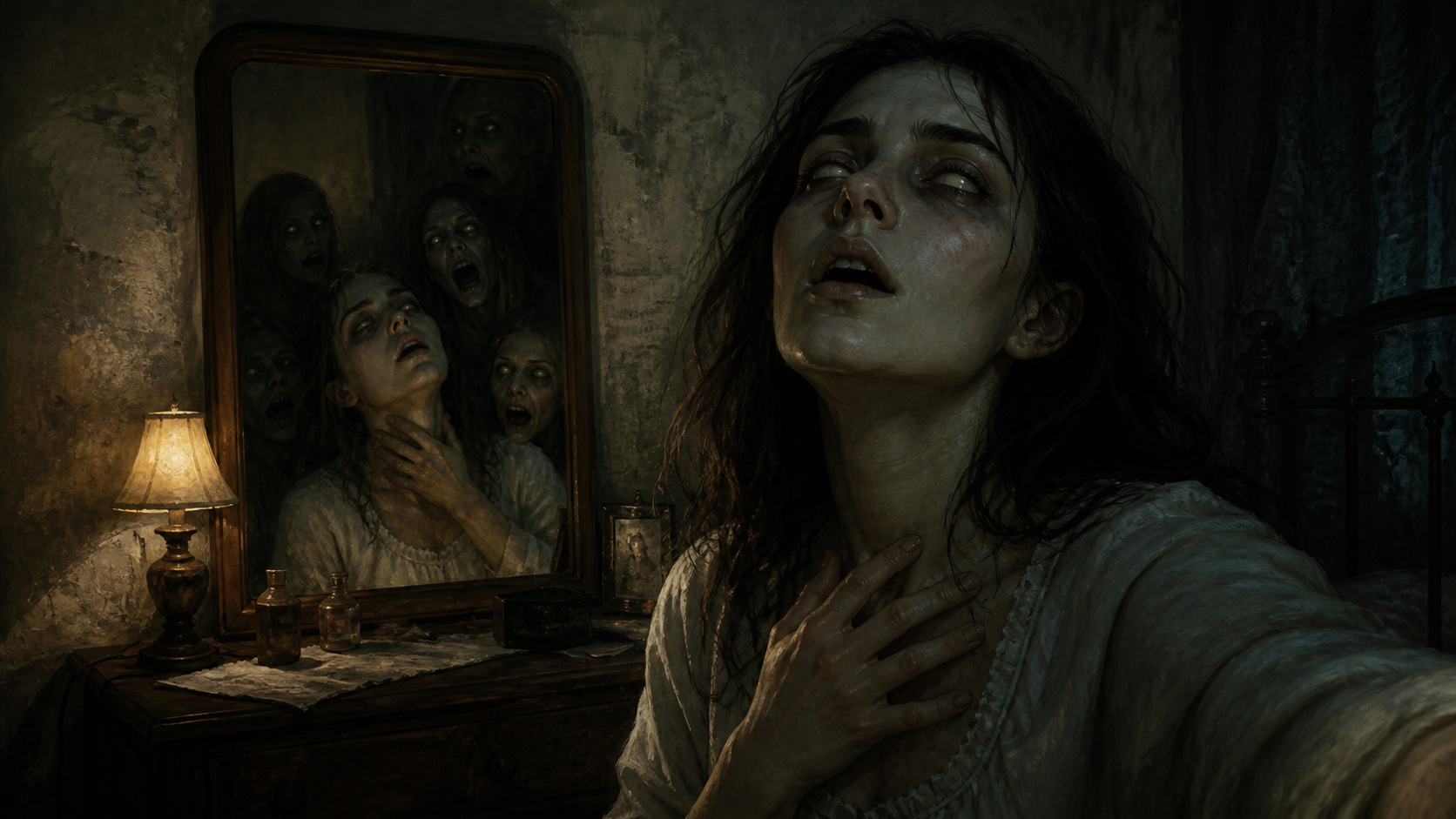
On the mirror above the basin there were fine white specks, too small at first to name. They clung to the glass in a pattern that looked, absurdly, like tally marks.
I scrubbed until my skin burned, but the grains did not all come away. Some of them were embedded under the surface of my wrist, near where Wade had bitten me, glinting faintly beneath the skin in a line no wider than a thread.
That was three weeks ago.
Ruth says I look tired when I video-call her, and I keep the camera angled high enough that she cannot see my hands. The bite has not healed. It has dried. Certain hours of the day it itches with a deep, intimate insistence, and when I scratch too hard, a dust of white comes off under my nails. I have stopped putting salt on my food. I have stopped keeping the windows open. I have also stopped telling myself the camp was an accident.
Yesterday a parcel arrived with no return address. Inside was my final wage envelope, stuffed with coarse white crystals instead of cash, and folded around them a note in Wade’s handwriting, the ink blurred by damp.
DEBT ALWAYS MOVES.
This morning, while I was emptying the envelope into the sink, I heard the same granular dragging sound from the hallway outside my flat. It paused at my door, just long enough for me to see a thin line of white seeping under the frame.
Then came a voice, soft and familiar, speaking through the gap with my sister’s careful cadence.
“Open up,” it said. “I’m freezing.”

Horror Stories