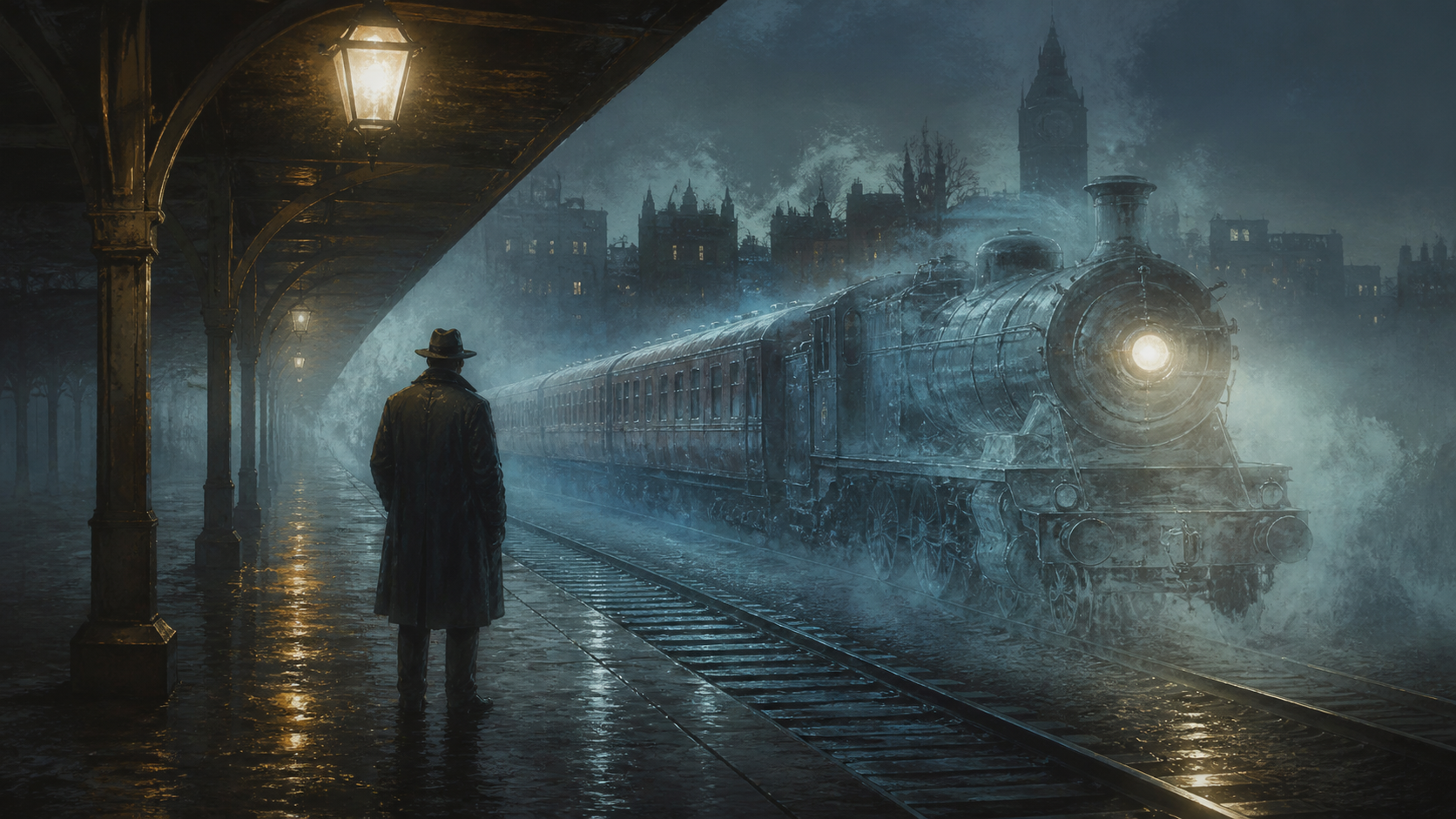
At half past one in the morning, when the last train had already gone and the station cleaners were pushing wet sheets of steam across the platform, the night bus from Wrenford should have been empty apart from the driver and the few souls too tired, too poor, or too stubborn to pay for a cab.
It was not empty.
Mara Singh saw the first odd thing when she climbed aboard at Queen’s Wharf with her takeaway coffee cooling in one hand and her ID badge still hanging round her neck. A woman sat in the second row on the nearside, perfectly upright, gloved hands folded on a shopping bag with the handles tied in a neat knot. Her coat was the sort rich women wore in television dramas, camel-coloured and severe, with a fur collar that looked wrong in this weather. Her face was turned to the window, so all Mara could see was the pale line of a cheekbone and a dark twist of hair pinned low at the nape.
The second odd thing was that the bus, which had been nearly empty at the depot, now had ten or eleven passengers, all of them so still they might have been asleep if not for the fact that none of them slumped or shifted or even breathed in a way Mara could see. A schoolboy in headphones. A man with a bicycle helmet on his knees. Two women in scrub tops, one with her hair net still on. An old fellow in a raincoat with a plastic bag from a pharmacy. A girl with bright pink nails and a sequinned purse. Every face, as far as Mara could tell in the dim orange light, was turned away from the aisle.
The driver, a thick-necked man she’d seen before, caught her eye in the mirror. He gave a tiny shrug, the sort that meant: don’t start.
Mara took the last single seat at the back, by the emergency hammer, and tried to ignore the smell.
It was not the usual bus smell of damp upholstery and old coins and somebody’s takeaway chips. Beneath that was something cold and metallic, like a drawer in a morgue that had been opened too long. She put her coffee between her shoes and watched the city retreat in smeared reflections. Office towers, shuttered taxi ranks, a billboard with half its bulbs dead. The bus crossed the river by the iron bridge and headed into the older part of the city where the streets narrowed and the streetlamps gave off a jaundiced, underwater light.
It was there, on Fenwick Gate, that the woman in the camel coat got off.
Mara only noticed because the bell rang, a sharp little electronic chirp that cut through the engine’s drone. The bus halted under a leaning plane tree and the doors folded open. The woman stood, turned, and for the first time her face was fully visible.
She was beautiful in the way some masks are beautiful. Smooth pale skin, dark brows, lips pressed thin as a seam. Her eyes were the worst part. They looked not at Mara, not at the driver, but past both of them, as if measuring a depth behind the bus that no one else could see.
She stepped down without touching the rail.
The doors shut. The bus pulled away.
Mara glanced at the seat the woman had vacated. Nothing there but the faint impression of her coat and, on the vinyl, a wet crescent of something clear and reflective, like a tear. The bus moved on.
At the next stop, three people got on who had no business being there at that hour: a man in a suit carrying a briefcase, a little boy in pyjamas with a dinosaur on them, and an elderly woman with a walker folded under one arm as neatly as an umbrella. They did not speak. None of them looked at the driver when he barked, “Fares or passes.”
The boy lifted his chin and gave him a card. Mara could not see what was on it. The driver took it, frowned, and punched the ticket machine.
The elderly woman asked, in a voice so dry it seemed scraped from paper, “Is this the one to Fenwick Gate?”
The driver stiffened. “This route ends at Kingsford Road.”
“I asked if it’s the one,” she said.
He stared at her for several seconds, then gave a short nod. “If you’re on it, you’re on it.”
The woman settled herself near the front. The boy climbed onto the seat beside her. The man in the suit remained standing, briefcase held against his thigh, and stared down the aisle with an expression of such private horror that Mara felt her own stomach tighten in sympathy.
No one else spoke until the bus reached the municipal square, where a pair of lads in football shirts stumbled out laughing and a drunk woman in silver heels leaned into the doors, demanding to know whether this was the 02:15 to Westbridge or “another bloody lie”. The driver waved her back before the doors had fully opened.
That was when the man in the suit sat down opposite Mara, though there were seats everywhere else.
He was perhaps forty, with a face that had not slept enough for years. His tie was loosened. His eyes were bloodshot and bright with panic. He smelled of expensive aftershave and stale sweat.
“You want to move,” he said under his breath.
Mara looked at him. “Excuse me?”
“You want to move before we get there.”
“Get where?”
He laughed without humour. “That depends what it’s taken.”
She almost asked what he meant, but the old woman at the front spoke first.
“Don’t frighten the girl, Stephen.”
The man’s jaw clenched. “I’m not frightening her. The city is frightening her. You all should be frightened.”
The driver shouted, “Quiet back there!”
The bus turned into Fenwick Gate five minutes later, though Mara had no memory of the route leading there. One moment the street outside was all shuttered shops and the glow of a kebab place; the next, the buildings had gone strangely close together, their windows dark and their brickwork stained with damp. Fenwick Gate was not a gate in any real sense. It was a narrow street in the old quarter, one of those roads that had survived all the demolitions by accident rather than design. It ran between a closed pharmacy and a fence of black iron pointed like teeth. At its far end stood an archway of pale stone carrying no sign, only the shadow of a former inscription worn away by weather or deliberate abrasion.
The bus slowed.
Every passenger turned to look at it.
The old woman with the walker made a small noise, half sigh, half prayer.
The driver’s hands tightened on the wheel. “No,” he muttered.
The doors opened.
Nothing happened.
Then, from somewhere beyond the archway, came the sound of footsteps on wet pavement. Not one pair of footsteps, but many, overlapped, as if a crowd were approaching in perfect synchrony. Mara felt the hair lift on the back of her neck. The boy in pyjamas slid down his seat until only his eyes were visible above the cushion.
The man in the suit stood. “We’re not stopping.”
The driver slammed the gear into drive. The engine revved. The bus lurched and did not move.
The footsteps ceased.
A voice called from outside, low and cordial. “Late, are we?”
The driver’s face went ash-grey. He hit the door controls. Nothing. He struck the panel with the heel of his hand, hard enough to make the dashboard rattle. “Come on, come on.”
The old woman closed her eyes. “Let it in,” she whispered.
The voice outside repeated, still mild, “Open up. Last stop.”
Mara looked through the glass at the archway. At first she saw only darkness beneath it. Then a shape resolved there, a figure standing just beyond the lights. It was tall and narrow and unnaturally still. She could not make out its face, but the impression of a face was there all the same, like a thumb pressed into clay and smoothed away.
The man in the suit said, “Don’t look at it too long.”
The driver turned in his seat, his voice fraying. “What is this? What the hell is this?”
No one answered him.
The thing outside lifted a hand and tapped once on the door. The sound was small and polite. The bus shuddered.
A crack appeared in the front windscreen, fine as a hair. Then another. The driver swore and backed away as the glass spread in a slow silver web. The lights inside flickered.
The old woman said, “He’s gone too far this time.”
The boy in pyjamas started crying. Not loudly, just with great wet sobs that seemed almost embarrassed.
Mara found her voice. “Who is?”
The man in the suit looked at her with pity so sharp it made him seem suddenly older. “The one who takes the last stop.”
Outside, the figure touched the glass again. The crack widened.
The driver finally found his courage or lost his mind. He grabbed the radio mic and shouted, “Control, this is bus four-one-seven. I’ve got an obstruction on Fenwick Gate. Requesting assistance.”
Only static answered. Then, in a voice that was not the controller’s, and not any human voice Mara had ever heard, a calm reply came through the speaker.
“No assistance available.”
The old woman began to laugh softly. Tears ran down the sides of her nose. “It always says that.”
The bus doors slammed shut with a violent clang. The engine cut out. All the interior lights went black at once.
In the dark, someone screamed.
Mara had no idea who made the sound. It went on and on until the bus doors opened again by themselves, spilling in a shaft of sickly yellow light from the streetlamp outside. The figure at the archway was no longer there. Instead, a woman stood on the pavement in a white shirt, her sleeves rolled to the elbow, her hair tied back in a work knot. She looked like a midwife or a nurse. She smiled in a tired, gentle way and held out her hand as if inviting someone to step off the bus.
“Come now,” she said. “We’re keeping you.”
No one moved.
The man in the suit whispered, “Don’t answer.”
The woman outside tilted her head. “Stephen, you’re late.”
At that, the man in the suit made a strangled sound. He clutched the briefcase to his chest so hard his knuckles whitened.
The old woman said, very quietly, “That’s not for you. Don’t listen.”
The woman outside was looking at the old woman now. “Mother.”
Mara saw the old woman flinch as if struck.
The boy in pyjamas began to whimper harder. The driver, still frozen at the wheel, stared ahead with his mouth open.
Then the woman outside took one step towards the bus.
Mara would later be unable to explain why she did what she did next. She had no bravery to speak of. Her life, at thirty-two, had been a sequence of sensible compromises. She worked payroll for a property firm she disliked. She had the kind of quiet, competent face people trusted to stand near a photocopier. But there was something in the figure’s smile, in the way it called the old woman “Mother”, that made Mara remember her own mother after the stroke, how the woman in the hospital bed had once reached for her and missed by an inch because the left side of her body no longer answered.
Mara stood up.
“Wait,” the man in the suit said. “No. Sit down.”
She ignored him and went to the front of the bus. Up close, the driver looked as if he’d been punched in the chest. Mara put a hand on his shoulder.
“Unlock the doors,” she said.
He stared at her. “Are you mad?”
“Unlock them.”
The woman outside smiled wider, as if she had heard. “Good girl.”
Something in Mara snapped then, hot and furious. She leaned over and yanked the emergency release hidden by the frame.
The doors opened.
Cold air flooded in.
The woman on the pavement was no longer smiling. Her face had become flat and patient, almost displeased. She stepped up into the doorway.
Mara saw, for one impossible instant, that there was no street behind her. No pharmacy, no fence, no archway. Only a long tunnel of black stone receding where Fenwick Gate should have been, and along its floor, rows upon rows of shoes.
The woman reached for Mara.
The driver shouted and grabbed Mara by the collar, dragging her back. The man in the suit lunged from the opposite side and slammed the doors with both hands. They caught on the woman’s wrist. She did not cry out. She only looked at Mara with a focus so intense it seemed to strip the skin from her thoughts.
Then the doors shut.
The bus shook violently. The lights burst back on.
The woman outside was gone.
For one heartbeat, everyone remained still. Then the old woman gave a terrible, broken gasp and clutched at the boy in pyjamas. He was sobbing openly now. The driver was shaking so badly that tears had pooled in his lower eyelids.
Mara’s own hand burned where the cold had touched it. She looked down. There was a dark crescent on her skin, as if a fingerprint had been left in frost.
The man in the suit was staring at the front step. “That’s not enough,” he whispered. “It never is.”
The bus lurched forward.
No one had touched the gear.
It moved with a grinding groan, as though something huge and unseen had begun pushing it from behind. The driver swore and seized the wheel, but the bus was already rolling away from Fenwick Gate, through the darkness and back into the lit streets. The passengers on the bus were no longer looking at one another. Every face had turned towards the windows.
Mara followed their gazes.
On the pavements outside, at every stop they passed, stood people waiting in the dim orange pools of the streetlamps. A young woman in an apron with flour on her hands. A cyclist with one shoe off. An office cleaner in orange overalls. A man in a hospital gown under a coat too big for him. They were all motionless, all watching the bus as it went by, and every one of them looked faintly familiar in the unsettling way of faces glimpsed in dreams.
None boarded. None spoke.
At the next junction the bus nearly collided with a white hatchback. The driver veered hard and swore, then cried out because the road ahead had vanished. Not closed. Not blocked. Vanished. The tarmac ended in a ragged lip, beyond which stretched the same black tunnel Mara had seen behind the woman, as if the street itself had been peeled open.
The bus brakes screamed. It stopped inches from the edge.
The passengers all cried out at once.
Then, from the rear of the bus, came a soft knocking.
Not on the window. On the inside of the bus wall.
Three neat taps.
Everyone froze.
Again, the knocking came. Tap, tap, tap.
The boy in pyjamas looked over his shoulder and began to shake so hard his teeth clicked. The old woman made a low keening sound. The driver would not turn round.
Mara did.
At the very back, where the emergency hammer hung, there was a figure seated where she had first climbed aboard. A woman in a camel coat with the fur collar, her hands folded on a tied shopping bag.
Except now, if anything, she was less like a woman than before. The face was still beautiful, still smooth and pale, but stretched thin with something eager beneath it. Her eyes were fixed on Mara with polite attention.
“You shouldn’t have opened the door,” she said.
Mara could not breathe. “What are you?”
The woman considered this as if choosing the right phrasing. “We manage departures.”
The man in the suit made a choking sound. “No,” he whispered. “No, no, no.”
The woman in the coat smiled at him, and Mara saw then that the smile did not move the skin around her mouth. It was merely placed there.
“Stephen,” she said, “you made a promise.”
He shut his eyes. “I know.”
Mara looked between them. “Who are you?”
“Passengers,” said the old woman, with a bitterness that seemed to cost her. “That’s what we were. Before.”
The bus lights flickered. The woman in the coat leaned forward a little.
“Come now,” she said. “We can take the last stop properly, if you like.”
The driver, who had been rigid as wire, suddenly yanked the door release and jumped from his seat. He ran for the front doors, but they had sealed shut. He hit them with both fists. The woman in the coat watched him with mild curiosity.
Then the bus gave a long metallic groan and tipped, not sideways but inward, as if the entire vehicle were folding into itself. Mara was thrown to her knees. The windows blackened. Outside, the street disappeared. The aisle stretched impossibly long. Every seat seemed to recede away from her.
People began to vanish.
It was not dramatic at first. The man with the bicycle helmet simply dropped out of sight as if he had sunk through the floor. One second he was there clutching his knees, the next only a shallow dent remained in the seat. The girl with the sequinned purse opened her mouth to scream and then her face was gone, the rest of her following in a blur, like an image erased by a hand. The boy in pyjamas reached for the old woman and the two of them, still holding on to each other, slipped backwards into darkness at the far end of the bus.
The driver was next. He vanished mid-strike, one fist still raised against the front doors.
Only Mara, the man in the suit, and the woman in the camel coat remained.
Stephen stumbled towards Mara, eyes wild. “You have to keep moving.”
“What?”
“Do not stand still. Don’t let it name you.”
Too late.
The woman in the coat looked straight at Mara and said, with exquisite gentleness, “Mara Singh.”
The sound of her own name struck Mara like a blow. The blackness beneath the bus seemed to open under her feet. She felt herself pulled, not forward or back, but down into a waiting absence.
Stephen seized her wrist. “Run.”
He hurled himself at the woman in the coat. For a second they struggled in the aisle, the man’s expensive suit tearing, the woman’s gloved hands impossibly strong. Then Stephen grabbed the shopping bag from her arm and ripped it open.
There was a rush of cold air.
Inside the bag was not anything Mara could name. No groceries, no personal items, not even emptiness. It was depth. A folded, breathing darkness lined with countless small pale things that flashed as they shifted, like teeth or fish scales or fingernails. The smell that burst out of it was unbearable, a sweet rot that made Mara gag.
The woman in the coat shrieked. Her first real human sound.
Stephen screamed back, “Go!”
Mara lurched for the front doors, but they were opening already, and beyond them was not the street, not Fenwick Gate, not anything she recognised. There was only the tunnel again, lined with shoes, and at its end a lightless mouth yawning wider than the bus.
She backed away. Stephen was on the floor, clutching the torn bag. The woman in the coat had gone from beautiful to furious in an instant. Her face was peeling, not with skin but with something underneath, a blank pale surface that seemed to slide as she moved.
“Last stop,” she said, and now the words were not a welcome but a sentence.
The bus plunged.
Mara felt herself falling through her own body. For one awful instant she was in the tunnel, surrounded by shoes and hands and whispers she could not understand. She saw figures in the dark, standing packed together shoulder to shoulder, all of them faceless or half-faceted, all of them waiting to be called. Among them she glimpsed the driver in his uniform, the pink-nailed girl, the football lads, the woman in silver heels, people from the platform, from the pavement, from other nights and other routes. Not dead, exactly. Held.
Then Stephen drove his elbow into the woman’s throat. The bus convulsed. The light went out.
When Mara woke, she was on the pavement outside Fenwick Gate, lying on her side in a puddle that smelled of rust and rainwater. Dawn had smeared the sky grey. Her shoulder ached fiercely. Across the road, a bakery was opening its shutters. Somewhere a bin lorry clanged and reversed. The ordinary city went on as if nothing had happened.
The bus was gone.
So was Stephen.
So, she discovered after she staggered to her feet and looked around, were all the passengers except one.
The old woman sat on a low wall beneath the plane tree, her walker folded beside her. She looked smaller in daylight, not less dangerous but less certain. Her hands were empty. Her eyes were red-rimmed and exhausted.
Mara stared at her. “What the hell was that?”
The old woman took a shuddering breath. “A line.”
“A line to where?”
The woman gave a bleak little smile. “To whatever keeps place of the ones the city forgets.”
Mara swallowed bile. “You knew?”
“I knew enough.”
“You let me open the door.”
“I was hoping it would take me instead.”
The admission sat between them like a stone.
Mara looked back up Fenwick Gate. In daylight it was only a narrow street with too many peeling signs and a church spire leaning over the roofs. Yet she had the awful sense that if she went to the end of it, if she crossed under the archway and listened hard enough, she might hear the bus doors opening in the dark.
“What happened to the others?” she asked.
The old woman closed her eyes.
“When people vanish,” she said, “the city edits around them. Families forget a name. Employers lose a file. Messages fail to send. The seat on the train is empty and no one remembers why. Sometimes they come back wrong. Usually they don’t come back at all.”
Mara thought of the people on the pavement, waiting. Her throat tightened.
“And Stephen?”
The old woman’s mouth trembled. “My son.”
It was such a simple answer that it made the horror of the night worse.
“I sold the house to pay his debts,” she said, staring at her own hands. “Paid one man, then another. He kept saying there was a way to settle things. Easy money. Just a route. Just a temporary job driving nights. He never told me what he was carrying. Never told me there were rules.”
She looked up at Mara with a despair that had been worn smooth by years. “They always take the last stop, love. The ones who get on for the ride. The ones who think they can look away. They take the last stop because it’s the only place in the city where nobody asks where you’ve been.”
Mara felt suddenly, horribly tired. “Why me?”
The old woman glanced at the dark mouth of the street and then back at her. “Because you opened the door.”
Before Mara could answer, a bus turned into the road behind her with a hiss of brakes. It was not the same one. The route number on the front was different. It slowed at the stop, doors folding open with a patient sigh.
The driver, a young woman with a cigarette-shaped scar on her cheek, looked out at Mara, then at the old woman.
“You getting on?” she called.
The old woman rose with surprising speed, gathered her walker, and without another word stepped aboard.
The doors shut.
The bus pulled away.
Mara stood alone in the morning light, listening to the city wake around her. For a moment she almost convinced herself it had been some kind of breakdown, some feverish hallucination built from too little sleep and too much fear. Then she looked down at her left wrist.
There, faintly pressed into the skin, was the mark of a hand that had not wanted to let go.

Urban Legends