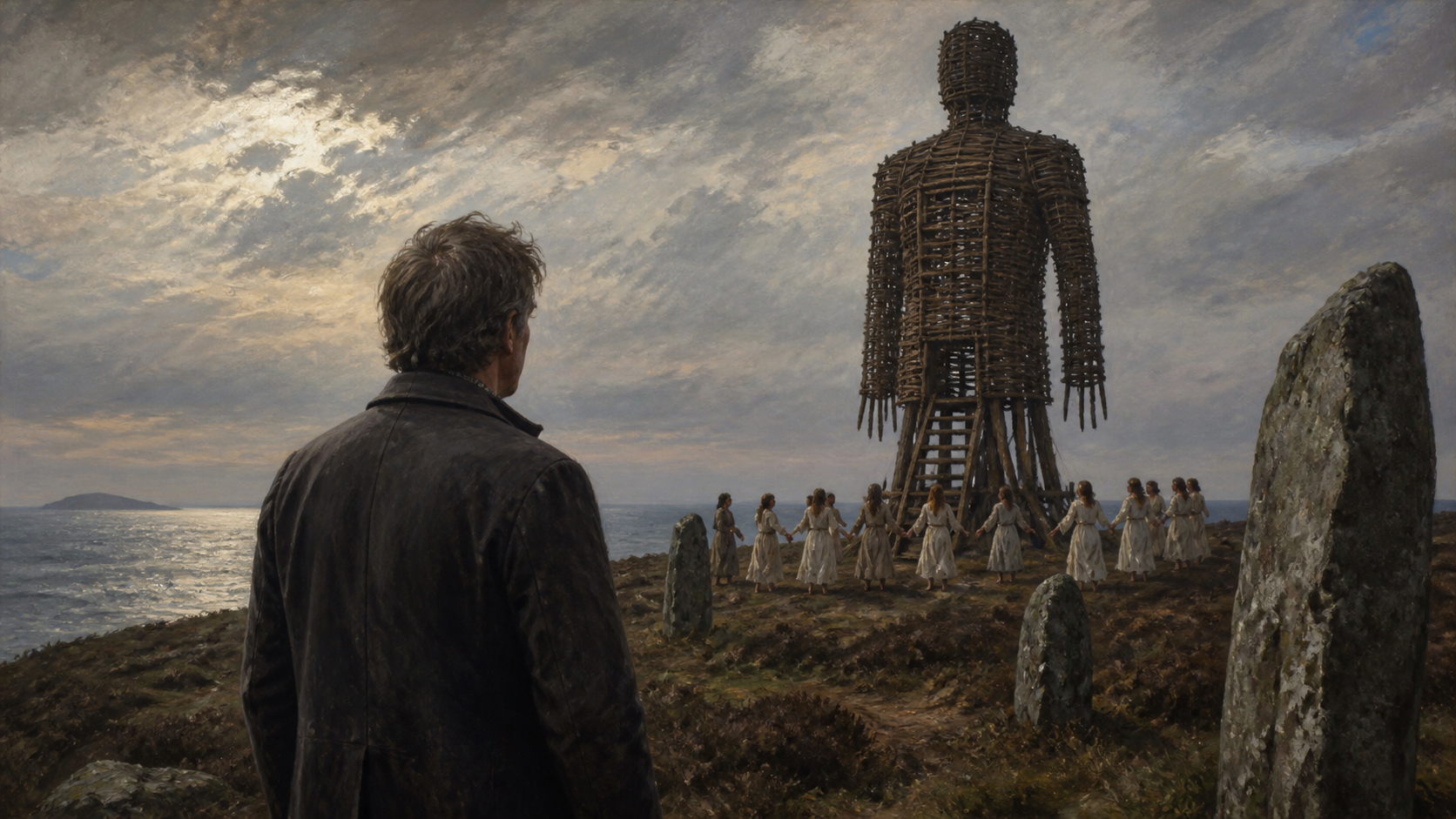
The Wicker Tree is a 2011 British horror film from Robin Hardy, the director of The Wicker Man. Set in a Scottish border community, it follows two evangelical Americans who travel from Texas to preach Christianity and instead find themselves drawn into a place where hospitality, pageantry and pagan custom sit uneasily together. It is best approached as folk horror with a comic, satirical edge, closer to a uneasy spiritual sequel than a straight repeat of its predecessor’s template. The film’s appeal lies in that collision between religious certainty and rural ritual, plus the curiosity of seeing Hardy return to the terrain that made his name.
The Film File
- Original release year: 2011
- Director: Robin Hardy
- Writer: Robin Hardy
- Principal cast: Brittania Nicol as Beth Boothby; Henry Garrett as Steve Thompson; Graham McTavish as Sir Lachlan Morrison; Jacqueline Leonard as Lady Delia Morrison; Honeysuckle Weeks as Lolly; Clive Russell as Reverend Moriarty; Christopher Lee as Lord Summerisle
- Approximate runtime: 95 minutes
- Country of production: United Kingdom
- Relevant horror subgenres: folk horror, religious horror, satirical horror, supernatural horror, cult horror
The film database used by the British Council lists the running time at 95 minutes, the year as 2011, Hardy as both director and screenwriter, and the principal cast named above.
Behind the Screams
The Wicker Tree grew out of Robin Hardy’s long-running interest in extending the world of The Wicker Man without simply remaking it. The film is closely tied to his novel Cowboys for Christ, and the project’s own synopsis frames it around two young Christians from Texas who head to Scotland to evangelise door to door. Hardy wrote and directed the film himself, which makes its tone and shape especially personal: the story is built around his continuing fascination with faith, performance, ritual and the uneasy meeting point between idealism and local custom.
The production is also notable for bringing Christopher Lee back into Hardy’s circle, albeit in a brief role as Lord Summerisle. That casting matters because it positions the film as a spiritual continuation of the earlier work rather than a disconnected imitation. British Lion Films is part of that continuity too, since it is the company associated with the film’s sales and with the original British film heritage around Hardy’s earlier classic. The British Council entry also identifies Tressock Films Ltd as the production company and notes the film was completed.
One useful detail is that the project was in circulation under more than one title. The British Council page identifies the feature as The Wicker Tree, while contemporary coverage and distribution materials also refer to Cowboys for Christ as the source novel and earlier project title. That shift matters because it signals the film’s balancing act: one side of the material leans into evangelical Americana, the other into the folkloric menace of the Scottish setting.
Into the Dark
At its simplest, the film sends Beth Boothby and her boyfriend Steve Thompson, devout young Americans associated with a purity-ring faith culture, into rural Scotland on a missionary trip. They expect rejection, then discover that the border community of Tressock is unexpectedly welcoming. That welcome is not benign. The villagers are interested in the couple for reasons that are only gradually made clear, and the film steadily turns the language of piety, courtship and public devotion into something more sinister and more teasingly absurd.
The conflict develops less like a conventional slasher or supernatural pursuit and more like a ritual trap closing around the outsiders. Beth and Steve are absorbed into local customs, especially the May Day celebrations and the ceremonial Riding of the Laddie, while the village’s social order grows stranger and more controlling. Hardy builds the unease through a clash of values: evangelical certainty collides with pagan spectacle, and the couple’s faith is repeatedly tested by temptation, vanity and social manipulation. The result is a story about vulnerability, not in the sense of physical fragility alone, but the way belief can make people easy to guide, flatter or misdirect.
Spoilers ahead: the following paragraphs discuss major plot developments.
As the film progresses, Beth’s arrival in Tressock is revealed to be part of a wider pagan scheme, and Steve’s own conduct makes him increasingly complicit in his downfall. The village’s rituals are not decorative background. They are mechanisms of seduction and sacrifice, and the film’s central joke, if it can be called that, is that the missionaries arrive intending to convert others while the community has already settled on converting them. The Christian couple’s ideals are steadily broken apart by lust, vanity and confusion, with the surrounding village culture offering each weakness an accommodation.
The ending completes that process with a grimly comic inversion of the couple’s missionary hopes. Beth is trapped within the village’s reproductive and ritual logic, and the film closes on the sense that Tressock has absorbed her future into its own cyclical belief system. This is the point at which The Wicker Tree becomes most clearly a sequel in spirit to Hardy’s earlier work: the horror lies not in sudden revelation, but in realising that the social structure around the protagonists was already prepared to consume them.
What Gets Under Your Skin
The film’s strongest asset is its odd tonal blend. Hardy does not play the material as straight tragedy, nor does he push it into full parody. Instead, he uses awkwardness, innuendo and ritual as the building blocks of dread. That choice will not satisfy viewers looking for the sombre precision of The Wicker Man, but it gives The Wicker Tree a peculiar personality of its own. The horror comes from humiliation and entrapment as much as from overt threat, and the comedy is often the kind that makes the viewer uneasy rather than amused. Contemporary coverage at the time described it as a tongue-in-cheek black comedy, which is a fair way to frame the film’s off-kilter approach.
The performances work best when they register the story’s social friction. Brittania Nicol and Henry Garrett have the unenviable job of carrying the film’s outsider viewpoint, and the script asks them to embody innocence without letting the characters become blank. Around them, Graham McTavish, Clive Russell and Jacqueline Leonard help root the village in a specific kind of theatrical confidence, the sort that can seem hospitable one moment and coercive the next. Christopher Lee’s brief appearance matters less for screen time than for lineage: it gives the film a direct, if fleeting, link to Hardy’s earlier mythology.
Visually, the film leans on the contrast between the practical, open textures of a rural setting and the closed social world that operates within it. It is not a lush or especially polished film, and that modesty has consequences. Some of the material feels staged with the air of a chamber piece, where dialogue and ritual carry more weight than spectacle. That can be an asset when the film is probing belief, but it also means the atmosphere has to do a great deal of work, and the film does not always have the force or precision needed to make every transition land.
As horror, it is more suggestive than punishing. There is temptation, sexual pressure and the threat of sacrificial logic, but the film’s concern is less with shocks than with moral disorientation. That makes it a different proposition from many folk horrors that rely on escalation or revelation. Here, the discomfort comes from watching the missionaries lose control of the terms on which they thought they had arrived. If that sounds like a promising premise, it is, though the film sometimes shows its seams when the script has to explain itself too openly.
The Film’s Afterlife
The Wicker Tree met a mixed-to-poor critical response on release and has largely remained a curiosity rather than a rediscovered classic. Rotten Tomatoes currently lists it under its alternate title Cowboys for Christ; its critical consensus reflects the broad view that the film never quite achieves the potency of Hardy’s earlier work. Contemporary reviews also tended to frame it as a footnote to The Wicker Man rather than as a standalone essential. That reputation has not vanished, but it has settled into a niche: of interest to completists, to folk-horror enthusiasts, and to viewers who want to see how Hardy reworked his own obsessions late in his career.
Horripilations Verdict
An intriguing but uneven folk-horror sequel that finds real flavour in its clash of faith, temptation and ritual, even when the execution is less sure than the premise. Best for viewers interested in Robin Hardy’s thematic return to familiar ground.
What works
- Distinctive folk-horror premise
- Robin Hardy's thematic continuity
- Strong sense of social unease
What holds it back
- Uneven tonal balance
- Less forceful than its predecessor