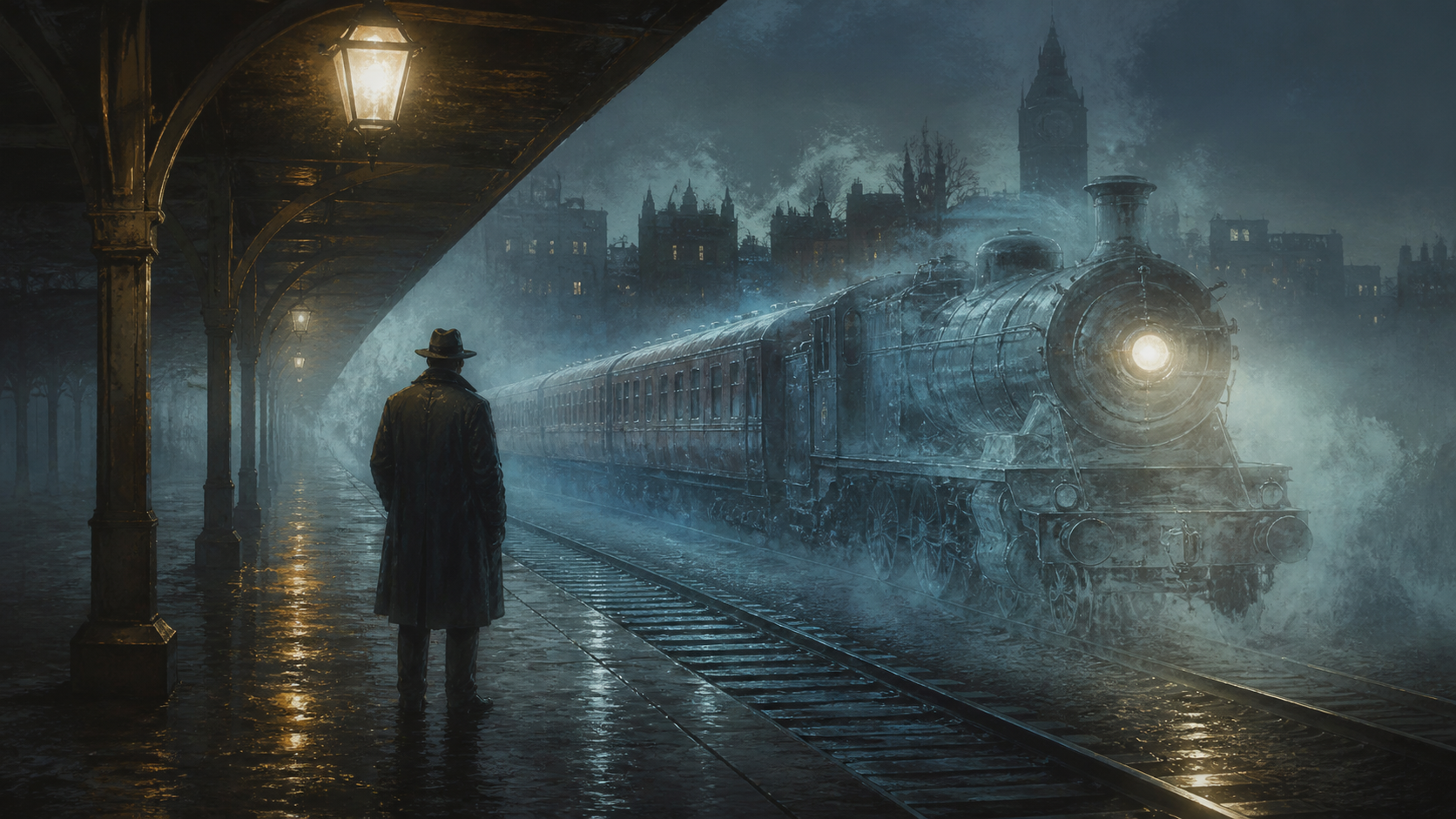
By the time the train reached the outer suburbs, the rain had already turned the windows into one long smeared reflection of the carriage lights.
Callum sat hunched with his backpack between his feet, one hand wrapped around a paper cup of coffee that had gone lukewarm an hour ago. He was tired enough to feel strange about his own body. Everything ached in that dull, administrative way after a day spent on your feet: the soles, the neck, the small muscles between the shoulders. He had spent ten hours loading pallets in a warehouse off the ring road, then an extra forty minutes because one of the forklifts had died and no one else wanted to stay.
Now, at nearly half past midnight, the train was almost empty.
A couple across the aisle slept with their heads tilted towards one another like fruit hanging on a branch. A student in a football jacket had earphones in and his mouth open. At the far end of the carriage, under a flickering strip light, sat an older man in a navy overcoat. He was small and thin, with a neat grey moustache and a leather satchel on his knee. Every time the train rocked, he steadied the satchel with his palm, as if it contained something alive.
Callum noticed him because the man was watching everyone.
Not in a glaring way. Not rudely. Just with a quiet, patient attention that never quite looked away. When Callum lifted his eyes, the man dipped his chin in a polite little nod, as though they were neighbours sharing a lift.
Callum looked down again.
By the time the train pulled into Lytton East, the student had gone. The couple got off earlier, leaving the carriage warmer somehow, heavy with damp wool and tired breath. Callum rose, slung his backpack on, and stepped onto the platform.
The station was one of those half-abandoned urban ones that always seemed to be under temporary repair. One ticket machine was bagged over in black plastic. The fluorescent lights buzzed and made the puddles look greasy. A vending machine in the waiting room hummed to itself with no customers. Beyond the barrier, the road shimmered with reflected brake lights and rain.
Callum checked his phone. No signal.
He swore under his breath.
His mobile had died completely by the time he was leaving work. He had meant to charge it on the train, but the socket by his seat had been out of order and he’d forgotten. He knew the way home well enough, but it was a twenty-minute walk through streets that got less pleasant after dark. He could have waited for a bus, but the buses at that hour were irregular and half the time full of drunks from the pubs near the river.
He pulled his hood up and started out through the station entrance.
There was no one on the pavement outside except the old man from the train.
Callum had not heard him come up behind. He was standing beneath the glow of a closed florist’s sign, umbrella folded under one arm, satchel in hand.
“Excuse me,” he said.
Callum stopped. “Yeah?”
The man’s voice was light, with a London shape to it, the kind that had flattened itself a bit over the years without losing its edges. “Can you tell me the way to Barden Street?”
Callum frowned. “Barden Street?”
“Yes. I’m afraid I’m not from round here.”
He gave a small, apologetic smile. It made him look harmless. Grandad harmless, almost. The sort of man who would apologise to a chair if he bumped into it.
Callum had heard of Barden Street. It was on the other side of the district, close to the old warehouse yards and the motorway slip road. There was nothing there but shuttered mechanics, a row of terraced houses, and a burnt-out pub called The Crown that had been boarded up for years.
“Down there,” Callum said, pointing along the wet pavement. “Then left at the lights, over the bridge, and keep going till you hit the industrial estate. But I wouldn’t walk it if I were you. It’s a bit of a trek.”
The old man nodded as though weighing the information carefully. “I see. And after the bridge?”
“Then it’s straight on.”
“Straight on,” he repeated, and his eyes held on Callum’s face a second longer than necessary.
Callum shifted. “There’s probably a taxi rank at the station if you want one.”
“I’ve been to the rank. No cars.” The man glanced back at the road. “I don’t suppose you’re going that direction yourself?”
“No. I’m heading towards Mayfield.”
“Ah.”
He said it gently, with no visible disappointment. But somehow Callum felt as if he had failed an invisible test.
“Thanks,” the man said. “You’ve been very kind.”
He turned and walked off, his shoes tapping softly through the wet.
Callum watched him go for a moment, then shrugged to himself and headed the opposite way.
He had got no further than the corner when he heard footsteps behind him again.
Not hurried. Measured. Almost in time with his own.
He glanced over his shoulder.
The old man was coming the same way, head slightly bowed against the rain.
Callum frowned and stopped. The man stopped too, three metres back, under a broken streetlamp that blinked orange and then went dark.
“You all right?” Callum asked.
The old man looked up. The streetlight above them shuddered back to life, painting one side of his face in a weak amber wash. “I am now,” he said.
There was something odd in the way he said it.
Callum felt a prickle rise under his collar. “I told you, Barden Street’s the other way.”
“Yes, you did.”
“Right. So…”
The man smiled again, patient and thin. “You might have misunderstood me.”
“What do you mean?”
“I asked for the wrong street.”
Callum let out a short laugh that was more nervous than amused. “What, you want Barden Street or not?”
The old man adjusted his satchel strap. “No. I wanted to know whether you’d send me there.”
Callum stared at him. Rain ticked on the pavement between them.
“Send you there?”
“It’s a very useful talent, if one knows how to use it.”
Callum snorted. “I’ve got a job in a warehouse, mate, not magic beans.”
The old man’s eyes did not move. “You’d be surprised what people carry without knowing.”
A horn blared at the far end of the road. A taxi rushed past, water hissing from its tyres. For a second Callum felt normal again, annoyed instead of uneasy. “Look, are you winding me up or what?”
“No,” said the man. “I’m trying to be polite.”
He lifted one hand, palm out, in a gesture that could have meant goodbye.
Callum turned away.
He had only gone ten steps before a woman on a bicycle shot out of a side street and nearly clipped him. He stumbled back with a curse. She yelled something at him, furious and half drowned by the rain, and swerved away into the dark.
By the time Callum looked back, the old man was gone.
He stood there a moment, heart thudding, then shook himself and carried on.
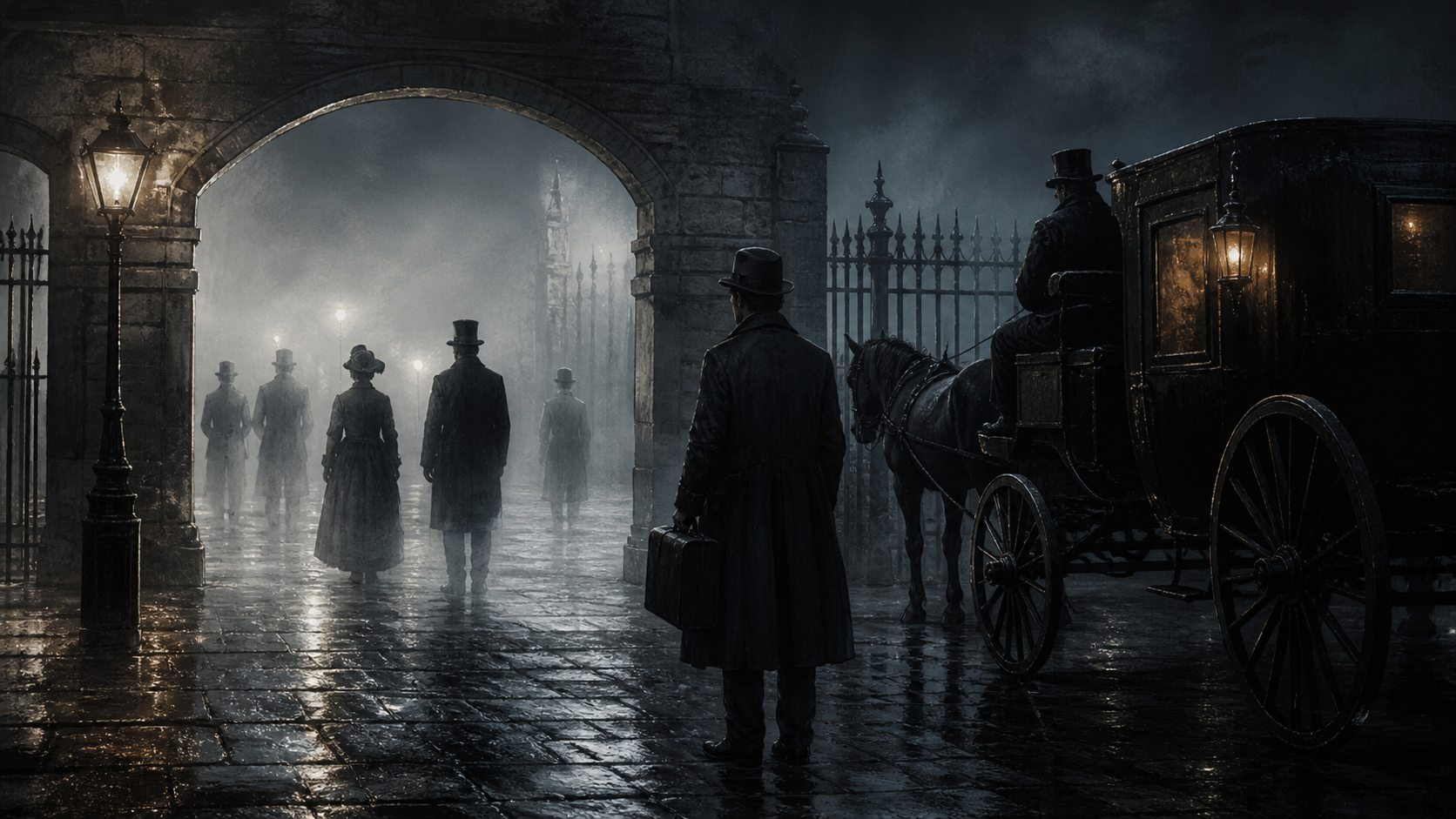
The walk home took him through a strip of takeaways and closed shops, then into streets with terraced houses and overgrown front gardens. The rain eased but left the air cold and metallic. At the corner by the off-licence, he stopped under the awning to take shelter and saw, across the road, the old man standing in front of a chemist that had been shut for months.
Callum’s stomach tightened.
He crossed towards him. “How are you doing that?”
The man tilted his head. “Doing what?”
“Following me.”
“I’m not following you.”
“You’re standing there again.”
“Yes,” said the old man. “Because you told me where to go.”
Callum stared. “I did no such thing.”
“You did. You told me straight on.”
A pulse of irritation cut through the fear. “That was directions.”
The man gave a tiny shrug. “All directions are instructions.”
Callum opened his mouth, then closed it. For a moment he had the absurd sensation that the pavement had tipped beneath him, that the street was only a thin surface over something deeper and more aware.
A car passed with its lights on full beam. When the glare faded, the old man was closer.
Not abruptly. Not in a way Callum could point to. But now he was at the edge of the awning, where rain dripped from the gutter to land on his shoulders.
Callum took a step back. “Leave me alone.”
The man looked mildly surprised. “I have not touched you.”
“I don’t care.”
For the first time, the smile vanished from the old man’s face.
“Then care quickly,” he said.
Something moved behind him in the chemist’s dark window, but Callum could not tell if it was his own reflection shifting, or another shape taking form. He blinked, and the window was empty again.
He made a decision then, in the hard animal part of him. He would not go home by the usual route. He would cut through the estate, maybe lose the old man in the alleys, maybe reach a main road with more people. There was a 24-hour garage by the traffic lights where he could call his sister, use the payphone if he had to. He’d laugh about it later. A creepy old bloke, a weird joke, nothing more.
He crossed the road at a jog.
“Callum.”
The voice came from behind him, clear as a hand at the back of his neck.
He froze.
No one in his life outside work used his name. He turned slowly.
The old man was on the pavement opposite, but now he was not alone.
A second figure stood beside him, a woman in a yellow raincoat with the hood up. Her face was not visible. In the wet streetlight, she looked oddly cut out, flat and bright like something placed there.
Callum’s mouth went dry. “Who’s that?”
The old man glanced at the figure as though noticing it for the first time. “You should not have answered.”
The woman in the yellow coat lifted one hand and pointed.
Not at Callum.
Past him.
He turned.
At the end of the street, where the row of houses gave way to a narrow lane between boarded-up garages, someone was standing beneath the flicker of a security light. A tall shape. Broad-shouldered. Head bent.
For a second Callum thought it was another stranger.
Then the figure raised its face into the light, and he saw that it had no features worth naming. Just a slick pale oval, wet as wax, with a mouth that opened too wide.
It started walking towards him.
Callum ran.
He heard the old man shout something behind him, sharp and angry, but the words were swallowed by the pounding in his ears. He bolted down the side street, skidded on the wet cobbles, nearly fell, caught himself on a brick wall slick with moss, and pushed on.
The estate was a maze of identical blocks and service roads. He knew it by day, not by night, and now every turn looked wrong. There were dim entries, overflowing bins, bicycles chained to railings, the smell of stale frying oil seeping from vents. No people. No open windows. Just rain and the hum of distant traffic.
He reached a row of garages and found the gate locked. He pivoted left, then right, then realised with a sick lurch that he was back where he had started. The security light above the garages clicked off.
In the dark, something moved.
Callum backed away, breathing hard, and nearly collided with a parked van. He threw himself sideways and found a narrow passage between two houses, a passage he had never noticed before. It was barely wide enough for a person. A rusted wheelie bin blocked part of it. He squeezed through and stumbled into a back lane lined with gardens and fence panels.
There was a sound behind him.
Not footsteps. Scraping.
He looked back and saw, at the mouth of the passage, the old man standing perfectly still.
The woman in the yellow coat was gone. The faceless thing was gone.
Only the old man remained, umbrella still folded under his arm, his satchel dark with rain.
For a moment the two of them stared at each other across the narrow lane.
Then the old man spoke, and his voice had changed. It was flatter now, stripped of its earlier politeness.
“You should not have sent me that way.”
Callum swallowed. “What are you?”
The old man considered the question. “Tonight, I think, I am your problem.”
Then he stepped to one side, as if making room for something behind him.
Callum looked.
At first he saw only the lane beyond, the back fences, the slant of rain. Then he noticed that the darkness at the far end was not darkness at all. It was depth. A mouth in the world, opening between two houses where there should have been only brick and nettles and a recycling bin.
He could see movement within it. A corridor, perhaps. Stairs. An indoor light flickering somewhere far down. And voices, indistinct but pleading, as though from a crowded room.
His skin crawled.
“No,” he whispered.
The old man’s expression was almost pitying. “You may go home if you like.”
Callum stared at him. “Go home?”
“Yes. But if you do, I shall have to ask someone else for the wrong street.”
A gust of wind made the lane shudder. Callum’s breath came in short sharp pulls. The opening at the end of the lane seemed to widen, like a door being opened by an unseen hand. Something white and thin stirred inside it, as if paper were being moved by a fan.
He remembered the train carriage. The old man watching. The question. The way he had asked for Barden Street with such careful courtesy, as if he expected the answer to matter.
“What happens if I tell you the right one?”
The old man blinked once. “Then you will have done me a kindness I cannot permit.”
Callum did not understand that at all, which frightened him more.
He reached into his pocket and found his phone. Dead. Useless. He nearly laughed from the absurdity of it. He was thirty-one years old, standing in a filthy back lane, and his only plan was a dead mobile and a man with a satchel opening the dark behind him.
The old man sighed. “I am running out of patience.”
Callum’s gaze flicked to the fences, the bins, the back doors. On the far side of the lane, two storeys up, a kitchen window glowed. A woman’s silhouette moved across the blind. There was a human life there, real and ordinary, and it felt suddenly precious.
He backed away from the opening. “What do you want from me?”
“Only the street.”
Callum shook his head. “No.”
The old man’s face hardened. Something in the line of his mouth, the set of the eyes, changed him at once from harmless to ancient and hostile. “Then give me a better answer.”
He took one step into the lane.
Callum moved before he had time to think. He grabbed the nearest thing to hand, which turned out to be the wheelie bin he had squeezed past earlier. It was heavy and reeking. He heaved it between them with both hands and sent it slamming into the old man’s legs.
The man staggered, more from surprise than pain, and for a heartbeat Callum saw his face twist into something wrong, the skin bunching too tightly over the bones, the mouth stretching at the corners far beyond what a human face should do.
Callum ran.
He burst out of the lane into a cul-de-sac with parked cars and a row of detached houses. One of them had a porch light on. He pounded up the steps and hammered on the door with his fist.
“Help! Open the door!”
No answer.
He looked over his shoulder.
The old man was in the lane mouth, but now the street behind him was not a street. It was the interior of something vast and dim, corridors branching away, walls sweating with rain, shapes flitting at the edges of sight. The opening kept changing size, as if deciding whether it could take him whole.
The old man stepped onto the cul-de-sac and the world snapped back into place, but only for a second. Then, in the reflection of a nearby car window, Callum saw the thing behind the man. Not a body. A crowd of bodies. Pressed close, layered and moving, all of them peering through the same wet face.
He screamed in pure disgust and fear.
The front door at the house opened at last. A woman in her dressing gown stood there, blinking, one hand still on the chain.
“What on earth is it?”
“Please,” Callum said, almost choking on the word. “Let me in.”
Her eyes went past him to the street, and her face changed. “Martin?”
The old man inclined his head. “Good evening, Mrs Harlowe.”
The woman went white. “No. No, not again.”
Callum looked from one to the other. “You know him?”
She was already pushing the door wider. “Get inside, now.”
Callum did not wait to be asked twice. He stumbled through the doorway, nearly tripping on the mat, and the woman slammed the door behind him and threw the chain. She had one of those practical kitchen knives in her hand, the sort kept in the block by the sink.
The old man stood on the step outside.
But when Callum looked through the small glazed panel in the door, he did not see only one man. He saw, for a fraction of a second, dozens of faces in the rain beyond him, pressed to the glass of the world like listeners at a wall.
Mrs Harlowe whispered, “He found you.”
Callum stared at her. “Who is he?”
She did not answer. Her attention was fixed on the door with absolute dread.
The old man tapped once, softly, with his knuckle.
“Mrs Harlowe,” he said. “I asked for Barden Street.”
She flinched as if struck.
Her mouth opened, then closed. The knife trembled in her hand.
“You should not have answered,” she said.
Then she began to cry.
Callum’s blood ran cold.
Outside, the old man smiled in the narrow rectangle of glass.
“It was the wrong street,” he said, with perfect, intimate gentleness. “And now he knows where you live.”
The porch light exploded.
For one blinding second the hall filled with white sparks and hot glass, and something slammed against the front door hard enough to shake the frame. Mrs Harlowe screamed. Callum threw up an arm, cursing, as the room went dark except for the red pulse of the smoke alarm.
There came a sound from outside like several people trying to breathe through one throat.
Then silence.
No one moved.
The dark held.
Callum could smell singed dust and wet wool. The woman beside him made a broken little choking noise and backed away from the door as though it might open by itself.
A voice from outside, now far away and very calm, said, “That was careless.”
The lock clicked.
The chain rattled once.
Then there was a scrape, not from the handle but from somewhere lower down, as if nails were dragging through the wood.
Callum did the only thing that made sense. He grabbed Mrs Harlowe by the elbow and dragged her towards the kitchen at the back of the house.
“Back door,” he hissed.
She shook herself free. “No, wait. Wait.”
But she was looking at the hallway mirror, and Callum followed her gaze.
For a moment, in the black glass, the hall behind them was full of people.
They were standing shoulder to shoulder, damp and patient, all facing the front door.
Among them, clear as day, was the old man.
He was looking not at the door, but at Callum.
Then the mirror went dark.
Mrs Harlowe made a sound like a sob being swallowed. “He’s inside.”
Callum spun round.
The kitchen door at the end of the hall was open.
A shape stood there, blocking the yellow light from the room beyond. Not the old man now. Something taller. Bent. Wearing his overcoat like a skin.
And it spoke in the old man’s voice, with the same courteous fatigue as before.
“Could you tell me, please,” it said, “the way to Barden Street?”
Callum did not answer.
Because behind the thing in the doorway, reflected in the black microwave window, he could see the rest of the house filling up with faces. Silent faces. Waiting faces. Every one of them turned towards the hall as if waiting for someone to make the right mistake.

Urban Legends