Sickly Harvest
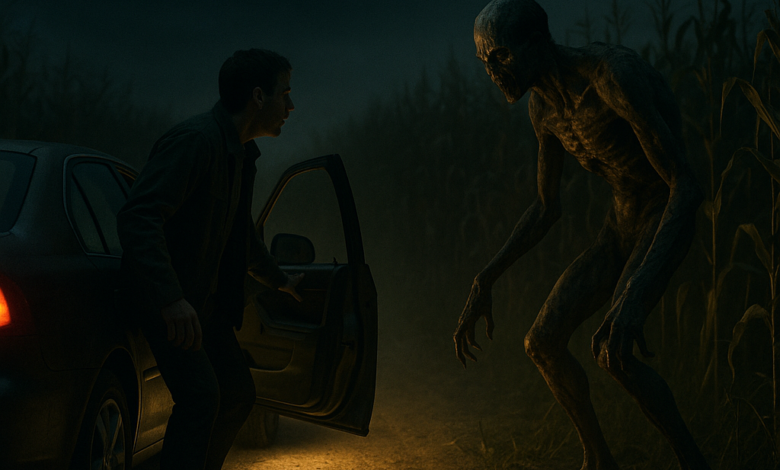
The squelch of mud stuck beneath his wellington boots made Peter grimace as he slogged through the thick, damp soil of Wetherby Hollow. The village had been abuzz with the unsettling tales of livestock and wildlife disappearing without a trace, leaving behind nothing but traces of blood and an eerie silence in their wake. What local folk talked about in hushed tones, Peter intended to confront head-on. He had been a farmer all his life, and the peculiar disappearances posed an imminent threat to his livelihood.
The first sign of something amiss had come on a grisly morning when he found one of his sheep withered and gasping for breath, splattered with a pattern of dark spots resembling mold. The vet had said illness; the villagers whispered of a curse or, worse, something intangible prowling the edges of their world. Peter had buried the lamb, and in a fit of defiance, decided to investigate before the entire flock succumbed.
As he made his way deeper into the hollow, the trees bowed like mourners at a funeral but remained as silent witnesses to his plight. Occasionally, he caught sight of tufts of fur or feathers lodged in branches, remnants of something that should be gone by now. A gnawing unease settled in his stomach. Something was feasting on the life of the land.
He reached a decaying fence where he often found pathways leading into the thickets beyond. There, at the base of a gnarled oak, he knelt down and noticed a formation of tiny, shimmering spores centred in a perfect circle—a visually baffling display against the dying brown earth. The air smelled damp and sickly sweet, a perfume both alluring and unsettling. He felt the urge to touch it, compelled by an instinct he couldn’t explain. But the lingering presence of an ancient fear kept him at bay, and he chose to retreat instead.
As night descended, a chill gripped the air, causing him to shiver despite his thick coat. He grabbed a lamp and began his trek back home, but a sudden sound—a rustling among the brambles—stopped him in his tracks. It was a flurry of wings; startled, he raised the lamp to reveal a dishevelled barn owl, its feathered form slick and unnatural. The bird’s eyes, wide and wild, held a frantic look that made Peter’s heart race. Before he could calm it, the owl fluffed its matted feathers, and with a single flutter, left behind several small, translucent eggs that rolled to his feet.
Confused, Peter stared at the quivering shells shimmering in the lamp’s glow. He felt the instinct to destroy them, to rid the world of those strange ovoid shapes, but something stopped him. Senses heightened, he heard a low rustle, a movement that echoed within the stillness of the night. It wasn’t the owl it was trying to evade.
He picked up a stick and swung it, preparing himself for whatever hunted beneath those trees. But whatever it was remained obscured, a predator edging closer, perhaps waiting for the right moment. The air around him thickened, heavy with the pungent aroma of decay. He backed away, heart hammering in his chest, the distant tale of missing livestock now a palpable fear gnawing at his sanity.
The following day, Peter pondered his discovery in the light of morning. Could the spores and eggs be connected to the vanished animals? As he wrestled with his thoughts, he noticed a strange rash appearing around the edge of his forearm. Smooth, glossy, and faintly shimmering, it spread like a living thing slowly creeping over his skin. Panic seized him, and he rushed home to scrub at the mark, desperately trying to wash away something that had already seeped into him.
Days passed, and the villagers had grown wary, the air thick with anxiety and darkness. More livestock had turned up limping, lamed by unexplainable weakness. Desperation drove Peter to the library, the old archive brimming with dusty tomes of nature and lore. Flipping through pages, he stumbled upon sporadic references to parasites that controlled their hosts, beings that manipulated life for sustenance. The parallels drew an unsettling picture.
“Like a disease, overtaking,” he murmured to himself, haunted by the images it conjured. If the rash on his arm grew, if he lingered in Wetherby Hollow too long, would he succumb as well?
On an impulse, he returned to the oak, where he carefully examined the strange spores and decided to burn them, hoping to halt whatever sickness lurked there. That evening, he gathered dry branches and made an initial fire, allowing his rage and fear to engulf the last vestiges of the cursed land.
What came next was a symphony of shrieks. A host of small creatures erupted from the shadows, swarming like angry bees. Their forms obscured by the swirling smoke, they descended upon him, bearing wings glistening with the same sickly sheen as the eggs he’d seen. With a heart pounding in his chest, Peter fought back against the storm, desperately waving his makeshift torch—a futile act against the encroaching tide.
The creatures roiled around him until he felt their grip, tight and probing, slithering beneath the fabric of his clothing towards his very skin. Their leathery wings caressed him in a bald attempt to attach and burrow. He screamed, stumbling backward, but not before one managed to pierce the raw edge of his rash with a tenderness that felt like a promise.
Peter fell, clutching his arm, the world spinning as their assault shifted to a slow drift. The ground beneath him felt wet, as though the earth itself rejoiced at his suffering, and he quickly realised he was not the first to become a vessel for this parasitic swarm. The air rippled with movement, the landscape wavered beneath the weight of countless whispers, and the animals began to surf his consciousness like tide pulling at the shore.
In the culminating chaos, he saw faces—his own sheep, disoriented and melded, utterly lost within a desecrated body. Desperation gripped him. They were feeding, using him to move freely now and for what? The insatiable hunger defined the boundaries of his lost humanity, and yet a flicker of resolve lit within. They would not consume him completely.
Utilising the knowledge he had learned from the books, something instinctual sparked—Peter focussed his thoughts against the disturbance that threatened to drown him, consolidating the strength of his will. Squaring his shoulders, he fought against the darkness creeping into his mind, but while he struggled, the creatures thrashed against the corners of his sanity.
As he wrestled for control, he saw an opportunity. With one final push, he ignited the fire surrounding him, letting the flames burn brightly alongside his defiance, ensuring that the swarm of twisted life would have no hold on him.
When morning light broke, Peter lay sprawled and weary, the remnants of vanished creatures drifting in smoke above. He had produced an irreversible choice. The path back was forever lost, and each breath tasted like ash. At last, he gazed down at his arm; the once-glossy rash dulled, the eerie shimmer extinguished but accompanied by the nagging sensation of something still pulsing beneath.
Wetherby Hollow still stood, but life had shifted yet again; the threat had not vanished but morphed into something new. No longer fearful whispers of villagers would ring through the trees but a growing acceptance of a reality that coexisted now within them. Embracing the sickly harvest as shadows lengthened, Peter lifted his gaze up to the oak from which he had conjured his last resolve, but something was ever so silent, curling like tendrils beneath the earth, whispering promises of undying life below.