The first time Mara heard the singing, she thought it was the building.
St. Jude’s was a dead thing in the rain, all soot-black stone and blocked-up windows on the edge of the old docklands, its bell tower lopped off long before the city council had decided churches could be luxury flats if you painted them white enough. The rehearsal rooms sat in the converted vestry behind the nave, where the heating pipes clanked and the damp rose through the floorboards no matter how often they were treated. On Friday nights the place smelled of dust, wet wool and old hymn books.
“Could be the boiler,” said Lewis, closing the door behind him with his shoulder. “Or ghosts. Your choice.”
Mara set her case down and gave him a look. “You’ve got a stupid face when you’re trying to be funny.”
“That’s the nicest thing you’ve said to me all week.”
He was smiling, but the smile thinned as he noticed she wasn’t. There were eight of them in the chamber choir now, down from twelve in the spring. People dropped out because of work, babies, moving abroad, bad attendance, or simply because life had got meaner and noisier and they no longer had the patience for unpaid singing in a cold church on a Friday. Tonight only six were here. The others were late or ill or had sent apologies with the guilt of the permanently unavailable.
Joanna, the conductor, was already at the piano, sleeves rolled to the elbow, her silver rings flashing as she marked the score with a pencil. “Right, places. We’ll do the Tallis first, then the new piece.”
“What new piece?” said Lewis.
Joanna didn’t look up. “The one I sent you. If you read your email occasionally, you’d know.”
Mara took her usual place, third from the left in the soprano line. She glanced across at Priya, who mouthed, “What new piece?”, and then at Tom, who simply shrugged. Tom was the sort of man who had made a life out of shrugging, a warehouse manager with a soft voice and a nice tenor, the kind of person who apologised to chairs if he bumped into them.
Joanna began the Tallis. The first phrases were tentative, the room settling around them like a coat. Mara felt her shoulders loosen. Singing always did that. Even on bad weeks, even when her mother rang during the commute to tell her in a tight voice that the biopsy had been moved again, the act of breathing together made some small arrangement in her chest. The notes rose and braided and for a while the world was only that.
Then, from somewhere beyond the vestry wall, there came a thin metallic sound.
Clink.
The choir broke.
Joanna stopped playing at once. “What was that?”
No one answered. Lewis gave a short laugh that sounded forced. “Probably someone in the nave. One of the security lads, maybe.”
The building was supposed to be empty after six, but St. Jude’s had a habit of becoming inhabited by contractors, squatters, and the occasional teenager looking for a place to drink and be sick in peace. Still, the sound had not been footsteps, or coughing, or a dropped tool. It had been deliberate. A small, hard, bright little noise.
Joanna looked annoyed in the way only musicians can look annoyed, as though noise itself had committed a personal insult. “We’ll ignore it. Again.”
They started the Tallis from the top. The second time, the sound came again, this time accompanied by another, lower one, like a spoon tapped against a basin.
Clink. Clink.
Priya frowned. “That’s not the boiler.”
Mara heard herself say, “No.”
And then the singing began.
It came from behind the wall on the far side of the vestry, where the old confessional booths had once stood before the partitions were ripped out and the space turned into a storage area. At first she thought it was another choir, very faint, reaching them through the masonry. But the voices were not singing words. They were humming a single note, then another, rising and falling in a pattern that made the skin on her forearms tighten.
Joanna’s face changed first. She lifted her hands from the keys. “That’s impossible.”
Lewis was already on his feet. “There’s someone in there.”
The hum deepened, and with it came the metallic noise again, louder now. Clink, clink, clink. A rhythm. Not random.
Tom swallowed. “Could be on the other side of the yard.”
“There is no one on the other side of the yard,” said Joanna sharply. “The new flats are empty. The site is fenced off.”
The humming stopped.
Silence fell so suddenly that Mara could hear the radiator ticking.
Then a voice, muffled but unmistakably close, spoke from the wall.
“Come out and sing.”
No one moved.
The voice was male, young perhaps, but with an odd softness to it, as if spoken through cloth. “Come out and sing,” it repeated, patiently, almost kindly.
Lewis laughed once, too loud. “Nope.”
He crossed to the door, yanked it open, and looked into the corridor. The fluorescent light buzzed. Nothing was there. He turned back with a flourish that tried to pass for bravado. “See? Prank. Probably kids.”
But Mara noticed he hadn’t gone past the threshold.
Joanna stood. “I’m going to check the nave. You lot stay here.”
“Absolutely not,” said Priya.
Joanna ignored her and walked out, the piano stool scraping behind her. After a moment Lewis followed, then Tom, then Priya with a muttered curse. Mara hesitated. The sensible part of her wanted to stay where there were walls and a lock, but curiosity, or something less sane, pulled her after them.
The corridor opened into the nave through a set of double doors. St. Jude’s interior was half in darkness, the floodlights outside making cold rectangles through the high windows. Folding chairs had been stacked near the font for a planned recital. The altar had been stripped bare years ago, but the old stone still held a hush that made every step feel profane.
Nobody was there.
Then Mara saw the door to the crypt stairs standing open.
“It’s below,” whispered Tom.
Joanna looked at it with a rigid expression Mara had never seen on her before. “Who’s been down there?”
“Not me,” said Lewis.
The crypt had been sealed for years after a burst pipe flooded the lower chamber. Most of the lower access was padlocked. Yet the heavy oak door hung ajar, and from below came the same faint chiming noise, like cutlery in a sink.
Clink. Clink. Clink.
Joanna should have called the police then. Mara knew it and saw it in the others’ faces too, the moment where ordinary embarrassment and disbelief were supposed to give way to common sense. But there was also the embarrassment of being frightened by a sound, in a church, in front of your friends. There was the absurdity of admitting fear before you had proof of danger. Joanna set her jaw and began down the steps.
“Joanna,” said Mara. “Wait.”
But she kept going.
The crypt smelled of earth and rust. A temporary worklight glowed in the far chamber, not powered by the church mains, but by a generator or battery pack. It cast long shadows on the stone arches. On the floor, arranged in a rough circle, were metal bowls, crowbars, kitchen knives, screwdrivers, secateurs and broken lengths of saw blade. Rusted, all of them. Some were streaked with dark brown old blood.
Mara stopped dead.
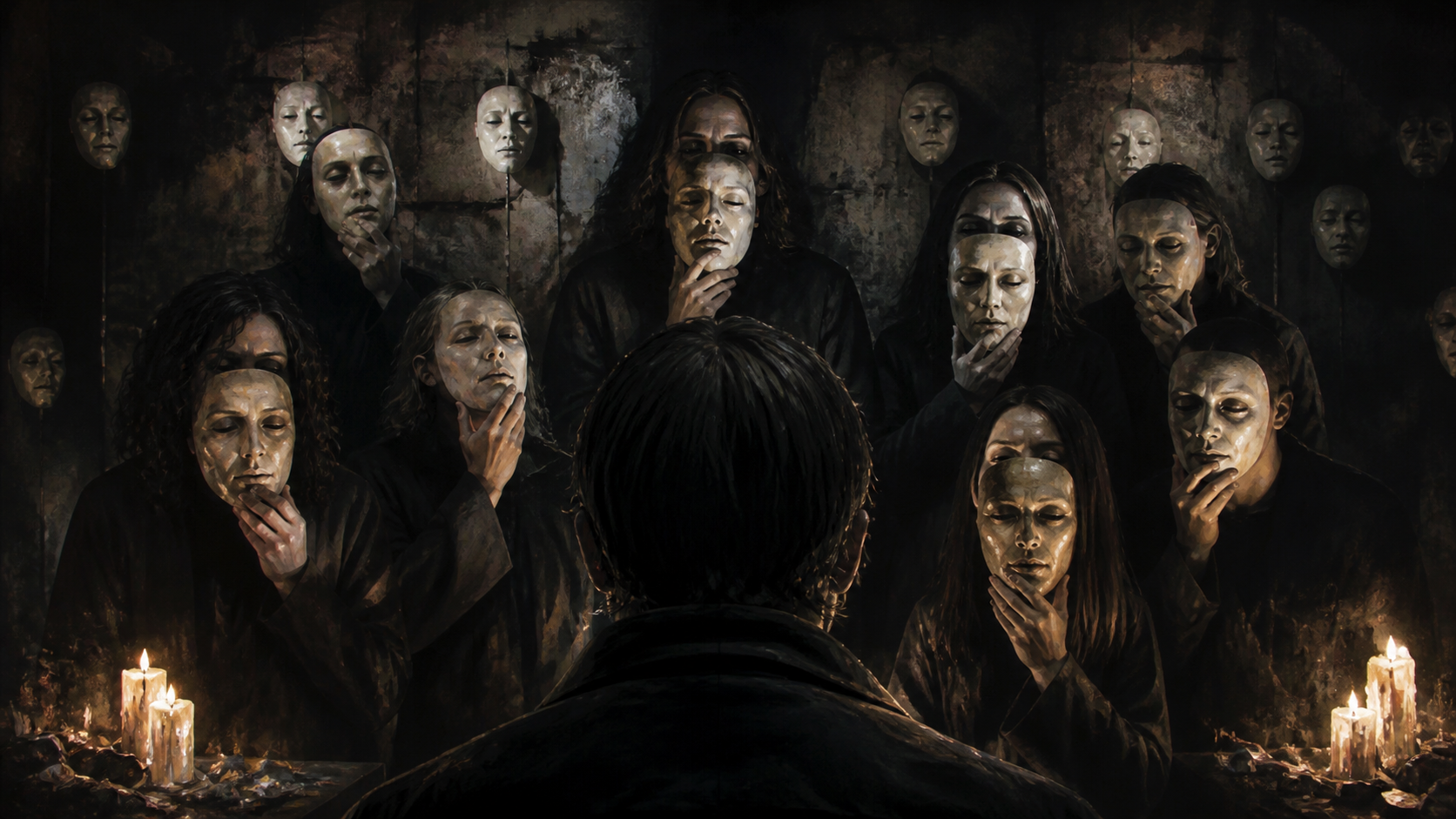
At the centre of the circle stood a man in a dark coat, his face hidden by the hood. Around him were six more figures, perhaps seven, hard to count in the shifting light. They wore masks fashioned from wire mesh and painted plaster, crude faces with holes cut for the eyes and mouth. One of them held up a kitchen knife and struck it gently against a spoon. Clink.
The choir.
“Welcome,” said the man in the coat. “We were worried you wouldn’t come down.”
Joanna’s voice came out flat. “Who are you?”
“Tonight?” He spread his hands. “An audience.”
Lewis took a step back, and his heel scraped stone. Every masked head turned towards him at once. The movement was so precise it seemed rehearsed.
The hooded man looked at Joanna. “You’re in charge. I can tell. You make the brave noises.”
“Get out of the building,” she said. “Now.”
He gave a little sigh, almost disappointed. “No. We’ve only just begun.”
Then the nearest masked figure moved.
It happened too fast for Mara to fully register. One second the person was standing near the bowls, the next they had lunged at Tom with a hooked length of metal. Tom screamed and stumbled away, the blade catching his arm and opening it from wrist to elbow. Blood sprayed across the stone. The smell hit Mara almost immediately, hot and coppery.
Everything turned chaotic.
Lewis shoved Mara hard towards the stairs. “Run!”
Joanna snatched up a music stand from the side of the room and brought it down on the nearest attacker’s head. The frame bent with a horrible clang, but the masked figure only staggered, then swung a knife at her face. She ducked, losing her glasses. Priya was already scrambling back up the steps, one hand clamped over her mouth. Tom fell to his knees, his blood darkening the front of his shirt.
Mara started up, then froze when she saw the hooded man blocking the stairwell above them. He had moved without haste and now stood at the top like a doorman, one hand on the rail. In the other he held a long butcher’s knife with a serrated back.
“Not yet,” he said gently. “You haven’t heard the rest.”
Lewis charged him.
It was a stupid, brave thing to do. He was broad shouldered, strong from years of carrying speakers for his band, and for one perfect second Mara believed he might knock the man aside. Instead the hooded man stepped in close and drove the knife into Lewis’s abdomen with a quick, economical motion. Lewis made a noise that was not a word. Blood poured down the handle and over the man’s glove.
Lewis looked down in disbelief, then at Mara.
His mouth opened. No sound came.
The hooded man pulled the knife free and Lewis collapsed sideways against the rail, his blood slicking the stone steps. Mara screamed. She heard herself scream and knew it would bring nobody. Joanna, below, was shouting for them to move, move, move, but the steps were blocked by bodies and panic and the smell of blood.
Then the masked figures began to sing.
It was not music, not properly. They took the same note they had hummed before and forced it into harmony, each of them on a different pitch, the sound raw and dissonant and somehow ecstatic. As they sang, they advanced, knives and screwdrivers and rusted blades glinting under the worklight. Mara backed up until her shoulder hit stone. She fumbled for her phone with shaking hands and managed to unlock it, but there was no signal. Of course there was no signal. Someone had brought a jammer. Of course they had.
A blade flashed. She jerked away and felt a slicing heat across her upper arm. Not deep, but enough to make her gasp. Blood ran into her sleeve.
Priya appeared beside her, white-faced, clutching a wrought-iron candlestick she had somehow found. “There’s a side passage,” she said. “I saw it. Come on.”
“I can’t leave Lewis.”
“He’s dead, Mara!”
The words hit like a slap. Mara looked down at him and saw, with a coldness she would carry for the rest of her life, that Priya was right. Lewis’s eyes were open, staring at nothing, the blood soaking into the stair carpet in thick, dark ribbons.
Joanna climbed to the middle step, one hand over her forehead where she had been struck, her hair coming loose. “Go,” she cried. “Get out!”
A masked figure lunged for her. Joanna drove her knee up and, with astonishing ferocity, seized the attacker’s wrist and bit down hard. The person howled. She tore free and kicked them backwards into another body. For a moment Mara saw not the conductor, but a woman with blood on her face and terror in her eyes, refusing to fall.
Priya grabbed Mara’s good arm and hauled her towards a narrow service door set into the crypt wall. It stuck at first, then gave with a shriek of rusted hinges. Behind it was a passage no wider than Mara’s shoulders, descending into blackness. The walls sweated. Pipes ran overhead like bones.
They stumbled into the passage just as something heavy slammed against the door behind them.
“Keep going,” hissed Priya.
The passage bent and dipped. Mara could hear footsteps behind them, a wet, dragging pursuit, and beneath that the singing, louder now, as if the voices were coming through the walls themselves. The metal in the ceiling rang with every impact. Priya was crying but still moving, one hand outstretched, the other holding the candlestick like a useless sceptre.
They emerged into a lower maintenance corridor, lit by a single emergency bulb. Ahead was a fire door marked EXIT. Mara nearly sobbed with relief. She lunged for it, but it was chained from the other side.
“Bastards,” Priya whispered.
Something thudded behind them. The passage door had opened.
Mara looked round.
The hooded man stood at the entrance, knife in hand, coat dark with Lewis’s blood. Behind him, one of the masked figures was dragging Tom by the ankles into the passage, his head bouncing once against the floor. Tom’s face was grey. He was still alive. Barely.
“Please,” Mara said, and hated herself for saying it.
The hooded man tilted his head. “Now you’re listening.”
Priya lifted the candlestick and threw it. It struck the man’s face with a crack of metal on bone, and he staggered back. In the same motion Mara threw herself at the chained fire door, screaming, shoulder first, and felt the chain bite into her collarbone as the door jolted. Again. Again. The links slipped enough for a gap to appear. She wriggled through, tearing skin from her arm, and fell into cold night air.
Rain hit her face. She was outside, in the service yard behind the church, between a rusted skip and a row of overflowing bins. Floodlights from the nearby road threw a sodium blur over the brick wall. She dragged in breath, nearly choking, and turned to see Priya still inside, one hand through the gap, reaching.
“Mara!”
Mara seized her wrist. Priya’s fingers were slick with blood. Something smashed against the inside of the door, and a scream burst out, cut short. Mara pulled with all her strength. For one desperate second Priya was in the gap, eyes wild, face grey with panic.
Then the hooded man’s hand appeared over her shoulder, holding the knife.
Mara saw what he did before he did it, but not enough to stop it. The blade drove down between Priya’s neck and collar, then a second time under the jaw. Priya’s eyes widened. Blood pumped over Mara’s hand, hot and slippery. Priya’s grip went slack.
Mara fell backwards into the rain.
The door banged shut.
For a moment she could not move. She just stared at her own hands, red to the wrists. Priya’s blood was everywhere, shining in the yard lights, in the seams of her sleeves, on her chin where she had wiped her face without knowing. Her body tried to make sense of what had happened and failed.
Then she heard singing from inside the church.
Not the ragged, horrible humming from before. This was a fuller sound, a triumphant chord, voices layered and rising as though the choir had found its proper arrangement at last.
Mara understood then, with a clarity so brutal it felt like another wound, that this was not a random massacre. They had wanted a choir. Wanted the sound of voices gathered in a sacred room. Wanted witnesses. Wanted some piece of them for whatever private sacrament was unfolding below the church.
She backed away, one step at a time, then turned and ran.
The yard gate was locked, but the lock was old and cheap. She hammered at it with her shoulder until it gave. On the street, a cyclist hissed past her in the rain, phone light glowing in his hand as he stared at her bloodied face and then swerved away in fear. She ran to the first lit doorway she saw, pounding on it until a woman in slippers answered, mouth open in outrage.
“Call the police,” Mara gasped. “Call an ambulance. St. Jude’s. They’re killing people. Please.”
The woman took in the blood, the torn clothes, the wildness in Mara’s face, and shut the door.
Mara stood there for one stunned second, then found herself running again, barefoot now because she had lost one shoe in the yard. She made it to the corner shop on the high street, where the owner finally listened when she collapsed against the counter, and then the police came, then ambulances, then flashing lights and statements and bright blankets and questions she could not answer properly because every answer was lodged behind the fact of Lewis’s open eyes and Priya’s blood on her hands.
At dawn, officers went in with a firearms unit and found the crypt empty.
There was blood, a lot of it. There were knives and bowls and broken masks and signs of a struggle. There were drag marks leading to a sealed archway in the far wall that nobody could account for, because no plans showed it. When they broke through, they found a second chamber, dry and windowless, with benches arranged in rows and candles burning in rusted tins. On the back wall, painted in blood, were five words:
WE LIKE OUR CHOIRS DOUBLED.
No one was ever charged. The church was demolished six weeks later after the discovery of a tunnel network and several bodies in the foundations, though the official report was carefully worded and never fully released. The city called it an organised attack by a cult-linked gang, then shifted to “interpersonal violence” when questions about security and building records became awkward. Newspapers used the word slaughter for three days and then moved on to elections and floods and a celebrity trial.
Mara attended none of the public memorials.
She went once to the hospital to identify Lewis’s belongings and again to give a final statement. She was told there had been seven assailants, though only five could be identified from the surviving fingerprints. One had escaped, perhaps through the tunnels. No one mentioned the singing. When Mara tried, the detective at the table looked at her with tired eyes and wrote something down that she could not read.
Joanna survived, though she lost two fingers to the tendons and one eye to the knife that had caught her across the face. She never sang again. A year later, Mara saw her in a pharmacy queue with her daughter, and they stood in silence for a moment while the child stared at them both, sensing old pain but not naming it. Joanna gave Mara a small nod, as if to say there are some things we do not forgive because forgiveness would be too neat. Mara nodded back.
She no longer sang either.
For months she could not bear music, not even from radios in taxis or the tinny leakage of someone’s headphones on the train. Any harmony made her throat close. At night she woke with the choir in her ears, their notes curdling into the scrape of metal on stone. She began to avoid old buildings, then churches, then the whole riverfront. She moved flats twice because the first had a view of spires.
In winter, while clearing out a drawer, she found the programme for the spring recital she had never attended. It had been printed before the attack. On the back, in the margin beside the list of pieces, someone had written in neat block capitals:
THE BEST SOUND IS FEAR.
Mara stared at it until her hands began to shake. Then she folded the paper, put it in the sink, and set it alight with a match.
The flame curled the edges black. For an instant, before the paper collapsed into ash, she thought she heard voices.
Not from the room. From inside the walls.
A soft hum, almost tender.
And underneath it, the faint metallic clink of something sharp being tapped against something harder, in time, as though from a great distance a choir was still waiting to be joined.

Horror Stories