The first time Lena saw the sun, it had a hole in it.
Not an eclipse. Not smoke. A clean, circular darkening at the centre of the white disc, as if something had burnt through the sky from the other side. Around it, the light flickered with a weak, sickly pulse that made the dunes beyond the settlement look like rippling metal. People in the line at the water station had stopped talking and were staring upwards with their sleeves over their eyes. One of the children began to cry, then was cuffed by his father for making noise at a time like this.
The sun had been wrong for months. Everybody knew that. The first hot season after the black rain, crops had failed in fields that were already dust. The second hot season, the birds dropped from the sky with their throats split open, as if something had bitten through them from the inside. After that, people stopped calling it a drought or a disease or a war, because those were words for things with names. This was simply the world giving out.
Lena was twenty-nine and had learned to be practical about apocalypse. She traded batteries, antibiotics, and old fuel filters for rice. She slept with one boot on. She did not ask what was buried under the ash hills west of the city, because everyone knew there were old government bunkers there and everyone also knew it did no good to ask about sealed things.
On the morning the sun went hollow, she was standing beside the tankers outside Port Augusta One, arguing with a man named Isaac over the last two litres of clean water in a cracked jerrycan.
“You’re short,” she said.
“You’re counting wrong,” he snapped. He was a narrow man with grease under his nails and a permanent squint from years of reflected glare. “I gave you a litre and a half yesterday.”
“You gave me a litre and a quarter. Which would have been acceptable if you hadn’t taken a mug for yourself while I was outside.”
He looked at the can, then at her. “You’ve got a memory like a curse.”
“It’s not a curse, it’s accounting.”
That was when the shouting started at the far end of the line. A woman was pointing at the sky, mouth wide. Lena followed her gaze and felt her stomach pull tight. The hole in the sun was no bigger than a coin, but it was there, black as a nail wound, and around it the light stuttered in uneven bursts.
People began to back away from the tanks. Someone dropped a tin bucket. Dogs, which had been lying in the shade of a collapsed billboard, started barking at nothing and then flattened themselves to the ground, whining. The radio mast atop the old civic building gave a crack like a rifle shot. Every bird in the scrubland at once took flight, a flurry of pale wings, then banked and fled towards the sea.
Isaac muttered, “No.”
Lena’s throat had gone dry. “Get inside.”
Too late. The first scream came from the queue by the western gate. A man had raised his hands to shield his face, and when he lowered them, his left eye was leaking clear fluid. He cried out that something was moving in the glare, something behind the light, and then a second man behind him clutched at his nose and began tearing at his own cheeks with both hands, nails digging as if he could scratch away what was crawling under his skin.
Panic rolled through the line. People ran in all directions, tipping jugs and knocking each other over. The guards on the gate platform lifted their rifles, then hesitated because there was nowhere sensible to shoot.
Lena saw it then, or thought she did. A shimmer in the bright air. Not a shape exactly, but a dragging distortion in the sun, as though the light were being eaten in long mouthfuls. Wherever it passed, the exposed skin of the nearest people blistered white, then blackened. A child stumbled into open ground and shrieked as his arm sizzled. His mother snatched him up, and skin came away in strips under her hands.
The hollow sun pulsed again. Everyone who looked straight at it screamed.
Isaac seized Lena by the wrist. “Canteen. Now.”
They ran for the service corridor behind the desalination shed as sirens began to wail from the settlement tower, a sound so thin and hopeless it almost made Lena laugh. She did not, because she heard the wet popping noises behind them as faces and hands and necks failed under the light. Something hit the metal fence with a clang and slid down it, leaving a smear that smoked in the air.
Inside the corridor, the shade was near black. Lena leaned against the wall and gulped air through her mouth, trying not to look back. Isaac locked the hatch with shaking hands.
“What was that?” he whispered.
Lena wiped sweat from her lip. It came away pink. “I don’t know.”
He stared at her. “Don’t lie.”
“I’m not.”
But she had seen things before the blackout. In the first year after the rain, some of the dead had not stayed dead. Not in any theatrical way. No groaning corpses, no rotten armies. Just the occasional body found sitting upright where it had no business to be, skin dry as ash, eyes gone white, the mouth full of dirt. They were never far from radiation markers or storm pools or old military sites. Rumours had grown around them. Spores. Spoilt water. Something in the ash.
Then, three months ago, Lena’s sister Mara had died.
Or not quite died. That was the trouble.
Mara had been coughing black mucus for weeks, and then one night her pulse had gone thin under Lena’s fingers and stopped. By dawn her body had gone cold. Lena had wrapped her in a sheet and carried her to the communal pit outside the market wall, because that was what people did now. But as she lowered her sister into the trench, Mara’s eyes had opened and looked at her with a horror so lucid it froze her blood.
“Lena,” Mara had whispered.
Then the pit team had dragged her under with the others, and Lena had not told anyone what she had seen, because there were some things that could only be survived by keeping them private.
Now Isaac said, “We need to get to the cellar.”
“The cellar of what?”
He gave her a look that was almost laughter, if laughter had been dead for years. “Your sister’s place. The clinic.”
Lena went cold. “Why?”
“Because a convoy came through from the northern road two days ago, and one of the men who got out was from the old university in Adelaide. He said something about a solar event, something hidden in the dust, something under the bunkers that’s waking up.”
“He was drunk.”
“Maybe. But he also said the ones who saw the thing in the sky first were the ones who started changing.”
Lena thought of Mara’s open eyes in the pit. “Changing how?”
Isaac swallowed. “Like they were being used.”
The siren cut out mid-wail. For a second the silence was worse. Then came banging from the outer gate and a chorus of voices, high and raw, begging to be let in.
Lena pushed off the wall. “If you’re making this up, I’ll kill you.”
“I know.”
They moved through the back lanes, keeping to shadow. The settlement had no power except what the solar rigs could salvage, and even those had failed in the first pulse. The streets were full of people staring upwards through slats, covers, scraps of mirrored tin, anything to keep the light from their eyes. Some had already burned in the open and were clawing the skin from their own forearms because they said they could feel something under it, moving.
At the clinic, the front door stood ajar. The room inside smelled of antiseptic, sweat, and mould. Lena’s sister had been the only licensed medic left in Port Augusta One, which meant she was also the one everyone came to when their teeth fell out or their children fit or a man tore up his leg on old wire. Her place had always been messy, but now it looked ransacked. Cabinets open. Papers on the floor. A chair overturned.
“Mara?” Lena called.
No answer.
Isaac found the hatch under the supply shelf. It was half-hidden under a rug stained dark at the edges. He knelt, lifted the metal ring, and grimaced at the smell that came up. Not rot, exactly. Hot stone. Burnt sugar.
“After you,” he said.
The cellar stairs were narrow and damp. Lena descended first with a torch made from scavenged batteries. The beam shook over stacked crates, water drums, old bandages, and a row of notebook boxes. At the back was a man sitting on the concrete floor with his knees up, his hands tied in front of him. He looked up at Lena with rheumy eyes and tried to speak through a swollen mouth.
Her torch jerked.
It was Dr Sayed, Mara’s old mentor from the city before the collapse. He should have been dead for years. He was so thin he looked folded in on himself. One cheek had been eaten away to the bone. Around his neck hung a cracked plastic badge from the university, half melted.
Lena lowered the torch. “What have you done?”
He coughed wetly. “Too late,” he whispered.
Isaac stepped down behind her. “You know him?”
“I used to,” she said.
Sayed laughed, and it became a choking sound. “She hasn’t told you.”
Lena’s skin prickled. “Told me what?”
He lifted his bound hands with difficulty and pointed towards a metal cabinet at the far wall. “Open it.”
Inside were maps, sealed sample vials, and a hard-bound notebook full of Mara’s handwriting. Lena snatched it up and began turning pages. Her sister had been recording weather anomalies, radiation traces, strange blooms in the salt flats, reports of “resonant particulate” in ash samples. Then, three weeks before she died, the notes changed. The sentences grew shorter. The handwriting became jagged.
There is a chamber beneath the old test bunker.
The ash is alive.
It responds to sunlight.
The things in the pit are not dead, only waiting.
At the back of the notebook, her hand had shaken so badly the ink had torn through the paper.
It wears faces to be seen.
Lena looked up slowly. “What does that mean?”
Sayed’s eyes filled with tears. “Your sister opened the lower seal.”
Isaac said, “What seal?”
Sayed began to laugh again, a broken, desperate noise. “You think the world ended in fire or water or war. It ended because men found a thing that could survive anything and thought to teach it how to speak.”
A loud bang rattled the ceiling above them. Dust drifted down in thin grey curtains.
Lena rounded on him. “What thing?”
“Not a thing,” he said. “A hunger. It learned the shape of thought from light.”
The banging came again, closer. From upstairs, someone screamed. Then another voice shouted, “They’re in the clinic! They’re in the walls!”
Isaac looked towards the hatch. “Who’s in the walls?”
Sayed closed his eyes. “Those who looked.”
Lena wanted to throw the notebook at him. Instead she shoved it into her pack. “What have you done to Mara?”
His face crumpled. “I was trying to stop her from sealing it back.”
“What did she open?”
He shook his head, and blood dripped from his nose onto his collar. “A mouth.”
A wet, deliberate sound came from the stairwell above. Not footsteps. Something dragging itself down each step with a fleshy scrape.
Isaac raised his knife. Lena took the torch and backed up with him until the beam found the movement at the top of the stairs.
It was a woman from the settlement, or had been. One side of her face was blistered raw. Her jaw hung open, and inside her mouth was not tongue but a mass of blackened threads glistening with sap-like fluid. As she descended, she kept blinking in perfect rhythm, as if some remote signal controlled the motion. When she saw Lena, her head tilted, not with recognition but assessment.
Then it smiled.
The expression split the burned skin on its cheeks, and from the wound came a hiss like hot wire in water.
Isaac made the first mistake and lunged. The thing caught his forearm with hands that were already half-unstitched at the knuckles. He screamed as the black threads in its mouth snapped forward and sank into the flesh beneath his wrist. Lena slammed the torch into its eye socket. The bulb burst, the room flashed white, and the thing recoiled with a shriek that was almost human.
Isaac tore himself free, leaving skin behind in strips. Blood spattered the steps.
Lena dragged him backwards. “Move!”
The creature came on with impossible speed, ignoring the broken eye. Sayed began shrieking from the floor, “No, no, no,” as if he were pleading with a child. Lena yanked the cellar door open and forced Isaac up ahead of her. He nearly collapsed in the clinic, clutching his arm, which was already darkening around the puncture.
Above them the building shook again. Glass shattered. The smell of burnt hair thickened.
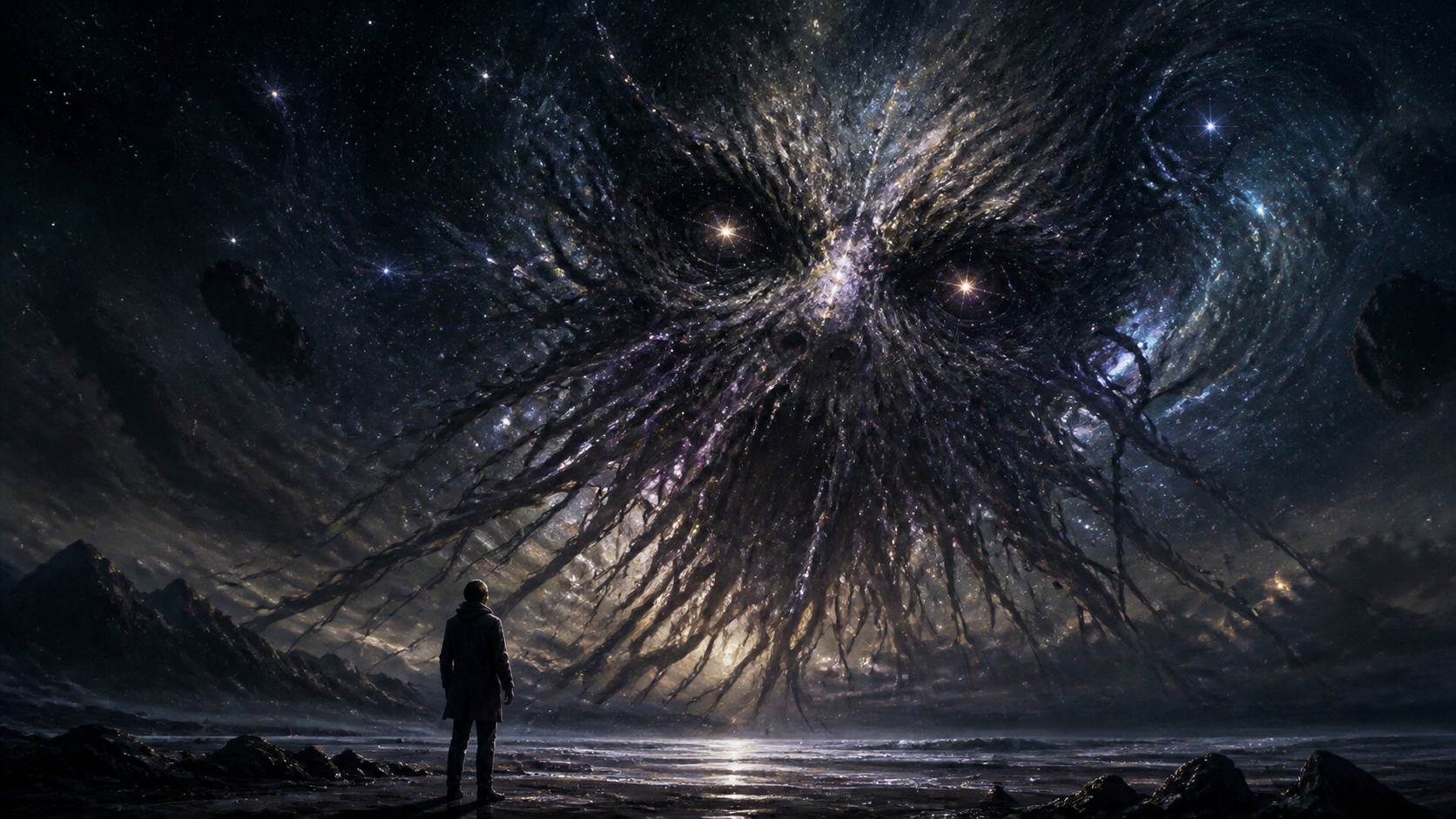
Outside, the world had gone a dim orange, as though dusk had been dragged out early by force. Across the square, people were running toward the northern road. Others were lying still in the dust, their faces turned to the hollow sun, which now pulsed with a slow and horrible rhythm. Between the pulses, something moved in the glare. Not a cloud. Not a bird. A great shifting seam in the air, as though a giant eyelid was trying to open.
Lena grabbed the clinic radio from the shelf, its cracked casing warm from the dead batteries. She jammed in a fresh cell from her own pack and twisted the dials until static scratched out a voice.
“…all units retreat east… repeat, east gate compromised… do not expose skin… it’s in the light…”
Then a man screamed and the transmission cut off.
Isaac was slumping against the wall, sweating hard. “Lena.”
“I know.”
He lifted his bandaged arm. Blood had soaked through already. Under the gauze, something moved.
She stared at him.
“I can feel it,” he whispered.
The first time her sister had died, Lena had not wept. Now, looking at Isaac’s arm, she did. One hot tear. Then another. She wiped them away angrily, ashamed of the uselessness.
“We’ll cut it off,” she said.
He shook his head once. “Won’t help.”
From the open doorway came a new sound, low and layered. A chorus of murmurs, as if several people were speaking in the same throat. The clinic windows began to rattle.
Lena looked out and saw them gathering at the edge of the square, twenty or thirty of the changed, their blistered faces turned upwards. Some were still half-recognisable. A butcher from the market. The schoolteacher. A boy who sold filtered water from a bicycle cart. They stood with their mouths open to the sky, swaying in unison, and from each mouth trailed the black filament like roots.
Then they began to move.
Not towards the clinic. Towards the old bunker road west of the settlement.
Lena understood with sudden sick certainty. “They’re going back.”
Isaac blinked at her through fever-glazed eyes. “To where?”
“The bunker. Mara opened it.”
Sayed stumbled into the doorway behind them, one hand on the frame. His face had gone the colour of wet ash. “If it reaches full light,” he said, “it will use the sky as a lens. The surface is only the first mouth.”
Lena grabbed the notebook out of her pack and shoved it at him. “How do you stop it?”
He looked at the pages as if seeing his own execution. “You don’t let it gather bodies.”
The meaning hit her slowly, then all at once. “No.”
He nodded, tears running into the grooves on his cheeks. “It feeds on the seeing. The more it wears, the wider it opens.”
Outside, a child began screaming. Lena turned and saw a little girl being carried by her mother through the square. The child’s face was raw where her hands had rubbed the skin away. Behind them, one of the changed had caught the mother by the throat and was dragging them both towards the road. The mother tried to fight, but her movements were already slow and clumsy, as if she could not remember which part of her body belonged to her.
Isaac slid down the wall. “Lena, don’t.”
She looked at him. “If it gets out, there won’t be anything left.”
“There’s barely anything left now.”
“That’s not an argument.”
“It’s the truth.”
She crouched beside him. “Can you walk?”
He gave a small, humourless laugh. “Not with my arm like this.”
“Then stay.”
His eyes searched hers. “You’ll go without me.”
“Yes.”
He nodded once, as though he had expected nothing better. “You always were the cruellest person I knew.”
She pressed the knife from his belt into his good hand. “If it comes in here and I’m not back, use it on yourself before it touches your face.”
He frowned. “Lena.”
“I mean it.”
She left before he could answer.
The road west crossed the ash flats to the old test bunker buried under a hill of blackened rubble. In daylight, it was invisible. At dusk it looked like a wound in the earth, a half-collapsed concrete mouth ringed with warning signs long bleached to bone. The changed were already there, kneeling or standing in rows around the cracked entrance, their heads turned towards the dark opening as though listening to something inside.
The air smelled of ozone and cooked iron. Lena crouched behind a shell of a burnt-out truck and studied the scene. The hollow sun hung low, its centre now a black disc the size of a fist. Every few seconds it flickered, and with each flicker the shadows on the ground shifted in the wrong direction.
At the bunker mouth stood Mara.
For one stunned heartbeat, hope stabbed through Lena so sharply it hurt. Then she realised the figure was only using her sister’s face. It was standing with Mara’s posture, Mara’s slight lean, even the old scar across the brow where she had fallen off a camel as a child. But the skin was too smooth, too stretched. The mouth smiled too widely.
Lena’s breath caught. “Mara.”
The thing turned its head.
Its face split open at the temple. Inside there was no skull, only depth, a layered darkness like wet fabric stretched over an empty room. From within came Mara’s voice, thin and pleading. “Lena?”
The sound nearly undid her.
Then the black threads began to move under the skin of the thing’s neck, and the voice changed, thickening into many voices at once. “You came back.”
Lena had to bite the inside of her cheek to keep from crying out. The thing took one step forward, and with that step the kneeling bodies around the bunker all lifted their faces at once. Dozens of empty, obedient expressions. Dozens of mouths opened.
Lena understood then what Dr Sayed had meant. This was not a monster that killed and fed and moved on. It assembled itself from witnesses. It needed bodies to look through, mouths to speak through, eyes to brighten the world enough for it to cross.
There were too many already.
She took the only path left to her.
From the truck cab she had stolen two fuel canisters from the wrecked depot and a flare gun from Isaac’s workshop. She had thought, absurdly, that if she had to die, she would at least choose the shape of it. She dragged the canisters from the truck bed and uncapped them. Diesel splashed over her boots and soaked into the ash.
The thing wearing Mara’s face smiled wider. “You won’t.”
Lena raised the flare gun and shot it into the bunker entrance.
The flare struck the wall and burst with a white-hot crack. The nearest changed recoiled, shrieking as the light hit their skin. Lena flung the first canister after the flare, then the second, both cracking open over the bunker steps. She ran as the thing lunged.
Pain lanced her shoulder. Fingers, or something like fingers, slammed into her back and drove her into the ash. She tasted blood and grit. Above her, the hollow sun pulsed brighter, the light suddenly unbearable.
Then the bunker ignited.
Fire raced along the diesel in a roaring sheet. Heat punched the air out of Lena’s lungs. The thing above her screamed in a dozen voices, and in that scream was Mara, terrified and furious and begging. Lena rolled away, half blinded. The changed near the entrance collapsed, clutching at their faces as the fire caught their filaments and made them twist like burning wire.
The bunker mouth began to collapse inward with a deep grinding groan. Concrete cracked. Something beneath it heaved once, hard enough to throw Lena onto her side. For an instant she saw down into the opening, not a tunnel but a chamber full of reflected sunlight, thousands of mirrored surfaces turning within one another, and at the centre of all that light a vast pulse, like a lung trying to breathe.
Then the hill caved.
A shockwave knocked Lena flat. Debris rained down. Fire blasted out of the entrance in a rolling orange tongue, and with it came screams, human and not human, merging into a single long broken cry. The hollow sun above shuddered. The black disc at its centre widened, as if something on the far side had blinked.
Lena struggled to her knees through smoke and ash. The thing in Mara’s shape was on the ground nearby, half its face burned away. It looked at her with one surviving eye.
For a moment, it was Mara. Not fully. Enough.
“Lena,” it whispered.
Lena crawled towards it, hands shaking. She wanted to ask if there had been any part of her sister left in the pit, any part that had known, any part that had called out across the dark. Instead she took the broken end of a metal stake from the bunker fence and drove it through the thing’s eye and into the ash beneath.
It spasmed once. Black fluid spurted warm over her hands. The mouth opened and from it came a final sound like a laugh drowning.
Then the light in the eye went out.
By nightfall the sky had dimmed to a bruised grey. The hollow sun still hung overhead, but it was smaller now, veiled by smoke and ash. Most of the changed had burned where they stood or fled into the scrub where the fire followed them. The bunker was gone, or mostly gone. The settlement was damaged but standing, though by dawn there would be only a fraction of the people left.
Lena found Isaac near the clinic, sitting with his back against the wall and the knife across his wrist exactly as she had told him.
He looked up when she approached. “You made it.”
She stared at him. “You didn’t cut.”
“I thought I might like to see what happens.”
His arm was black to the elbow. The skin around the wound had split into tiny moving seams. He was breathing shallowly, careful not to panic himself too fast.
Lena sat beside him. For a while neither of them spoke.
At last he said, “Did it work?”
She watched the smoke drift over the ruined square. The corpses were already cooling. Somewhere a woman was moaning for her child. Somewhere else, a dog was barking at the dark with frantic persistence.
“I don’t know,” Lena said.
The answer was honest, and almost immediately she hated it.
Then Isaac began to smile.
Not because of anything she had said. Because something under his skin had twitched the corner of his mouth upwards and held it there. His pupils were widening, not with fear but with attention, as if he were listening to a distant instruction only he could hear.
Lena’s stomach turned.
He lifted his left hand, the one that was still his, and touched her cheek with tender caution. “It’s quieter now,” he whispered.
Lena jerked back. “Isaac.”
He blinked, confused, and for one raw second he was himself again. Horror crossed his face as he felt the movement in his arm, then the skin there split from wrist to elbow with a soft wet tearing sound. Black threads pushed through the wound, delicate as roots.
He screamed.
Lena grabbed the knife from his hand and, with a violence so sudden it felt outside her own body, severed two fingers before they could flex. Blood fountained over her lap. Isaac convulsed and fell against her, sobbing. The threads writhed under the severed skin, searching.
She understood then that the bunker had not been the source. Only an opening. The thing in the sky had already tasted them all.
“Lena,” Isaac gasped. “Don’t let me look at you.”
She held his head against her shoulder, forcing his face away from the hollow sun. His body shook as the filaments bored deeper, and she knew with cold certainty that if she let him stand, if she let him see the sky long enough, he would rise wearing a face that knew her name.
So she kept his face buried in her coat until the shaking stopped.
By the time it did, he was dead.
Or perhaps he was not. She could not tell anymore. In the dark of the ruined square, with ash falling like weak snow, she heard a faint tapping from somewhere inside the clinic walls. Once. Twice. Then a patient, deliberate scrape, as though something within were learning the shape of a door.
Lena looked up at the sky.
The hollow sun watched her back.

Horror Stories