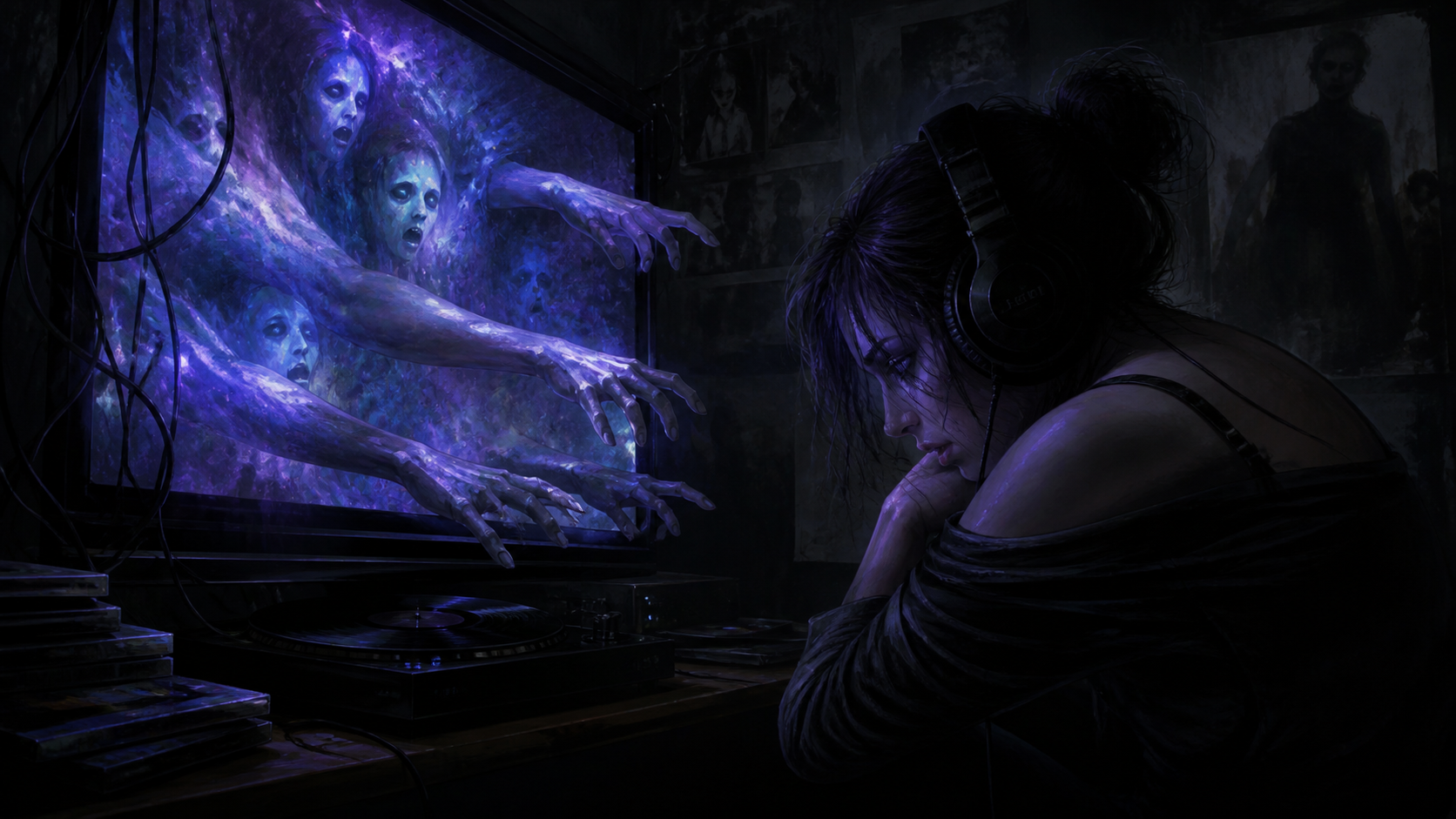
I first heard my own voice from the sitting room at 2:13 in the morning.
Not a recording. Not the television. My own voice, speaking from the dark with the same flat Edinburgh burr I’d used all my life.
“Don’t go back to the room.”
I sat bolt upright in bed so quickly I nearly cracked my skull against the wall. Beside me, Ruth did not stir. She had gone to sleep with one hand on my wrist, and even now her fingers tightened a little in her dreams, as if she had sensed movement. The flats were quiet except for the old pipes ticking in the walls and a low, wet sound from the bathroom radiator, as though something inside it was breathing through a blocked nose.
“Ruth,” I whispered.
She mumbled, turned over, and pulled the duvet tighter to her chin.
The voice came again, from the sitting room.
“Malcolm. Do not go back to the room.”
This time it had my voice in every detail, even the tired impatience in it when I was afraid. I swung my legs to the floor. The boards were cold. The light under the bathroom door was on, though I was certain I had switched everything off before bed.
There was a shape on the other side of the frosted glass.
I stood very still, listening.
It stood still too.
Then it moved away.
I should tell you now that before this night, before the voice in the sitting room and the room that should not have been opened, I had been a sceptical man in the ordinary way. Not an atheist exactly, just a man with bills, a mortgage, a bad knee and too little time for nonsense. I worked nights at the Royal Infirmary in the pathology lab. Blood, tissue, slides, paperwork. Death was something I handled in small, labelled portions.
Ruth worked at a primary school in Leith and believed in all sorts of things without making a fuss about them. She burned sage when neighbours died. She would not let me put the shoes on the table. She crossed herself, privately, before long drives in winter. I teased her about it. She teased me back, calling me a “mechanistic little goblin”.
We had lived in the tenement on Easter Road for six years. It had its noises, its moods, its old damp corners. Nothing worse than that.
Until the room.
Three weeks earlier, the letting agent had phoned with the kind of frantic politeness that means trouble.
“Mrs Lennox has passed, I’m afraid. Her nephew’s clearing the flat. There’s, er, a small matter in the spare room. If you could perhaps keep out of it for the moment.”
“What sort of matter?”
“Just some belongings. Nothing unsavoury.”
Then he added, after a pause, “It’s been locked a long time.”
By then we had already signed the renewal. We did not want to move, and we could not afford to. The room was the smallest in the flat, barely big enough for a narrow bed or a desk. We had used it for storage since we moved in. Dust, Christmas decorations, old books, a rowing machine that never worked. The lock on the door had always stuck a bit.
On the afternoon of the clearing, a van came and the nephew, a pale young man in a dark suit, carried boxes out with the expression of someone trying not to look at the floor. He did not speak to us. His hands shook. He was in and out within twenty minutes.
That evening, Ruth and I went to open the room.
The key turned too easily.
The first thing I noticed was the smell. Not mould, not rot, but something stale and metallic, like pennies left in a mouth too long. The curtains were closed. The room was darker than it should have been, though the window faced the back lane and let in a strip of streetlight.
In the middle of the floor sat a wooden chair.
I do not know how it got there. Neither does Ruth. We would have noticed if it had been there before. The seat was polished to a shine by use, which made no sense in a room no one had entered for years.
On the chair was a tape recorder.
An old portable one, the sort with a cassette deck and built-in microphone, yellowed plastic, cracked corners. Beside it lay a small cardboard box tied with black thread.
Ruth touched my arm. “Did Mrs Lennox have one of these?”
“I don’t know.”
“It looks old.”
“I can see that.”
We should have left it there until morning. Instead, because we are both stupid in different ways, we stayed while I undid the thread.
Inside the box were six cassettes, all labelled in a woman’s neat hand.
VOICE PRACTICE 1
VOICE PRACTICE 2
VOICE PRACTICE 3
VOICE PRACTICE 4
VOICE PRACTICE 5
VOICE PRACTICE 6
At the bottom was a folded sheet of paper.
If this room is ever opened, do not speak in it.
If you hear yourself, leave at once.
If it answers back, burn the tapes.
Ruth laughed nervously. “That’s theatrical.”
“It’s daft, is what it is.”
We both looked at the recorder.
It was switched on.
The tape was already inside.
I should have taken it out, but the need to know got into me. We lived in an age of instructions, warnings, labels. A handwritten note from a dead woman should not have mattered. Yet I pressed play.
Static.
Then a woman’s voice, thin and wavering with age, speaking in the same room we were standing in now.
“I am practising to imitate my son,” she said. “He is asleep next door. He does not know.”
The tape hissed. Then the same voice again, lower, roughened, trying to flatten its vowels to match another person’s mouth.
“Daniel, come here. Daniel, come here.”
Ruth gave a short, involuntary laugh and looked at me. “This is absurd.”
The tape continued.
The woman repeated a man’s voice, then a girl’s, then her own, over and over, as if she were learning their shapes. The sound of her breathing changed each time. There was something desperate in it, something hungry. It was not entertainment. It was practice.
At the end, she whispered, “They are learning me back.”
The recorder clicked off.
I turned to Ruth. “We’re getting rid of this rubbish.”
But she had gone pale. She was looking past me, into the mirrored wardrobe door.
I turned.
There was no one there.
At least, no one visible.
That night we slept with the bedroom door locked. At some point near dawn, I woke to the sensation of someone standing in the room. The air was wrong. Ruth was sitting up in bed, rigid, facing the door. Her eyes were open.
“Did you say something?” I asked.
She did not answer.
Then, from the other side of the door, in Ruth’s voice, came a soft, intimate whisper.
“Malcolm, let me in.”
Ruth began to cry.
The next day, she refused to go near the spare room. I rang the agent and said there had been a mistake and we wanted whatever was left collected immediately. He sounded irritated, then worried when I mentioned the tapes.
“What tapes?”
“The ones in the room.”
There was a pause. Then, “There shouldn’t be anything there. The nephew took everything.”
He came out that afternoon with a joiner friend to remove the old chair. The room was empty by then, except for the tape recorder, which I had put on the windowsill.
No one believed me when I said there had been a woman’s voice on it. The agent laughed awkwardly. The joiner made a joke about haunted cassettes. Ruth said nothing, but she would not look at the room.
That evening, while I was at work, she phoned me eight times. I saw the missed calls in a block during a break and rang her back.
She answered on the first ring, whispering, “There’s someone in the flat.”
I put the phone to my ear and heard breathing at the other end, but not hers.
“Ruth?”
“It knows my voice,” she said, and then the line went dead.
I left work and drove home through rain that made the roads shine like black enamel. I arrived to find the front door unlocked. The hall light was on. The flat smelled of something burnt.
Ruth was in the kitchen, wrapped in a blanket. She had cut her hand badly. Blood was drying on the tiles, her white shirt, the cupboard handle. When she saw me, she started shaking.
“There was a woman here,” she said.
“In the flat?”
“In the room.” Her voice broke. “I heard her inside the walls.”
I took her hand and inspected the cut. “How did this happen?”
“I tried to get the tapes.”
“What?”
“They were in the bin. I put them there and then I heard you calling me from the spare room. I thought you’d come home. I opened the door and there was a woman standing behind it, just a shape at first, and then she spoke like me.”
She swallowed hard.
“She said, ‘Don’t listen to him. He lies in my mouth.’”
I looked at the bin. The tapes were inside, damp with tea and kitchen scraps. The recorder sat on the worktop, clean, as though someone had dried it carefully.
I do not know why I touched it. Maybe because that is what men like me do when terrified. We test things. We insist on evidence. I pressed play.
The same woman’s voice.
A little clearer this time.
“I can do children. I can do men. I can do the dead if I hear them enough.”
Ruth made a sound like she was choking. I stopped the tape.
The kitchen went cold. Not metaphorically cold. The thermometer on the wall, which I had bought because the flat always ran damp, dropped from nineteen to twelve in less than a minute. The glass in the window rattled though there was no wind.
From the hall came a knock.
Three polite taps.
Ruth and I stood frozen.
The knock came again.
I went to the door and looked through the peephole.
No one.
I opened it anyway.
The corridor was empty except for Mrs Mair from the flat opposite, standing in her dressing gown with a carrier bag of shopping. She blinked at me.
“Is everything all right, Malcolm? I heard shouting.”
Behind me, in Ruth’s voice, came a soft reply.
“Yes, thanks. We’re fine.”
Mrs Mair frowned, looked past me, and then her face changed. She saw something I could not. She dropped the shopping bag. Apples rolled across the landing.
“God preserve us,” she whispered, and backed away.
I turned. Ruth was standing in the kitchen doorway, but she had not spoken. Her mouth was slightly open. Her eyes were on the wall behind me.
There, on the wallpaper, was a wet mark forming in the shape of a hand.
It was not a print. It was moving, spreading under the paper like something trying to push through from the other side.
Ruth screamed.
What happened next was chaos, the kind you only half remember later because your body goes into another mode. I grabbed the kitchen knife from the counter by instinct, though what good I thought it would do against a thing in the walls I cannot say. Ruth ran for the front door and then stopped dead, as if an invisible wire had caught her.
From the spare room came a voice, low and male, speaking in my tone.
“Come in, Ruth.”
Then another voice, hers, overlapping it.
“Come in, Malcolm.”
Then a third, a child’s, whispering fast and delighted, “Come in, come in, come in.”
The doorknob to the spare room began to turn.
We had not locked it.
I do not want to describe what came out in full detail because there are some things that become more real when the mind is forced to skip them. But I will say this. It was shaped like a woman at first, though too tall for the room, bent slightly to fit through the doorway as if it had learned human posture from memory. Its skin looked damp and grey, the colour of boiled poultry. Its face changed as it lifted its head. Not in a theatrical way. In pieces. A mouth appearing where there should have been none, then an eye, then another mouth at the cheek.
It spoke with my mother’s voice.
“Malcolm, don’t be rude.”
I stabbed at it.
The knife went in without resistance, like plunging it into wet cloth. Black blood, or something like it, ran down my hand, thick and hot. The thing did not recoil. Instead it smiled with a version of my smile so accurate it nearly broke me.
And then it said, in Ruth’s voice, “You already let me in.”
Ruth was on the floor behind me, retching. The thing moved with sudden speed and seized her by the throat.
I drove the knife into its shoulder. It did not release her. Its fingers were too long, jointing wrong, skin splitting where it squeezed. Ruth’s face went red, then purple.
Something in me snapped. I grabbed the tape recorder from the worktop, smashed the cassette lid open with the heel of my hand, and yanked out the tape. The thing turned its head towards me, too quickly, as if I had made a sound only it could hear. I remembered the note. Burn the tapes.
The smell of burnt plastic was already in the flat from the kitchen light fitting, which had shorted and started smoking. I shoved the tape into the gas hob and struck the ignition.
For a moment nothing happened.
Then the tape curled, blackened, and the thing screamed.
It was not the scream of a creature in pain. It was the scream of a dozen voices pressed through one throat, each of them trying to get out first. The windows trembled. The light blew. Ruth collapsed coughing. The thing convulsed, and I saw, very clearly, inside its face, a man’s mouth opening and opening again, trapped behind the skin.
The smell was beyond description. Hair, meat, oil, sewage, old incense, and something sweet underneath, like rotten fruit. The fire alarm began to shriek.
Then the thing was gone.
Not exploded. Not dissolved. It was simply no longer in the kitchen. The doorway to the spare room stood open and empty, the wallpaper torn, the air beyond it dark.
Ruth and I got out into the street with only our coats and her bleeding hand. Mrs Mair had already called the fire brigade. By the time they arrived, the fire was out. The damage was minor. Burn marks around the hob, smoke in the curtains, one smashed cupboard door. The spare room, oddly, was untouched except for the chair in the middle of the floor and the recorder on it, charred at the edges but still whole.
One of the firefighters picked it up with a gloved hand. He listened to the silence coming out of it and handed it to me with a look I can only describe as pity.
We did not sleep that night. We sat in our car in the hospital car park while Ruth’s hand was stitched in A&E. The doctor asked what had happened. She said she cut it on broken glass. It was easier than the truth. I watched her answer with my own jaw clenched, because I knew what would happen if I let the true words out of my mouth. The thing would hear them. Or perhaps it already had.
The next morning, I phoned the agent again. I told him we were moving out.
He sounded relieved. “Of course. I’m sorry for the trouble.”
“Did Mrs Lennox have children?”
“Yes, a son. He died, some years ago.”
“Before or after she started with the tapes?”
There was a silence.
“Mr Fraser,” he said carefully, “there were no tapes when the nephew cleared the room.”
I laughed then, because that is what you do when the world refuses to obey its own rules. “There were six.”
“Then where are they now?”
I looked at the kitchen bin. It was empty.
Ruth stared at me from the sofa, her bandaged hand in her lap.
We moved that week, but not far enough. We found a small place in Portobello, on the second floor of a new build with bright white walls and no history that anyone would admit to. For a while, things seemed to settle. Ruth began sleeping again. I worked. We did not speak of the room.
Then, two months later, Ruth called me from the school in tears because one of the children had repeated something to her in a voice exactly like mine.
“Don’t go back to the room.”
She thought I was playing a joke at first. She thought I had coached the boy. But when she asked where he had heard it, he said, “The nice lady in the cupboard.”
That night we searched the flat. In the airing cupboard, behind the towels, we found one of the cassettes.
VOICE PRACTICE 2.
I do not know how it came there. I had thrown the recorder away. The bin men had taken the rest. Yet the tape sat on the shelf as neatly as if it had always belonged there, its plastic case warm to the touch.
Ruth would not let me touch it. “Burn it.”
I did. In the sink, with methylated spirits and the hob flame.
The tape screamed while it burned.
I know how that sounds. I know how impossible it is. But it screamed in my own voice, then in Ruth’s, then in the voice of the child from her school, then in the dead Mrs Lennox’s thin old croak, all layered together until I dropped the matchbox and nearly set fire to the curtains.
After that, it got clever.
At first it only spoke when one of us was alone. Then it began to use our neighbours, our phones, the intercom, voices from the other side of thin walls. It learned the gaps in our routines. Ruth would hear me calling her from the bedroom when I was still at work. I would hear her in the supermarket, clear as a bell, from the next aisle, saying my name with that tender note she used when I was ill. We began to check and double-check, then to doubt the checks themselves.
The possession, if that is the right word, did not begin with floating heads or spines turning backwards. It began with imitation. With borrowing. With learning.
Once it learned my voice properly, it used it to make me answer.
I came home one evening to find the flat silent and all the lights off. Ruth was meant to be visiting her sister in Glasgow, but her coat hung on the hall peg. Her phone sat on the table. The smell from the kitchen told me something had been cooking and then left too long.
“Ruth?” I called.
From the bedroom came my own voice.
“Come here.”
I stood in the corridor, every muscle locked.
Then, from the kitchen, Ruth called back, “Malcolm, it’s all right.”
And from the bathroom, a child’s voice whispered, “He’s already here.”
I backed out of the flat and ran to the stairwell. I did not stop until I was on the pavement, gulping wet air, and even then I could still hear them upstairs through the closed door, using our voices to call each other, overlapping, patient and intimate.
I did not go back for Ruth that night.
I did not go back because I knew, at last, what the note had meant.
The room had not been a room. It had been an opening. A place where something hungry had been kept in the dark long enough to learn the sound of a family. Not just voices, but permission. Concern. Habit. The everyday words that lower your guard. It had lived by imitation until imitation became entry.
I called the police in the morning. I told them my wife was missing. The officer who took the report asked if there had been any domestic issues. I said no. He asked if she had left voluntarily. I said I hoped so. By then I was not sure what the truth was worth.
They found the flat empty except for me. No sign of Ruth. No blood. No forced entry. The kitchen was spotless. The spare room door, which I had boarded shut, stood open when the officers arrived, though I had not touched it. Inside, the wallpaper was peeled away in strips, revealing the plaster beneath scored with words scratched over and over in six different handwritings.
LISTEN
LISTEN
LISTEN
I have not seen Ruth since.
People sometimes ask, later, whether I truly believe she is dead. The answer is no. I believe she is somewhere else, or somewhere inside something that knows how she spoke. I believe that if I heard her on the phone now, I would recognise her instantly. That is the worst part. Not the loss, but the certainty that recognition no longer protects me.
A month ago, I received a parcel with no return address. Inside was the tape recorder, repaired, polished clean. In the battery compartment was a note in Ruth’s handwriting, though changed somehow, as if copied by an unsteady hand.
You should not have left me there.
Last night the recorder played by itself.
I was in the bathroom brushing my teeth when I heard the click of a cassette engaging. I went into the bedroom and found it on the pillow. The red light was on.
My own voice came from the speaker, tired and very close.
“Don’t go back to the room.”
Then Ruth’s voice, from somewhere deeper inside the machine, laughing softly.
“Too late.”
I have been sitting in the kitchen since then with the lights on, writing this because I cannot bring myself to speak. The flat is otherwise quiet. Too quiet. The kind of quiet that suggests something listening from just beyond hearing.
A minute ago, from the hall, my voice called, “Malcolm?”
It was not me.
I have not answered.
But I think it has learned enough now to say my name without asking.
And if you are reading this aloud, if you have given these words your own mouth, then I am very sorry.
Because that is how it begins.

Horror Stories