By the time the first person in São Miguel de Vento called it a ghost, the building had already been empty for thirteen years and the town had learned to cross the street without looking at it.
It stood above the harbour road in a crescent of crumbling white, once a hotel for sugar merchants and pilgrims, then, briefly and disastrously, a municipal clinic, and now a shell of damp plaster, rusted balconies and shuttered windows. The locals called it the Casa dos Rostos because of the carved stone masks around its upper cornices, though the masks had long since been eroded by salt and rain into something less human and more accusation. Officially it was the old Casa Valença. Unofficially, it was where children dared each other to shout through the fence and where fishermen said the air changed at dusk.
It was in the Hall of Vanished Faces, the grand central corridor that ran from the entrance vestibule to the back garden, that the first true sighting was made. The hall had once been lined with framed portraits of the Valença family and of visiting dignitaries, but the frames had been stolen years earlier. The wall hooks remained, black like old teeth. At the far end hung a single iron lantern on a bracket above the servants’ door, a lantern that had no business still being there, because the glass had been broken on one side and the candle inside, if there ever was one, had long since melted into a waxy, ash-coloured mass.
That lantern should have been dead.
It was not.
When Marta Gouveia first saw it lit, she was standing in the rain with a torch in one hand and a clipboard in the other, trying not to let the wind blow her umbrella inside out. She was forty-two, a structural surveyor for the municipal council, and had spent most of her adult life telling people that old buildings did not haunt themselves. Bad roofing, dead rats, unstable beams, mildew, electrical faults. She believed in all of them. It had made her popular in offices and unwelcome at wakes.
She was there with Rui Almeida, the heritage officer, whose optimism had the abrasive persistence of a salesman’s cologne.
“They want to know whether it can be made safe,” Rui had said, peering up at the façade. “If the council buys it, we could restore the frontage. Apartments, maybe. Or a museum.”
“It can be made safe for what? For ghosts?” Marta muttered.
Rui laughed. “You sound like my mother.”
“Your mother is sensible.”
He gave her a look. “That’s not what my wife says.”
They entered through the side door because the main doors had swollen shut. The air inside was colder than the rain outside and carried the smell of wet plaster, pigeon droppings and old antiseptic. Their torches picked out broken tiles, collapsed lath, a staircase with one banister carved by woodworm into lace. Somewhere above them, a raven flapped in panic and banged against a shutter.
In the hall, Marta stopped.
A light glimmered at the far end, yellow and low and unmistakable. It swayed gently, as if someone had just passed with it.
Rui saw it a second later.
“What is that?”
“Probably a maintenance lamp,” Marta said, though even as she spoke she could hear the false note in her own voice.
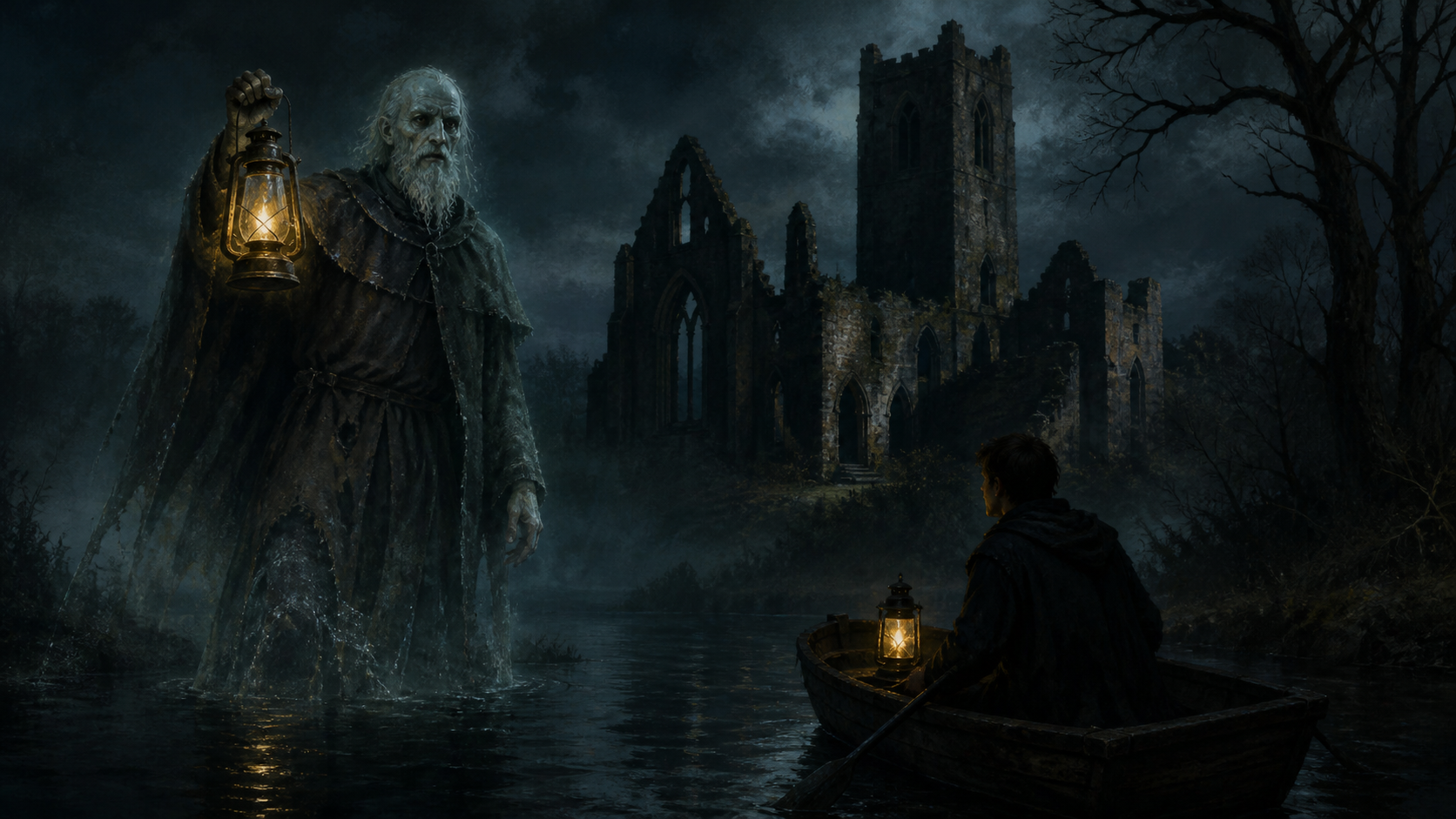
There was no sound of footsteps. No electric hum. The lantern’s glass seemed to gather and breathe. Then, very slowly, a face began to appear in the light behind it.
Not a face exactly. The suggestion of one. Pale skin, hollow cheeks, a mouth opening and closing as if tasting words. And where the eyes should have been, only a smooth blur, as though the features were sinking into wax.
Rui swore under his breath and took a step back. Marta raised her torch, though she knew the beam had no effect on whatever it was she was seeing.
The apparition did not advance. It only watched them, if watching was the word for a thing that had no eyes. Then it tipped its lantern once, as politely as a host, and went out.
The darkness that followed felt heavier than before.
Neither of them moved for several seconds.
Finally Rui said, too brightly, “Right. Well. That was not in the brochure.”
Marta let out a breath she had not realised she was holding. “No.”
They completed their survey in a nervous silence. The hallway was structurally compromised, the west wing unsafe, and the basement partially flooded. When they emerged into the rain, Rui was trying to make a joke about chlorine gas and old wiring, but Marta was listening to the shape of the house behind them. She could not hear it, of course. That was the trouble. The building made no sound at all.
“Did you see it properly?” she asked.
“Enough.”
“Did it have a face?”
He hesitated. “It had something.”
That night, Marta wrote in her report that the building was unsuitable for immediate occupation and required secure boarding, electrical isolation and a full heritage assessment. She did not mention the lantern. She told herself that keeping the report factual was professionalism, not cowardice.
Three days later, her sister Ana called from the main road outside the harbour clinic and said, “Marta, don’t laugh, but is there some reason the old house is full of light?”
Marta was in her kitchen, cutting tomatoes for supper. “What do you mean, full of light?”
“I mean there’s a lamp in the upper hall. One minute it wasn’t there, the next minute it was, and now it’s moving. Like someone’s walking with it.”
Marta’s knife stopped.
Ana worked nights in triage and rarely dramatized anything. She was the more practical sister, the one who kept spare batteries, drove with a blanket and knew which neighbours would answer their doors after midnight.
“Don’t go near it,” Marta said.
“I’m not near it. I’m across the road.”
“Did anyone else see it?”
“Yes. Two dock workers. One of them crossed himself and nearly got run over by a scooter.”
Marta set the knife down. “I’ll come.”
By the time she reached the harbour, dusk had bled into a thick blue evening and the old house was visible across the slope, its windows like blank teeth. A small crowd had gathered at a distance respectable enough to call caution and close enough to satisfy curiosity. Children stood in front. An old man with a dog sat on a bollard smoking.
Marta followed their pointing fingers upwards.
There it was, in the upper hall behind the cracked windowpanes. A lantern, swinging slowly from side to side. Its light was amber and deep, like a flame seen through skin.
Then a shadow crossed in front of it.
Not the shadow of a person. A shape, tall and narrow, with shoulders too high and a head inclined as if listening. It moved with terrible patience from one end of the corridor to the other, and as it passed, faces pressed up behind the side windows. Not one face. Many. A flicker of cheeks, mouths, eyes, noses in the glass, appearing and vanishing as if someone were turning pages too fast. There was a woman with her hair pinned back. A child with a slack mouth. A bearded man whose expression was frozen in mid-scream. Each face seemed to belong to the house for an instant, then be taken away.
The crowd made a sound like a held breath being released all at once.
Ana gripped Marta’s arm. “Tell me that’s a reflection.”
Marta could not.
The figure reached the central window and stopped. The lantern lowered. Behind it, a face formed, as it had before, only more clearly now. The features were grey-white and drained, the skin drawn so tight over the bones that every movement seemed painful. The mouth opened.
Even across the road, Marta heard the whisper.
Not a word, exactly. More a request.
Come.
Then the faces in the windows turned towards the crowd, and people stumbled back. A boy began crying. The old man on the bollard stood up too quickly and dropped his cigarette. The dog barked once and ran.
The lantern went out.
After that, no one in São Miguel de Vento pretended the house was harmless. The police came. The mayor gave a statement about unauthorised entry and urban myths. A priest from the cathedral came with holy water and a face like a closed door. He would not cross the threshold, but he sprinkled the entrance from the safety of the gate and said the old place had “an atmosphere of unrest”.
The town took offence at that, which was better than fear. People like their mysteries local and their clergy useful. Still, the sightings continued.
The lantern appeared at different times, never on a fixed schedule. It was seen in the upper hall, then in the servants’ passage, then in the ruined dining room, where it cast a perfect circle of light upon the table though there was no table left. Those who looked directly at it often reported hearing their own names spoken from the dark beyond the beam. A baker swore he saw his dead daughter standing in the hall wearing her school uniform, though she had been dead twenty years. He ran inside and locked himself in the pantry, and when they got him out he had bitten through his own lip.
Marta tried to keep out of it. She had work, bills, her mother’s appointments, and a daughter in university in Lisbon who rang only when she needed money. Yet the house kept returning to her thoughts with the persistence of a toothache. Each report she read, each witness statement, seemed to gather around one impossible detail. The faces seen through the windows did not look at the living with anger. They looked as though they were waiting to be recognised.
Two weeks after the first sighting, Rui visited her at her office with a file in his hand and a look that suggested he had stopped sleeping.
“Look at this,” he said, spreading photocopies on her desk.
They were archive photos, faded and pinholed. The old house in 1911, in 1938, in 1956. In each image, depending on the angle, the hall windows reflected a pale gleam from inside. In one picture there were figures standing in the corridor behind the glass, though the photographer had never intended to capture them. Marta stared at the image. The figures were blurred, but one of them held something in front of his chest.
“A lantern,” she said.
Rui nodded. “I spoke to the local historian. There was a fire in the house in 1908. The family servants escaped. The owner, Dom Estêvão Valença, apparently locked the upstairs wing from the outside during the blaze. Four people died. Maybe more. The records are incomplete.”
“People died in many old houses.”
“Yes, but listen. There’s a note here from the parish burial ledger. No bodies identified for two of them. A woman and a child. The family claimed they’d left before the fire.”
Marta leaned back. “You think the house is showing them.”
“I think,” Rui said carefully, “that something in there wants to be seen.”
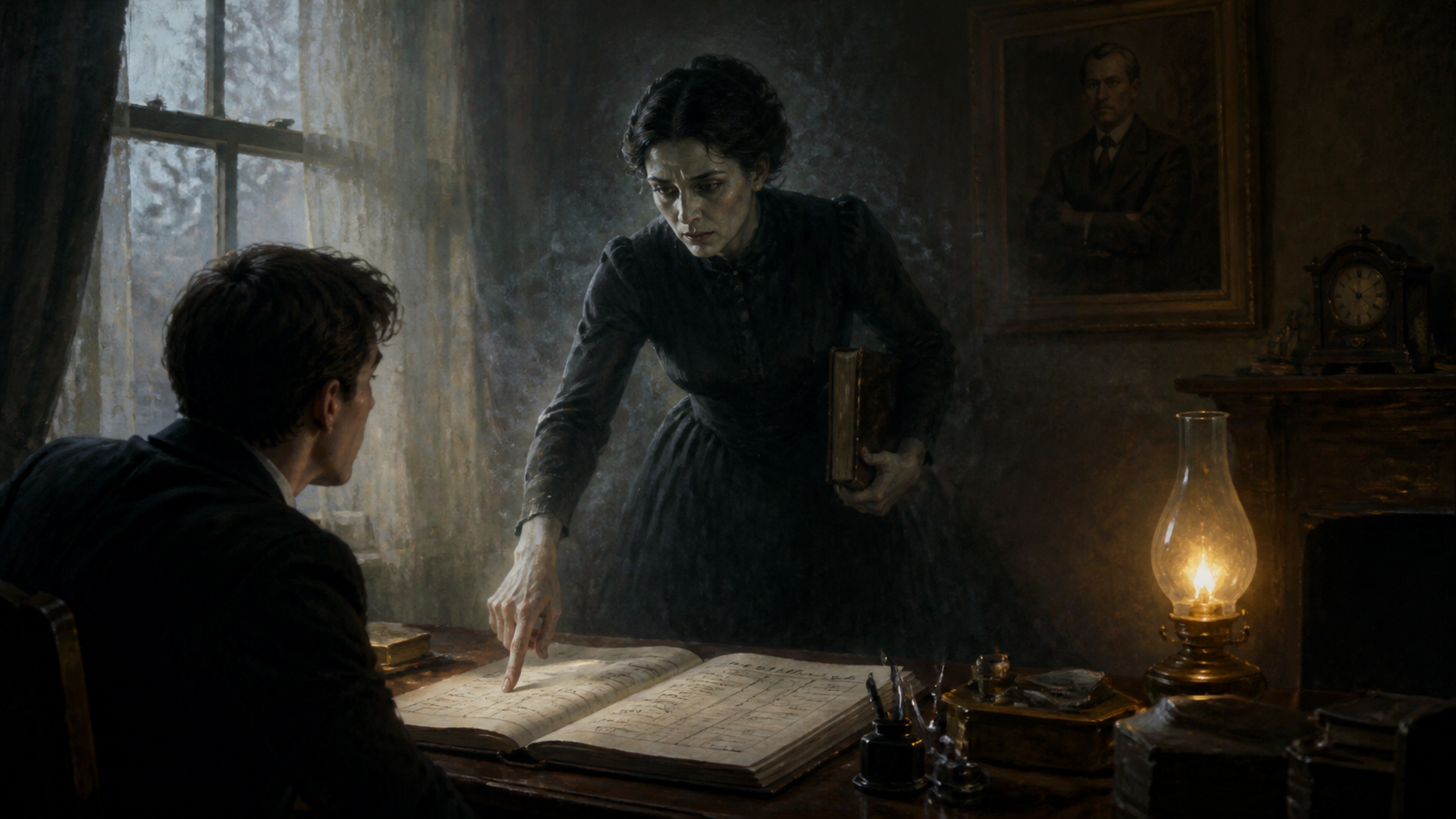
That evening, after the office had emptied, Marta went back to the archive alone. The town records room was above the library, under a roof that rattled in the wind. She found the fire report, the parish ledger and, tucked inside a folder of correspondence, an unsigned complaint from a housemaid named Leonor da Cruz. The paper had browned at the edges. The handwriting was sharp and cramped, as if written in haste.
Dom Estêvão has ordered the doors chained at night. He says it is for theft. I think it is for the faces. He does not wish them to leave the hall.
There were more lines, but the ink had smudged from water damage. At the bottom was one clear sentence:
If I am found, do not let him keep my name.
Marta read it three times.
A draft touched the back of her neck. She looked up. The library room was empty. Yet from the open corridor beyond came the faint metallic click of a lantern hook moving against stone.
She left at once and did not tell anyone.
Two nights later, her mother began calling her by her dead father’s name.
At first it was only once, at the kitchen table.
“João, pass me the salt.”
Marta frowned. “Mãe?”
Her mother blinked, annoyed. “What?”
“You called me João.”
Her mother laughed weakly. “Did I? I’m tired.”
But over the next hour she did it again, then again. Not only names. She forgot which cup was hers. She turned towards the dark doorway and said, “Why are you there?” in a voice that made Marta go cold.
“No one’s there.”
“I can see him.”
Marta stood up so abruptly the chair scraped hard against the tiles. “Mãe, there’s nobody in the hall.”
Her mother stared past her shoulder with frightened intensity. “Yes, there is.”
Marta turned. The hall was empty.
When she looked back, her mother had started to cry.
That same night, Ana phoned from the clinic, her voice tight.
“One of the patients here keeps saying a woman in a black dress is standing beside the nurses’ desk.”
“Does anyone else see her?”
“Not until they turn away. Then they say they can smell smoke. Marta, what is happening?”
Marta knew then that the haunting was no longer confined to the old house. It was spreading by sight and name, climbing through the town by means she did not understand. She remembered the complaint in the archive. Do not let him keep my name.
The next morning she returned to Casa Valença alone.
The authorities had nailed planks over the lower entrance, but one side door had been left unsecured by vandals. She pushed it open and stepped into the stale interior with a torch, a bottle of holy water she had stolen from the church porch, and a foolish confidence borrowed from habit.
The hallway looked unchanged, though the windows were dim with dawn. The hooks still lined the walls like missing teeth. At the far end, the lantern was there.
Lit.
It hung at chest height now, though there was no visible chain. Its flame was steady and silent.
“Marta.”
She stopped breathing.
The voice came from nowhere and everywhere, as if the house had learned her name from listening.
She forced herself onward, each footstep loud in the corridor. The lantern did not retreat. Instead, as she approached, the walls on either side darkened and the plaster seemed to pulse. Faces emerged in the surfaces, half-moulded into the damp. A woman with a broken nose. A child with a cut lip. A servant in a linen cap. Then others, more shallow, as though only the impression of features had been pressed from the air.
Marta’s torch beam shook. “What do you want?”
The flame in the lantern guttered. In its glow, a figure appeared behind it, not fully formed at first, then steadily more so, as if built from exhalation and soot. The same tall shape she had seen before. Close now, she could see that it was a man in a dark coat with a white collar turned up high around his throat. His face was not decomposed so much as erased, the flesh smoothed away in places until the bones showed through. Yet the mouth remained, and when he smiled it pulled the ruined skin with it.
Dom Estêvão, she thought, though she had never seen his portrait. The house itself seemed to confirm it with a low settling groan.
He lifted one hand and pointed, not at her, but at the wall beside her.
There, in the plaster, a face was surfacing slowly. A woman’s face. Eyes shut. Mouth open in the shape of a cry. And beneath it another, and another. Not painted. Not carved. Trapped. Layer upon layer of people pressing upward from behind the walls as if the house had swallowed them long ago and was only now beginning to return them.
Marta staggered back. The torch fell from her hand and rolled, throwing frantic shadows.
The voice came again, though this time it was not the ghost’s alone. It was joined by many others, whispering through the corridor like wind in paper:
He keeps them.
Keep the names.
Take the lantern.
Marta understood at once, in the strange brutal way people understand danger when there is no time for theory. The lantern was not the haunting. It was the lock. Or the key. Or perhaps both.
The ghost of Dom Estêvão moved towards her. His feet made no sound on the floor. Behind him, the faces in the wall opened their mouths wider, and the corridor filled with an odour of ash and old blood.
She bent, seized the torch, and flung the holy water at the lantern.
It struck the glass and ran in bright trails. The flame inside shuddered. Dom Estêvão jerked as if slapped.
The faces in the wall screamed.
It was not a sound of voices but of plaster cracking, of wet clay splitting under strain. Marta clapped her hands over her ears. The corridor lurched in a burst of cold. Then the lantern dropped, though nothing had touched it. It fell straight through the floorboards and vanished, carrying its light with it.
The hall plunged into darkness.
For a moment there was only the sound of Marta’s breathing, ragged and animal. Then, from somewhere below the floor, came a deep, wet thud, followed by another, as if something heavy had landed in the flooded basement.
She fled.
Outside, the morning seemed indecently bright. She made it to the street before she began vomiting into the gutter, her hands shaking so hard that she missed the pavement once and scraped her palm raw on the stone.
Later, when she could speak, she told Rui everything.
He listened without interrupting, his expression growing more and more ashen.
“You’re sure the lantern went down into the basement?”
“I heard it hit water.”
“And the faces?”
“I’m telling you what I saw.”
He rubbed his forehead. “There’s a drainage chamber under the hall. The old cellar rooms, too. If there are remains in there, or records, or some sealed space…”
“Then we go in?”
He looked at her, understanding all at once that this was not a question about archaeology but about consequence.
That evening they returned with two police officers, the priest, a bolt cutter and three battery lamps. Marta insisted on coming because the haunting knew her name and because no one else was going to decide what happened to the town she had spent her life trying to measure and repair.
The side door had swollen against the frame. They forced it. The hall smelled worse than before, a sour tang of rot and river silt. Their lights moved over the walls, and where the faces had appeared that morning there were now only damp stains and cracks.
The basement access stood at the end of the corridor beneath a trapdoor warped by age. One officer prised it up. A rush of air came from below, cold and stale and carrying the smell of extinguished candles.
The stairwell was flooded to the ankles. They descended carefully, beams cutting through blackness that seemed to swallow light rather than reflect it. The basement chambers had once been storage rooms and laundry spaces. Now they were half collapsed, the masonry sweating water. In the far room, on a low stone ledge above the flood line, sat the lantern.
Lit.
No one spoke.
The flame inside was larger now, almost white at the centre. Around it, in the water, floated pale scraps that might have been old paper until Marta saw the shape of them. Hair. Bits of cloth. A child’s shoe. Then, just under the surface, a row of faces. Not reflections. Faces looking up from below the water, their features blurred by the depth, eyes open and pleading.
The priest began to mutter a prayer. One of the police officers backed up so fast he slipped and struck the wall.
Marta moved forward without thinking. She could not have said why. Perhaps because she had seen enough foundations fail to know that some things only collapsed if approached. Perhaps because the lantern had chosen her from the start.
As she neared the ledge, the figure of Dom Estêvão appeared again on the far side of the room, taller and darker than before. Behind him stood the woman from the wall, and the child, and many others, each ghostly and incomplete, as if forced into being by proximity to the flame.
The man raised his hand. His mouth opened wide enough that the skin at the corners split.
From the shadows behind him came a whisper that was not one voice but a chorus:
He named them wrong.
He locked them in the house.
He wore their faces in the town.
Marta stared, understanding with a sickness in her chest that the house had not merely killed these people. It had held them, borrowed them, fed on the shape of their identities until they were only accusations in the walls. The town had seen them all these years in small, careless ways. A neighbour misnamed. A child forgotten in a census. A servant absorbed into family memory, then erased.
The haunting had been a theft continuing after death.
The lantern flame flickered towards her as though in recognition.
Then, one by one, the faces in the water began to rise.
They came up silently at first, then with the awful wetness of things forcing themselves free. A woman’s head, hair streaming. A boy with one swollen eye. An old man whose jaw hung loose. They did not climb out in whole bodies, only faces and shoulders and hands, as if the rest of them had been left behind somewhere deeper in the house.
The officers shouted. The priest cried out. Someone dropped a lamp. The basement exploded in confusion and sparks.
Marta saw Dom Estêvão turn towards the lantern, suddenly fearful. For the first time his expression changed from arrogance to something like begging. He reached for it.
The faces surged.
They dragged him into the water.
He went down without a splash, his ruined mouth open in a silent scream as the black water closed over his head. The lantern tipped, its glass cracking. The flame in it burst high, white as magnesium, and every face in the room flinched away.
Marta did the only thing that made sense. She seized the lantern with both hands.
The glass burned through her gloves at once. Pain shot up her arms, but she held on and lifted it clear of the ledge. The flame inside did not consume the oil. It stared at her.
A voice came from within it, thin and familiar.
Marta.
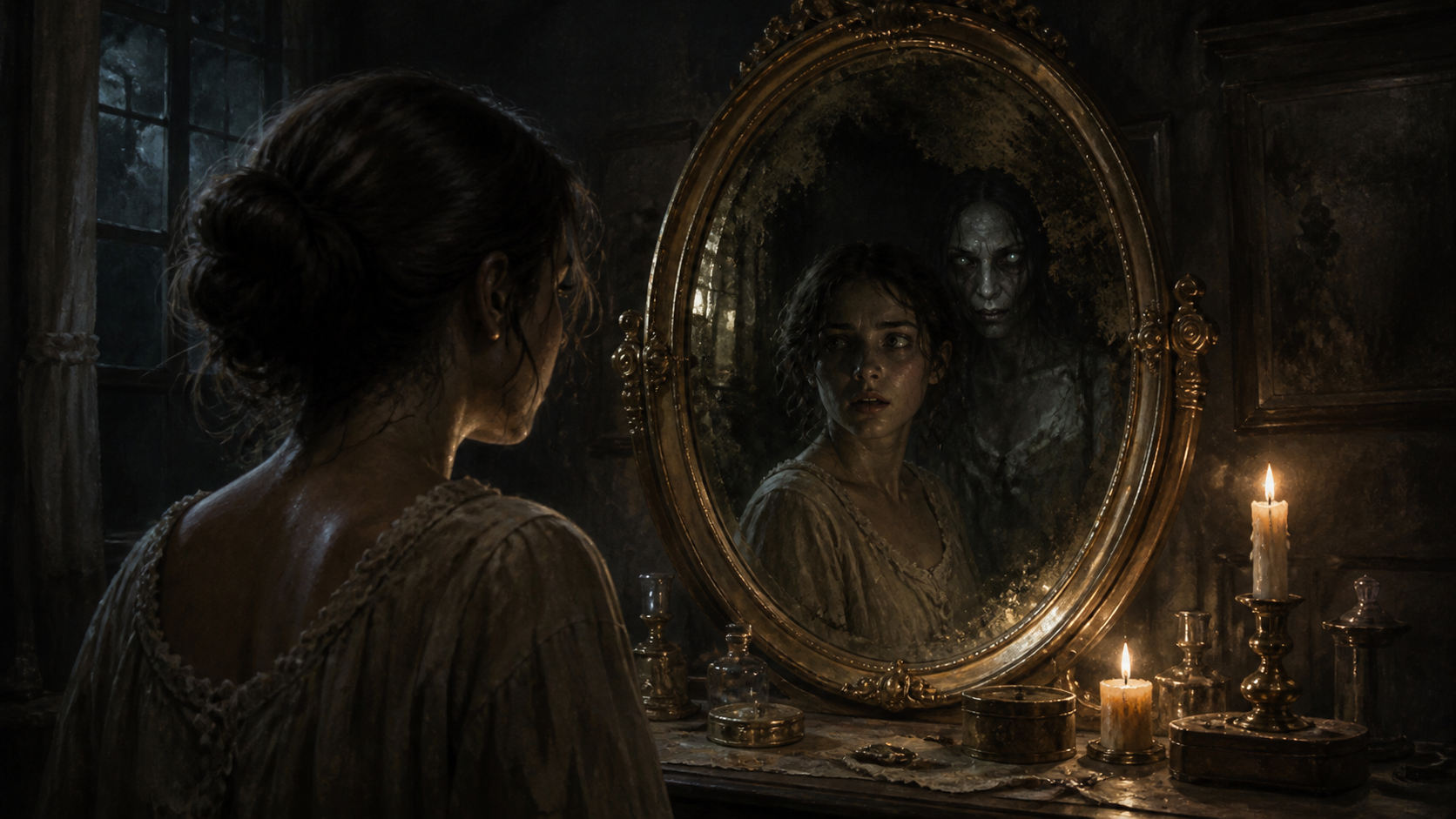
She almost dropped it. In the light she saw, not a ghost, but her father’s face. Then her mother’s. Then her own. Then Ana’s. Not properly formed, but as if the lantern were searching through every face it had ever taken and trying to choose one that would keep her still.
The chamber trembled. The water sloshed against the walls.
“Take it out,” the priest shouted. “Take it away from the house!”
Marta staggered towards the stair. The lantern grew colder in her hands, colder than ice, colder than anything living. Behind her, the room filled with a howling so vast it seemed to come from inside the masonry itself. The faces in the water were opening their mouths, all at once, and the walls began to crack.
She climbed, half blind, the lantern dragging her down like a weight of sorrow. Above, the hall shuddered. The police were yelling. One of them grabbed her arm and nearly lost his footing when she shoved the lantern towards him.
“Take it!” she screamed. “Don’t look at it!”
He recoiled. The priest made the sign of the cross so violently he struck himself in the face.
At last Marta reached the doorway to the street. The evening air hit her like a slap. Behind her the house gave a long, slow groan, and for a single impossible instant every window in the façade lit from within, each one filled with a face looking out.
Then the lantern in her hands went dark.
The silence after was worse than the noise.
The house did not explode or collapse. It simply settled, as though some vast knot had loosened. The windows emptied. The screaming stopped. The basement flooded up through the stairwell and the corridor with a sound like an enormous exhalation.
No one moved for a long time.
When the first light of dawn reached the harbour road, the old house looked exactly as it had the day before, only older somehow, diminished. The plaster had peeled in long wet strips, and several of the carved masks on the upper cornice had fallen away overnight, leaving raw stone beneath.
They searched the basement after daybreak. There were no bodies, no hidden room, no proof at all beyond the collapsed waterlogged chambers and the stink of mud. The lantern itself was gone. In its place they found only a black scorch mark on the stone and, floating in a corner of the flooded room, a scrap of old paper so waterlogged it nearly dissolved in Marta’s hand. On it, written in cramped brown ink, were two names.
Leonor da Cruz.
And beneath it, in a different hand, one she did not recognise, her own surname.
Marta kept that scrap.
The haunting did not end cleanly. Such things rarely do. For several weeks after, people in São Miguel de Vento reported seeing faces in mirrors, in shop windows, in the glass of buses at night. A few swore they heard a lantern walking in the hallways of their homes. One of the officers involved resigned and moved inland. Ana stopped working nights at the clinic and took a post in Funchal, saying she did not like being in rooms where the lights flickered without cause.
As for the old house, the council eventually fenced it off and left it for demolition that never happened. The budget disappeared into committee. The building remains standing to this day, boarded and silent, the masks on the cornice eroding grain by grain. Children still dare each other to run up to the gate, though now they do it with less enthusiasm.
Marta never returned inside.
But sometimes, in the blue hour before dawn, when she cannot sleep, she feels the weight of that lantern again in her hands. Not the heat. The cold. And for a moment she has the impossible sense that there are many people standing just beyond the edge of her sight, waiting for someone to speak their names correctly.
She does not know whether she freed them or only let them go somewhere worse.
Only once, months later, did she see the hall again.
She was walking home from her mother’s apartment after an argument about medication and money, and the street was empty and damp with sea mist. She looked up at the dark mass of Casa Valença on the hill and saw, for a single blink, a glow in the upper corridor. A lantern, moving slowly from one end of the hall to the other.
Behind it, in the windows, a row of faces turned towards her.
Not accusing.
Waiting.
Marta stood still until the light vanished. Then she went home, locked her door, and wrote down the names from the scrap of paper in a notebook she keeps in her bedside drawer.
Leonor da Cruz.
And hers.
She has never shown the page to anyone.
But every so often, when the wind comes up from the harbour and rattles the shutters, she thinks she hears footsteps in the corridor outside her bedroom, pausing at the door as if someone is holding a lantern and wondering whether to knock.

Ghost Stories