By the time Mara found the first person clawing at the inside of their own skin, the emergency ward had already lost power twice and regained it once, which in her experience was the sort of detail that made everyone believe they were still in control.
The ward’s backup lights painted everything the colour of old wounds. Monitors flickered. A child in an oxygen mask whimpered somewhere behind a curtain. The smell was disinfectant and sweat and the metallic tang of fear.
“Still with us?” said Ravi, the charge nurse, appearing at her elbow with a clipboard that had become useless three hours ago.
Mara did not look away from the woman in Bed 4. “Barely.”
The patient was in her forties, thin, with a surgical dressing taped across her forearm. Her eyes were fixed on the ceiling, but her fingers were busy. She had gotten them beneath the skin at her wrist and was working slowly, methodically, as though peeling an orange. A neat strip of dark blood slid down her palm. She did not seem to notice pain.
“Mouths,” the woman murmured.
Mara stepped closer. “What did you say?”
The woman turned her head with a wet click. Her pupils were too large. The whites of her eyes had gone faintly milky at the edges, as if film was spreading under the surface.
“Little mouths,” she said. “Under. Listening.”
Then she smiled, and something in the smile made Mara take a step back. It was not the blood. It was not even the skin. It was the absolute certainty on the woman’s face that whatever was under her body had already heard them.
Ravi swore under his breath. “Sedate her.”
“Already has midazolam in her line.”
“Then why is she doing that?”
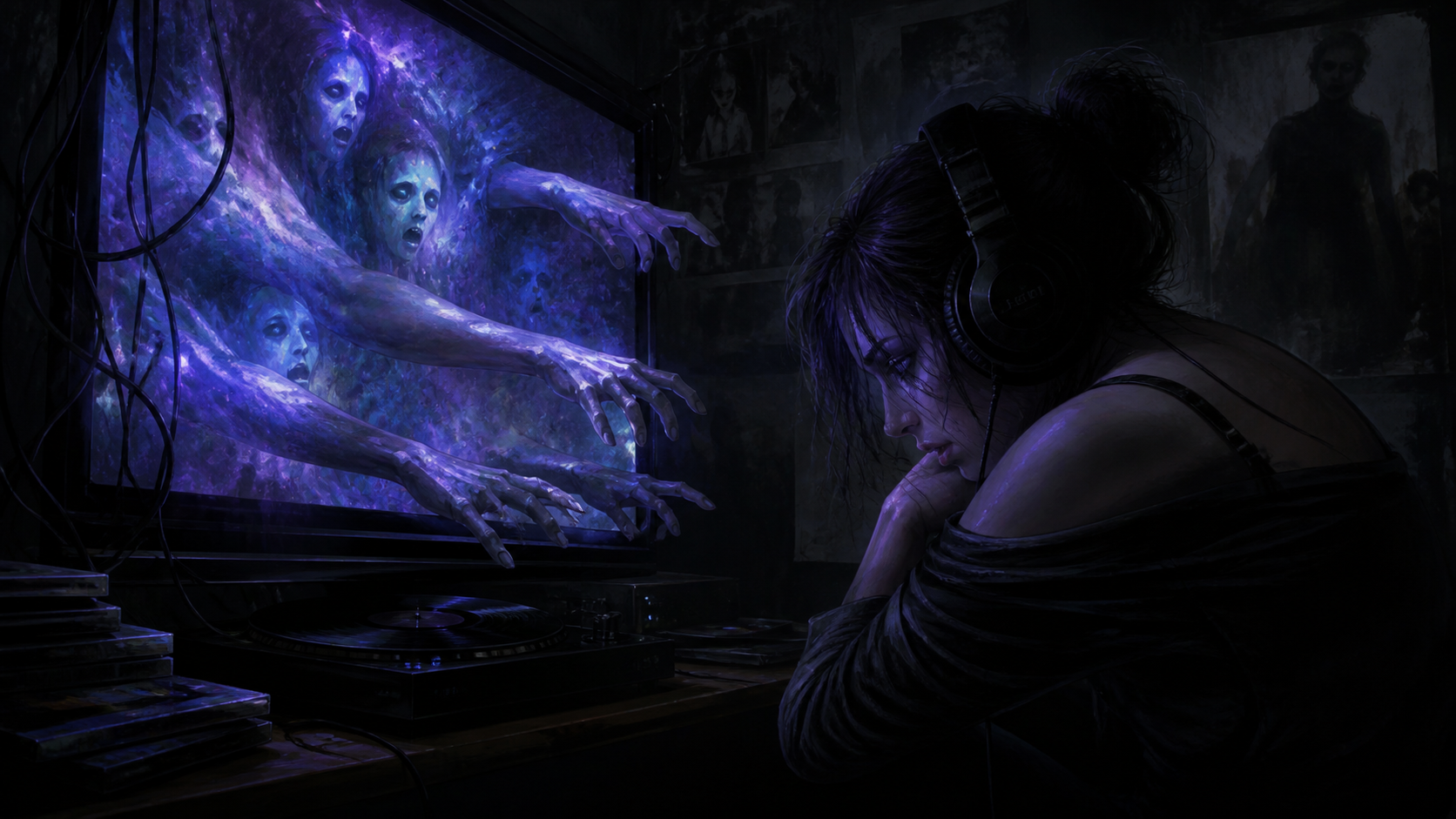
Mara did not answer, because the woman had begun to laugh, and the laugh had a second sound inside it. A faint, shrill clicking, almost too fast to hear, as if a radio somewhere had tuned itself between stations.
Outside the cubicle, the ward’s main doors banged open and a stretcher was shoved in by two paramedics in soaked fluorescent jackets. Rain had been hammering the city for six hours. The streets were flooded. The hospital, on the edge of Durban, was taking in the injured from a collapsed pedestrian overpass and a bus crash, plus all the usual things that arrived when power failed in a district that could not afford darkness.
One of the paramedics shouted, “You’ve got to see this one.”
Mara was already moving.
The man on the stretcher was young, maybe twenty, with a cracked helmet still strapped beneath his chin. His T-shirt was plastered to his chest. What frightened her first was not the blood, but the geometry. At the centre of his sternum, beneath a split in the skin, was a perfectly circular opening no larger than a coin. The tissue around it looked charred and then carefully scraped clean. Through the hole she saw a glimmer of something pale and wet inside, moving with tiny deliberate pulses.
The patient’s eyes snapped open.
He stared directly at her and whispered, “Don’t let it finish the call.”
Then his chest convulsed. A thin thread of blood spurted out, followed by a sound like a wet cough from very deep inside him. The pale thing retreated. He arched once and went limp.
Mara put two fingers against his neck. Nothing. She pressed harder, as if force could summon a pulse from the dead.
Ravi said quietly, “Doctor?”
She looked up.
The paramedic, a woman with rainwater running off her jaw, was holding a handheld radio in one shaking hand. “He was talking nonsense in the ambulance. Said everyone had a signal in them. Then he started scratching at his own chest. We’ve got two more like this in the vehicle. One’s dead. One’s not.”
Mara took the radio. It hissed with static.
Then, beneath the static, she heard something else.
A voice.
Not words exactly. A layering of tones so faint she might have imagined them, if not for the ice that ran down the back of her neck. It sounded like many mouths speaking over one another from a long distance away, all bent around the same tune.
She jerked the radio away from her ear. “Where did this come from?”
The paramedic blinked at her. “What?”
Mara stared at the radio. The display was smashed. No signal bars, no frequency. Still the hiss continued, and inside it the same almost-voice kept trying to form itself.
Ravi touched her arm. “What is it?”
“Nothing,” she said automatically, because that was what doctors said in emergencies, and because the alternative was too large to fit in her mind. “Bring the other patients in. Isolate anyone with neurological signs. Eyes, skin, speech, anything odd. And stop everyone touching their own wounds.”
Ravi gave her a look that said he had already noticed the phrase and hated it. “We’ve got no rooms left.”
“Find them.”
He went.
Mara turned back to the dead man. For an instant, she thought she saw movement beneath his skin, just under the sternum, a soft shifting ripple as if something small and many-legged had turned in place. Then the overhead lights flickered out.
The ward plunged into darkness save for the emergency strips along the floor.
From three cubicles away came screaming.
By dawn, they had fifteen cases.
By noon, they had thirty-seven.
The emergency ward had become a little kingdom of sealed curtains and trembling hands, of overheated bodies and the smell of antiseptic unable to cover rot. Patients arrived from the floodwater districts, from the taxi rank, from the collapsed overpass, from apartment blocks where whole families had started scratching themselves raw. Some came awake and talking. Some came catatonic. A few died before they could be logged.
Almost all had the same strange injury somewhere on the body. A puncture under the ribs. A slit on the neck. A bruise at the base of the skull. No entry wound from any blade Mara recognised. The skin around the marks had the same unnerving quality: too smooth, almost polished, as if something had been pressed from beneath until the body yielded.
And in each case, if you leaned close enough, you could hear it.
A faint clicking. A soft electrical tick, like insect legs on glass.
Mara and Dr Sithembile Dlamini, the senior consultant on duty, stood over a boy of about twelve who was trying to bite his own tongue in half.
“Restrain him,” Dlamini snapped.
“His jaw muscles are locking.”
“Then sedate him harder.”
Mara injected the child as ordered and felt sick at the speed with which his body jerked, not in pain but in response to something else, something with its own rhythm.
The boy’s eyes rolled towards her. His face was grey with fear, though his mouth was moving around the tongue he had half-chewed away.
“Help,” he whispered.
Then, with no warning, he screamed. The sound was so high and raw it made the monitors along the corridor spike. His chest heaved once, twice, and a dozen thin white filaments tore through the skin over his sternum, writhing in the air like pale roots searching for light.
Ravi stumbled backwards and dropped a tray. The filaments twitched, then snapped inward as if yanked by an invisible hand. The boy convulsed and went still.
Mara stood frozen for one terrible moment, the memory of the body’s interior imprinting itself in her mind. The filaments had not been veins. Not tendons. They had looked manufactured, biological but not human, each one subdivided with tiny glistening segments.
Dlamini was the first to speak. “Get that under a drape. Nobody leaves this ward until we know what the hell we’re dealing with.”
He sounded angry, but beneath the anger lay something more fragile. Fear, yes. Also disbelief. He was fifty-eight, brilliant, and had spent his life believing that the body, for all its cruelties, remained legible.
At 13:14 the hospital’s network died.
At 13:17 the phones stopped working.
At 13:19 the radio in security began broadcasting a tone that made everyone in the admin office clutch their ears and vomit.
Mara was in the staff room when the first body hit the floor in the corridor outside. She heard the impact and then the awful dragging sound that followed, as if someone were trying to stand with strings attached to their bones.
She ran out. Ravi was there, white-faced, pointing. An elderly man in a yellow hospital gown had collapsed against the wall. He was not dead. He was trying to speak. His lips were moving in wet little bursts, but the sound coming out of him was not language. It was the same layered clicking she had heard on the radio, now louder, now more insistent. The skin at his throat bulged and split.
Something pale emerged.
Mara’s breath stopped.
It was no larger than a fist, the colour of candle wax and slick with blood. It had no clear eyes, only a cluster of dark pits around a central opening that flexed like a mouth. Its body was segmented, insectile, yet there was a softness to it too, a grotesque familiarity, as if some obscene engineer had decided to make a parasite from the idea of a human nervous system. It unfolded a fan of fine filaments, and the air around it filled with that rapid clicking.
The elderly man jerked once, violently, and the thing withdrew back into him. His throat collapsed as if the skin had decided to close over a hidden wound.
Ravi made a strangled noise. “What in God’s name is that?”
The old man’s head turned, too smoothly. His eyes focused on them. There was no one home in them now, only obedience.
Then he lunged.
Mara barely got clear. Ravi struck the wall and slid down with blood on his forehead. The old man slammed into the staff room door, rattling the glass, and then began beating his face against it with animal force. Each impact left a smear.
“Help me,” Ravi gasped.
Mara hauled him up. “Move.”
They staggered into the corridor as the old man broke the door frame with his shoulder and came after them, mouth open, teeth cracking against his own lips. Behind him, from several cubicles and the resuscitation bay, came the sounds of more patients waking the same way.
Dlamini appeared at the far end of the corridor with a fire extinguisher in one hand and blood on his sleeve. “Get everyone into theatre two,” he shouted. “Lock it. Now.”
“You’re assuming we can confine this,” Mara said.
He saw the look on her face. “You know more than you’re saying.”
“I know it isn’t a psychotic break.”
“That was obvious five minutes ago.”
Then he saw the old man hit the floor and convulse as a pale thread burst from his neck, seeking the fluorescent strip lights overhead. Dlamini swore, once, very softly.
“All right,” he said. “What is it?”
Mara wished she could say she did not know. Instead she heard herself answer, “I think it’s using people as receivers.”
He stared at her.
“The radio,” she said. “The tone. It isn’t interference. It’s a pattern. Something is transmitting through tissue. Or into tissue.”
“From where?”
She had no answer. But the old man on the floor did. His jaw worked, and a voice that was not quite his came out in broken fragments.
“Beneath… the city… open… listening…”
Ravi crossed himself, then looked embarrassed by it.
A nurse screamed from the resus room. Another patient had torn open her own abdomen and was pulling at the contents with both hands, not in horror but urgency, as if trying to free something trapped inside her. Mara saw, before the curtain was yanked shut, a pale shape quiver between blood-soaked loops of intestine.
Dlamini made a decision. “We need to know if this is localised. If it’s in the water, the air, the pipes. Mara, come with me. Ravi, clear the staff and seal the ward doors. No one in or out unless I say so.”
“Dr Dlamini,” Ravi said hoarsely, “half the staff are already symptomatic.”
“Then keep them away from the patients. And if anyone starts speaking in a voice they do not recognise, you sedate them. Understood?”
Ravi nodded, eyes huge.
They went to radiology because it was the only place with a generator-backed system still partially alive. The storm had chewed through the power lines across the city, but the hospital’s basement hum persisted like a wounded animal. The scanner room was cold enough to raise gooseflesh. On the screen, the images from the young man on the stretcher loaded slowly, grainy and half-corrupted.
Mara stared.
Inside the sternum, nestled behind the bone and threaded into the tissues of the chest, was a structure no radiograph should have made visible. A nest. A tangled architecture of fine branching lines descending into the ribcage and disappearing beneath the diaphragm. Not tumour. Not abscess. A network.
Dlamini whispered, “Jesus.”
Mara zoomed in. At the centre of the network was a rounded chamber, and inside it, a shape like a folded ear.
The screen flickered. For an instant the image changed. The whole chest cavity seemed full of tiny pale forms pressing against the ribs from within, clustered around the heart as if waiting for a signal to begin.
Mara stepped back. “That’s in everyone.”
Dlamini looked at her sharply. “What?”
“The injured. The ones showing symptoms. It’s not just one organism. It’s spawning from the same pattern. Distributed.”
He rubbed a hand over his face. “You’re talking as if it’s technological.”
“It is. Or it was made to be.”
Before he could answer, the scanner room speaker crackled to life.
A tone filled the room. Soft at first, then almost musical, until it became impossible to ignore. Mara clapped both hands over her ears, but the sound was inside the bones of her skull, vibrating behind the eyes, behind the teeth.
Dlamini staggered. “Turn it off!”
Mara lunged for the control panel and hit every button in sight. The tone continued. Then a voice rose through it, low and patient and wrong.
We have found the threshold.
Mara froze.
The voice was not in English exactly. The words were carried on the same layered clicking, translated by something in the brain that had no right to understand.
Dlamini backed away from the speaker. “Who is that?”
The answer came from the wall behind him.
A nurse, one of the paediatric staff, had entered without either of them hearing her. Her head hung at an impossible angle. There was blood on her collar. When she lifted her face, Mara saw that her left eye had gone cloudy and the skin at her throat was pulsing with movement.
“She’s here,” the nurse said in a voice flattened by pain. “It needs more mouths.”
Dlamini took a step towards her, palms out. “Mpho, stay still. You’re injured.”
The nurse smiled and, with sudden speed, drove a scalpel into her own neck.
Mara shouted, but the woman only widened the wound with both hands. Blood fountained across the floor. Beneath the torn flesh writhed a compact pale body, glistening and segmented, already forcing its way out. It opened a ring of tiny black pits towards them.
The tone changed.
Every monitor in the room began to squeal. Somewhere above them, in the ward, alarms erupted in a ragged chain.
Mara felt her own throat tighten. A pressure had started behind her tongue, a subtle muscular flutter. She realised with a lurch of terror that she was hearing not just the tone, but an answer forming in herself.
Dlamini saw her expression. “Mara?”
She touched her neck. Skin normal. Pulse racing. But beneath that, deep in the tendons, something was moving in time with the signal.
“No,” she whispered.
The speaker spat static. The voice returned, closer now, almost intimate.
You were always listening.
The paediatric nurse dropped to her knees. The thing emerging from her throat unrolled with a soft, obscene grace and twitched towards the ceiling lights. Mara grabbed a defibrillator paddle and smashed the speaker unit with it. Sparks burst. The tone cut out.
Silence hit the room like a blow.
For one heartbeat nothing moved.
Then the nurse’s body sagged, and the pale thing dropped from her neck onto the floor with a wet slap. It lay there, opening and closing, while the blood beneath it shivered.
Dlamini was breathing hard. “We need to burn this floor.”
“We need to get out,” Mara said.
He looked at her as if she had betrayed him. “Leave the patients?”
“Doctor, there are things coming out of them.”
He stared at the thing on the floor, then at the corridor beyond the glass. Something moved past, too fast to see clearly. A human shape, bent low, dragging itself along by one arm.
“No,” he said, voice suddenly ragged. “No, we don’t just leave.”
That was his mistake. It was a humane mistake, and because of it he hesitated long enough for the nurse behind him to lunge.
The scalpel was still in her hand. It went into Dlamini’s side under the ribs and came out sticky with blood. He grunted and struck her away, but she was already opening her own mouth impossibly wide.
A pale filament shot from between her teeth and slapped across his cheek.
His whole body locked.
Mara grabbed him, but his muscles had gone rigid. The filament burrowed under the skin at his jaw. He let out a sound that was half gasp, half static.
“Run,” he managed.
She pulled him towards the door, but more figures were entering the corridor, all of them patients or staff, all of them moving with that same obscene coordination. Their mouths opened and closed in irregular timing, and from many throats came a sound like a radio tuning itself.
Mara saw Ravi among them, one eye swollen shut, blood on his sleeve. He was not yet fully turned, but his mouth was already moving to a rhythm that was not his own.
When he saw her, something like pleading crossed his face.
“Mara,” he said. “I can hear it under the floor.”
She dragged Dlamini into the radiology prep room and slammed the door. On the other side, bodies hit the glass.
Dlamini was shaking now. The filament under his skin had reached his throat. He was fighting it, jaw clenched, eyes wet with strain. Mara pressed gauze to the wound in his side. Blood soaked through instantly.
“What floor?” she asked.
He swallowed hard. “Basement. Service tunnel.”
The building shuddered. Somewhere below them, deep in the concrete, there came a pulse. Not an explosion. A beat. One slow, immense throb that seemed to travel up through the soles of her shoes and into her bones.
Mara understood then with a savage clarity: the storm had not caused this. It had uncovered it.
The hospital was built over old drainage works and sealed service shafts that predated the modern city. Something had been there, waiting in the dark, and whatever signal it carried had woken in the failure of power and rain and interference. It had not infected the patients by chance. It had been reaching through them, trying to make the building itself into an antenna.
Another pulse came. Louder.
The concrete floor trembled. Dust sifted from the ceiling.
Dlamini caught her wrist. “If this is in the basement, then cut the line. Destroy the source.”
“With what?”
He let go and tried to reach into his pocket. His fingers came out slick with blood and a key card. “Generator room. Fuel lines. There’s a valve. If you can get there before it’s overrun.”
She stared at him. “You’re not coming?”
He smiled then, though it was a terrible, broken thing. “I think it’s too late for me.”
The filament at his throat twitched.
Mara stood very still. Every sensible part of her wanted to run, but the hospital around her was filling with voices that were not voices and bodies that no longer belonged to themselves. If the thing beneath the building was broadcasting through flesh, then destroying the generator might not help. But if it needed power, if it needed the hospital alive long enough to complete whatever message it was sending, then maybe she had one chance.
Another impact hit the door. The lock snapped.
She kissed Dlamini once on the forehead. It was a foolish, human gesture, and he shut his eyes as if ashamed to receive it.
Then she took the key card and ran.
The corridors were chaos. Red emergency lights strobed over blood-smeared walls. Patients crawled out of rooms and then stiffened, hearing something far away. Nurses with vacant faces stood shoulder to shoulder, mouths opening in synchrony. One man in a trauma gown had split his chest to the sternum and was pulling with both hands at the pale writhing thing nested there, as if it were an umbilical cord and he a frightened father.
Mara kept running.
At the stairwell, she met Ravi.
He had one hand wrapped around a mop handle like a spear. His eyes were clear, but only just. The skin over his left temple was moving.
“I knew you’d come this way,” he said.
“Get out.”
He laughed once. “Where?”
She started down the stairs. He followed.
Below, in the basement corridor, the sound was unbearable. Not the tone from earlier, but a chorus of wet clicking so dense it seemed to coat the walls. Pipes rattled. The floodwater slopped against the lowest steps. Somewhere beyond the emergency lighting, something large and organic was pulsing in time with the building.
Ravi whispered, “I saw it in the water.”
Mara did not answer. The generator room door was ahead, half open. Inside, the emergency lights cast a dim amber sheen over the tanks and pipes. The smell of diesel was thick enough to sting her nose.
There, in the centre of the room, under the fluorescent strip that still flickered stubbornly overhead, stood three people she recognised. One was a porter. One was a cleaner. The third was a child from paediatrics, barefoot and soaked to the knees.
They had their backs to her.
Their shoulders twitched in unison.
“Mara,” Ravi said, voice cracking.
The figures turned.
Their faces had not yet broken fully, which made them worse. The porter’s mouth trembled with effort, trying to hold itself in a human shape. The cleaner’s eyes were streaming tears. The child was smiling with awful concentration, as if performing a task.
Then, beneath the skin of all three, the filaments began to move.
Mara understood she had maybe seconds.
She snatched the fuel valve tool from the wall, a metal wrench designed for maintenance, and ran straight at the nearest tank. The cleaner lunged. Ravi intercepted, slamming the mop handle into her throat. It cracked with a sickening snap. She fell, convulsing, and a pale shape burst from her mouth in a spray of blood.
Ravi screamed and kept swinging.
Mara jammed the wrench into the valve assembly and threw her weight into it. The metal resisted, then gave. Fuel hissed out in a hot chemical stream across the floor.
The child made a sound, not human, and charged.
Mara struck it across the face with the wrench. It went down, but already its chest was opening, skin parting around the movement beneath. She stumbled back, tripped over the spilled fuel, and hit the floor hard enough to crack her elbow.
The basement began to ring with that deeper pulse again.
From the drain in the centre of the floor came a soft, sucking sound.
Something pale pushed upward through the grate.
It was not one of the parasite forms. It was larger. A many-limbed bloom of white tissue, bulbous and ridged, with an aperture at its centre that opened and closed like a mouth trying to remember how to speak. Filaments trailed from it into the floodwater, into the pipes, into the concrete itself.
The whole room vibrated around it.
Ravi stood staring, mop handle trembling in his hands. Blood dripped from his chin. “What is that?”
Mara knew, with the certainty of nightmare logic, that this was the relay. The root. The thing that had turned the hospital into an ear.
It lifted itself from the drain and the clicking around them intensified, as if every infected body in the building had heard it rise.
Then the speaker in the ceiling crackled, though no speaker had been visible there a moment before.
Open.
Mara looked up. The ceiling light shivered. The voice came through the walls, through the pipes, through the bones in her teeth.
Open and be received.
Ravi dropped the mop handle. Tears were running down his face now, and with them came the first split of skin at his throat. He made a horrified sound and pressed both hands there.
Mara did the only thing left.
She dragged herself to the open valve, reached into the slick fuel, and yanked the emergency igniter from the wall. The spark burned her wrist. The room filled with the stench of raw diesel.
She looked once at Ravi.
He understood.
For a moment he looked very young.
“Go,” he said.
She ran.
The blast hit her from behind like a living wall.
Heat and pressure slammed her down the corridor. The basement door blew outward in a wave of fire and smoke. The building shuddered above her. Sprinklers burst. Alarms began to scream in earnest, human and mechanical and blessedly unharmonious.
Mara crawled through broken glass and water, half blinded, half deafened. Behind her the hospital groaned. Somewhere in the collapse came a sound like thousands of tiny mouths closing at once.
She reached the stairwell and kept climbing.
On the second floor, smoke had filled the corridor. The infection was no longer hidden. People were on the floor, seizing, vomiting blood, tearing at themselves. Some were on fire. Some were still alive enough to scream. Through the chaos she saw a nurse slam her own head repeatedly against a wall until the skull cracked. She saw a man crawling with his own intestines in his hands. She saw Ravi, or what remained of him, stumbling from the smoke with one arm hanging useless and his mouth opening in that measured, alien rhythm.
He looked at her, or through her.
Then he turned and walked back into the smoke.
Mara did not follow.
She got out through the ambulance bay as the roof began to collapse over the central ward. Rain hit her face, cold and clean and unimaginably ordinary. The whole city was still dark. Sirens approached from somewhere beyond the floodwater. Across the road, people stood under the eaves of a pharmacy, staring at the hospital as it burned.
For one moment she thought it might be over.
Then the radios in every nearby vehicle burst into static.
The sound was thin at first. A familiar clicking underneath. Then the tone rose, not from the hospital, but from every direction at once.
Mara turned slowly.
In the flooded street, in the reflections of red and blue sirens, she saw movement beneath the water. Not fish. Not debris.
Pale shapes were travelling through the runoff, moving with purpose towards the storm drains.
The signal had not died. It had only changed medium.
Mara put a hand to her throat and felt it answer, a tiny involuntary flutter beneath the skin. The tone in the air deepened, and from somewhere inside her own chest, something clicked back.