When my mother died, I inherited three things I did not want: her tenancy, her debts, and a brass oil lantern with a cracked glass chimney and a handle polished bright by years of use.
The estate agent had already been into the flat by the time I arrived from Bristol. He was a young man in a linen suit, sweating through the armpits, standing awkwardly in the narrow hallway while the air from the open windows did nothing to shift the smell of lilies, stale tea and the sweet rot that lingers after a body has been taken away.
“There’s not much,” he said, cheerful in the wrong way, as if he were discussing a kitchen refurbishment. “Your mother was quite private. You’ll want to clear it fairly promptly, if possible.”
I remember looking past him into the sitting room and seeing the lantern on the mantelpiece. It was the only object in the room that seemed to have been deliberately placed. Not decorative. Waiting.
My mother had lived in the flat above a dentist’s surgery in St Leonard’s for twenty-seven years. She had become a small woman by the end, so bent with arthritis that she seemed folded in on herself, but the neighbours all said she had once been a force. She had brought me up alone after my father disappeared in 1998, and by disappearing I mean he walked out one Thursday after supper and never came back, never wrote, never rang. My mother never said a bitter word about him. She simply stopped speaking his name.
I was forty-two when I came back to clear her things. Divorced, renting a room in London I could barely afford, freelance proofreader for a legal publishing company, and old enough to know that grief is less a wave than a process of continual catching your breath under water.
The lantern fascinated me for reasons I could not name. It was heavy, old brass, with a squat fuel chamber and a wick blackened almost to powder. The glass chimney had a hairline fracture running from base to rim. There was nothing unusual about it, except that my mother had once told me, years before, never to leave it lit after midnight.
At the time I had laughed. “You don’t even use it.”
Her face had gone pale. “I use it when I need to remember things.”
I thought of that now with a strange, unpleasant tug under the ribs.
I took the lantern down and turned it over. On the underside of the base, nearly invisible beneath old grime, was a line of scratched lettering, shallow but deliberate. I rubbed it clean with my thumb.
MORGAN.
My name.
I stared at it until the estate agent coughed gently. “Anything important?”
“No,” I lied. “Just junk.”
But I took the lantern home with me anyway, because I had learned from my mother that some objects should not be left behind simply because they make you uneasy. Objects like that have a way of following you in other forms.
My rented room was in a converted terrace in Kilburn with thin walls, a perpetually damp bathroom, and a landlady who spoke to me as if I were a disappointed nephew. I set the lantern on the windowsill and washed my hands twice before I touched my tea.
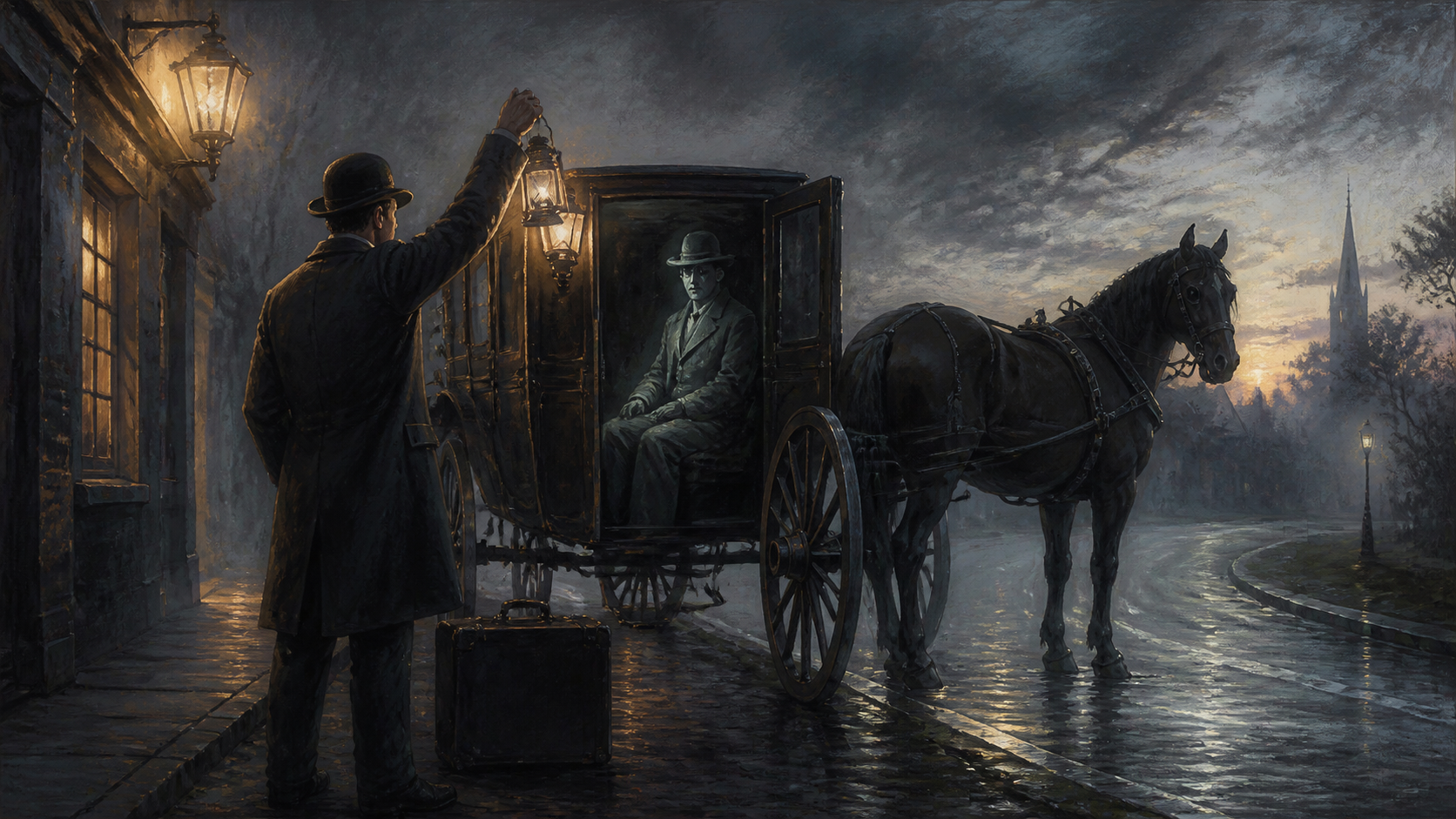
At 1.13 a.m., I woke to the smell of paraffin.
Not strong. Just enough to cut through the flat’s usual odour of dust, laundry detergent and the curry house downstairs. I lay still, listening. Traffic hissed through the night. Pipes ticked. Somewhere a baby cried and went on crying with the determined breathlessness of the exhausted.
The smell sharpened.
Then I heard, from the corner of the room, the soft metallic click of a wick being raised.
I sat up so fast I bruised my elbow on the wall.
The lantern was lit.
A low yellow flame trembled behind the cracked glass, bright enough to throw a circle of light across the floorboards. I had not touched it since placing it on the windowsill. I knew that as certainly as I knew my own name.
And there, within the lantern’s light, stood a shape that was not a shape. A man-sized absence. A darkening in the air, as if the room had grown a hole and was remembering how to be human.
I could not move. The flame made a faint, dry fluttering noise.
Then a voice, thin as paper dragged over wood, said, “Morrie.”
No one had called me that since childhood.
My heart rammed against my ribs. I found my voice in pieces. “Who’s there?”
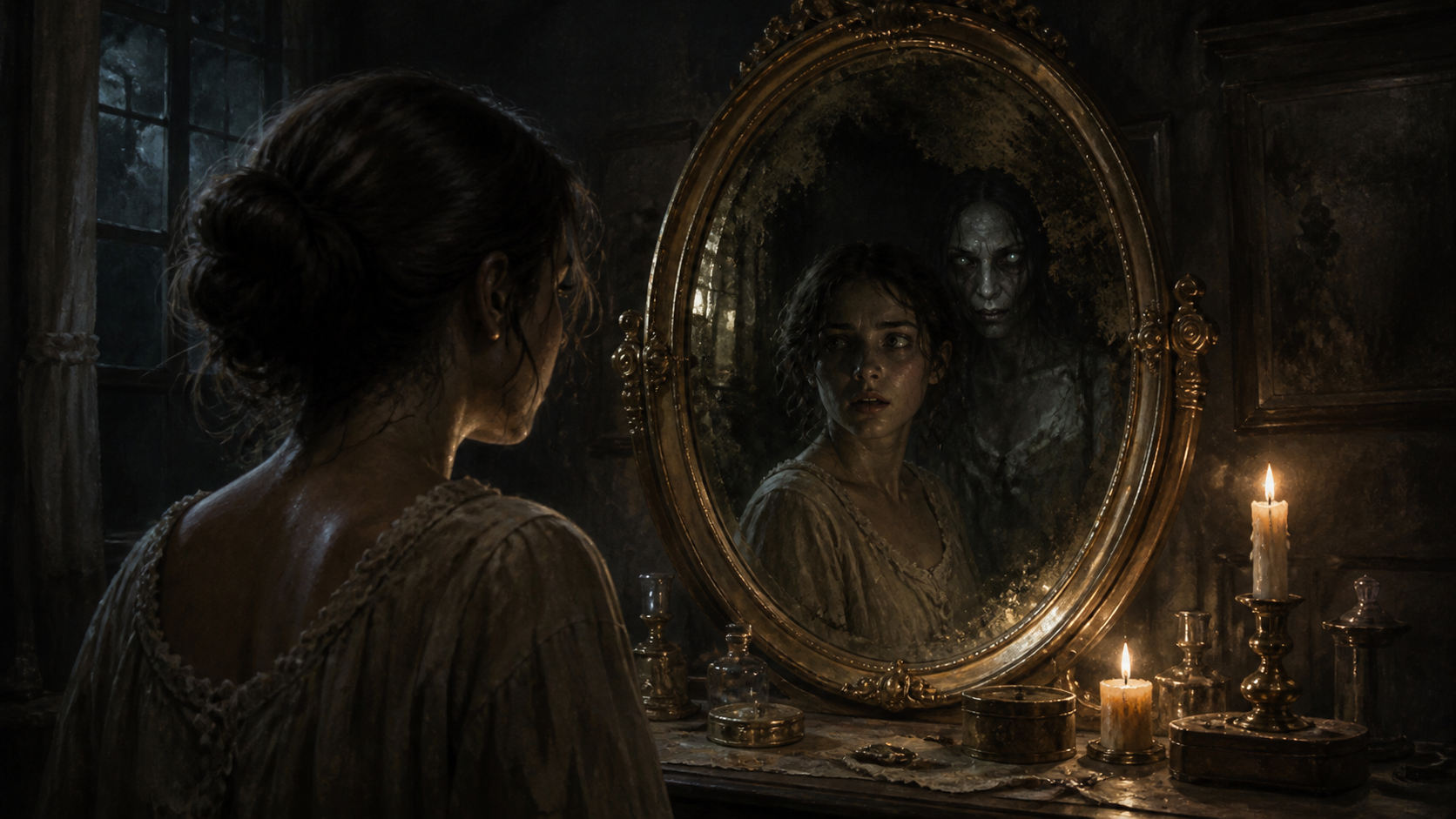
The lantern answered by brightening, and in the golden pulse I saw a face pressed into the darkness behind the chimney glass. Not reflected, exactly. Imprinted. A stranger’s face, drowned-looking and swollen around the eyes, mouth open in a shape of unfinished speech.
I switched on the bedside lamp. When I looked back, the lantern was dark.
I did not sleep again that night.
In the morning, I phoned my sister, Ellen, in Manchester. We had been estranged for six years, since an argument about our mother’s care that ended with her calling me selfish and me telling her she had no idea what it cost to be the one who stayed. We talked now and then, only because blood makes a weak but persistent demand.
“You sound terrible,” she said.
“I’ve had a bad night.”
There was a pause. “Is it Mum?”
“Possibly.”
Another pause, less forgiving. “You’re still in that flat?”
“No. I brought something back.”
“Something what?”
“A lantern.”
She laughed once, sharply. “You’ve been working too much.”
“I’m serious, Ellen.”
She sighed. “Then take it back.”
“I can’t explain it.”
“Try.”
I did, badly. The smell, the light, the voice. By the time I finished, she was quiet.
Then she said, “Did you ever ask her about the man in the cellar?”
I closed my eyes. “What man?”
“She told me about him when I was ten. Said there was a man who’d come to the house during the winter after Dad left. Said he was a friend of hers, or maybe his. She was always vague. She made me promise never to go downstairs alone.”
I felt the room tilt slightly. “I don’t remember that.”
“You wouldn’t,” Ellen said. “You were the one she was trying to protect.”
From what? I wanted to ask, but she had already gone on, faster now, as if afraid of what she might hear herself say.
“She used to have that lantern out whenever there was a power cut. I remember it in the kitchen window. She said it helped her find things. Once I asked what things, and she said lost things. She looked terrified when she said it.”
That evening I searched through my mother’s papers and found, in a biscuit tin with old photographs, a bundle of letters tied with a blue ribbon. Most were mundane, late bills and council notices, but at the bottom was a small envelope with my name on it, written in my mother’s hand.
I sat on the floor and opened it.
The note inside was brief.
If the lantern lights, do not answer when it calls you by your name.
There was no signature.
I read the note three times, then once more, because disbelief often needs numbers.
The next morning I went back to the flat. I told myself I wanted to sort the cupboards, collect the rest of her things, perhaps ask the letting office to let me keep the tenancy open another month. In truth I wanted to see the lantern in daylight and be laughed out of my own fear.
The flat looked ordinary enough in the grey afternoon. Beige carpet, linoleum, a sink with a slow leak. The winter sun through the net curtain turned the dust into a pale glitter. The lantern sat on the mantelpiece where I had left it, inert and unremarkable.
I picked it up and found, under the base, a second line of scratched letters I had not seen before.
DON’T LEAVE ME DOWN THERE.
I dropped it so abruptly that it struck the hearth and cracked the glass chimney further. For a moment I thought I had imagined the words, but there they were, one beside the other, my mother’s hand or someone mimicking it, I could not tell.
The kitchen door slammed behind me.
I spun round. Empty flat. Quiet.
From the hallway, very softly, came the sound of someone trying not to breathe.
I opened the door and saw no one. Yet the corridor was colder than it should have been, the stale communal carpet smelling suddenly of wet earth and extinguished matches. At the far end, by the front door, a smear of light moved across the wall. Not sunlight. Lantern-light, trembling and low.
I followed it, because people are idiots when fear is mixed with unfinished business.
The light led me down the stairs to the basement door.
I had lived in that building for weeks after my mother’s death and never noticed there was a basement. The door had been painted over many times. A cheap padlock hung from the latch, but the hasp had been ripped through long ago and then bent back into place. It was not secure. Only neglected.
When I put my hand on the handle, I heard my mother’s voice as clearly as if she stood beside me.
“Morgan. Don’t.”
I turned sharply. No one.
The voice had not come from behind me. It had come from inside the lantern I held under my arm.
I nearly threw it. Instead I backed away, my pulse hammering so hard I felt light-headed. The basement door, half open now, breathed out a smell of damp stone, coal dust and something sweetly foul underneath, like old blood washed into concrete.
And there was another sound. A dragging, wet movement in the dark below.
I shut the door and left the building without taking my eyes off it. On the pavement, with traffic hissing by and a delivery van mounting the kerb in front of me, I stood shaking like a man recovering from an electric shock.
That should have been the end of it, or the point at which I ran.
Instead I did the one thing the note had warned me against.
That night, when the lantern lit again, I answered.
I had not touched it. I was lying awake, listening to the radiator tick and a drunk singing somewhere on the street below, when the room filled with that same paraffin smell. The flame came on with a soft whoomph, and the ceiling seemed to shrink over me.
“Morgan,” it said.
The voice was neither male nor female. It was my voice, but worn thin, like a recording played too many times. “Morgan, come down.”
Every instinct told me not to answer. Yet I was already sitting up, my mouth open, my body moving with the sick obedience of a sleepwalker.
“Who are you?” I whispered.
The lantern flickered. In the glass, where the flame ought to have been, I saw instead a corridor of brick steps descending into darkness. At the bottom stood a figure with its back to me, head bowed, shoulders in a brown coat I dimly recognised from old photographs.
My father.
I said his name aloud before I could stop myself. “David?”
The figure turned.
His face was badly damaged, as if something had eaten part of it and then reconsidered. One eye gone. The skin on his throat stretched shiny and black. But he smiled at me with an expression I remembered from childhood, affectionate and faintly amused.
“Nearly,” he said.
The room changed. I was not in my rented room anymore, but in the basement beneath my mother’s old flat, though I had never been there before. The walls sweated. Old pipes ran like bones overhead. The lantern hung in my hand, although I had no memory of taking it. Its light made a small golden island in the black.
A shape lay against the far wall under a tarpaulin. The smell came from there, rank and deep.
The voice from the darkness said, “You left me.”
I could not speak. My throat had closed around my own breath.
The tarpaulin shifted.
I saw a hand emerge from beneath it. Grey skin, nails split, fingers stained with what might have been coal dust, or earth, or dried blood. Then another hand, scrabbling, and the shape beneath the tarpaulin heaved once as if something inside it were trying to rise through layers of wet cloth and time.
I stumbled back. The lantern flared. In the wall opposite me, a row of names appeared, scratched into the brick in frantic, shallow lines. Some were initials. Some were full names. More than I could read.
At the centre: MORGAN H. WILKES.
My mother’s maiden name was Wilkes.
I heard my own breath coming in short, brutal gasps. “What is this?”
The figure under the tarpaulin began to laugh. It was a horrible sound, a wet metallic rasp as if someone were scraping a spoon across the inside of a skull.
“You were the lamp-keeper,” it said. “Your mother made you mine.”
Then the lantern went out.
I woke on the floor of my room with my nose bleeding and the lantern beside me, cold in my hand. The bedsheets were soaked through with sweat. Dawn had not yet come. For a long time I lay there unable to decide whether I had dreamt it or whether something had truly taken me under the building, into a place hidden below the ordinary world.
There was blood under my fingernails.
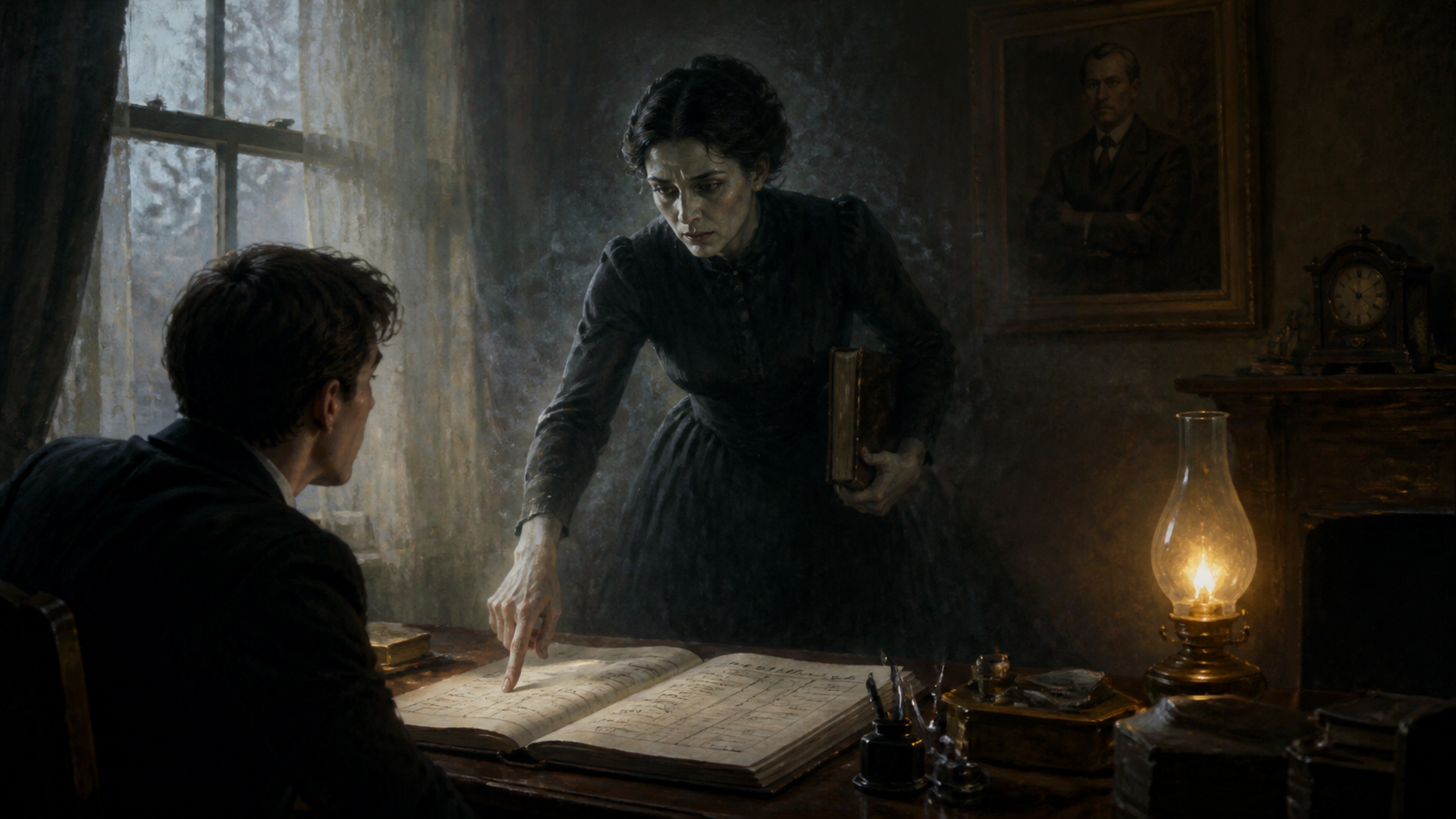
The next day I went to see Mrs Patel, who lived opposite my mother for almost thirty years and made curry in bulk every Sunday for the lonely people on the landing. She was seventy if she was a day and had the look of someone who had seen too much to ever be surprised properly.
When I showed her the lantern, she crossed herself in a brisk, irritated way.
“Your mother kept that in the dark cupboard,” she said. “Never on display. She used to say it needed feeding.”
“Feeding what?”
Mrs Patel looked at me for a long moment. “Names.”
I laughed then, because it was absurd, and because if I did not laugh I would have to believe her.
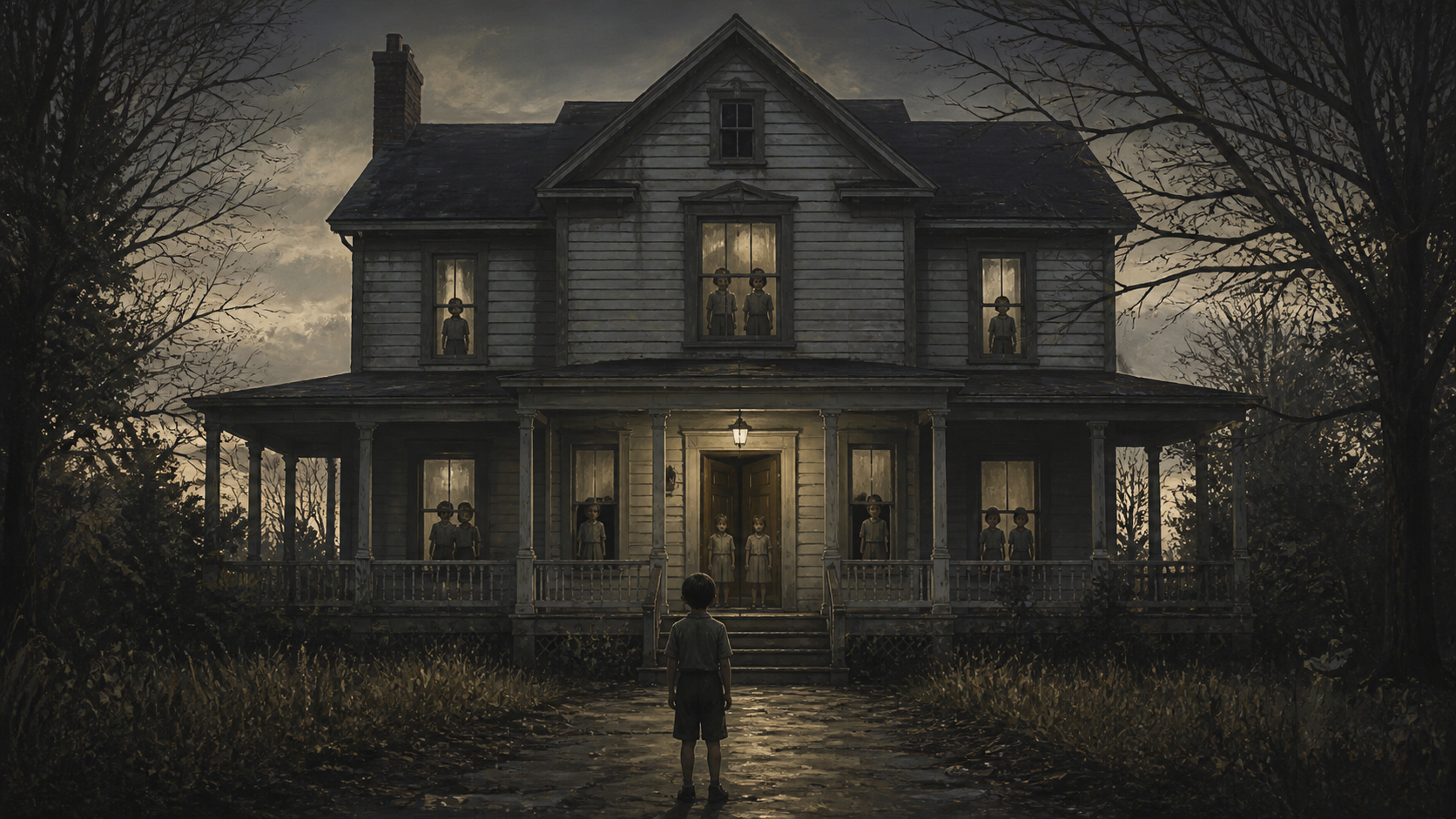
Her expression did not change. “In the old days here, before the surgery and the flats, there was a house. One of those big damp houses the rich abandoned and the poor inherited. During the war, a child went missing. Then a sailor. Then your grandfather’s brother, if I remember right. People said the house took them.”
“People say all sorts of things.”
“Yes,” she said. “And some things stay said because they are true.”
She told me my mother had once been one of six women who cleared the basement after a flood and found, behind a false wall, a small room with no window, a chair, and black soot on the floor shaped like a circle. In that room there had been the lantern, locked in a box. My mother took it home against everyone’s advice. After that, she stopped sleeping properly.
“Your father was involved,” Mrs Patel said. “Not at first. He came later, with a man from the council and a priest who was not a priest. They wanted it buried again. Your mother would not let them.”
I left before she could say more.
By then I understood enough to be afraid in a different way. Not of a ghost in the usual sense, but of a system. A hunger with rules.
That night I phoned Ellen and told her everything.
She was silent so long I thought the call had dropped.
Then she said, “Mum told me Dad didn’t go missing. She said he was taken.”
“Taken by what?”
“You’re asking me?”
“No,” I said. “I’m asking whether she ever said who took him.”
I could hear her breathing through the line, shallow and quick. “She said the lantern did.”
We met the following afternoon in the cemetery at Kensal Green, half because it was neutral ground, half because neither of us could bear to be in a room with the lantern. I had wrapped it in a towel and tied it in an old coat, but it still seemed to stain the bag with a sour smell. Ellen kept looking at it as if expecting movement.
“We have to decide what to do with it,” she said.
“Bury it.”
“Burn it.”
“Can we?”
She stared at me. “You’ve seen what it does, and your first question is about feasibility?”
“What would you do?”
She drew a hard breath. “I would like to smash it against something and watch it break. But if Mum was right, that might not be enough.”
We argued then, in the frozen silence between graves, about whether the thing was a prison, a lure or a vessel. Ellen wanted to throw it into the Thames. I wanted to destroy it with a hammer. Neither of us said the most frightening possibility, which was that the lantern did not contain the haunting but fed it, and that by carrying it we had already become part of whatever cycle had begun before we were born.
I finally told her about the basement room and the names scratched in the brick.
She went pale. “Morgan H. Wilkes,” she said. “That was Grandad’s name. Morgan Harry Wilkes.”
My stomach lurched. “My full name is after him?”
She nodded. “Mum hated it. She said it made you easier to find.”
At that moment the lantern, inside the coat, lit through the wool like a coal held to paper.
We both saw it.
The light pulsed once, and around us the cemetery seemed to lean inward. The trees went still. Somewhere in the distance a dog began to bark and then stopped as if strangled.
Ellen backed away first. “No.”
The coat moved in my arms. Not violently. Worse, with purpose.
And from within it came my own voice, whispering, “Morgan, let me out.”
I opened the coat despite myself. The lantern glowed a dirty yellow. Inside the glass chimney was not flame but a tight, revolving shape like smoke compressed into a face. It was looking at me.
Then I understood. Not fully, not in some noble final way. Just enough.
The lantern remembered names because it had once been made to hold them. To keep the lost souls of the house from wandering, to bind them in light and make a map of the living. But it had grown hungry over the years, or perhaps it had always been hungry, and my mother had used it because she had been taught, in desperation or inheritance, that the only way to stop the thing in the basement was to feed it someone to carry the light.
My father had not been taken by accident. He had been offered, or traded, or left to bargain poorly in the dark.
And my name, scratched into the base, was not a blessing.
It was a claim.
“Don’t listen to it,” Ellen said, but her own voice had gone thin.
The lantern spoke again, and this time it used my father’s voice.
“Your mother chose you,” it said. “She gave you up and called it love.”
Ellen gasped as if struck.
That was the worst thing it could have said, because it fitted the shape of some old resentment I had carried without naming. My mother’s protectiveness. Her secrecy. The way she watched me too closely whenever I was ill, as if measuring me against a private debt.
The lantern brightened until the glass was almost white.
Behind the light I saw the basement again, and in it a child-sized figure crouched in the corner, face turned away. Not a child. A shape made of absence. Lost soul, yes, but not one soul. Many. Layered, folded, waiting to be remembered or used.
The figure in the basement lifted its head.
I knew then what the lantern wanted. It wanted a name spoken with enough belief to fasten it. It wanted someone to carry it down and open the room again. It wanted to be fed, or to feed, I could not tell the difference anymore.
Ellen seized my wrist. “What are you doing?”
I had started to speak my name aloud.
She slapped me hard across the face. “Don’t you dare.”
The shock broke whatever pull held me. I dropped the lantern.
It hit the path and shattered.
The sound was like breaking bone.
The chimney burst. Brass split. Oil flashed out in a sudden arc of fire that rolled over the gravel and licked at the dead grass. Yet the flame was wrong, too bright and too quiet, burning with a pale yellow light that did not give warmth. Inside it, shapes writhed. Hands. Faces. Mouths opening and closing around words no one could hear.
The cemetery air filled with voices.
Not one voice. Dozens. Hundreds. A murmuring crowd, all speaking names, all trying to remember themselves through the fire.
Ellen screamed. I lunged to help her, but the lantern’s flame leapt up between us and I saw, in the centre of it, my mother’s face.
She was younger than I had ever known her, her hair dark, her cheeks hollow, eyes full of terrible exhaustion.
She looked straight at me and mouthed, not a plea but an apology.
Then the fire went out.
For a long moment neither of us moved.
The gravel was blackened, the brass shell split open. The smell was awful, like wet ash and old chapel candles. Yet the voices did not stop. They had gone into the air, into the trees, into our lungs.
Ellen began to cry. “Is it over?”
I wanted to say yes. I wanted to believe broken brass meant release.
Instead I looked at the fragment of glass nearest my shoe. A face peered back at me from within it, distorted by the curve.
My own face.
Not mine. Something older, hollow-eyed, with a mouth that had learnt my shape by listening.
That night I dreamed of the basement under the flat, but the room was full of lanterns, each with a name scratched underneath. Some were names I knew. Some were my own, repeated in a hundred different hands. At the centre stood my mother, holding the original lamp with blood on her fingers. She was trying to close a door that kept opening behind her. Every time she shut it, someone screamed from the other side.
When I woke, my phone was full of missed calls from Ellen.
She left a voicemail. Her voice was ragged, almost unrecognisable.
“It’s in my flat,” she said. “Morgan, it’s in my kitchen. I can smell it. Please.”
I drove to Manchester at dawn. The motorway was thick with lorries and rain, and every service station looked like a place where people had once been happy and no longer were. By the time I reached her terrace in Chorlton, I was exhausted enough to doubt my own memory.
Her front door stood open.
Inside, the hall smelled of paraffin.
I found her in the kitchen, standing very still, staring at the worktop. There was a lantern there. Not broken. Whole and polished, the brass gleaming as if newly made.
Ellen looked at me without blinking. Her face was white and wet with sweat.
“It came back,” she whispered. “I didn’t bring it here.”
The lantern flame was already lit.
I knew then that breaking it had not destroyed it. Only released what had been bound inside the pattern of names. It had found a new bearer. Or perhaps it had always been heading here, to the sibling who had been left out of the first bargain and was therefore easier to reach.
From the flame came a voice we both knew.
“Morgan.”
I stepped towards the lantern, but Ellen grabbed my arm. “No. Don’t answer it.”
“It knows my name.”
“It knows our names.”
The voice in the lantern laughed, and it was my mother’s laugh this time. Not cruel. Tired.
“You were never meant to keep me,” it said. “Only to carry me until I found the other one.”
Ellen’s grip tightened painfully. “What does it want?”
The flame rose higher. In it, I saw the basement door again, standing open beneath the flat in St Leonard’s. I saw the room with no window. I saw all the names scratched into brick, and among them names I had not noticed before, names of women, children, strangers, all the lost things my mother had hidden from the world.
The lantern wanted what all such things want in the end. Witness. It wanted to be remembered so that the lost might not remain lost, even if remembrance meant bondage, and bondage meant hunger.
I thought then of my mother standing alone in that room, young and frightened, trying to make a choice between the living and the dead. Perhaps she had chosen us badly. Perhaps she had chosen the only way she could. Love, in families like ours, is often indistinguishable from damage.
I let go of Ellen and took the lantern.
Her eyes widened in horror. “Morgan, no.”
But I had already made the only choice left that felt like mine.
I carried it out of the house and into the rain.
At the end of the garden was a narrow brick wall overgrown with ivy, beyond which ran the railway line. Trains thundered past every few minutes, shaking the ground. I could feel the lantern growing warm in my hands, the flame inside it shivering with anticipation.
I held it over the wall and said my own name once, clearly, into the storm.
The lantern answered at once, not in my voice but in a chorus of them, all the names it had gathered and all the ones it wanted still.
Then I threw it.
It fell into the tracks just as a train hit the curve, and the impact was monstrous. There was a flash, a shriek of metal, and a burst of fire so bright I had to turn my face away. The ground shuddered beneath my feet. When I looked back, there was only wreckage and steam and a smell like scorched brass.
For a moment I thought the thing was gone.
Then, through the smoke, I heard a voice from the dark below the rails.
“Morgan.”
Not calling me.
Remembering me.
I have not slept properly since. Ellen moved in with a friend for a while and then, against my advice, returned to her flat. She says the room sometimes smells of paraffin when it rains. I smell it too, now and then, in lifts and train carriages and the corridor outside my room in London. Once, in a stationery shop, I saw my name scratched on the back of a receipt in a handwriting I recognised as my mother’s.
I still do not know whether I was spared, or marked, or merely delayed.
What I do know is this.
There are losses that do not end when a person dies. Some are kept. Some are fed. Some learn your name and wait for you to answer.
And sometimes, when the light is wrong and the room is dark enough, I think of my mother in the basement, holding the lantern with blood on her hands, and I wonder whether she was trying to save me from the thing inside it.
Or from myself.

Ghost Stories