The first sign was the smell.
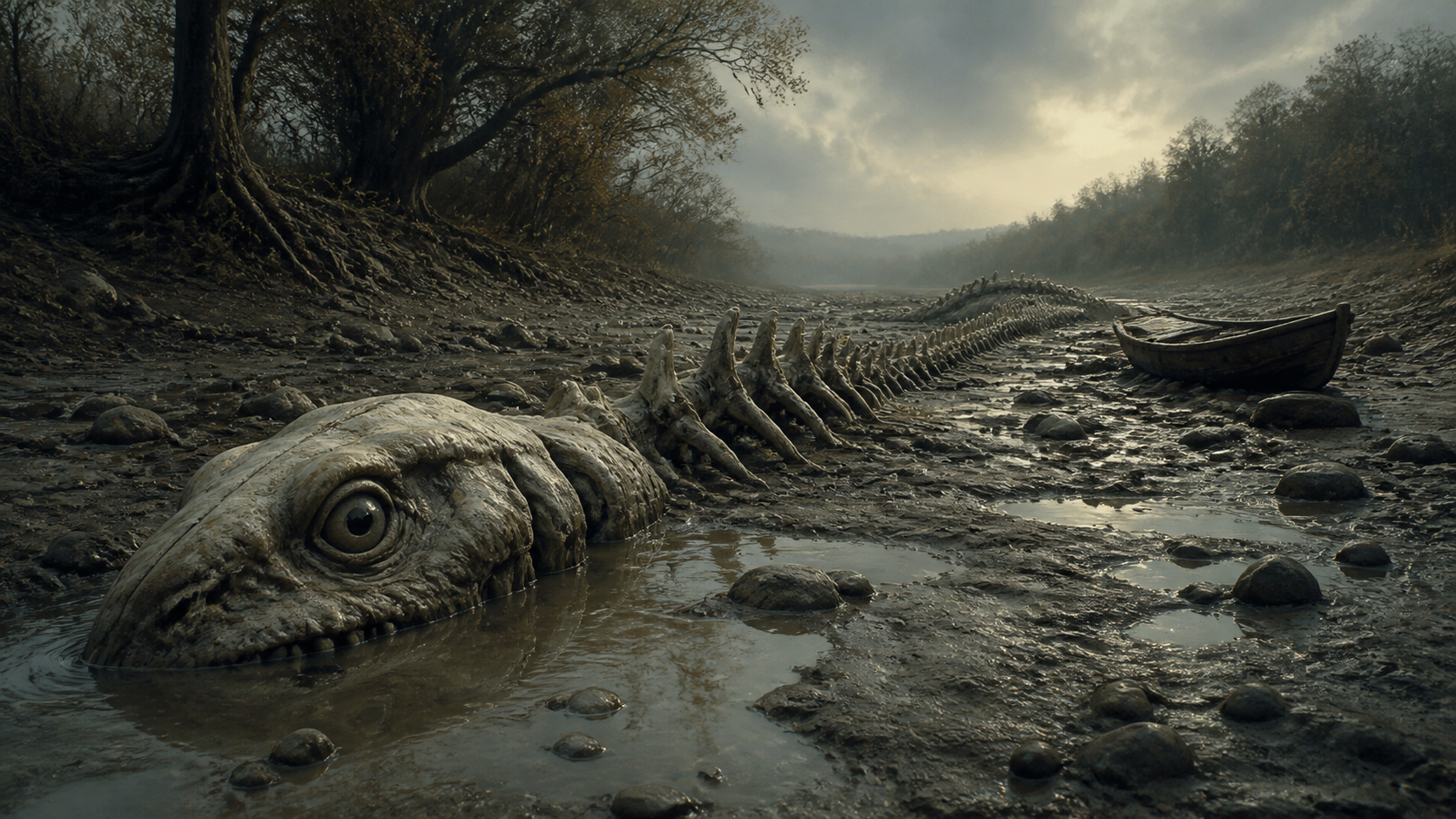
Not sewage, not diesel, not the sweet rot that drifted up from the reeds in summer, but something denser and wetter, as if the river itself had begun to breathe out the contents of a sealed stomach. It sat on the air above the old lock at Moulton, clinging to the stonework and the dead black water below. People on the towpath slowed, frowned, and walked on.
Nisha Desai noticed because she had spent twelve years inspecting things other people wanted ignored.
She stood on the narrow lockside in her company’s orange waterproof, clipboard tucked beneath one arm, and watched a chain of bubbles rise from the centre of the basin. They were not the quick silvery fizz of a fish turning in weed. These were slow, deliberate, each one the size of a fist, surfacing with a thick wet pop.
Beside her, Mick, the lock keeper, spat into the water.
“Something’s dead in there,” he said.
“Or alive,” Nisha said.
Mick gave a humourless laugh. He was in his sixties, broad in the shoulder, with a face weathered to the same colour as the lock stones. He had lived beside the river since boyhood and had a superstition for every month. “If it’s alive, I don’t like the manners of it.”
Nisha clipped her pen to the board. “When was the last boat through?”
“Yesterday evening. Narrowboat, name of the Brisket. Young couple. Nearly scraped the gate because they’d had one too many at the pub.”
“Anyone in the water?”
“Not that I saw.”
Another bubble rose. This one burst with a slow, cavernous sound, like a huge person exhaling through a blanket.
Nisha looked down into the basin. The water was the colour of black tea, opaque with silt and the bloom of summer algae. The old lock at Moulton was rarely used now that the newer channel had opened downstream. It sat in a bend of the river, half tucked into meadowland, the stone steps worn soft by a century of boots and ropes. The locks upstream and down had been automated years ago, but Moulton remained old-fashioned, worked by hand for heritage trips and local traffic. That meant the basin was inspected, but not watched constantly.
“Any livestock near the bank?” she asked.
Mick shook his head. “Only swans and the bloody tourists.”
Nisha frowned and made a note. She was forty-one, precise in habits, with a planner’s mind and enough fieldwork to know that oddities usually resolved into rot, blockage or human carelessness. Still, something in the smell had made the hairs along her forearms lift. She leaned closer over the parapet.
The water moved.
Not from the breeze, not in the usual tug of current through a lock chamber, but in a spreading pressure beneath the surface. Something large shifted below, and the basin bulged as though an immense body were turning over in sleep. A long silver-grey form rolled just under the black mirror, then vanished in a cloud of disturbed silt.
Nisha stepped back at once.
“What did you see?” Mick asked.
“Nothing clear.”
“That’s the answer people give when they’ve seen something they wish they hadn’t.”
She almost smiled. Instead she said, “I need the maintenance log.”
Mick fetched it from his hut while she phoned the county office. The line crackled. A man named Elliot in asset management told her to arrange a dredging team if the obstruction was serious and to keep the lock closed until then. He sounded bored and overworked in equal measure, which meant he would sign off on almost anything if she phrased it properly.
When she hung up, Mick was waiting with the logbook. Rain had begun to stipple the surface of the river. The smell deepened.
“Look,” Mick said.
On the far side of the basin, along the algae-slick stone edge, something pale lay half submerged. At first Nisha thought it was a dead gull or a folded plastic sheet. Then it shifted and she saw a broad triangular fin lift and settle with a wet, muscular flex.
“It’s a fish,” she said, but the words came out careful.
Mick bent, squinting. “That’s no fish I’ve ever seen.”
The thing was gone before she could get a proper look. The water gave another deep bubble, and then a shape the length of a man’s arm slid free of the surface, slick and grey-white, ending in a wrinkled mouth like an opened purse. It touched the stone, sucked once, and clamped onto a patch of green weed. The mouth flexed with a tireless suction that made Nisha’s stomach tighten.
Then, as quickly as it had appeared, it let go and vanished.
She stood very still.
Mick crossed himself so casually it was almost part of scratching his cheek. “I’m closing the lower gate,” he said.
The lock had been closed by the time the rain became steady. Nisha stayed long enough to tag the basin for inspection and to watch the bubbles rise and burst in the middle, one after another, as if the water below were learning how to breathe.
At the office that afternoon she filed the incident under obstruction and possible invasive species. She called Dr. Anwar Khan at the university, a hydrobiologist she knew from a planning review on riverbank erosion, and asked whether he could identify a strange aquatic organism from a description that sounded absurd when spoken aloud.
He arrived the next morning in a damp blue coat, carrying a cooler and the expression of a man who expected disappointment.
Nisha met him at the lock with Mick and a temporary barriers team. The morning was overcast, the reeds silver in the wind. No boats had passed since closure, and the basin lay still except for the occasional tremor where something below brushed the stones.
Anwar crouched beside the water and peered in. “You’ve got the smell right,” he said. “That’s encouraging.”
Mick grunted. “Aye, if rot is encouraging.”
Anwar smiled thinly. He was in his fifties, with neat hair gone iron-grey at the temples and a habit of speaking as though every sentence might be tested in court. “Let’s not anthropomorphise the decomposing mystery. Can you show me where you first saw movement?”
Nisha pointed to the centre.
He opened the cooler and took out a baited trap cage, a mesh cylinder with a weighted flap door. “If it’s a fish, crustacean or eel, this might bring it up. If it’s something worse, we can at least identify what’s chewing your paperwork.”
They lowered the cage with a rope. It sank a metre, then two, disappearing into the tea-dark water. They waited. Rain ticked on the lockhouse roof. A moorhen scudded along the opposite bank and vanished into reeds.
Ten minutes passed.
Then the rope went slack.
Mick swore. Nisha leaned over. The cage was still there, or something pale was where the cage had been. The rope trembled, once, then the whole line jerked hard enough to bite into her gloved hand.
“Let go,” Anwar said sharply.
She did, and the rope flew down into the lock basin. A dull thud came up from below, followed by a steady, powerful pulse against the stones. Not a thrash. A press.
Something was pushing against the underside of the cage. The water above it began to ripple in widening rings.
“Get back,” Anwar said.
A shape rose directly beneath the surface. Pale membranes slid over one another, textured like wet parchment. The thing was large, far larger than the arm-length fragment Nisha had glimpsed the day before. It pressed itself up against the top of the water with a slow, terrible deliberation, as if testing the boundary between lake and air.
Then the surface broke.
The creature came half out of the basin, dragging itself against the inner wall on broad rippling flanks. Nisha saw a body like a thick, limbless mass, silver-grey and mottled with mud, nearly as wide as the stone steps. Its skin was not smooth, but lined with rows of soft openings that flexed and sealed in time with its breathing. Along its underside were concentric rings of muscle, each contracting in sequence to drag it forward. The head, if head it was, was mostly mouth. A round muscular aperture the size of a washtub opened and closed in folds, lined not with teeth but with dark ridges and a rim of flesh that worked like a pump. Around it clustered four smaller mouth-like openings, pale and puckered, each drawing at the air with a faint wet hiss.
Mick made a strangled sound and stumbled backwards into the rail.
The thing hauled itself another foot onto the stone. Water streamed from its sides. The big central mouth opened wide enough for Nisha to see a narrowing tunnel beyond it, pink and pulsing. A narrow fish, still trapped half in the broken cage, slid into that opening in one convulsive motion and vanished. The creature did not chew. It swallowed by suction, whole.
Anwar had gone white.
Then the thing turned its upper body towards them. Not in the way a snake turns, but with a deliberate shifting of mass, as though it had sensed them through the air.
Nisha saw that the smaller mouths were not mouths at all. They were spiracles or vents, each one puffing and tightening. The creature was breathing wetly through its skin and these openings, taking in air in great shuddering pulls.
The creature slid one broad edge of its body onto the stone. Nisha saw barnacled scars, rope burns, the pale ragged mark of old injury. This was not a newborn thing. It had lived here, or somewhere like it, for a very long time.
Mick shouted, “Get away!”
He snatched a long-handled maintenance hook from the bank and jabbed it at the creature. The metal caught in its side. The reaction was immediate. The creature recoiled with a wet heave, and from one of the smaller openings came a blast of fetid spray. Mick cried out and dropped the hook, clutching at his face. He stumbled, eyes streaming.
The creature surged forward with shocking speed, its body flattening and lunging in a single rolling motion. Its central mouth latched onto the hook where it lay on the stone and sucked. The hook slid from sight, swallowed to the iron curve. Mick backed away, tripped, and fell hard against the rail.
Nisha grabbed his coat and hauled. Anwar seized Mick’s arm with both hands. The creature’s mass heaved, inching out of the lock like a sack of living wet clay. It was nearly entirely on the stone now, its underside writhing, the smaller openings inflating and collapsing in irregular rhythm.
“Don’t let it dry!” Anwar shouted.
“How do you know that?” Nisha yelled.
“I don’t. I’m guessing.”
It was a ridiculous thing to say in the midst of terror, but it anchored her. She looked around wildly and saw the answer in the lock maintenance hose coiled by the hut. She ran for it, yanked it free, and turned the valve. A hard jet of water blasted out, striking the creature broadside.
It reacted at once. The body spasmed. The skin, which had been glistening and supple, tightened and dimmed where the spray hit it. The creature drew back with an audible hiss, smaller mouths puckering shut. Mick staggered to his feet, blind in one eye, swearing and wiping sludge from his cheek.
“More water,” Anwar shouted. “Keep it wet!”
Nisha held the hose. The jet hammered the creature’s flank and head. It writhed, dragged itself awkwardly towards the basin, and then, with a violent contraction, dropped back into the lock water. The impact sent a muddy surge over the stone. The surface broke in a froth of bubbles and pale folds. The smell became almost unbearable.
For a moment they saw nothing.
Then the water settled.
The creature was gone.
Mick leaned on the rail, breathing through his mouth. The side of his face was smeared with dark fluid. His right eye had swollen shut. “Tell me that was a seal,” he muttered.
“No,” said Anwar, staring at the water. “It was not.”
Nisha shook out her hands. They were trembling. “Can it get out?”
“It already did,” he said. “The question is whether it chooses to again.”
They called police, then environmental health, then the county wildlife officer, who suggested cormorant damage and wanted photographs. Nisha nearly laughed at him. By lunchtime the lock had become a cordon of wet hi-vis jackets and baffled authority.
No one believed the first description until a teenage volunteer, pale and shaking, produced a phone video taken from across the lock bridge. The image was blurred and half obstructed by rain, but it showed enough: a vast breathing grey mass on the stones, the sudden eruption of motion, Mick falling back with his hands over his face.
The police officer who watched it, a tired sergeant named Paula Mercer, stopped smiling. She asked what had been done since.
“Closed the lock,” Nisha said. “Kept it wet. We’ve got no containment net and no sign of where it’s gone.”
Mercer rubbed her forehead. “And you want me to put this in a report as what?”
Nisha looked at the river beyond the basin. The water was high from the rain, moving sluggishly through the reeds. She had the sick feeling that the creature had not retreated so much as repositioned.
“A hazard to the public,” she said.
Mercer gave her a flat look. “That’s all? No species name, no known threat profile, no nice tidy category?”
Anwar answered before Nisha could. “It is something aquatic, amphibious or semi-aquatic, large-bodied, highly dependent on moisture, and it uses suction to ingest prey. It may be blind or near-blind, but seems to sense movement or vibration. It is also, apparently, capable of coming out of water.”
Paula stared at him. “You say that as though it’s a normal thing to say.”
He shrugged with grim composure. “Today I have no interest in normality.”
By mid-afternoon a temporary exclusion zone had been set. Folk from the nearby houses gathered behind tape and watched the lock from a distance, phones out, faces alight with fear and appetite. The county men spoke of dredgers, animal rescue, and night surveys. Nobody could say where the creature had gone.
Then one of the volunteers found a trail.
Not footprints, exactly. A wide wet smear led away from the lower lock gate and through the grass towards the riverbank, flattened reeds marked by a heavy passage. The trail stopped at the edge of the shallows.
Mick, bandaged now around one eye, stared at the smear. “It’s in the river.”
Anwar crouched and touched the grass where the fluid had dried dark. “Or just inside the reeds. It may be seeking shelter. Or bait.”
“From what?” Nisha asked.
He looked up at her. “Us, perhaps.”
The river at Moulton ran between low meadows and a line of poplars, then curved under the old railway embankment before widening towards the estuary. The lock basin sat in a side cut, its water slower and warmer than the main channel. If the creature had shifted into the reeds, it had options. Water downstream. Culverts. Drainage channels. It could reach livestock fields if it followed the flooded margins. It could, if it wished, stay hidden in mud and wait.
Nisha found herself thinking not of what it might eat, but of how it breathed. The smaller openings she had seen on its body had pulsed in sequence, like gills or valves, while the great mouth did the swallowing. It came to the surface to breathe because it had to, and because it could not remain fully out of water for long. The hose had hurt it. Drying had hurt it. That meant there was a limit.
“You’re thinking,” Mercer said to her.
“Yes.”
“Care to share?”
Nisha glanced at the cluster of people around them. “It came up because the basin was enclosed. Shallow. Warm. It probably followed a fish school or the smell of mud. When it was trapped on the stone, the hose made it recoil.”
“Water was pain,” Anwar said.
“Or oxygen,” Nisha said. “If it relies on wet skin and those openings, drying may force it back.”
“Which means?” Mercer asked.
“Which means we might be able to drive it out,” said Nisha, “but not if we only wait.”
The plan that formed over the next hour was ugly, improvised and more dangerous than anyone liked. There was a sluice a quarter mile upstream, used to control overflow from the meadows into the side channel. If the sluice was opened, the current through the old lock cut would strengthen. The creature, if it remained in the side water, might be pushed towards the lower gate and the outlet culvert. If it was in the reeds, the movement might flush it. The culvert itself could then be sealed with a temporary barrier and a pump line used to keep the area soaked while the lock basin was swept and confined.
“It’s risky,” Paula said.
“That’s the charitable version,” Mick muttered.
The man from county said they’d need two more hours to get a portable barrier unit from depot. Two hours in which the creature might slip into the river proper. Nisha stared at the map on the bonnet of the van. The old railway embankment, the lock cut, the side channel, the sluice. She could see the lines in her head, the way water would move through them. One thing was certain: if the creature found the main river and its deeper channels, it was gone.
“If we can’t get the barrier here,” she said, “we need something else.”
Anwar’s eyes followed the map. “The old fish screens.”
Mick looked up sharply. “No one’s used those in years.”
“But they’re still there,” said Anwar. “Down by the sluice access. Rusted, perhaps, but if we can lower them into the outlet, they may catch any large body trying to move downstream.”
“Catch it how?” Paula asked.
“In a mesh cage.”
Mick’s mouth tightened. “And if it’s already halfway through?”
Anwar did not answer immediately. That silence was answer enough.
Nisha said, “Then we need bait.”
No one liked the word. But it was obvious what the creature had reacted to before. Movement. Water. Fish. The smell of blood, perhaps. There were several loose minnows and perch in the lower trap cages used for survey work, enough to draw a predator if the predator was feeding. She would rather have swallowed gravel than say it, but the thing had shown one clear habit. It swallowed living things whole and did not care to grind them. A fish netted in the right place might lure it into the narrow stretch below the lock, where the screens could trap it.
“The screens have never been tested under load,” said the county man.
“Everything’s tested under load,” Paula snapped. “Usually when it’s too late.”
The air had grown thick and metallic. Cloud piled low over the fields. Somewhere a dog barked and barked and then went silent.
By four o’clock they had the sluice cracked open and the fish screens chained and lowered into position. Nisha stood with Mick at the upper bank, both of them soaked with river mist, while Anwar and two maintenance men rigged the bait cage below. Paula coordinated the cordon and kept the curious back. The current in the side cut began to quicken, pushing detritus and weed towards the lower outlet.
The smell returned.
Nisha felt it first, that sour, wet exhalation on the wind. Then the water in the reeds to their right quivered. Something large was moving just beneath the surface, not rushing but gliding with the patience of a thing that did not need to chase if the world could be made to come to it.
“There,” Anwar said quietly.
The creature surfaced fifty yards downstream, in a trough of brown water near the old stone revetment. It lifted part of itself out, the pale folds of its body heaped and glistening. The smaller mouths opened one by one, taking air. Its great central mouth yawned, closed, then opened again.
It was bigger than Nisha had realised. Not a hundred tonnes, of course, as some idiot journalist would no doubt write if this became public. But immense enough in the way of nightmares, immense enough that her stomach refused the scale. It used the current to hold itself almost still, only the breathing parts moving.
“Don’t let it see us,” Mick whispered, though he had no reason to think it could.
Then a fish in the bait cage thrashed.
The creature turned at once.
Its whole body shifted in a long roll and began to move towards the outlet with surprising speed, undulating in powerful lateral contractions. It was drawn not just by the fish, but by the flow of water and the narrowing channel. Nisha understood with a cold rush what the screens were for. The creature did not merely pass through a gap. It would press itself, suction and all, through any route that promised dark water on the other side. If it reached the culvert, it might wedge itself and tear through barriers, or vanish into the river beyond.
“Now,” Paula shouted.
They lowered the second screen.
The first caught the current with a groan. The creature hit the waterline near it and recoiled, not from the metal itself but from the sudden turbulence. It thrashed sideways, and a vast fold of its skin scraped the screen with a sound like wet canvas dragged across gravel.
Then the central mouth opened wide.
Nisha saw the bait cage tilt in the water, the fish inside flinging itself against the mesh. The creature lunged. Not onto land, not at them, but straight into the flow, sucking with a violence that pulled water, weed and debris towards its mouth. The bait cage struck the screen and stuck fast, the fish vanishing in a flash of silver as the creature swallowed.
The screen shuddered. One of the chain anchors at the bank spat loose. Metal screamed. The maintenance man nearest the winch yelled and jumped aside as the cable snapped taut.
“Hold it!” Paula screamed.
Mick ran to the manual wheel and hauled with all his weight. Nisha saw the creature’s side pinched against the mesh, one of the smaller openings torn and leaking dark fluid. It writhed, seeking depth and failing to find it. The screen held for one breath, then another.
The creature changed tactics.
Its body folded, compressing length into thickness. The broad front surged upward and over the lower lip of the screen, where the water was shallowest. The suction mouth locked onto the metal frame with a horrible slithering grip. For an instant it looked as if it might climb it.
“Water!” Anwar shouted. “Flood it!”
No one had time to ask how. Nisha saw the hose line from the maintenance pump, free and coiled. She and Mick grabbed it together and dragged it to the bank. Paula helped strip the coupling. The pump fired with a cough and a shudder, and a hard jet of river water blasted into the creature’s upper flank and mouth.
It convulsed.
The effect was immediate and terrible. The skin where the stream struck reddened, then puckered. The smaller breathing openings collapsed. The creature’s great body spasmed as if seized by cramps. Its grip on the screen loosened for an instant.
Then it slammed down against the mesh with all its weight.
The impact buckled the lower bar and sent a spray of rusty water over the bank. One of the maintenance men cried out, clutching his shin, where a snapped shard of metal had sliced through his trouser leg. The creature shoved again, using the current and its own mass. The screen began to bend.
“Pull back!” Anwar yelled.
But if they pulled the screen free, the creature would have the channel. Nisha saw the choice clearly and with it the certainty that someone would be hurt either way. The thing was not attacking in blind fury. It was pushing towards the only place the water promised. It knew the shape of its world better than they did.
Mick, one hand on the wheel, shouted, “It’s got a way round the side!”
Nisha looked and saw the truth. A spill seam beneath the screen, a gap in the old stone where water poured around the edge into a narrow service drain. Too small, she thought. Too small for that body.
Then the creature folded itself in a way that made her skin crawl. The front third compressed, the lateral flesh rippling into a narrower column. The central mouth narrowed to a vertical slit, then expanded again, sucking hard against the mesh. It was changing shape to fit.
Anwar saw it too. “It can compress.”
“Can you stop it?” Paula shouted.
“Not by arguing with it!”
The drained service channel beyond the screen ran beneath the towpath and into a brick culvert, then out under the road. If the creature got through, it would have new water, new refuge, maybe the river again. Nisha’s mind raced. Hose. Drying. Pressure. The smaller openings on the body had been the weak point when she blasted it on the stone.
She caught sight of the portable lime sacks stacked near the maintenance van. Dry quicklime, for bank stabilisation. It would burn in water, heat up violently.
“Lime,” she said.
Mick stared at her. “What?”
“Spread it where the water runs round the side. If it gets in the drain, the lime will flash. Heat and drying together.”
“That’ll burn the bank, maybe the culvert too.”
“It’ll burn it worse if that thing gets through.”
Paula barked orders. One of her officers and the maintenance man with the sliced leg stumbled to the sacks, tore them open and dragged the powder in a white stinging rush towards the spill seam. The wind caught it and blew it back over their faces. They coughed and cursed. Nisha, eyes watering, grabbed the hose and kept the creature hosed while Mick strained on the wheel.
The creature had nearly folded through the side gap when the lime slurry hit the water.
It reacted as if scalded. The skin at its narrowest point contracted. Steam or vapour rose in a pale foul burst. The creature heaved, half in the screen, half in the current, and let out a sound unlike any animal noise Nisha had ever heard. It was not a roar, nor a cry, but the noise of something powerful failing to breathe.
Its smaller openings sealed tight.
The water jet struck the sealed flesh. The creature jerked backwards, then lunged again, driven by panic or instinct. The screen groaned and gave another inch.
Then the creature did something that froze Nisha where she stood.
It drew water in.
Not just through the great mouth, but through every visible opening in its body, inflating itself briefly, massively, as if preparing to launch. The whole front expanded. For a heartbeat it seemed it would burst through sheer force.
Then the lime under the spill seam flashed in a wet hiss.
Steam exploded into the culvert mouth. The creature convulsed, the seal on its openings breaking all at once. A jet of foul water and slime blew back from its body. It spasmed, lost purchase, and slid half off the screen. Mick shouted and nearly fell as the wheel jerked in his hands.
The creature slipped sideways into the stream, struggling now, one flank pinned against the metal, the other rolling in the current. Nisha could see the smaller breathing vents collapsing and reopening erratically. The thing was hurt. Badly.
Not dead. But hurt.
Anwar grabbed her sleeve. “If it gets to deeper water, it’ll recover.”
“Then it doesn’t get there,” she said.
There was a heavy iron boat hook at the bank, left from the lock equipment. Nisha snatched it and ran along the edge to where the creature’s body had dragged close enough to the shallows to expose part of its underside. Mick shouted after her, but she barely heard.
Up close, the creature was worse. The skin under the river slime was marked by old scars and fresh raw patches, and beneath the folds she could see the pulse of muscle and something softer, almost translucent, moving in a rhythm that suggested organs crowded beneath the skin. The central mouth gaped and closed in violent, desperate rhythms.
She jammed the hook into the lower rim of one of the smaller breathing openings and levered hard.
The flesh tore.
A gush of dark fluid sprayed her sleeve and face. The creature lurched with a whole-body spasm. Its great mouth opened wide, and for an instant she thought it would take her arm, hook and all.
Instead it recoiled from the pain, hauling itself in the wrong direction, towards the bank.
“Now!” Anwar shouted.
He and Paula, both of them waist-deep in filthy bank water by now, grabbed the screen cable and yanked it tighter. Mick hauled the wheel as if trying to pull a ship from the sea. The screen finally bit, pinning the creature’s body against the channel lip. The current thrashed past. The creature’s breathing vents fluttered, weak and uneven.
It was still alive.
Nisha stepped back, chest heaving, the hook slick in her hand. She saw the small service drain still pouring foam and lime-soured water. She saw the creature’s body pulse as it tried one last time to contract and slip free.
Then the pump hose, left running, swung loose and drove a fierce stream directly into the torn opening she had made.
The flesh there blistered immediately.
The creature bucked in a violent spasm that sent water over all of them. Its central mouth sucked once, twice, then clamped shut. The body sagged against the screen with a great shudder. One of the smaller vents opened and did not close. Another collapsed. The skin darkened where the lime water touched it.
Still it moved, a little, until at last the whole mass seemed to lose coherence, the muscles no longer coordinating. It sank a few inches, then another. The current took more of its weight. The screen held.
No one spoke for several seconds.
Rain had begun again, fine and persistent. The cordon lights reflected in the water. In the distance, a car passed on the road and did not stop.
Paula was the first to break the silence. “Is it dead?”
Anwar crouched, careful not to touch the creature. He watched the smallest movement for a long time. “Not dead,” he said. “But badly compromised. It’s trying to breathe and cannot coordinate its body properly. The lime has damaged the exposed tissues.”
“That’s a yes with academic seasoning,” Paula muttered.
“Keep the water running,” Nisha said. Her voice sounded strange to her own ears.
Mick sank onto his heels, still gripping the wheel. Blood from his bandaged eye mixed with rain on his cheek. “I’m too old for this place,” he said.
Nisha looked at the creature again. It had stopped attempting to force itself through the screen. Instead it lay almost motionless in the shallows, half pinned, half buoyed, the great mouth opening and closing in shallow, laboured pulls. The smaller openings along its sides fluttered weakly. It was, unmistakably, breathing. A hundred tonnes of breathing, if the mind wished to make poetry of the thing, though the poetry was obscene.
The decision arrived in her with awful clarity. If they left it here, it might recover enough to tear free after dark. If they tried to move it, someone would have to get close. If they called in heavy machinery, the vibrations might drive it wild or breach the culvert and send it into the river.
There was one way to end it, and everyone there knew it.
The sluice controls upstream could be closed again. If the lower outlet were shut and the pump kept on it, the channel could be drained enough to expose the creature. But that would take time, and by then it might regain its grip. The quicker option was the lock gate itself. Open the lower gate fully, flood the side channel and force the creature towards the drainage culvert where the lime remained active. If the gates were timed right, they could wash it into the culvert mouth and trap it in the dry, corrosive section beneath the road. The culvert was brick, old and narrow. A body that size might jam there.
And then?
And then it would die, or be trapped underground and suffocate while the river tried to claim it.
It was not a clean answer. It was not even a good one. But it was a choice.
Nisha turned to Paula. “Open the lower gate. All of it.”
Paula stared at her. “That might push it right through.”
“Yes,” said Nisha. “Or pin it in the culvert. We don’t have a better option.”
Anwar looked from one to the other. “If it reaches deeper water, we lose it. If it reaches the road culvert, we may have a collapse risk.”
“It’s already a risk,” Nisha said.
Mick stood slowly, all the weariness of his years visible in the way he moved. “I’ve opened that gate every wet season since I was sixteen,” he said. “Never thought I’d use it like a weapon.”
“You’re not using it like a weapon,” Nisha said. “You’re using it like a lock.”
He gave a rough, humourless snort and limped towards the gate wheel with Paula and two officers.
Nisha remained by the screen, hose in hand, watching the creature’s body. Its mouth opened wider as the current changed, and she saw that it was still trying to orient itself towards the deepest flow. The smaller openings flared. It could feel the water shifting. It understood.
For one terrible second she thought it might gather itself and come for her.
Instead it began to slide with the current.
The lower gate groaned open. Water poured through the lock basin with a thunderous clap, surging into the side channel. The flow lifted weed, mud and debris around the creature’s body. It shuddered, then rolled, caught by the new current. The screen strained. The chain anchors sang. Nisha kept the hose on its torn flank and saw the flesh there blanch and tighten under the spray.
The creature was dragged towards the drain.
It fought, not in any recognisable way but with all the motion a body of its size could muster. It flexed, twisted and pressed itself against the water in an attempt to gain purchase. But the combination of current, lime and drying made it clumsy. Its smaller breathing vents failed one by one. It slid, half over, half under the flow, into the narrower mouth of the culvert.
There was a sudden deep grinding sound as its mass struck the brick lining.
Paula shouted for everyone to stand clear. The road above shivered with the vibration. Another push of water drove the creature further in, and its central mouth came up beneath the culvert lip in a brief obscene bloom of flesh. It opened wide, as if in one last effort to inhale.
The lime water entered it.
The mouth closed on nothing. The body convulsed. Then the whole mass jammed hard across the culvert, wedged between stone and brick. Water surged around it, frothing white.
For several seconds nothing moved except the river.
Then the creature shuddered once, a long slow tremor that ran from its head to its rear. The smaller openings deflated. The great mouth opened, but only a little. Water poured past and around it. The body sagged.
Nisha did not realise she had been holding her breath until she let it out in a ragged gasp.
Anwar said softly, “It’s trapped.”
“Is it dying?” Paula asked.
He watched the culvert mouth, eyes fixed. “Yes.”
Mick sank onto the bank with the expression of a man who had just watched the world survive his worst day by an inch. The rain kept falling. Somewhere, beyond the cordon, a woman was crying.
Nisha approached the culvert only once more, to the edge of the wet stone. She could see the creature’s pale hide through the rush of water, jammed tight in the brick throat. It no longer looked like a monster of the river. Up close it seemed almost manufactured, an impossible convergence of muscle and wet tissue, ancient and blind and hungry. The body gave one weak contraction. One of the smaller openings fluttered.
Then nothing.
She set the hook down and stepped back.
Paula ordered the road closed and the fire brigade called to assess the culvert once the current dropped. Someone would have to come back tomorrow with cameras, masks and maybe cutting gear. They would find a dead thing or a dying thing or a thing gone to pulp in a tunnel, and then paperwork would begin to make it small enough for the world. Nisha knew that much. She also knew she would not be the one to write the neat version.
As the bank crews started packing equipment under the rain, Mick came to stand beside her. His bandage was soaked through, his face grey with exhaustion.
“Do you think there are more?” he asked.
Nisha looked at the river. The lock basin was still churning from the opened gate, the surface broken and ugly. Beyond it, the main channel ran under the darkening fields, silent and ordinary as if it had never hidden anything at all.
“I don’t know,” she said.
Mick nodded as though that was the only honest answer left. Then, after a moment, he said, “I’m shutting the lock for good if I’m asked back.”
She let out a breath that was almost a laugh. “I think everyone will agree with you.”
He looked once more at the culvert, where the water continued to pound over the jammed grey shape below, and then he walked away slowly, one hand on the rail.
Nisha stayed at the edge of the lock until the rain turned the path to mud and the light went nearly gone. From where she stood she could no longer see the creature clearly, only the disturbed water above the culvert and the occasional pale blur under the rush. It was no longer breathing loudly enough for the sound to carry, if it still breathed at all.
At last she turned off the hose and watched the flow settle to a hard cold run.
The river kept moving through the dark fields, carrying reeds, silt, dead leaves and whatever else the night chose to feed it. Behind her, men in wet jackets argued about barriers and structural safety. Ahead of her the culvert mouth stayed stubbornly half flooded, holding shut on the thing inside.
Nisha picked up her clipboard from the bank, smeared with mud and lime, and found that her hand was steady at last.
She wrote the last note by the failing light: gate opened, creature driven into culvert, contained pending retrieval.
Then she crossed out contained and wrote another word in its place.
Held.

Monsters & Creatures