At half past four every morning, before the heat had properly gathered in the streets, the river market behind Saint Jude’s Wharf was already awake. Men in rubber boots hauled crates from flatbeds. Women with sharp pencils checked fish against lists. Carts rattled over the cracked concrete. The smell was always a mixture of brine, diesel, wet rope and the sweeter reek of overripe fruit knocked open in the dark.
Ana Ruiz had worked there for eleven years, long enough to know which of the wholesalers paid on time, which one liked his squid iced twice, and which of the old flood doors would stick after rain. She kept the accounts for three fish stalls and a small shellfish distributor, and on quiet mornings she did a little of everything else besides. At forty-two, she had learned to make herself useful. It was the sort of place where usefulness mattered more than qualifications.
Her brother Leo hated the wharf and had for years. He called it a place that existed entirely between weather reports. He came by at dawn sometimes, mostly to borrow money or cigarettes, and had a habit of looking at the river as though it had personally disappointed him. But that Tuesday he arrived sober, at least by his standards, with his cap in his hands and a crease of worry between his eyes.
“Can I talk to you?” he asked.
Ana did not look up from the ledger. “If it’s about money, no. If it’s about Mum’s roof, also no. If it’s about some woman who has discovered your charm in spite of evidence, absolutely not.”
“It’s about Sadiq.”
That made her look up. Sadiq was their mother’s younger cousin, and he ran the night hatchery down by the old lock. He had a narrow face and careful habits, and had once described koi breeding to Ana with such tenderness that she had briefly considered it a form of religion. He also had the practical failings of everyone in the family, which made him susceptible to bad investments.
“What’s he done?”
Leo rubbed the back of his neck. “He’s got a delivery from the north marsh. Special order. He says it’s not fish.”
Ana pushed her glasses higher. “Then why is it in the hatchery?”
“Because he’s already paid for it, or partly paid, and because he thinks he can move it on to a restaurant in the city. He said it’s legal if it’s kept live.”
Ana stared at him. “What on earth did he buy?”
“He wouldn’t say. Only that the people up there called it river dead.”
The phrase meant nothing to her at first. It sounded like dockside nonsense, one of those names men gave to rotten cargo, storm-drowned cattle, or a trick to sell something that ought to be thrown back. But Leo’s expression was not casual. He was frightened in the embarrassed way people are frightened when they have already involved themselves in the thing that scares them.
“Sadiq wants me to help unload it tonight,” Leo said. “He says it’s only until dawn. He says it won’t last long out of the water.”
Ana shut the ledger. “And you came to me because?”
“Because he listens to you, and because if this goes wrong, I’d rather you shout at me first.”
The hatchery sat under a concrete apron beside the old lock gates, where the river widened and slowed before the docks. Sadiq had converted half of it from a municipal storage unit into a maze of tanks, mesh partitions and oxygen lines. On good days the place smelled of fishmeal and clean water. On bad days it smelled of stagnant reeds.
They went after dark in Leo’s dented van. The river road was lined with warehouses whose upper windows reflected the orange sodium lamps in long trembling bars. By the time they reached the hatchery, a curtain of mist had risen from the water and sat low over the concrete yard. Sadiq met them with his sleeves rolled up, his face strained and damp.
“You came,” he said, sounding relieved and ashamed at once.
Ana glanced towards the rear of the hatchery. “What have you bought?”
“Not bought. Contracted.”
“That’s not reassuring.”
He gave a tired, humourless laugh. “It’s in the quarantine tank.”
Inside, the tank was lit from beneath. The water was dark except for a dull, silvery stirring just under the surface. Ana could not make out the shape at first, only a repeated, deliberate movement as if something below were turning itself over and over without rising.
Sadiq folded his arms. “The men up north caught it in a tributary near the marsh. They said it came in with the floodwater after the cemetery bank broke.”
“That doesn’t tell me what it is.”
“They called it a river dead.”
Leo leaned close to the glass. “That’s just a superstition, isn’t it?”
Sadiq shook his head. “Maybe. But they had three of them.”
Ana frowned. “Three of what?”
“They said there were more in the shallows, but those were the only ones they could net. One went straight through the mesh. The others were already half ruined.”
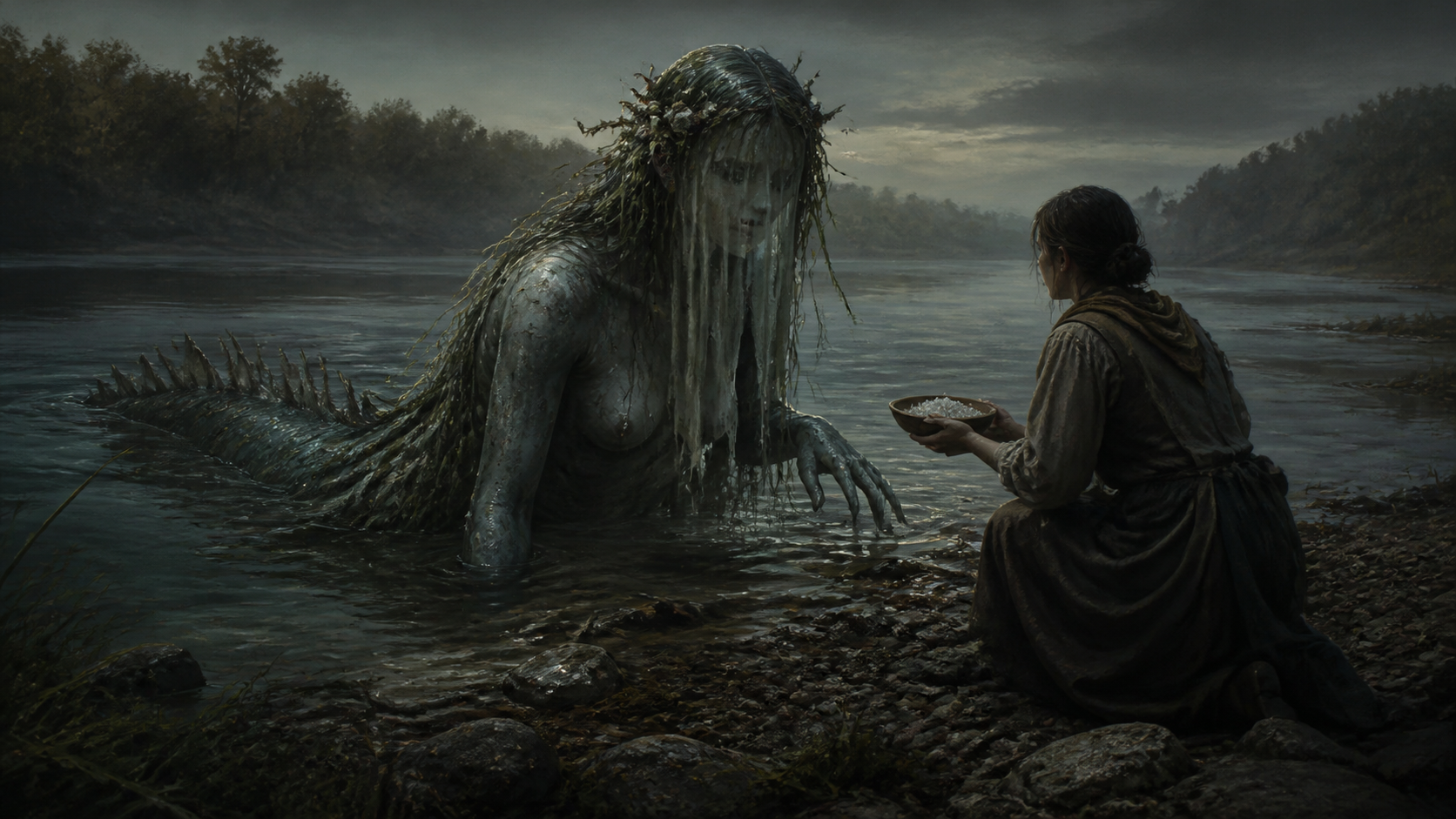
As if in answer, the thing in the tank pushed itself up. Ana saw a narrow head with the pale, waxy look of skin that had been underwater too long, except this skin was not soft. It was tight over bone, stretched taut and slick with weed slime. The mouth was open slightly, not gaping, but enough to show the line of teeth beneath the lips. Small river teeth, she thought absurdly, until she saw that they were not all teeth. Some were fishbone spines, some broken and yellowed, set unevenly in the gum.
Its eyes were the worst part. They were human in shape and size, but dulled to a cloudy pewter sheen, as though the pupils had been flooded from the inside. Yet they moved with purpose, finding the light, then the three of them beyond the glass.
Sadiq spoke softly. “It has not eaten since yesterday.”
“What does it eat?” Ana asked.
He hesitated. “I didn’t know. The men said minced carp. It refused that. Then crushed prawn. It took it, but only after we cut the flesh open.”
Ana looked at him. “You are keeping it alive for sale?”
“Not now,” he said quickly. “At first, yes. Now I only want it gone.”
The creature lifted one thin arm and pressed the hand to the glass. The fingers were webbed not by skin but by a fringe of black thread, as if something had grown between them and failed to finish. Around each wrist was a ring of pale scar tissue, old rope marks or maybe old wire marks, laid over with silt.
Then, with a sound like a wet stone dragged across concrete, it opened its mouth wider and drew in a breath through the water.
Ana stepped back. “That can’t be right.”
“No,” said Leo. “No, that’s not right at all.”
The first sign of trouble came from the drainage channel behind the hatchery. One of the old sluice grates was missing, and something had moved through the shallow runnel to the lower yard. Sadiq found a trail of wet algae and a scattering of tiny silver scales on the concrete by the feed store. No one had seen anyone enter. The yard gate was bolted. The camera above the loading bay was dead, its cable chewed through so neatly it looked cut.
“They’re not fish,” Sadiq whispered, as if saying it aloud might make it more true. “There are more of them.”
Ana crouched by the drain. The slime on the concrete was streaked with grit and little threads of weed. Among it were marks like fingernails, but too long and evenly spaced. She stood and looked towards the river.
Something had come in with the tide.
The rest of the night unfolded with the grim logic of a bad mistake. They moved the quarantine tank deeper into the hatchery, locking the corridor doors and setting bags of salt across the thresholds because Sadiq swore the creatures had avoided them before. He did not know whether that meant they feared salt or disliked it, but it was the only measure he had. Leo fetched a torch, a rake handle and a crowbar from the van. Ana phoned the private security company that serviced the wharf, only to find the night line unmanned. Twice she called the police non-emergency number and received a message telling her to hold.
While she was on the third call, something thumped against the metal shutters at the back entrance.
Everyone turned.
It happened again, not a strike but a dragging impact, as though a body had climbed the yard wall and now lay against the corrugated sheet, working its way upwards by slow, deliberate force. Then came a scraping sound from the other side of the building, followed by a second and third, circling.
Sadiq stared at the corridor door. “There weren’t that many.”
Ana, who had seen enough dead things in the river over the years to know the difference between drift and intent, gripped the crowbar. “How many did they catch?”
“Three, they said.”
“And how many escaped?”
He did not answer.
The first creature came through the loading bay window. It did not smash the glass in the dramatic way of films. It simply pressed itself against the pane until the old seal failed and the frame gave a wet crack. Then it folded through the opening with the slow competence of something accustomed to tight places. Its clothes, if they had once been clothes, hung in tatters from its shoulders. One arm ended at the elbow in a tangle of blackened reed fibres and cloth. It landed on the floor on all fours, but not because it was animal. It rose again almost at once, blinking as though adjusting to the light.
Leo swung the rake handle before Ana could stop him. The blow caught the creature across the temple. It fell sideways, hard, and did not move for a breath. Then the head jerked up in an irritated, almost offended way, and it bared those uneven river teeth.
“Back!” Ana shouted.
It came at Leo first. Not with the speed of a predator, but with the certainty of a drowned thing knowing where the living were. Its hand closed on his wrist. He cried out, more in shock than pain, and Ana smashed the crowbar down on its forearm. The arm bent wrong. The creature made a low, hoarse sound, almost like someone trying to speak through mud, and released him.
Two more appeared in the doorway behind it, both soaked through as if they had dragged themselves up from the river minutes before. The light caught their faces and Ana saw the same distension around the throat, the same loosened, river-washed skin. They did not rush. They advanced with a terrible patience, heads tilted, listening.
Sadiq seized a bucket of salt feed from the shelf and hurled it across the floor. The nearest creature stepped through the spray without hesitation, but when the damp crystals caught in the cracks of its skin it recoiled, hissing through clenched teeth. That was enough to tell Ana two things at once: salt did not destroy them, but it irritated them badly enough to buy time.
“Get the doors!” she snapped.
Leo stumbled to the side exit, yanking down the steel bar. Ana and Sadiq kept the creatures at the far end of the room with the crowbar and a broom handle, pushing them back when they lunged. One got its fingers around Ana’s sleeve, cold and slick as eel skin, and she nearly gagged at the touch. The thing smelled not of rot but of river mud and old pennies. She twisted free, drove the crowbar into its chest, and felt the impact stop on something hard beneath the flesh, a resistance like wet bone.
Then the power failed.
The tanks went black. The strip lights died with a hiss. For one long moment there was only emergency red over the feeding bay and the smell of salt and damp metal. In the dark the creatures became harder to track, but not invisible. They moved by sound and vibration, heads turning whenever someone shifted or breathed too sharply. One of them clambered onto the edge of a tank and leaned down to the water, as if listening.
Ana understood then what they wanted. Not food. Not exactly. Water.
Or something in it.
“No,” she said under her breath, and saw Sadiq look at her as if she had guessed his worst thought.
The quarantine tank held the largest of the captive creatures, the one with the cloudy eyes. It had been almost still all evening, conserving itself. But now it was striking the glass from inside, not frantically, but with repeated blows aimed at the seam where the old metal frame had rusted. With each impact the whole tank shuddered.
Sadiq went pale. “It knows.”
“What did you do?” Ana demanded.
“I didn’t know what they were.” His voice broke on the words. “They were already in a live-haul coffin by the time we got to the marsh. The men said if we could keep them damp until the buyer arrived, he’d pay double. I thought they were some kind of prohibited eel.”
Leo stared at him. “You put them in a coffin?”
“They called it that. A holding vat.”
Another blow from within sent a burst of water over the lip.
Ana looked from the tank to the creatures in the room. Their heads had lifted. All three were listening to the larger one as if it were calling them. Not in sound exactly, but in some rhythm through the pipes and standing water. The drain at the rear of the room gave a long gurgle.
“It’s the water,” Ana said. “They’re following the pipes.”
Sadiq swallowed. “The old lock feeds back into the river channel. If they get into the tank outflow, they can move through the whole place.”
“And if they get to the river?”
He had no answer for that.
A final impact cracked the quarantine tank seam. Water spilled across the floor in a sheet. The larger creature thrust both arms through the break, then forced its shoulders after them with a grinding, patient effort. It did not climb out so much as peel itself free. Once half its body was through, the others in the room became animated at once, drawn to it with a kind of crude recognition.
Ana did not wait to see what would happen next. She seized the canister of rock salt from beside the feed store and upended it into the broken tank outlet, then kicked over a crate of dried fish into the spill, making a messy barrier of crust and grit. The first creature reaching the tank faltered as the salted water hit it. It jerked back, clawing at its face. The larger one, still half within the broken tank, seized the metal lip with both hands and dragged itself fully free with a roar that was raw enough to sound human.
It had once been a man, or nearly so. The jaw was heavy and malformed, one side lower than the other, and one ear was little more than scar tissue. A length of rope still hung from its neck, rotten and half embedded in the skin. Its gaze fastened on Ana with an intensity that was not mindless hunger but recognition of an obstacle.
The room door behind them slammed open. Wind from the river rushed in, cold and damp and carrying the stink of weed. One of the smaller creatures had found the back exit and dragged the bar loose. The hatchery was open to the yard now. Beyond it, the lock gates stood black against the mist.
Leo shouted, “Ana!”
She turned just in time to see the small creatures moving towards the yard drain, following the water trail left by the broken tank. If they reached the sluice, they would be into the lock channel within minutes. Sadiq had already gone pale with the understanding of it. He fumbled at the control panel by the side wall, trying to bring the emergency gate down.
“It’s jammed,” he said. “The rusted lever won’t take.”
The largest creature advanced on Ana in a shuffling run, fast enough now that the wet floor helped rather than hindered it. She had the crowbar in one hand and, with the other, the brass key that opened the manual sluice housing. On a shelf beside the panel lay the old maintenance hammer used for the gate pins.
Everything after that happened because she made a choice.
She could have swung at the thing’s head and perhaps bought herself seconds. Instead she snatched up the hammer, hauled open the manual housing cover and struck the pin retaining the outflow gate. The metal rang and shuddered. Again. The pin half-broke. The creature lunged and caught her shoulder, driving her backwards into the wall. The touch was cold and immensely strong. Its mouth opened near her face, full of river stink and bone.
Leo hit it from behind with the rake handle, not to kill it but to force its weight off her. Sadiq, seeing what she was doing, threw himself at the handwheel and put all his weight into it. The gate groaned, then began to turn. Outside, somewhere below the hatchery, there was the deep clunk of moving iron. Water started to surge through the channel in a hard, uneven rush.
The creatures in the yard turned at once and began to crawl towards the drain, not fleeing exactly, but being pulled. The largest one released Ana and staggered after them. Its wet hand slid over her sleeve, leaving a grey streak.
Ana found her feet and seized the crowbar again. She and Leo drove the last of them away from the opening, not by force alone but by angle and timing, until the water sluiced through the drain in a fast, muddy current that would carry them away from the hatchery and into the wider lock channel beyond. One smaller creature lost its footing and was drawn face-first into the outflow. Another clung to the drain lip, fingers scraping, until Leo struck its hands and it vanished with the current.
The largest was almost through when it stopped.
For a moment it simply hung there in the flow, shoulders bent, head turned back towards the broken tank. Then Ana saw why. Beneath the red emergency light, in the black pool of spilled water, its reflection had sharpened. The thing was looking at itself. Not with vanity, but with something like calculation. It understood, suddenly or perhaps had understood all along, that the salt and pressure of the outflow could carry it only so far. Beyond the lock, the river water would thin the barrier and let it swim again. But in the hatchery, with the gate forced open, it was trapped between currents.
Sadiq, half sobbing with strain, managed one last turn of the handwheel. The outflow widened. The creature was taken by the force and slid bodily into the channel with a wet, scraping cry that faded down the drain. One by one the others followed or were dragged after it, their hands flashing briefly in the red light before the current swallowed them.
Then the channel was empty except for water and debris.
The silence afterwards felt indecent. They stood in the ruined hatchery, wet to the skin, breathing hard, while the emergency light painted everything the colour of old meat. Somewhere outside, the river muttered against the pylons. No one moved for a full minute.
At last Leo sat down on an overturned crate and put his head in his hands. Sadiq did not look at either of them.
“I’m sorry,” he said.
Ana’s shoulder hurt where the creature had seized her. Her sleeve was torn, but the skin beneath, when she checked, was only bruised and cold. She looked at the flooded floor, at the open drain, at the tracks of slime leading out to the yard.
“Did they come from the marsh?” she asked.
Sadiq shook his head. “I think they came from the flooded cemetery bank. We dug there last winter for the new flood wall. There were old burial pits under the reeds. The men who caught them said the water was full of bones.”
Leo gave a short, humourless laugh. “Great. That’s lovely.”
Ana almost smiled, though the expression vanished as quickly as it came. “How many more are there?”
Sadiq folded his hands, tight enough to whiten the knuckles. “I don’t know.”
No one spoke for a moment. Then Ana took the keys from the wall, walked to the accounting office and turned on the desk lamp. On the ledger stack by the phone, the ink had not yet dried on the day’s entries. Outside, the first delivery vans were already beginning to roll over the bridge, and soon the market would need opening.
She stood there with her hand on the phone, thinking of the current pulling those dead-eyed bodies out into the river and of the fact that not all of them had been caught. There would be reports to make, lies to tell if necessary, repairs to pay for, and, she suspected, at least one argument with the council over the state of the old lock gates. Sadiq would want to salvage the tanks. Leo would want to pretend none of it had happened until the memory blurred enough for him to live with. As for Ana, she found that what she wanted most was simple and ugly: to keep the wharf from becoming a feeding ground for things that had once worn human faces.
She dialled the city pest control office first, because it was the only number she had that might bring someone with a truck and a lock pick. Then, before the call connected, she looked back through the office window.
The river below the wharf was broad and slate-coloured under the beginning light. Nothing moved on the surface except a cluster of reeds and a drift of foam at the pilings. But at the edge of the outflow channel, where fresh water joined the lock, there was a brief disturbance, a low ripple that travelled against the current for several feet before sinking out of sight.
Ana kept her hand on the receiver and waited for the line to pick up.

Monsters & Creatures