Mara Bisset had spent nine summers on the river and had learned that people who lived by water were forever counting, even when they pretended not to. They counted the tide by the smell of mud in the morning air. They counted the price of diesel, the dwindling catch, the way the mangroves were thinning at the bank where the current bit hardest. They counted the days until the wet season by the colour of the clouds over the estuary. And, more privately, they counted the things they could not afford to lose.
When her father’s hands began to shake, Mara counted the gaps between his good days. When the shrimping fell off and the work at the ferry dock dried to a trickle, she counted the bills under the fruit bowl in the kitchen. And when her younger brother, Jory, came home with a split lip and a borrowed motorcycle helmet, she counted how many more nights he would spend at the riverfront bar before his temper landed him in the hospital or the grave.
The town of Saint Brigid sat where the river widened before meeting the sea, a sprawl of weatherboard houses, bait shops, mangrove channels and one brick road that led to the church and the old market square. It was not large enough to keep secrets long, but it was large enough to let them grow teeth. By the time the first dog vanished from the fishers’ wharf, people had already begun speaking of the bride.
Mara heard the name in the kitchen of her aunt’s boarding house, where half the town took their supper when the day’s work ran late. “Bride of the river,” old Mrs Nunez said, crossing herself with a greasy finger. “She takes what’s owed.”
Her aunt snorted. “What’s owed by whom? The river’s been taking since before any of us arrived.”
But three nights later, a deckhand found his terrier’s collar on the steps of the ferry pier, clean and wet as if it had been rinsed. No blood, no body, just the collar and a stripe of silver slime on the wood that smelled faintly of oysters and rotten flowers. Then the town electrician, who had a pontoon moored upstream for his crab pots, claimed something had followed his torch beam under the water with a face “like a girl in a veil, if a girl could open her mouth sideways”. He was laughed at until his son disappeared from a skiff before dawn, leaving behind a pair of trainers and a line cut so neatly it looked sliced.
Mara did not believe in river brides. She believed in current, in greed, in men who went too far out with too little light. Yet the calls still came to her because she was the one who repaired the river tramline winch, patched the ferry ropes, and knew every hidden snag and channel marker from the old fish traps to the mangrove bend. She worked at the municipal dock office by day and helped her aunt with the boarding house in the evenings. People came to her with practical things. They trusted her to fix what could be fixed.
So when the mayor, Mr Pelayo, turned up at her aunt’s table with his collar sweat-dark and his smile arranged too carefully, Mara listened.
“We need to keep the waterfront calm,” he said, folding his hands on the oilcloth. “There’s a holiday weekend. Folk are already talking. You know how they are.”
Mara looked at him over her tea. “Talking about what?”
“An animal,” he said after a moment. “A big one. Possibly a crocodile from the marsh. Or a stray shark pushed up the river. We’re bringing in state wildlife next week, but I’d like the pier closed after dark until then.”
“You’d like to stop the tourists seeing the dead dog and the missing boy,” said Mara.
The mayor’s smile did not move. “I’d like to stop a panic.”
Mara thought of her father’s prescription bottle, nearly empty, and of Jory’s debt to the bar owner. “And if it’s not a crocodile?”
Pelayo’s gaze slid to the street, where the river mist had begun to drift between the houses. “Then we deal with it when we know what it is.”
He left a municipal pay envelope on the table as if that settled the matter. Mara took it after he’d gone, because the rent was due and because her brother had already spent the week’s cash on beer and petrol. That was how she came to be standing on the mangrove bank two nights later with Jory beside her, a sack of salt at her feet, and the moon hanging low and white over the water.
“You could’ve said no,” Jory muttered. He was twenty-two, broad in the shoulders and narrow in the face, with a habit of smiling when he was angry. He had brought a fisherman’s lamp and a crowbar for no good reason. “You always act like you’re responsible for the whole town.”
“It’s my job to know what’s in the river.”
“Your job is paperwork and broken ropes.”
“And tonight,” Mara said, hoisting the salt sack, “apparently a little trespassing.”
The river smelled wrong there. Not merely of mud and brine, but of something sweet gone over, like flowers left in a closed room. The old fish trap lay half-collapsed among the roots, a ring of split timber and shell-lime where the tide had gnawed at it. It had belonged to her grandfather once, and before him to the man who had built the dock road. When the level dropped, strange things sometimes snagged in its mesh.
Jory crouched and pointed. “There.”
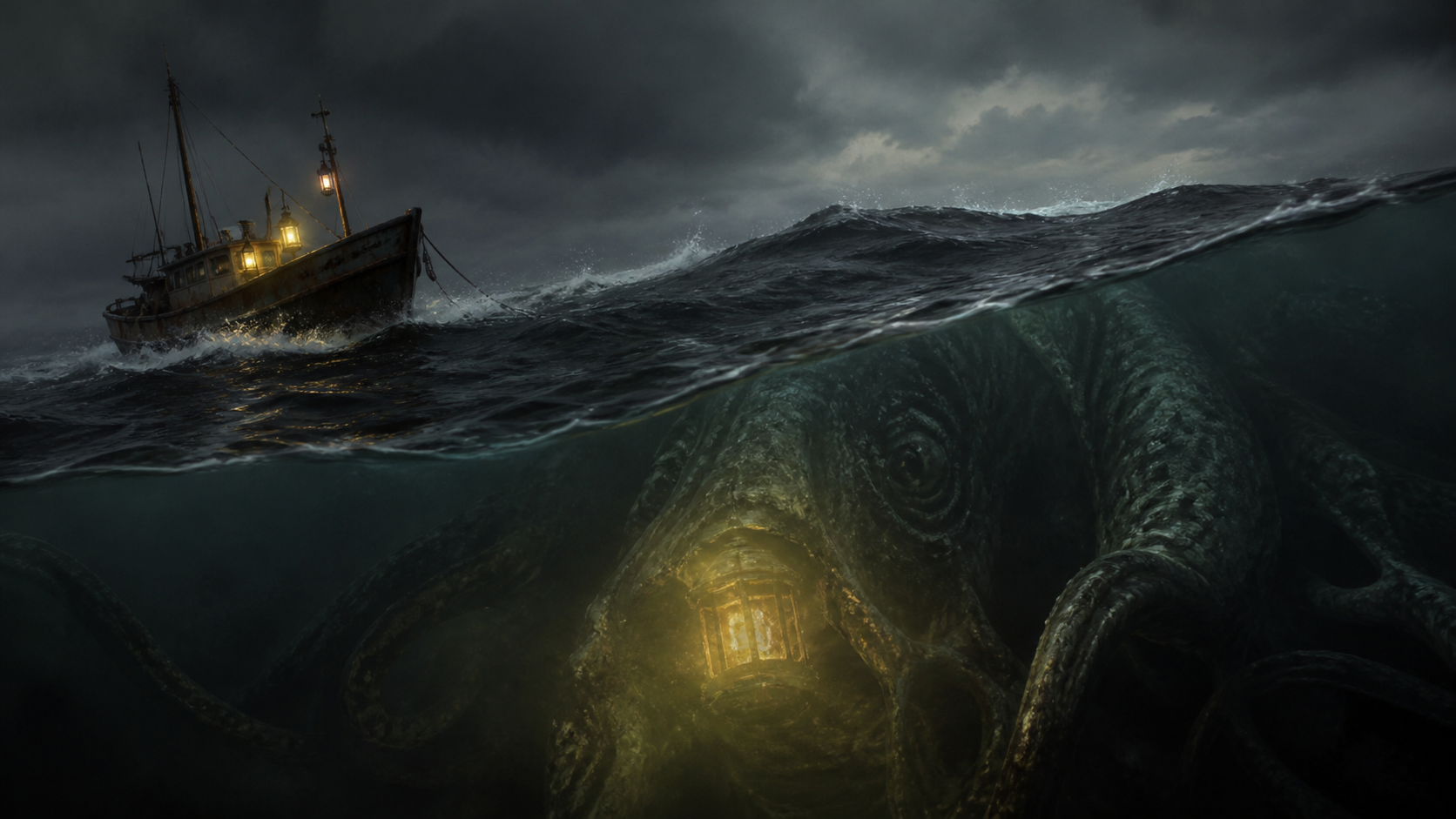
At first she saw only water shining black between the mangroves. Then a pale shape moved beneath the surface, too smooth for a log, too deliberate for drift. It rose with scarcely a ripple, and Mara’s breath caught not at its face, but at the uncanny arrangement of it. It had the body of a long eel, thick as a man’s thigh and perhaps twice as long as Mara was tall, but at the front the head broadened into a flattened triangle, draped with translucent folds of skin like a wedding veil. Two eyes sat low and round in the skull, pale as milk glass. Beneath them gaped a mouth not quite in the front of the face but along the underside, opening in a crescent lined with fine hooked teeth, while four narrow tendrils fringed the jaw and tasted the air.
It did not lunge. It watched.
Then the folds at its throat parted, and Mara heard a sound she felt in her teeth more than her ears: a wet, coaxing note, almost like a woman humming with her mouth closed. Jory swore and took a step back.
The creature moved once, with astonishing speed, and was half out of the water before Mara understood its intention. Its body was coated in a sheen of black river slime that made it impossible to grasp. It struck the bank and flung itself against the sack of salt, mouth working, tendrils twitching. Jory had already lifted the crowbar, but Mara shouted, “Don’t hit it!”
He stared at her as if she’d lost her mind. The creature writhed, its pale underside exposed for one brief moment, and Mara saw that the folds beneath its throat were not scales but a membrane beaded with tiny shell-like nodules, each one crusted in a white dusting where the salt had touched it. The thing recoiled from that patching as from fire.
Mara grabbed a handful of salt and threw it. The crystals struck the creature’s face and it lashed away with a harsh, choking hiss, slipping back into the water. A trail of slickness remained on the bank, and where the salt had landed the mud steamed faintly in the moonlight, not with heat but with some chemical sting.
Jory was breathing hard. “What in God’s name is that?”
“I don’t know,” Mara said, though she had already begun to understand the shape of the problem. “But it doesn’t like salt.”
The answer came with a sudden tug on the line of her thoughts, something from childhood and old gossip and the river itself. Salt for the river bride. A saying her grandmother had muttered once, half to herself, while cleaning fish. Not a blessing, not a joke. A warning.
They retreated only after they had ringed the trap with a rough line of salt from the sack. The creature did not emerge again, but once, from the dark water, came that humming note, lower now, less coaxing than angry. It made the mangroves seem full of watching.
Back in town, Mara went straight to her aunt’s house and found Mrs Nunez still up, shelling peas in the kitchen with the radio low. When Mara told her what they had seen, the old woman’s hands stilled on the bowl.
“Then it’s awake,” she said.
“Awake from what?”
Mrs Nunez glanced towards the dark window. “From the old channel, perhaps. Or from wherever the river keeps its hungers. My mother used to say there was a bride under the mud at the bend, one that took offerings in flood years. Salt on the doorstep. Coins in the water. Fish laid whole, belly up, so nothing could eat them first.”
Mara frowned. “That’s not helpful.”
“It is if you’ve got no better story.”
In the pantry there were paper bags of rock salt, and in the shed behind the house, old preserves jars, a coil of rope and a crate of tomato stakes. Jory, who had followed Mara home without being invited, took one of the jars and began filling it. “If it hates salt, we hit it with salt.”
“Not hit,” Mara said. “Barricade.”
He looked at her, then at the envelope the mayor had paid her with. “You going to tell Pelayo what we found?”
“No.”
“Why not?”
“Because he already knows something, and he’s hiding it.” She thought of the way his eyes had slid away from the river. “And because if he gets frightened enough, he’ll close the docks and blame whoever he can blame.”
Jory gave a short laugh. “You really do think like a civil servant.”
She almost smiled, but the humour didn’t hold. The next morning at the dock office, Mara found the pay envelope missing from the drawer where she’d left it, and the clerk on the far desk pretending not to notice. Pelayo had sent a note by way of the harbour master: keep the pier open, keep the talk down, and do not interfere with wildlife officers when they arrived. There was no mention of the missing boy, whose mother had been sleeping in the chapel alcove for two nights. There was no mention of the tide charts or the cracked sluice gate upriver where the municipal drain met the channel, now leaking a sluggish grey runoff from the new processing plant on the hill.
That evening Mara went back to the waterfront with Jory, a sack of salt, three jars of brine, and a coil of heavy rope. The river had risen with the tide, swallowing the trap and most of the bank. At the ferry pier, Mrs Doolan from the fish market stood with two neighbours, hanging strips of salted cloth over the mooring posts as if dressing a corpse.
“You’ve heard, then,” Mara said.
Mrs Doolan’s mouth tightened. “Heard enough. That thing took my grandson’s boot from the net. I’m not waiting for a council meeting to tell me what to do.”
Her neighbour, a man called Ivo who owned a crab skiff, held up a rusted bait knife and looked ashamed of the fact. “If it comes back, we cut it open.”
“No,” Mara said. “You don’t get near it unless it’s on land and already hurt. It moves faster than you think, and it can brace itself against the mud. One sweep and it’ll take your leg clean off.”
The men stared at her. She had not meant to say that, but the creature had shown enough in one glimpse to make her certain of it. It used the water to conceal its weight. Out of water, it would be slow only for a few seconds, not long enough to be careless.
“Then what do we do?” Mrs Doolan asked.
Mara looked at the pier posts, the bundled nets, the line of white salt glinting in jars and seams and cloth. “We make it come to us where it can’t use the channel. And we keep the salt between us and it.”
That was how they set the trap: not elaborate, just difficult enough to force a choice. Jory and Ivo dragged a spiked crab crate to the end of the old loading ramp and lashed it open with rope. Mara mixed salt into sacks of fish offal and laid them in a crescent across the pier, leaving a narrow path towards the shallow basin where the old slipway met the river. The smell of bait and brine thickened the air. They worked in silence, all of them listening for the wet scrape in the water below.
At half past ten, when the tide turned, the humming began.
It came first as a low note against the piles, then a series of clicking breaths, as if something beneath the surface were testing the air with a throat made for a different element. Mara saw the dark shape moving against the moonlit sheen, edging along the mangrove roots. It was larger than she’d judged, at least as long as a man was tall and thick as a barrel through the middle. When it rose, the veil-folds on its head parted, and she glimpsed the underside of its throat ridged with pale bead-like nodules, all of them glistening where the tide had washed them clean.
It had learned.
The creature stayed just beyond the strongest bands of salt. When it reached one of the cloth drapes, it halted, then pressed its snout against the salted linen and recoiled with a spasming jerk. Its mouth opened wide along the underside, and a rush of river water spilled from it along with half-digested scales and a bright object Mara recognised with a jolt: a child’s bracelet, blue plastic beads strung on elastic.
The mother’s cry from the chapel still echoed in her head. Mara swallowed hard and kept her voice steady. “Now.”
Jory and Ivo yanked the bait line. The sack burst, spraying fish guts into the water inside the shallow basin. The creature surged after it with astonishing suddenness, but the basin had been narrowed with planks and the muddy bottom rose there beneath the tide. Its body half-grounded, and for the first time it was visible above the water all the way to the tail, a ropey, muscular length that flexed under translucent skin patterned with faint river-mottled spots. The tendrils along its jaw whipped furiously. It turned too late to avoid the salt line, and its flank brushed the white crystals scattered on the boards.
The reaction was immediate. The creature convulsed, not in pain exactly, but in a violent attempt to escape whatever the salt was doing to its skin. The membrane folds over its head shuddered open and shut, and that humming note became a strangled, coughing howl. Mara saw then that the nodules on its throat were not decorative but gill-like organs, meant for drawing moisture and perhaps filtering minerals from the water. Salt crusted them, and where it touched, the skin puckered and dried.
“More salt!” she shouted.
Jory, eyes wide, grabbed a jar and hurled it. The glass shattered against the creature’s shoulder, and the brine streamed over its face. It thrashed, tail cracking the planks. One of the support posts snapped with a gunshot crack. Ivo stumbled, caught himself, and nearly went over the side. Mara seized his coat and dragged him back as the creature snapped at the air where his leg had been.
It was not mindless. Even half trapped, it angled itself towards the open run back into the river, fighting the barrier rather than flailing blindly. And when it turned, Mara saw the reason for the child’s bracelet and the collars and torn netting caught in the slick along its body. It had not only taken what it hunted. It had dragged things into the old fish trap upstream, into a hollow beneath the reeds where the tide could not reach so high. A lair. A nest of sorts, though not of offspring. Of kept things.
The thought sent a shiver through her, but there was no time for disgust or speculation. The creature had found a seam in the barricade and was forcing through it. Salt clung to its flanks in white streaks, yet its muscles still worked. It could endure contact for a while. Not indefinitely, but long enough to kill one of them.
Mara saw the end of the rope that held the open crab crate. It led to the winch bolt at the pier post. If the crate dropped, the spiked lid would slam shut across the basin mouth. Crude, dangerous and perhaps useless unless they got the creature fully inside.
“Jory,” she yelled, “the rope, when I say.”
He understood at once, or enough of it. She ran to the far side of the basin where the salt trail thinned, took up a sack of rock salt with both hands and hurled it in a wide spray across the creature’s head. It reared, veil folds slapping wetly, and that split second was enough.
“Now!”
Jory and Ivo heaved on the rope. The crate lid dropped with a crash of wood and iron, slamming down over the narrowed opening. One end struck the creature’s back. It bucked hard enough to lift the crate half off the bolts, then snapped its body sideways, but not before Mara jammed the crowbar through the rung and drove it down with all her weight, pinning the lid against the post. The metal screamed. The creature convulsed underneath, tail hammering the planks, but the salt-slicked edge of the lid had caught it across the throat folds.
Mara did the only thing left to do. She hauled the last sack of salt onto the crate and slit it open with the crowbar. White crystals poured through the gaps, into the basin, onto the writhing body below. The creature let out that humming note again, but now it was broken and thin, almost a keening. Its movements grew smaller. The veil folds collapsed inward. The tail struck once more, then lay still except for a slow, shuddering ripple.
No one spoke for a moment. The tide slapped softly against the piles. Somewhere down the bank a dog barked, uncertain and distant, as if the town itself had stepped back to listen.
Then, from beneath the crate, came a scraping, deliberate motion. Mara froze. The creature was not dead. It was pushing, testing the pinned gap, trying to lever itself free with a patience that turned her stomach. It would recover if given water, even shallow water.
“Jory,” she said, and heard her own voice shake at last, “the drain.”
He looked up, understanding coming only halfway. Behind the pier, just beyond the loading ramp, the municipal sluice gate channelled runoff from the plant into the river through a narrow concrete throat. It was choked with weeds and muck, but if opened fully it would flood the basin with brackish chemical waste from the drains. The creature would have to choose between salt-stung confinement and the churn of the outflow.
“That’ll poison half the river,” he said.
“It’s already poisoned,” Mara snapped, and then, because he was still hesitating, because people always hesitated when the bill came due, she softened her tone. “If we don’t push it back now, it’ll kill someone tonight.”
Ivo ran to the gate lever before Jory could answer. He had the right of it in his face, the look of a man who had finally decided which loss he could live with. The lever groaned as he heaved. Somewhere upriver, metal clanged. A rush began in the dark throat of the channel and then came sluicing down, carrying grey foam and reeking water into the basin.
The creature thrashed under the crate. It had survived long enough to sense the danger. Its tail slammed once, twice, and then the first surge of runoff hit it. The body arched hard against the planks, trying to wrench free of the salt and the crushing lid. Mara saw the pale nodules on its throat blanch as the brine washed over them, then darken under the muck. The humming note rose to a strained, broken pitch and cut off.
The basin filled. The water choked white around the crate, carrying salt, silt and chemical reek out towards the river. The body beneath the lid slowed. After a long minute, then another, it lay still enough that Mara did not trust herself to breathe. Only when the tide tugged lazily at the posts did she let go of the crowbar.
At dawn they prised the crate open with the winch hook. The creature had collapsed into the mud below, its veil folds flattened, the pale throat nodules shrivelled and crusted with salt. It was not beautiful dead, nor monstrous in some grand way; it was simply a river thing that had adapted badly to the wrong water, too altered by the drains and the estuary’s changing chemistry to remain where it had been. At its mouth, half swallowed in black slime, Mara found the child’s bracelet and, behind it, two dog collars, a strip of net and a ring of copper keys from the ferry office.
The town would tell the story badly, as towns always did. By midday, Pelayo had come down in his polished boots and looked at the creature’s body as if it were an accounting error that had crawled into the open. Wildlife officers were called after all, though by then they had little to say except that it was “an unusual native specimen” and that the sluice gate should be checked. The mayor was eager to speak of public safety, of prompt municipal action, of a difficult but successful response. Mara let him talk until he ran out of air.
She was standing on the pier when the missing boy’s mother came to see the bracelet. She took it with both hands and closed her eyes, not in relief exactly, but in the way of someone who has been handed a thing she had already buried in her mind. Mara could not apologise for the creature, or for the town, or for the fact that the river kept what it took unless something stronger took it back.
Jory found her later, when the officers had gone and the sun was high enough to make the mud shine like hammered metal. He was carrying the empty salt sack over one shoulder.
“You knew,” he said.
“What?”
“That it wasn’t just hunting. It was making a place.”
Mara looked out at the river, where the current moved broad and brown towards the sea. “I think it was cleaning out a chamber under the bank. Maybe the old trap. Maybe somewhere deeper. It was bringing things there because the water was changing, and because the drains had made the brackish channels richer in the wrong sort of prey. It was adapting. So were we, in our own useless way.”
He made a face. “You always talk like a book when you’re tired.”
“Only when I’ve nearly died.”
He laughed then, properly this time, though it did not entirely loosen the strain in his face. “What now?”
Mara thought of the empty bay in her father’s medicine bottle and the pay envelope on the kitchen table. She thought of the pier, already staining where the salt had soaked the wood, and of the way the creature had been drawn to runoff, to fish waste, to the careless abundance people poured into the river and called normal. “Now we force Pelayo to fix the sluice,” she said. “And we put salt on the old trap until the tide washes it clean.”
Jory eyed her. “That all?”
“For today.”
The river flowed on, indifferently as ever, but it had been given a wound and a warning, and the town could no longer pretend the water was only a road or a boundary or a hiding place. By the next week men were clearing the bank around the old fish trap, and women were hanging salt sacks in their sheds where the tide could smell them. Mara went back to work at the dock office with mud still under her nails and a new stack of complaints on her desk. The quiet that followed was not peace. It was merely the time between one accounting and the next.

Monsters & Creatures