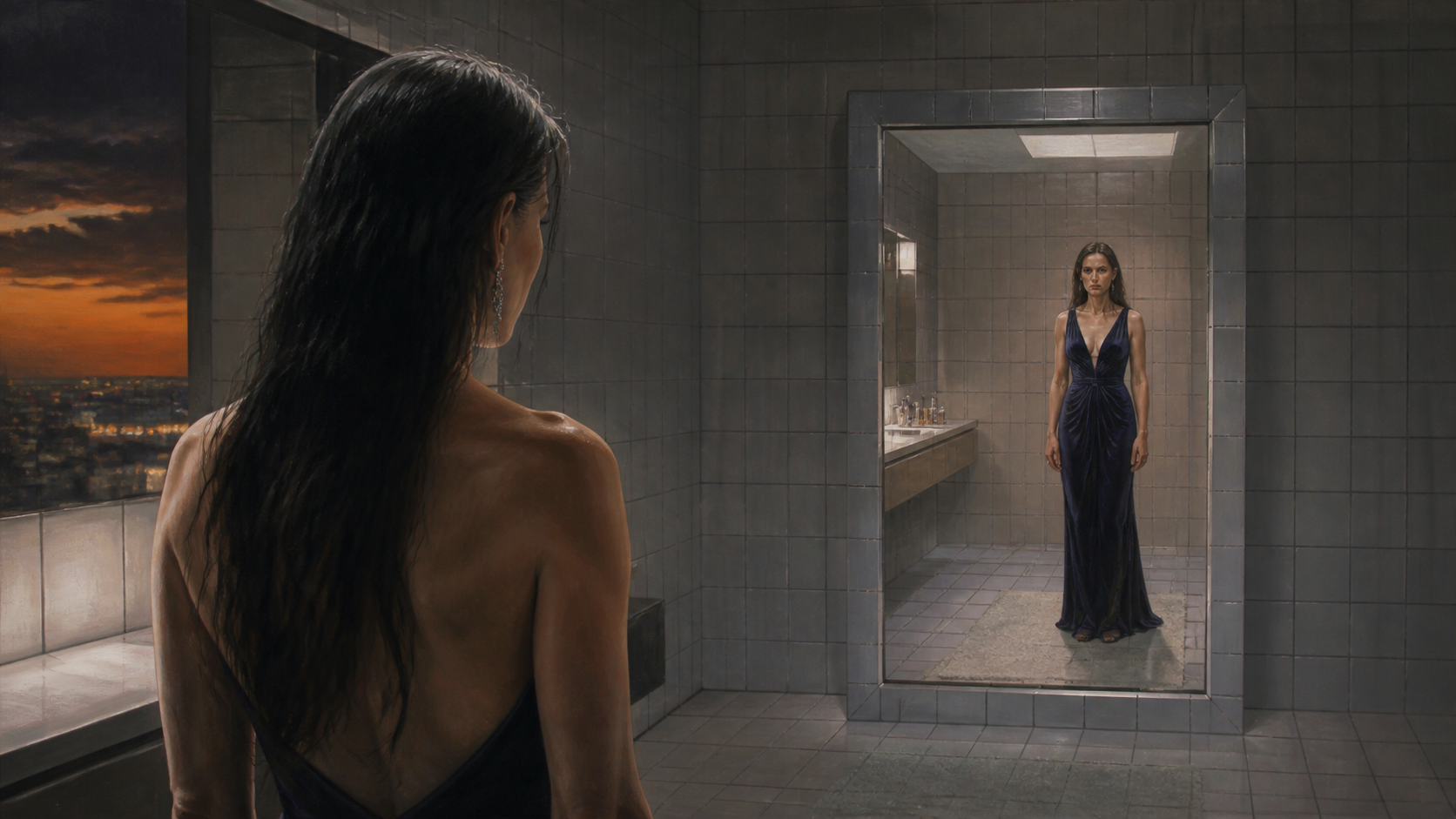
Candyman is a 1992 supernatural horror film directed by Bernard Rose, adapted from Clive Barker’s short story The Forbidden. Set in Chicago’s Cabrini-Green housing project, it centres on a graduate student researching urban legends who becomes entangled with the title figure, a hook-handed apparition invoked by saying his name in a mirror five times. Its appeal lies in the way it blends urban legend dread, gothic tragedy and social unease, turning a familiar call-and-response premise into something sharper, sadder and more disturbing than a standard slasher variation.
The Film File
- Original release year: 1992
- Director: Bernard Rose
- Credited writer: Bernard Rose, based on Clive Barker’s short story The Forbidden
- Principal cast: Virginia Madsen as Helen Lyle; Tony Todd as Candyman; Xander Berkeley as Trevor Lyle; Kasi Lemmons as Bernadette “Bernie” Walsh; Vanessa Williams as Anne-Marie McCoy; DeJuan Guy as Jake; Ted Raimi as Billy; Stanley DeSantis as Sergeant Ransone
- Approximate runtime: 98 minutes
- Country of production: United States
- Relevant horror subgenres: supernatural horror, urban legend horror, gothic horror, slasher-adjacent horror
Behind the Screams
Candyman began as Clive Barker’s short story The Forbidden, which was set in Liverpool and centred on class, folklore and the power of stories to shape behaviour. Bernard Rose relocated the material to Chicago, specifically to Cabrini-Green, and the change is one of the film’s most important creative decisions. It shifts the story from a largely British social context into an American one marked by racial segregation, housing neglect and public fear of violence, while still keeping Barker’s interest in belief, obsession and bodily violation intact.
The adaptation is a useful example of how a horror film can be altered without losing its source’s core anxiety. The story’s central mechanism remains simple, almost folk-tale in structure, but the film widens it into something closer to a haunted urban myth with historical weight. In practical terms, that means the Candyman is not just a monster who appears when summoned. He is presented as a figure emerging from violence, memory and legend, which gives the film a more layered identity than a typical “say his name” horror premise.
Phyllis Motley’s casting of Cabrini-Green as a real and lived-in environment matters as much as the supernatural premise. The film was shot on location and uses the neighbourhood’s social reality as part of its atmosphere, even when its perspective is filtered through Helen’s increasingly unstable investigation. That choice has also kept the film in critical discussion, because it ties the horror to questions of representation: who gets to tell this story, whose fear drives it, and how a supposedly objective academic gaze can become part of the problem.
Philip Glass’s score is another defining decision. Rather than pushing the film into a slasher rhythm, it gives the story a mournful, ritualised quality that suits the blend of romance, doom and legend. The music does not merely punctuate shocks; it helps shape the film’s identity as a tragic ghost story with a grimly lyrical streak.
Into the Dark
Helen Lyle is a graduate student researching urban legends, and her project leads her into the folklore surrounding the Candyman, a local figure said to appear when his name is repeated in a mirror. What initially looks like an academic curiosity becomes more dangerous as Helen interviews residents, visits Cabrini-Green and draws the attention of a killer whose reputation seems to operate both as a story and as a supernatural force. The film’s basic pleasure comes from watching a theory-minded protagonist move from detached investigation into lived terror.
As the story develops, the personal and the supernatural start to overlap. Helen’s domestic life becomes increasingly unstable, the line between external threat and psychological breakdown grows harder to separate, and the film steadily suggests that the legend is not merely being studied but activated. The killings around her are framed so that she is repeatedly made to look culpable, which intensifies the sense that she is being trapped by a narrative she no longer controls.
Spoilers ahead: the following paragraphs discuss major plot developments.
The film’s most important late revelation is that Helen is not just investigating Candyman’s story, she is being absorbed into it. After repeated encounters, she is drawn into the legend’s violent logic, and the film makes clear that Candyman himself has a specific interest in her. He claims her as a successor figure, not simply a victim, and this transforms the horror from “Will she survive?” into “What identity is being imposed on her?” That shift gives the ending its bleak force.
Helen’s final fate is the culmination of that process. After a fire and a sequence of deaths, she is remembered through the legend rather than through the ordinary facts of her life. The film’s closing movement turns her into part of the mythic machinery that Candyman embodies, while also linking him to a pattern of desire, violence and memorialisation. It matters because the film refuses a clean separation between monster and survivor: the story ends by showing how legend can consume a person and preserve them at the same time, but only in distorted form.
What Gets Under Your Skin
Candyman works best as a film of uneasy contrasts. It is polished but not glossy, intelligent without becoming aloof, and emotionally colder than many horror films that rely on similar supernatural setups. Its atmosphere comes less from cheap shocks than from accumulation: the apartment interiors, the exposed social spaces of Cabrini-Green, and the way Helen’s research leads her deeper into a world that feels both historically grounded and mythically charged. The film is always quietly telling you that the legend is bigger than the people trying to explain it.
Virginia Madsen gives Helen an appealing mix of confidence, curiosity and strain. She does not play the character as a passive witness to events, which makes the gradual erosion of her authority more effective. Tony Todd, meanwhile, gives Candyman a rare kind of presence: seductive, wounded and ominous all at once. The performance is important because it prevents the character from collapsing into a simple slasher villain. Candyman is frightening, but he is also articulate and ideologically loaded, which makes his scenes feel more dangerous than a standard stalking sequence.
The film’s visual design supports that duality. It uses contrasts between academic spaces and decaying urban environments to keep the story rooted in social reality even as the supernatural intensifies. The horror is partly visual, partly conceptual: the mirror ritual, the hook, the beehive imagery and the repeated reappearance of Candyman build a mythology that is easy to grasp but difficult to shake. When the film leans into bodily menace, it does so with enough restraint to let suggestion do a lot of the work, which suits the material well.
The storytelling is strongest when it treats folklore as something that changes depending on who is telling it and why. That is more interesting than a simple chase narrative. At the same time, the film’s social themes are not always fully integrated from every angle, and some viewers may feel that its perspective remains too dependent on Helen’s point of view for a story so concerned with race, class and public space. Even so, the tension between those ambitions is part of what makes the film memorable rather than merely neat.
The Film’s Afterlife
Candyman opened to generally favourable critical attention and has since become one of the more discussed horror films of the 1990s, especially for the way it folds urban legend horror into questions of race, housing and historical violence. Its reputation has grown further through later franchise entries, including sequels and a 2021 continuation that explicitly treated it as part of a larger mythology. The original film remains the touchstone because it is the one that most cleanly balances romance, dread and social commentary without losing sight of its central ghost story.
Its legacy is not just that it spawned sequels, but that it offered a model for horror with a specific social texture. Plenty of films use a city as backdrop; Candyman makes the city part of the haunting itself.
Horripilations Verdict
A smart, unsettling urban ghost story that fuses social unease with tragic menace, anchored by striking performances and a singular central figure.
What works
- Tony Todd's magnetic and mournful Candyman
- Bernard Rose's adaptation of Barker's story into a sharper American setting
- Philip Glass's score and the film's memorable imagery
What holds it back
- The social perspective can feel unevenly filtered through Helen
- Some thematic threads are more suggestive than fully developed