Fingers Grasping at the Living
Penny had always thought of herself as a sensible sort of person. A schoolteacher in the small seaside town of Penrose, she spent her days teaching history to restless youths who cared little for the past. Instead, she preferred the solitude of weekends spent at home—pursuing literature, enjoying quiet strolls along the beach, and tending to her modest vegetable garden. It was a simple life, one she cherished, yet still an understated life that felt eerily mundane at times.
It was on a grey Saturday afternoon, the kind where the clouds hung low and oppressive, that the intrusion first came. Penny was in her greenhouse, kneeling by her tomato plants, when she sensed it: a cool breath against her neck. She brushed it off as a chill brought on by the encroaching autumn, but when she reached for her watering can, her fingers brushed something cold and clammy. Startled, she turned, but found nothing out of the ordinary in her little retreat from the world.
With the sensation still prickling her skin, she shook her head at the foolishness of her fear. Just the weather, she thought, going back to her plants. But the air had changed. Every movement, every slight breeze felt infused with a life of its own—the greens, browns, and blues around her faded into a blur, and for a moment, she could swear the rustling leaves shaped themselves into crooked fingers reaching out. Dismissing the absurdity, she finished her chores and retreated into her home.
That night, as she settled with a cup of tea in her favourite armchair, she noticed her reflection in the nearby window seemed sharper, more substantial than it ought to be. She felt watched. In the darkness outside, the bushes rustled as if something were stirring, but just as she leaned in to peer more closely, the movement stilled, leaving only the thudding beat of her heart.
In the following weeks, the feeling returned intermittently, growing wilder each time. Rattling pots in the kitchen, whispers in the dark, the music of faint giggles under a full moon. The small, sweet vibrancy of her life transformed into a prism of unsettling moments. It spoke to her in the twilight hours, and soon her dreams filled with a face too hazy to remember—a girl with long dark hair framed by pale, waving fingers. Every time she awoke, the impression lingered, leaving Penny unbalanced.
One evening, after a particularly vivid dream in which the girl had cried for help, Penny returned to her greenhouse, a seed of determination planted in her heart. Perhaps in the quiet clutches of the earth, she might discover the source of her unease. Instead, she found articles strewn about on the stone table where she’d left the odd trinkets from her garden: a ceramic owl with a cracked beak, a rusted shovel. Startled, she overturned a small clay pot only to blink in disbelief at the words etched inside: “I need you.”
Panic fluttered in her chest. Who needed her? She rushed to the door, but a wave of cold air slammed it shut. The chill slid along her spine as the girl’s presence pressed close. It felt angry, desperate, and impossibly familiar. The hair on Penny’s arms stood rigid as the words formed in the corners of her mind: “Find me.”
Shaky, she stumbled backwards, her breathing quickening at the desperate command echoing in the silence. The girl was real; she sought her out; she desired something that evaded capture.
With determination hardened by uncertainty, Penny began researching local history. She unearthed tales of a girl who’d lived a century ago—Emelia, a spirited child who vanished, sparking searches that yielded nothing. Villagers spoke in hushed tones about her laughter and a shadow that still clung to the cliffs. Penny felt her heart twist at the thought. Could it be the same girl? Was Emelia’s soul tethered to some irredeemable sorrow?
But knowledge pierced her rationality as the nights grew darker, and she felt Emelia’s presence bleed into her life. Each attempt to ignore it only deepened the bond, turning her pursuits into feverish cycles of sleepless nights and disjointed days. She became a caricature of herself—her skin pale, her pupils dilated, and her laughter faded to a whisper. Friends scarcely recognised her; they viewed her as a ghost of the person they once knew.
Months passed before Penny discovered Emelia had had a sister—a sister who hadn’t moved on, who wandered the very same shores they once played upon. A chill danced down her spine as she grasped the implication: Emelia had stolen something more than her past; she sought to fill a void that could only reside in her sibling’s heart.
As storms lashed the shore and the waves roared, Penny was awash in sorrow, a grasping sense of negation that felt unbearable. Yet, in the eye of the tempest, she felt stronger. Perhaps, if she confronted the shadows—if she came to Emelia’s aid—the girl could be freed.
On the cliffs where Emelia had vanished, Penny called out, her voice sharp and clear against the howl of the wind. “I know you wish for your sister! Let me help you find her!”
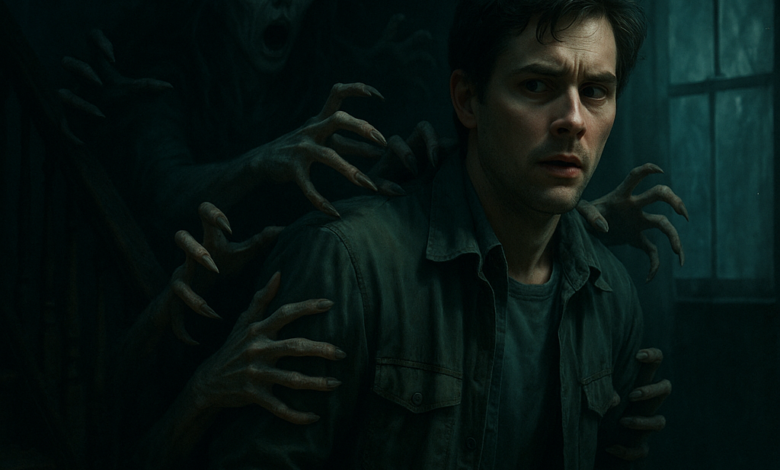
For an agonising moment, silence reigned. Then, like a dark predator loosed upon the hapless, Emelia emerged—no longer confined to faint sensations, but a vivid apparition draped in rags that flew about her as if the world’s air churned beneath her. Her eyes gleamed, and her fingers stretched outwards toward Penny, grasping and pleading.
Penny felt the chill wash over her as the memories rushed through her—of hiding behind trees, of laughter mingling with the crashing waves. Yet these memories morphed into something darker, laced with longing and loss that pierced through her chest like splintered glass. This hunger breathed life into Emelia’s ghost, transforming innocence into something grotesque.
“Where is she?” Penny gasped, horrified, as the spectre’s breath grew heavier, pushing against her until the tips of her fingers were crushed against her non-existent walls.
“Help me!” Emelia shrieked, shattering the fog of the wind, as fingers of a former time stretched hungrily from Penny to the void, yearning for the lost sister. But Penny was the one succumbing to the haunting beckon—her identity slipping, consumed as Emelia broke through the fragile fabric that tethered her to the living.
Suddenly, the air thickened, and a flash of memories surged through Penny—embodied laughter suffocating under the crushing weight of despair. The next moment, Penny gasped; she felt herself fading. Emelia’s grasp transformed into something tangible, threading through her very being, weaving into her memories and existence.
“Find me,” Emelia echoed in a cacophony of sound that enveloped them in the swirling darkness.
But it was too late. The musicality ebbed away, leaving Penny fragmented, spiralling into oblivion. She had become Emelia’s vessel—her ties to the world severed—lost to the presence she’d sought to unearth. Whatever it might mean to serve that longing, longing itself had become a curse.
When the villagers would speak of the girl who disappeared upon the cliffs, they would only ever whisper of two sisters lost to the surf, always together yet eternally separated—wherever Penny had landed, she existed only as a shadow of a life left incomplete, dancing along the fringes of an open grave.