
Flesh that Fades and Fractures
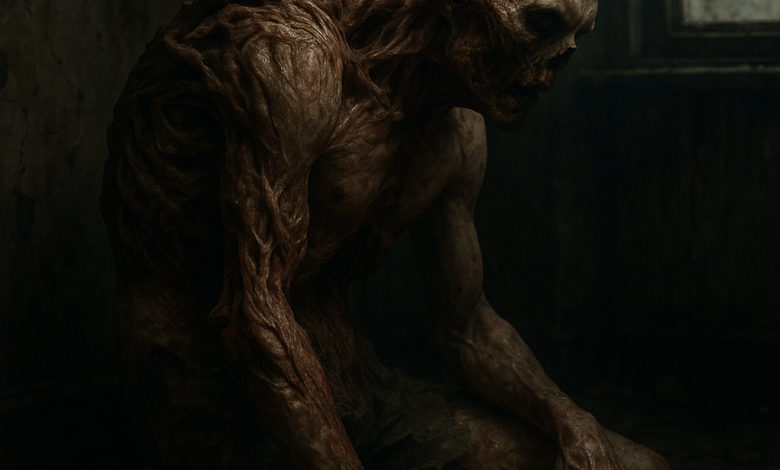
The rain fell relentlessly, hammering against the windscreen of Sarah’s battered Transit van as she navigated the maze of narrow lanes leading to Millway Farm. She was late, and the approaching darkness did little to ease the growing hostility of her surroundings. Mist swirled like vapour around the half-illuminated hedges on either side, the gloaming deepening into night with each mile she travelled.
Sarah clutched the steering wheel, her knuckles white. The barn shrouded in her thoughts was a family legacy—her father’s latest obsession. Determined to prove that he could restore it to its former glory, he had posted a last-minute invitation for enthusiasts. “Come to Millway Farm—transform the past,” he’d declared. The irony made her stomach churn. She’d learned all too well from his various projects: intentions could warp like the timber beneath a swollen roof.
Approaching the farm, the van’s headlights fell upon the building, revealing warped wooden slats jutting out like broken teeth. Once stately, the barn stood crooked, suffocated by creeping ivy. As she stepped out, the damp air wrapped around her like a shroud, and the smell of earth and decay hit her nostrils. An unsettling thought crossed her mind: perhaps it should remain forgotten, left to rot in peace.
Inside, her father was already bustling about, his silhouette a frenzied motion against the dark interior. “You made it!” he exclaimed, almost too enthusiastically. He was dressed in an oversized plaid shirt, sleeves rolled to his elbows, plastered with sawdust and dirt. “Look at this.” He pointed to a decrepit workbench littered with antique tools, a few radiating haunting impressions of a time long gone.
“Dad, this is…” She trailed off, unsure how to voice the unease twisting like a thorn in her gut. “Is this really safe?” The shadows danced wildly in the flickering fluorescence above, sparking unease in her chest.
“Nonsense, we’ll breathe new life into it,” he said, enthusiasm spilling over. In moments, he was lost in his own calculations of lumber and nails, leaving her alone to contemplate the oppressive silence hanging like a shroud in the barn.
She meandered through the lower level, her fingers grazing the aged wood, the timbers creaking faintly. Sarah’s gaze caught a glimmer near the rafters, something reflecting a dully metallic light. Curiosity pulled her closer, and she edged upward to the loft. Climbing the ladder felt like penance; each step echoed painfully, reminding her of what was beneath the floorboards. When she reached the top, shadows shifted, revealing an array of twisted mannequins suspended almost discreetly among the beams. They were grotesque mockeries: faces warped into expressions of agony, bodies bent into impossible poses.
“Dad?” she called hesitantly. There was no reply. She approached them, and as she did, a rancid stench rolled off the figures. She recoiled instinctively. A sick feeling churned within her as the mannequins stared back, hollow eyes devoid of life yet full of desperation. A memory surfaced—her childhood, tales of the village’s forbidden stories of the cursed lives trapped in the barn.
With a half-hearted chuckle, she pressed deeper into the loft. “It’s just a story,” she muttered, but the words tasted bitter. She returned to the workbench, where her father continued to enthuse about the restoration. As night deepened, the outside world had faded away. Rain lashed the building, each drop a chilling reminder of her isolation.
Suddenly, she caught a glimpse of movement from the corner of her eye. A truly ancient sound—like wood splintering. “Dad?” she called out again, feeling the thread of fear tightening around her throat. This time, the silence was heavier. The tools lay where they had been hastily put down, but an unsettling impression lingered in the air.
Staring into the barn below, she saw no sign of her father, only the disarray where he had been before. An irrational dread grew within her, compelling her feet to retreat. As she turned to leave, something shifted in the rafters above—was it a shadow? No, it was more than that; it twisted, bending, exhaling a rancid air that filled her lungs with an overwhelming urge to scream.
She stumbled backwards, heart racing, and her foot caught the edge of the ladder—a harbinger of panic. The wood fractured beneath her weight, sending her tumbling down with a shriek. She landed heavily, the impact knocking the breath from her lungs.
“Dad!” she gasped, rising. She scrambled back into the chaos below, the scant light catching an unpacked velvet cloth lying stark against the wall. Madness clawed at her throat—she pulled it away and uncovered jars filled with something unspeakable, grotesque tendrils reaching toward the tops like fleshy vines.
Then she heard it. A series of groans—her father’s voice, weak and distorted, echoed from the far corner, leading her deeper into the shadows.
“Sarah… help me…” his voice misformed, shivering against the barn’s wooden carcass. Instinct dragged her towards it. But as she moved closer, she saw it: her father lay slumped against the wall, not quite him, not quite anything she recognised. Flesh whispered against flesh, limbs twitched unnaturally, as though they sought to peel themselves from the confines of being human.
“Dad?” The word slipped cautiously from her lips. She approached, heart hammering like a chorus of dread in her ears, and crouched beside him. The terror in his eyes startled her, wide blue expanses that sobbed for relief. Something had consumed him. This was a transformation—a dramatic, dreadful metamorphosis.
“Run,” he rasped, the word fetid on his breath. There was something almost otherworldly about his form, a limpness that melded into the very barn floor.
“I won’t leave you!” she screamed, desperate threads binding her feet to the spot. As she gripped for the remnants of her father, his skin began to glow, swirling with patterned colours that writhed as if alive. Objects in the room rattled with anticipation of a fateful conclusion. The air itself thickened, the space bends and contorts like an eager child.
“No, you can’t help me. Get out! Go!” His face twisted, uncontrollable brawn momentarily surging as something responded to her presence. The barn convulsed, keen with a hunger it yearned to satiate, reaching out for her through her father’s own tortured figure.
In that moment of pure instinct, she understood: this existence wasn’t built to endure; it was a callous mold longing to envelop her.
She pushed herself back to her feet, stumbling, heart thundering, retreating from the loathsome tendrils spreading from him. She glanced back, and in a horrific dance of despair, she saw her father’s face fracturing, flesh that faded into vile curls of homogenous grotesqueness. She turned and bolted through the barn’s door, the sound of breaking wood echoing sharp as nails against her sanity.
Slipping through the rain-slicked earth and mud, every step felt like a choice for survival—the weight of the barn’s pall bearing down heavily behind her.
As she reached the van, the engine turned over, sputtering to life under the tension of frantic touch. Yet even as she escaped, she felt the pull of the barn’s horror—unfading, lingering in her thoughts.
Driving away, the barn sank into the mist, but the imprint of the horrific transformation lingered—a gaunt reminder that she couldn’t run from what had been shattered. Approaching the main road, her skin brushed with the memory of his fragile call. The feeling of defeat submerged within her.
There was no safety in distance; a part of her was forever trapped in Millway Farm, to silently fracture—flesh that could not fade, unable to transform back into what once was. No rescue could rend the scars open enough to mend without losing something else again.


