The Shape of Despair
In the quiet village of Ashwick, nestled between rolling hills and dense forests, a haze of unease lingered as thick as the mist that often cloaked the early mornings. People seldom spoke of it directly, yet an invisible weight seemed to hang over the cobbled streets and crumbling cottages. Tales whispered among the villagers spoke of a peculiar presence that preyed upon their hopes, a manifestation of all that brought despair.
Fiona Lawrence, a newcomer to Ashwick, arrived with dreams of a fresh beginning. Having escaped the clutches of a life steeped in heartache, she sought solace in the isolation of the countryside. With her auburn hair tumbling like autumn leaves and bright blue eyes that could pierce even the thickest fog, she seemed an unlikely target for the village’s dark undercurrents. Yet, it wasn’t long before she began to feel the village’s chilling embrace.
The first night, Fiona lay awake, listening to the soft rustle of trees outside her window. A chill danced through the air, stirring something deep within her—an inexplicable sense of dread. The winding path leading to her cottage beckoned by day, but at night it contorted into a sinister disclaimer of the night’s intentions. There was something unfathomable lurking in the dark, something that echoed her own buried misery.
Days turned to weeks, and though Fiona tried to forge connections with her neighbours, she often found herself on the periphery—an outcast in her own hope for camaraderie. The villagers wore expressions of weariness, burdened faces drawn tight with unspoken anxieties. They welcomed her politely, yet their eyes betrayed a reluctance to truly engage.
“What’s the matter, love?” an elderly woman named Maud once asked, her gnarled hands knitting furiously. “You look like you’ve seen a ghost.”
“Just the shadows playing tricks,” Fiona replied, dismissing the sensation that had been coiling steadily in her stomach. She chose to ignore the whispers that seemed to trample the silence, weaving through the village like an uninvited gust of wind.
Things began to shift when Fiona found an old journal tucked beneath a loose floorboard, pages yellowed and brittle with age. The delicate cursive inside bore the entries of a woman who came before her. Each word resonated with the torment of despair that seemed to seep into Fiona’s bones, detailing encounters with something that felt almost sentient—a cruel force that drained vitality and hope from those trapped in its thrall.
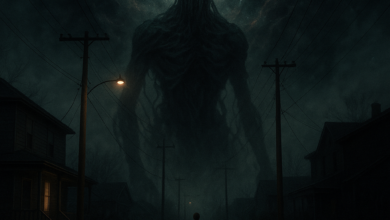
The journal spoke of strange occurrences: villagers who’d taken their own lives, swallowed by darkness. It described an amorphous figure that loomed in the corners of eyesight, its shape ever elusive, yet consistently overwhelming. This figure sometimes appeared at the edge of the woods, a silhouette against the twilight, casting an elongated shadow behind it—always beckoning, as if it called the villagers closer to their own demise.
Fiona was fascinated and terrified, her heart racing as her mind drifted deeper into the rabbit hole of the author’s torment. She skimmed through the final entries, finding a particularly chilling one: “It watches. Always watching. And when it comes for you, it shapes itself from your worst fears. Do not blink, do not turn away.”
As twilight deepened, Fiona’s sleep became fragmented, haunted by dreams of her past—those moments of failure that shaped the contours of her soul. Memories flared before her like shards of glass, each one more painful than the last. She found herself wondering if the village had seeped into her subconscious, planting the seeds of her own despair.
One evening, emboldened by curiosity, she ventured into the woods, a magnetic pull guiding her deeper among the twisted branches. The trees felt alive with centuries of secrets, and she could hear the whispers again, indistinct but fervent, as if they were weighing her down like an anchor. The atmosphere grew dense, and when she paused to catch her breath, she felt it—the suffocating presence that surrounded her, thicker than the fog, interference in the quiet.
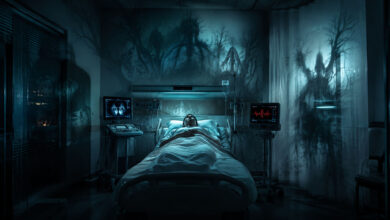
Before she could decipher what was happening, the shape emerged. Not an apparition in the traditional sense, but a disturbing amalgamation of shadows that twisted and curled with grotesque fluidity. It shifted and slid, taking form and reform, none of it coherent but all of it painfully familiar. Fiona’s heart raced as she listened, sensing that it had come to feast upon her insecurities, her darkest failures.
It morphed into her self-doubt—her hesitance to leave behind the miserable remnants of her past career and the relationships that had faded into nothingness. It became an echo of every tear she had shed, each unfulfilled promise she had made to herself. The darkness began to twine closer, and inwardly, something shrieked for release. It was as though her paling hopes entwined with the shadow, and she began to remember voices—the harsh criticisms of others that had burrowed into her psyche and decided to manifest here, in this cursed realm of despair.
She stumbled back, gasping breaths releasing whispers of fear into the stillness, but the shape slithered seamlessly after her. Fiona’s feet dug into the knotted roots of the forest floor, trying to escape the inescapable. Despair wrapped itself around her heart, squeezing tighter with every frenzied beat.
Fiona burst through the treeline, emerging into the fragile light of dusk, but it followed. The panic of being pursued ignited a frantic energy within her. She raced towards her cottage, a lighthouse in a storm of emotional chaos—the only sanctuary she could grasp. But she knew the shape shifted alongside her, a persistent shadow that wouldn’t let go.
That night, she paced and paced, reciting affirmations under her breath as if casting a spell against the darkness that hemmed her in. But the figure was relentless, pressing on the edges of her mind, whispering words of defeat and failure. Exhaustion and terror wove intricately into her being until she could scarcely distinguish between the mantras she’d devised and the cruel mockery echoing within her thoughts.
The next day, Fiona watched the villagers move through their routines with uncanny detachment, every smile slipping behind uncertainty, unresolved sorrow hiding behind their polite facades. She considered revealing her experience—a warning, or perhaps a plea for help. Yet something held her tongue; an invisible thread of shared despair stitched them together. They would not understand. They could not.
In the following weeks, she tried to blend in, but behind every polite nod, every hesitant interaction, she could feel the shape lurking in the distance, always lurking—waiting for the moment she let her guard down. It found its way into her dreams, coiling around her heart like a serpent, squeezing harder with every passing night.
As winter settled in with a bitter chill, an unshakeable realisation began to emerge. The despair was not merely a visiting spectre; it had woven itself into the very fabric of Ashwick. It lived there, breathed with the villagers, and fed off the regrets that stained their lives. The village itself was a host to this creature of overwhelming darkness, and Fiona was slowly succumbing.
With winter came more shadows, and news of tragedy began to ripple through the community—one by one, faces she had come to know disappeared. Some claimed to have gone on “extended journeys,” while others were buried in hastily arranged ceremonies, their lives reduced to whispers and later, memories. The figure thrived, taking with it lives that had been snuffed out long before their bodies succumbed to the earth.
The final straw broke when Fiona awoke one night to a loud knock at her door. It was Maud—the elderly woman whom she’d shared fleeting conversations with over tea, her eyes wide with panic. “Fiona! You must come with me! It’s come for me. I can feel it watching!”
Fiona recognised the terror in Maud’s voice; it mirrored her own. They rushed across the cobbled street, the full moon illuminating the path ahead, casting a spectral glow that seemed to rid the shadows of sanctuary. The village square became their sanctuary, anxiety crackling like electricity in the air.
Yet even among the gathering, Fiona could see that they were far from united. Fear split their attention as tension unfurled in the air. Millie, a local baker, stood protectively near her husband, her eyes darting left and right as if expecting something to emerge from the trees. Those once friendly faces now wore fractals of worry and distrust.
“It comes for all of us,” Maud breathed, collapsing to her knees in the cobbled square, “It watches relentlessly!”
“I saw it too!” someone shouted, voices climbing higher, hysteria splintering by the moment.
“The children, they told tales of it too. Thick shadows stalk through our dreams.”
Fiona realised then what she’d denied—this fear had nestled deep within them, preying as much on their collective despair as on each individual. They needed to confront it—together. With hearts pounding in synchrony, they formed a circle, bodies huddled close as they bore the weight of their shared fears.
In that quiet strength, Fiona began to chant, a unifying song that rose above the thrumming anxiety, her voice cutting through the fabric of the night. Others joined, hesitant at first, but then finding rhythm in the swell of emotion. Their fears became palpable, transforming the air into an emblem of shared struggle, each word refracting off the despair that had cocooned Ashwick.
The familiar shape interrupted their chants, a grotesque amalgamation snaking into their circle, but this time something powerful coursed through Fiona—a rebellion borne from the collective strength of the villagers. The ancient woods behind them moaned in response, as neighbours stood firm against the shape’s corruption. From the maelstrom of anguish emerged a tear, a fissure in the endless sorrow binding them.
Under that shimmering moonlit night, they faced their despair together—a multifaceted creature dissolving, the darkness shattering under the pressure of voices intertwined, one steadfast resolve glowing stronger than the shadow.
In the aftermath, dawn crept through the village like a cautious promise. The lingering fear and unease that had wrapped its tentacles around Ashwick receded, unveiling the world anew. Fiona stood among her neighbours who had, for better or worse, transformed from strangers to allies in a shared darkness. The promise of hope tinged the morning light.
The struggle against despair was no less daunting, Fiona realised, but this time she refused to surrender to the shapeless entity that had once loomed so closely. They would hold fast to their stories, cherish the connections carved from vulnerability and strength. Together, they would create a new tapestry woven from hope—a lifeline against the abyss.
In Ashwick, hope returned—not unscathed, but fervent. And as the mist lifted from the morning air, so too did the haunting shape of despair that threatened to engulf them all.