Before it became one of horror’s most discussed cult titles, The Evil Dead (1981) was a ferocious little supernatural siege movie about five young people trapped in an isolated cabin where an ancient book and a tape recording awaken something best left alone. Sam Raimi’s feature debut blends possession horror, splatter and grimly comic excess, but its central appeal is not just the gore. It is the way the film keeps turning a simple cabin-in-the-woods setup into a pressure cooker of dread, physical chaos and frantic invention.
The Evil Dead arrived as a deliberately rough-edged independent production, shot with friends, favours and very little money, yet it feels anything but timid. Even now, its distinctive charge comes from the collision between amateur-scale resources and extraordinarily committed design: a film that uses cramped spaces, practical effects and camera movement to make a tiny location feel wildly unstable. For viewers deciding whether to revisit it, or to finally meet it properly, this is the key point. It is not merely a notorious gore film. It is a lean, ugly, absurd, inventive horror machine.
The Film File
- Original release year: 1981
- Director: Sam Raimi
- Credited writers: Sam Raimi
- Principal cast: Bruce Campbell as Ash Williams; Ellen Sandweiss as Cheryl Williams; Richard DeManincor as Scott; Betsy Baker as Linda; Theresa Tilly as Shelly
- Approximate runtime of this version: 85 minutes
- Country of production: United States
- Relevant horror subgenres: supernatural horror, possession horror, splatter horror, body horror, cabin-in-the-woods horror
Behind the Screams
The Evil Dead grew out of a student-era filmmaking circle around Raimi, Bruce Campbell and producer Robert Tapert, who had already made earlier short-form and low-budget work before attempting a feature. The project’s development is closely tied to Within the Woods, a short made as a proof-of-concept to attract investment. The feature was initially known under the title Book of the Dead, and the eventual film’s mythology, including the taped incantation and the Necronomicon, evolved from that early concept rather than appearing as an afterthought.
What matters most about the production is how much of the finished film is the result of necessity becoming style. The film was made on a very small budget and shot largely on 16mm, with a crew made up mostly of friends and family. That constraint shaped the look and movement of the film: vigorous camera work, practical effects, severe close-ups and a willingness to let the cabin, basement and surrounding woods become a kind of visual trap. The film’s most famous effects, including the demonic faces, stop-motion touches and torrents of fake blood, are all rooted in handmade solutions rather than polish. The result is scrappy in origin but precise in impact.
There are also a few details in the film’s lore that are often repeated as if they were settled fact but should be treated cautiously when they drift into anecdote. The broad production story is well established: a fiercely low-budget independent feature, built from a short, financed with difficulty, then carried through post-production and distribution by persistence rather than industry support. The more colourful stories that surround the shoot tend to vary by retelling, but the central truth is clear enough without embellishment. This was a young team trying to turn a homemade horror idea into something that could survive on sheer force of personality.
Into the Dark
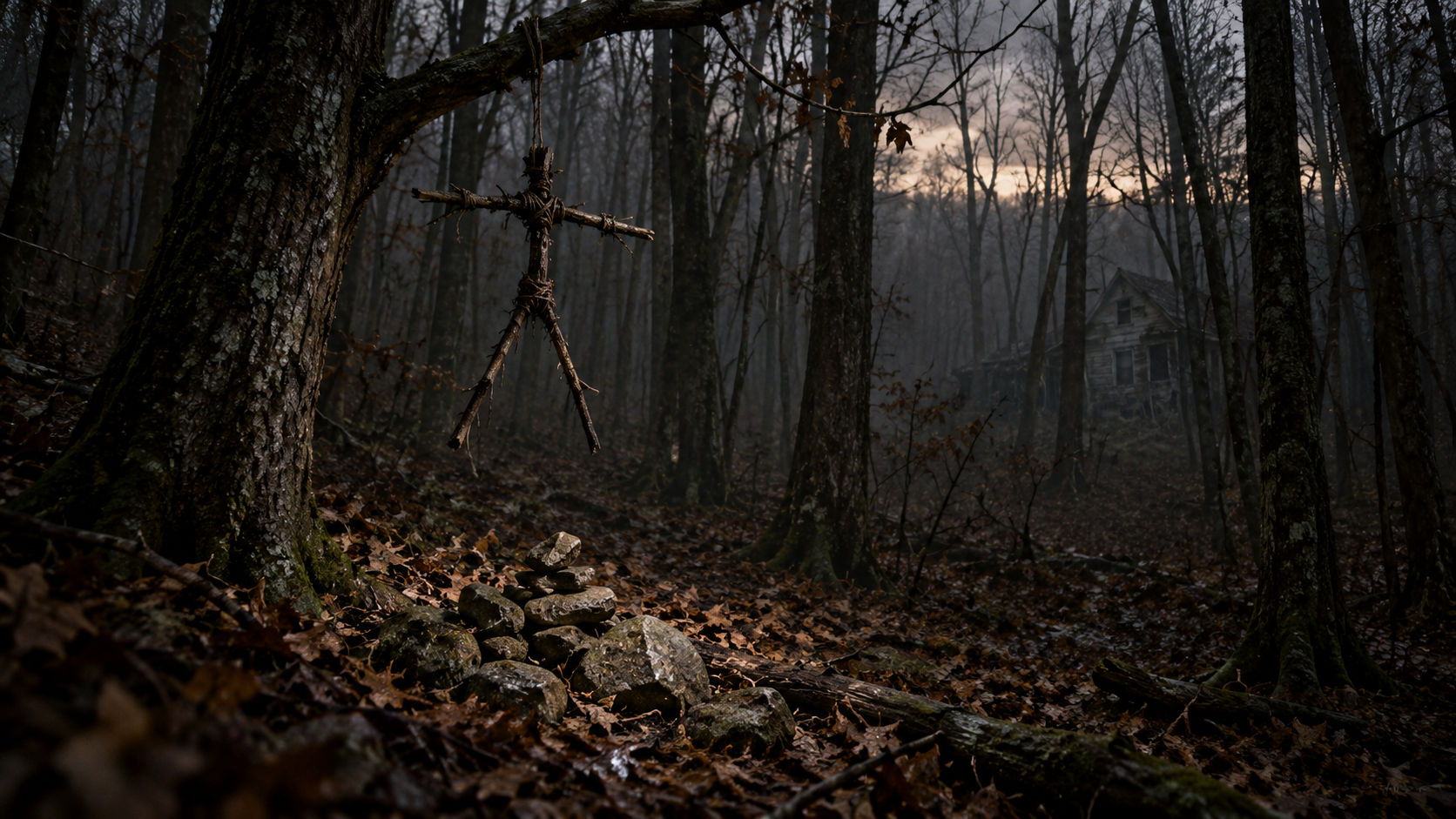
Ash Williams and his girlfriend Linda join friends Cheryl, Scott and Shelly for a break in a remote cabin in the woods. Almost immediately, the setting feels less like a retreat than a sealed container. In the cellar they find a strange book, a dagger and a tape recording belonging to the previous occupant, an archaeologist who has studied ancient rites tied to the book. Once the recording is played, the atmosphere shifts from unease to outright danger, and the woods around the cabin seem to turn hostile.
The film’s premise is straightforward, but it is cleverly escalated. Each possession hits a different member of the group, shrinking the circle of safety until the cabin becomes a battlefield. The horror here is not only that something evil has been released, but that the film uses the characters’ physical and emotional separations to keep increasing panic. The woods, the cellar, the cabin interior and even ordinary domestic objects become tools of assault. By the time the story reaches its final stretch, the film has become less about investigation than endurance.
Spoilers ahead: the following paragraphs discuss major plot developments.
As the possessions worsen, the film does not preserve the group’s bonds in any comforting way. Cheryl is attacked, transformed and increasingly monstrous; Linda is taken over and turned against Ash; Scott is injured and eventually becomes part of the film’s escalating chain of mutilation and return. Ash, who begins as one member of a social group, is forced into the role of sole survivor and reluctant fighter. The movie’s final movement is essentially a demolition of companionship, trust and bodily integrity. It matters because the film refuses to stop at one or two scares. It keeps stripping away stabilising relationships until the only remaining response is survival through violence.
The ending is abrupt and punishing. Ash, after surviving a sequence of increasingly impossible attacks, is left alone in the cabin with the force behind the whole nightmare still unresolved. That refusal to offer a neat escape is part of the film’s bite. It does not settle into triumph. It leaves the viewer with the sense that the evil has not been explained away, only temporarily held at bay. The final effect is bleak, but also fitting for a film that has spent its whole running time turning a weekend getaway into a nightmare with no clean exit.
What Gets Under Your Skin
The film’s atmosphere is one of its sharpest achievements. The setting is simple, but Raimi and his team make it feel diseased, exposed and increasingly claustrophobic. The woods are not just scenic isolation; they are a surrounding pressure. Once the house starts to feel contaminated, every room becomes suspect. That gives the film a nasty momentum, because the geography is easy to understand but hard to trust. You always know where the characters are, which makes it more unsettling when nowhere seems safe.
The storytelling is deliberately stripped down, but that simplicity is one of its strengths. This is not a film that depends on elaborate mythology or intricate explanation. Instead, it uses a bare-bones premise to build escalation through possession, bodily violation and panic. The escalation is also helped by the film’s willingness to let practical effects take centre stage. The demons are grotesque without being elegant, and that physical awkwardness suits the movie perfectly. It has the feel of something assembled by hand and pushed past the point where realism matters. That can make the film look rough, but it also gives the horror a handmade perversity that more polished films often lose.
The performances suit the material’s rawness. Bruce Campbell gives Ash a quality that is less polished heroism than sheer reactive survival, which is exactly what the film needs from him. Ellen Sandweiss, Theresa Tilly, Betsy Baker and Richard DeManincor all contribute to the sense that the characters are being broken down from within, rather than simply attacked from outside. The dialogue is not the main attraction, and the film is wise enough not to pretend otherwise. What carries it is the physical commitment of the cast, especially once possession and injury begin to dominate the action.
Visually, the film is famous for its inventive roughness. Raimi’s camera work is often kinetic, sometimes manic, and it helps the movie feel as if it is constantly lunging forward. That movement is not decoration. It gives the horror a shove, as though the film itself cannot remain still in the presence of what it has unleashed. The make-up, stop-motion touches and blood effects are central to the experience too, but they work because the film understands when to show and when to let a shot hang just long enough for the viewer to register the wrongness of what is happening.
Sound is another crucial part of the film’s impact. The tape recorder, the incantation and the various vocal effects all contribute to the feeling that speech itself has become contaminated. The film’s sound design does not merely accompany the visuals; it often seems to be another vector of possession. That is especially important in a story where reading, speaking and listening can all trigger disaster. The horror is not just in the cabin, or the woods, or the body. It is also in language being turned into a trap.
What the film does especially well is balance intensity with a darkly comic edge without collapsing into parody. The humour is not there to soften the violence so much as to make the violence stranger. That tonal instability is part of why the film still feels bracing. It is severe, ridiculous and ugly in quick succession, which keeps it from settling into a single familiar mode. Some viewers will find the rawness and extremity more compelling than graceful, but that roughness is integral to the film’s identity rather than a simple by-product of inexperience.
The Film’s Afterlife
The Evil Dead was not just a minor independent oddity that later picked up a fan base. It travelled into cult status through a contested path that included festival attention, critical advocacy and the later notoriety of Britain’s “video nasty” era. Its reputation was amplified by the way it sat between vulgarity and ingenuity: too extreme for some gatekeepers, too original to be dismissed by horror fans who recognised how much it was doing with almost nothing.
Its afterlife also includes the obvious franchise context. The film became the foundation for sequels and spin-offs that would push Ash Williams into very different tonal territory, but the original remains the franchise’s harshest and most unsettling entry. Just as importantly, it helped cement the cabin-in-the-woods template as a durable horror setting, while also showing how far practical effects and resourceful filmmaking could be stretched in independent genre cinema.
Horripilations Verdict
A ferocious, handmade possession horror that turns minimal means into maximum unease. Its roughness is part of the design, and its nastiness is matched by invention, making it a landmark debut rather than just a cult curiosity.
What works
- Inventive practical effects and camera movement
- Relentless escalation from simple premise
- Strong physical commitment from the cast
What holds it back
- The roughness can make the drama feel rudimentary at times
- Character depth is intentionally thin and may leave some viewers wanting more