Gas Station Eyes Don’t Blink
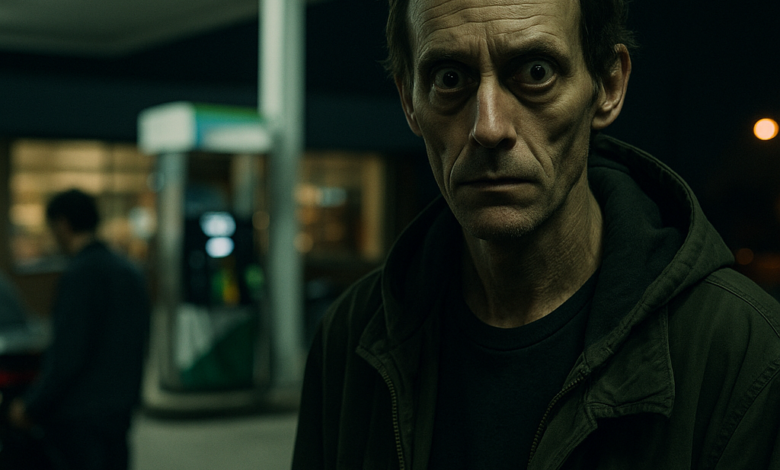
The station stood alone amidst a tangle of overgrown hedges and scattered brambles, its neon sign flickering like an uneasy heartbeat. Outside, a few battered cars waited in the small forecourt, rusted metal creaking against the wind. It wasn’t the sort of place where you’d expect to find both solace and dread, but that was the life of Samuel and his family in Hayworth, an underwhelming village barely touched by progress.
Samuel, a scrawny lad of fourteen, often found himself at the gas station during the summer holidays, entertaining the desperate notion that he could achieve independence. He aspired to earn pocket money for the latest gaming console, something that felt emblematic of growing up. But each afternoon spent there began with fatigue and ended with unease, as stories lingered in the air, tales shared among locals with unnerving precision.
“Gas station eyes don’t blink,” they whispered, their faces set in serious lines. The origin of the saying was murky, but the implication was clear: do not look too closely at the attendant who manned the station, for his unblinking gaze held something sinister.
Curiosity sparked like a bickering flame in Samuel’s mind. The staff was always the same—an elderly gentleman who bore the weight of decades in the folds of his weathered skin, his hands as rough as gravel. Sam had never engaged him in conversation beyond polite exchanges over petrol prices, but the other villagers claimed that the man’s eyes held the memories of a hundred lives long gone, each blink a world that flickered briefly before returning to darkness.
Driven by a cocktail of teenage bravado and incredulity, Samuel resolved to confront this fear head-on one evening, the dying light casting an eerie glow over the deserted forecourt. He brushed past the peeling door, an automatic jingle offering a facetious welcome. Inside, the mechanical hum of an old air conditioning unit mingled with the faint scent of petrol and something rancid.
“Evening,” Samuel greeted, crossing to the counter where the attendant stood, surrounded by shelves crammed with branded snacks and old magazines. The man lifted his gaze, and Samuel felt a prickle race down his spine. Those eyes—shiny, glassy—bore no signs of blinking.
“Good evening, lad,” he replied, his voice gravelly, like stones rolling down a hill. “What can I do for you?”
For a moment, Samuel faltered, unsure whether his levity was misplaced, but he was determined to test the legend. “What’s the deal with your eyes?” he pushed. “People say—”
The man leaned closer, his eyes unwavering, and Samuel stilled, feeling the air thicken around him. “A local tale to scare children,” he murmured, but there was a glint of something within the darkness. He straightened abruptly, returning to his former posture, leaving the words hanging.
Samuel felt a shiver of unease flutter in his chest, an instinctive recognition that perhaps some legends grow from a small truth. He cleared his throat, “I dare you to look away,” he laughed, the sound thin and desperate, and immediately regretted his bravado.
“I’ve seen things your lot couldn’t imagine,” the attendant muttered, his eyes locked onto Samuel’s, as if trying to unravel him from the inside. “Curiosity can be a dangerous companion.”
Samuel swallowed hard, the laughter caught in his throat like a fish in a net. He turned to leave, retreating into the dim evening. As he stepped outside, a low rumble echoed in the distance, the sky momentarily cloaked in clouds.
The next morning, Samuel learned of Jason Hawkins, a lad from his school who vanished without a trace. Everyone had been talking about it, and the weight of fear settled heavily in the village. Around the lunch tables, gas station eyes were discussed, bleary faces conveying that the legendary figure somehow bled into reality.
“Stay away from the gas station,” one of his friends warned. “They say people who linger too long start forgetting who they are.”
This only furthered Samuel’s desire to dig deeper. He had to know if there was a connection. A day later, armed with a camera on his phone—his way of documenting whatever secrets lay within the greasy walls of the station—he willed himself to return.
In the flicker of the fluorescent lights inside, he found the attendant behind the counter, unblinking as ever. This time, Samuel trained the camera on him, deciding that evidence was his trump card. “I’m going to show everyone,” he said boldly.
But the man’s expression twisted into something that made Samuel’s blood freeze. “You should watch where you point that,” he said slowly, each syllable dragged out like molasses. Samuel’s bravado faltered as the attendant reached under the counter.
“I have something to show you.” Balancing fear and intrigue, Samuel stepped closer, his curiosity bubbling to the surface like an unwelcome tide. The man revealed a small, tarnished mirror, the kind you might find in an attic; its surface was marred but undeniably significant.
“Look into it,” the attendant instructed, his voice a coaxing lure. Samuel stepped forward, and as he peered into its depths, he saw flickering images of people, faces intertwined—hollow visages caught in moments of panic, pain, and betrayal.
“Get away from there!” he shouted, stumbling back, but the attendant was no longer the old man he remembered. Instead, his vacant expression hinted at something monstrous lurking beneath the surface, as if the reflection were feeding on Samuel’s very essence, pulling him into its tragic throng.
Suddenly, the power flickered, plunging them into shadows, but Samuel’s heart pounded as he realised—he had lost track of the present. He couldn’t remember how long he had been gone or what he had done after entering. The attendant’s laugh echoed disturbingly in the obscurity, only amplifying his fears.
Without sparing a second thought, Samuel fled into the night, adrenaline driving him as he rounded the corner. As he reached the familiar timber of the footbridge, a cold whisper threaded through his thoughts, urging him to leave the past behind. But beneath that instinct lay a new knowledge, a growing void that gnawed away at his sense of self.
Days turned into weeks. With each passing moment, fears of the gas station lingered—his friends began to change, adopting tense, guarded expressions when the conversation turned their way. Then came Thursday, an unremarkable day deep within an unremarkable week, when he arrived at school to find dull whispers permeating the hallways.
Jason’s disappearance was not an isolated incident. Lurking within those gas station stories had been dormant threads, vibrant lives snatched away, woven into the tale of a hungry legend. Every boy who had dared approach the station somehow became lost, their identities siphoned through the unblinking eyes of the man behind the counter.
Samuel lingered longer than intended that evening, and while his parents searched in panic, he sat at the bus stop, waiting to return home. A shiver ran through him as the attendant’s gravelly voice echoed at the back of his mind, mingling with Jason’s face in the mirror—the very embodiment of a warning.
No one would believe him. Although he had turned away, flickers of that void crept into his dreams, stealing pieces of his past until no joyous moment remained untouched. Each blink of his eyes grew heavier, tainted by images he couldn’t comprehend.
The gas station legend would continue its sinister evolution, each new victim adding threads to the web of the foreboding tale. And as Samuel wandered down the road, trying above all to resist the pull of his own curiosity, he couldn’t shake the creeping sensation that as long as the old man wielded that tarnished mirror, stories of gas station eyes would continue to seduce the unwary.