
Blood Ties of the Accursed
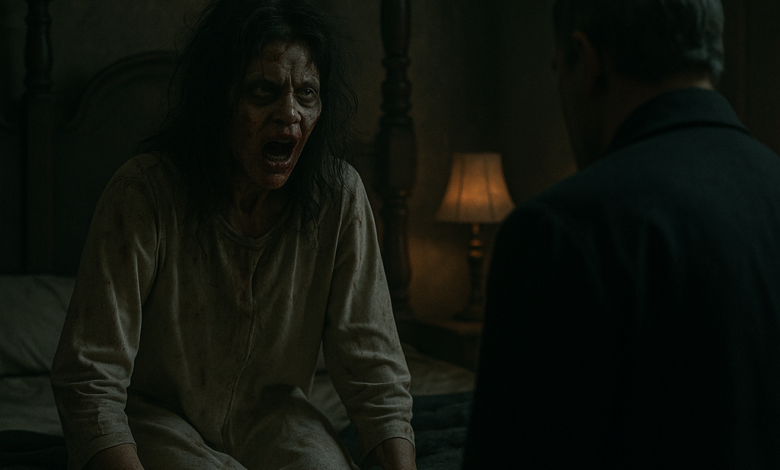
The sharp clang of the bell echoed across the old barn, muffled by the blankets dangling from the rafters. Inside was a jumble of half-completed crafts, faded childhood drawings pinned to the walls and an old rocking horse in the corner, long since abandoned. This was Jamie’s refuge, a place where she could escape into the world of memories instead of facing the grim reality that had descended on her family.
After the loss of her father, the air in the farmhouse was thick with grief, but it was Helen—her once-strong mother—who had changed the most. Since the funeral, Helen had become a wraith, moving through the house like a spectre of her former self. Jamie had tried to communicate with her, but every conversation felt like an exercise in futility. One moment, Helen would weep uncontrollably, and the next, she would glower, muttering incoherently about betrayal and secrets.
It began, for Jamie, with an innocuous hesitation. One evening, while she was drawing in the barn, she noticed a peculiar change in the way her mother spoke to her. When Helen entered, her tone dripped with disdain, her words wrapped in layers of sarcasm. The most unsettling part was the way Helen’s eyes—once full of warmth—had transformed into icy windows, reflecting something dark and incomprehensible. Jamie shook it off at first, blaming her own heightened sensitivity as she grappling with grief.
On a particularly tense evening, while they ate a silent dinner under the pallor of the flickering kitchen light, Jamie lost her patience. The silence suffocated her. “Mum, can we talk about Dad?” she said, her voice barely above a whisper.
Helen’s fork clattered against her plate, and her head snapped up, revealing a scornful grin that made Jamie’s stomach churn. “Why, Jamie? To wallow in his shame? The man was pathetic.”
Jamie stared, reeling. “You can’t mean that.”
“I think I’ve lived my life long enough to know the truth.” Helen’s laughter rang hollow, as if the words themselves had been torn from somewhere deeper—something more sinister—inside her.
Fear prickled at Jamie’s skin. This wasn’t the mother who had rocked her to sleep with lullabies or held her hand when monsters lurked underneath the bed. No, this was something else entirely, something that had taken residence within her mother’s frame, puppeteering her every move.
As the days dragged on, tangled in anguish and isolation, Jamie grew more desperate. She sought companionship from the village, but whispers about her mother tainted every interaction. Then there was the incident in the church—an excursion that seemed to doom them further. When Helen had screamed out loud during one of the services, her voice contorting into a terrifying echo that twisted the congregation in fear, Jamie felt the eyes of the townspeople boring into her. It was at that moment Jamie began to understand: Helen was not merely grieving; something had claimed her mother whole, stripping away every shred of humanity.
As Jamie slipped into this new understanding, she unearthed a box laden with dusty manuscripts in the corner of the barn. One tome caught her eye, thick with leather and bound with rusted chains. It spoke of possession, of familial bloodlines tainted by ancient pacts, dark choices leading to irreversible consequences. Panic consumed Jamie; what she found demanded action.
Heart racing, she confronted her mother that night. Helen paced the living room as thunder rumbled outside, her silhouette carved sharply against the window. Jamie felt her resolve weaken. “Mum? I know something’s wrong. You’re not yourself.”
“Ah, but I am, Jamie. I am finally myself,” Helen replied, her voice slipping into a low growl. “Now I can be free of his shame, especially from the likes of you.”
Jamie’s blood ran cold. Feeling trapped, she took a deep breath and bolted for the barn. She had read about rituals to expel demons, desperate to save the woman who had once laughed with her by the fireplace. The storm outside intensified as she gathered candles and herbs, the weight of her impending failure heavy in her breast.
When she returned to the house, breath fogging in the brisk air, she found her mother seated at the small, rickety dining table, eyes burning with an unnatural intensity. “You really think you can fight me?” Helen’s mouth distorted into a grin that sent chills cascading down Jamie’s spine.
Ignoring the dread pooling in her gut, Jamie lit the candles, their flickering lights casting elongated shadows on the walls. “You’re not our mother! Whatever you are, leave her!” She spoke the words of the incantation, discovering, to her horror, the voice that escaped her lips was not her own. It felt like a chasm yawning wide beneath her, threatening to swallow her whole.
For a moment, a look of bewilderment swept across Helen’s face—an inkling of recognition. But it vanished, replaced by a savagery that twisted her features grotesquely. “You think she’s worth saving? She was so alone. So weak.”
The air grew thick, heavy with the weight of this battle, and suddenly, the candles extinguished. Darkness enveloped Jamie. She groped in the shadows—clutches of despair wrapping around her throat.
Then it struck—pain like a thousand splinters lodging themselves beneath her skin as cold fingers gripped her heart. “Let her go!” she cried, the words shattering the silence, a plea mingled with panic. “You want me? Take me!”
From the depths of the murkiness, she felt the force constricting her loosen ever so slightly as her mother recoiled. In that instant, Jamie pushed forward, seizing an ancient dagger—the last trick she had read about. But when she raised it, her mother lunged, a primal scream ripping from her throat.
Jamie hesitated, fear locking her muscles. The chance to vanquish this thing that had claimed her mother turned in lethal rhythm with the pull of maternal love. And in that split-second, she faltered.
One movement sealed her fate. The blade grazed her wrist, dropping from her fingers, and all warmth fled from her being. Helen, back in the grip of that foul entity, bore down like a ravening wolf. With a primal howl, she lunged, and Jamie found herself flung against the wall.
Only horror awaited her. Desperation engulfed her as she looked into the darkness behind her mother’s eyes. The fear was palpable—electric, life-draining. She chose to flee, knowing she might never look back.
When the villagers found Helen the next morning, she was lifeless, her body twisted in a grotesque parody of sleep. Jamie was nowhere to be found. They would whisper of the tragedy, of the girl who had lived with her mother’s demons only to be consumed by them. And though Helen lay cold and dark, at that moment Jamie had become nothing more than a blood tie of the accursed.


