Vampires are among the most enduring creatures of horror because they sit at the point where folklore, disease, religion and desire meet. In their oldest forms they were not aristocratic seducers in capes, but feared revenants, the dead thought to rise from the grave and drain the life from the living. Over time, the vampire moved from village terror to literary monster, then to one of the most recognisable figures in modern popular culture. What makes the vampire so potent is not just the blood-drinking, but the disturbing idea that death may not end anything cleanly. The body returns, the appetite remains, and the boundary between the living and the dead fails.
Origins in Folklore
The vampire as a folkloric being is generally traced to the Balkans and Slavic-speaking regions of eastern Europe, where the word itself and many of the best-known beliefs were recorded in early modern accounts. The precise history is complicated, because these traditions were not invented at one moment and then spread intact. They formed through local custom, religious belief, burial practice and fear of the restless dead. By the early eighteenth century, reports of vampire cases from places such as Serbia and Hungary were circulating widely in Europe, helping turn a regional fear into an international sensation.
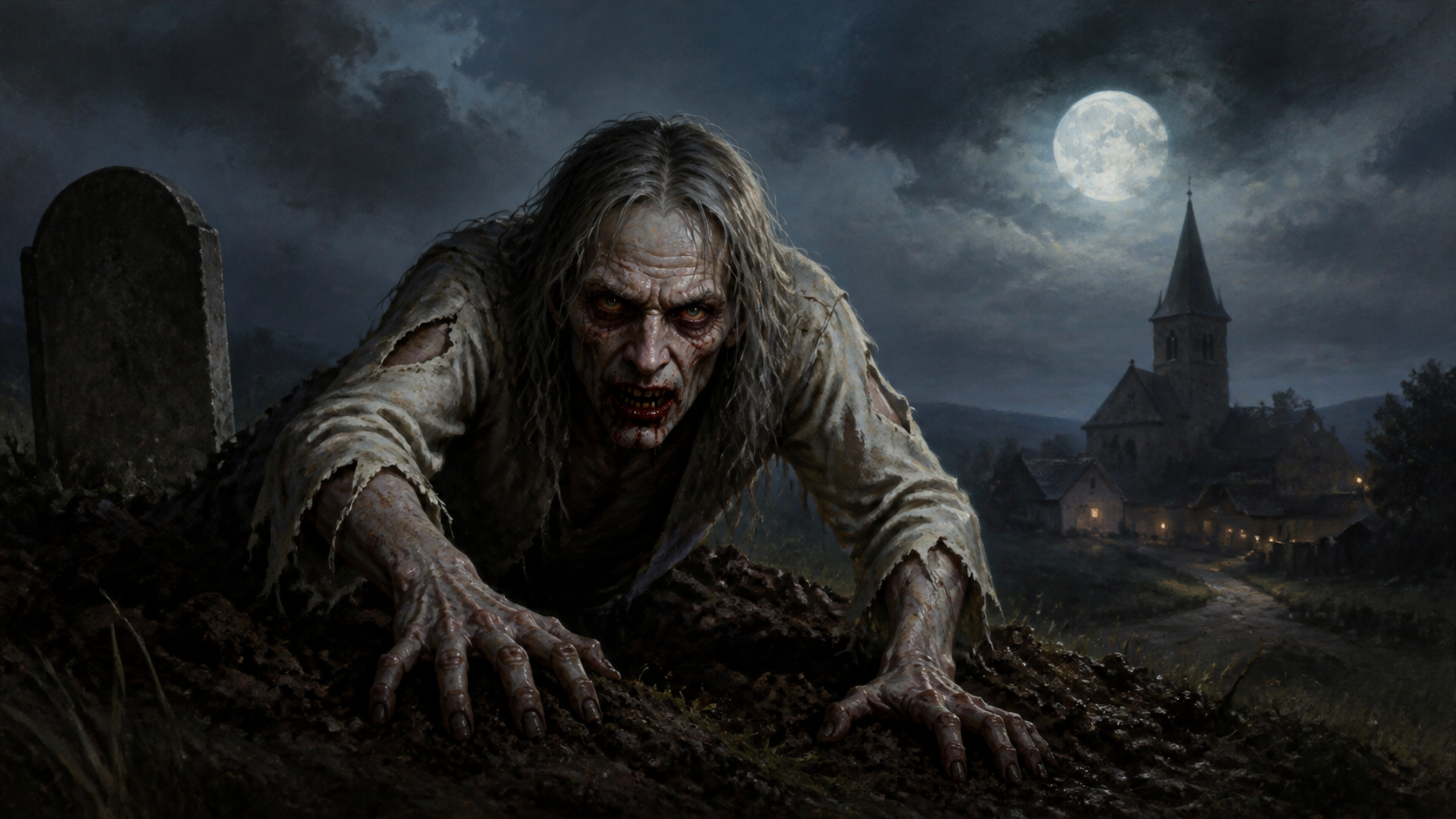
In traditional belief, a vampire was often a corpse that had somehow failed to remain properly dead. It might return to attack family members, neighbours or livestock, bringing wasting illness, death or bad luck. In some stories the vampire was a sinner, a witch, a suicide, an excommunicate or someone whose burial had been disturbed or improperly performed. Other traditions made the transformation dependent on omens at death or after burial, such as animals crossing the corpse or certain objects being omitted from the funeral rites. There was never one universal vampire. The figure changed from one language, region and religious setting to another.
These beliefs reflect a world in which death was highly visible and decomposing bodies were poorly understood. When a grave was opened and the corpse seemed oddly preserved, bloated, bloodied or newly active in appearance, that could be taken as evidence that the dead had been feeding. Such interpretations were reinforced by the spread of illness through households and communities. If several people died in succession, the dead person blamed for the deaths was sometimes thought to be the vampire at work. The creature therefore belonged to both folklore and crisis management, explaining disaster by giving it a face.
Appearance and Behaviour
The early vampire was usually not handsome, elegant or glamorous. Folkloric descriptions often present a swollen, ruddy or oddly fresh corpse, sometimes with blood at the mouth, sometimes red from internal decay rather than supernatural vitality. It was a revenant, not a romantic predator. In many traditions it emerged at night, returned to its former home, pressed on sleeping victims or attacked them in bed, and was especially associated with relatives and those close to the grave site. The vampire could also torment the household through misfortune and illness rather than dramatic feeding scenes.
Traditional methods of identifying a vampire varied, but many involved examining the corpse after burial. If a body was found to have grown more supple, red or well-fed in death, that could confirm suspicion. Communities responded with protective measures and violent remedies. These included staking the body, decapitation, burning, dismemberment and placing objects in the coffin or at the grave to prevent escape. Garlic, iron, prayer and other apotropaic practices also appeared in different regions. The point was not simply to kill the monster, but to secure the dead and protect the living from further contamination.
These practices are important because they show that the vampire was never just a story. It was embedded in burial customs, fears about death, and anxieties about proper communal order. The vampire threatened families, but it also threatened the integrity of the cemetery and the authority of ritual. A dead person who would not stay buried was a social and spiritual problem as much as a supernatural one.
From Village Horror to European Curiosity
The vampire entered wider European consciousness in the early eighteenth century, when reports from the Habsburg and Ottoman borderlands were translated and discussed across the continent. These accounts often mixed official investigation, local testimony and speculation. They described exhumations, wounds in the corpse, and ritual responses carried out by villagers or military authorities. Enlightenment writers took notice because the vampire seemed to expose the distance between rational explanations and popular belief. Clergy, doctors and administrators debated whether the phenomenon was superstition, fraud, disease or something truly uncanny.
This period mattered because it fixed several features that later writers would inherit. The vampire became linked to blood-drinking, death, contagion and exhumation. It was also increasingly treated as an object of curiosity rather than only a local fear. Once the creature entered print culture, it could be reimagined, standardised and reused. That process began well before the familiar literary vampire of the nineteenth century.
The Literary Vampire Before Dracula
The vampire in English literature emerged before Dracula, and this earlier stage is important. John Polidori’s The Vampyre, published in 1819, helped establish the vampire as a figure of aristocratic menace, charm and seduction. Polidori’s creation, Lord Ruthven, bears little resemblance to the peasant corpse of folklore. He is urbane, socially mobile and deadly in polite society. That shift transformed the vampire into a creature fit for Gothic fiction, where corruption could move through drawing rooms as easily as graveyards.
From there, the vampire acquired a new symbolic range. It could represent predatory sexuality, foreign threat, aristocratic decadence or moral contamination. Yet these meanings remained layered over the older folkloric foundation. The literary vampire still belonged to the dead, but now it could also belong to modern society, moving through salons, castles and cities rather than only churchyards and villages.
Dracula and the Making of the Modern Vampire
Spoiler notice: this section mentions major developments in Bram Stoker’s novel Dracula.
Published in 1897, Bram Stoker’s Dracula did not invent the vampire, but it defined the modern image of the creature more powerfully than anything before it. Stoker drew on older folklore, earlier vampire fiction, travel writing and historical material about eastern Europe. His Count Dracula is at once an undead predator, a foreign aristocrat and an invasive force that crosses borders into Victorian England. The novel gave the vampire a powerful narrative structure: the threatened household, the investigation, the gradual recognition of the monster’s nature, and the final pursuit and destruction.
Stoker’s vampire has a number of now-familiar traits, though not all later adaptations kept them in the same form. Dracula can transform into a bat, a wolf, mist or a small creature, and he must rest in earth from his homeland. He is vulnerable to certain sanctified protections, and he can be resisted through religious and practical means. The novel also gives the vampire a sharper erotic and psychological charge than many earlier folk versions. Dracula is frightening because he preys on the body, but also because he invades the self, blurring seduction and violation, appetite and domination.
Just as important is the way Dracula fixed the vampire in the public imagination as a creature of style. Later visual culture would add the formal evening wear, the cape, the Transylvanian castle and the insinuating manner. Some of these details were implied by Stoker, others came from the stage and screen. Together they created a more recognisable but less purely folkloric monster than the one found in village traditions. The modern vampire became elegant, eloquent and deeply theatrical.
Abilities, Weaknesses and Rules
The vampire’s powers and weaknesses vary depending on the tradition or fictional version. In folklore, the essential power is persistence after death, often with the ability to afflict the living through blood loss, sickness or nocturnal visitation. In many later literary and cinematic versions, the vampire gains heightened strength, speed, hypnotic influence, and shapeshifting abilities. These powers are not universal across all traditions, but they have become standard in much popular vampire fiction.
Likewise, the weaknesses associated with vampires are not fixed. Some versions are harmed by sunlight, though this is not a universal folkloric rule and becomes especially prominent in later literature and film. Religious symbols, especially the cross, prayer and holy objects, are common in Christian-inflected vampire fiction, though their effectiveness depends on the specific work and cultural setting. Staking, beheading and burning recur across tradition and adaptation, often because they reflect older burial rites and the desire to ensure that the body cannot rise again. Garlic, mirrors and invited thresholds are later accretions or genre conventions rather than core features of every vampire story.
One of the vampire’s great strengths as a monster is precisely this flexibility. It can be made monstrous in one story and tragic in another, ancient in one context and sophisticated in another. It adapts to the anxieties of each age without losing its basic charge: a dead thing that refuses to stay put.
Why the Vampire Endures
The vampire remains memorable because it is both ancient and adaptable. As a folkloric revenant, it crystallised fears about burial, disease and the unrest of the dead. As a literary creation, it became a vehicle for anxieties about sexuality, power, class and invasion. In film and television, it has been reworked into villain, romantic lead, antihero and immortal outsider, often in forms far removed from its grim peasant origins. Yet all of these versions retain some trace of the central nightmare: life consumed by death, and death made disturbingly intimate.
That is why vampires continue to be effective. They are not just monsters with fangs. They are a way of imagining the dead as still hungry, the body as vulnerable, and the border between life and death as fragile enough to fail. Few horror figures are as versatile, and few are as enduringly unsettling.