By the time the sea came for our street, most of us had stopped calling it flooding and started calling it a nuisance, which is what people do when they have to keep living beside a thing that frightens them.
Our house in Brier Bay sat two roads back from the harbour wall, high enough that the kitchen floor only took water in the worst storms. My mother said we were lucky. My father had once said the harbour was “good enough for boats and bad enough for everything else”, and then he died before I could ask what he meant. After that, it was just me and Mum and the smell of wet rope that always seemed to drift in from the docks when the weather turned.
I worked mornings at the fish-processing yard by the slipway, trimming fillets and packing them in iced boxes for the wholesalers upstate. It was not glorious work, but it was honest enough and paid the mortgage when the mortgage was not trying to eat us alive. The yard belonged to the Pritchards, who owned half the street and most of the opinion in town. Their youngest, Jory, was my age and had the unfortunate habit of talking to me as if we were in the middle of a long-standing argument, even when we were not.
On the evening this began, I was putting the bins out behind the yard when Jory came running from the quay with his cap in his hand and a face gone pale as bleach.
“Beth,” he said, and then had to stop because he was breathing too hard. “You need to come down. Now.”
“What for?”
He looked over his shoulder at the dark water. “Something’s in the boat basin.”
If it had been anyone else, I might have laughed. Brier Bay was full of rumours, and every winter some drunk swore he’d seen a fin in the tide or a shape in the mists. But Jory was not a boy given to nonsense. He was the sort who worried over broken seals on crates and the correct stacking of haddock boxes. So I wiped my hands on my trousers and followed him along the quay.
The basin was tucked behind the net sheds, where the water was black and still except where the incoming tide brushed at pilings. A work light buzzed over the slipway. Tom Pritchard, Jory’s older brother, stood at the edge with two harbour men and a flashlight. I heard a low, wet dragging sound before I saw anything.
In the water near the basin wall, something pale rose and settled again, as if the tide had found a thought it could not quite finish.
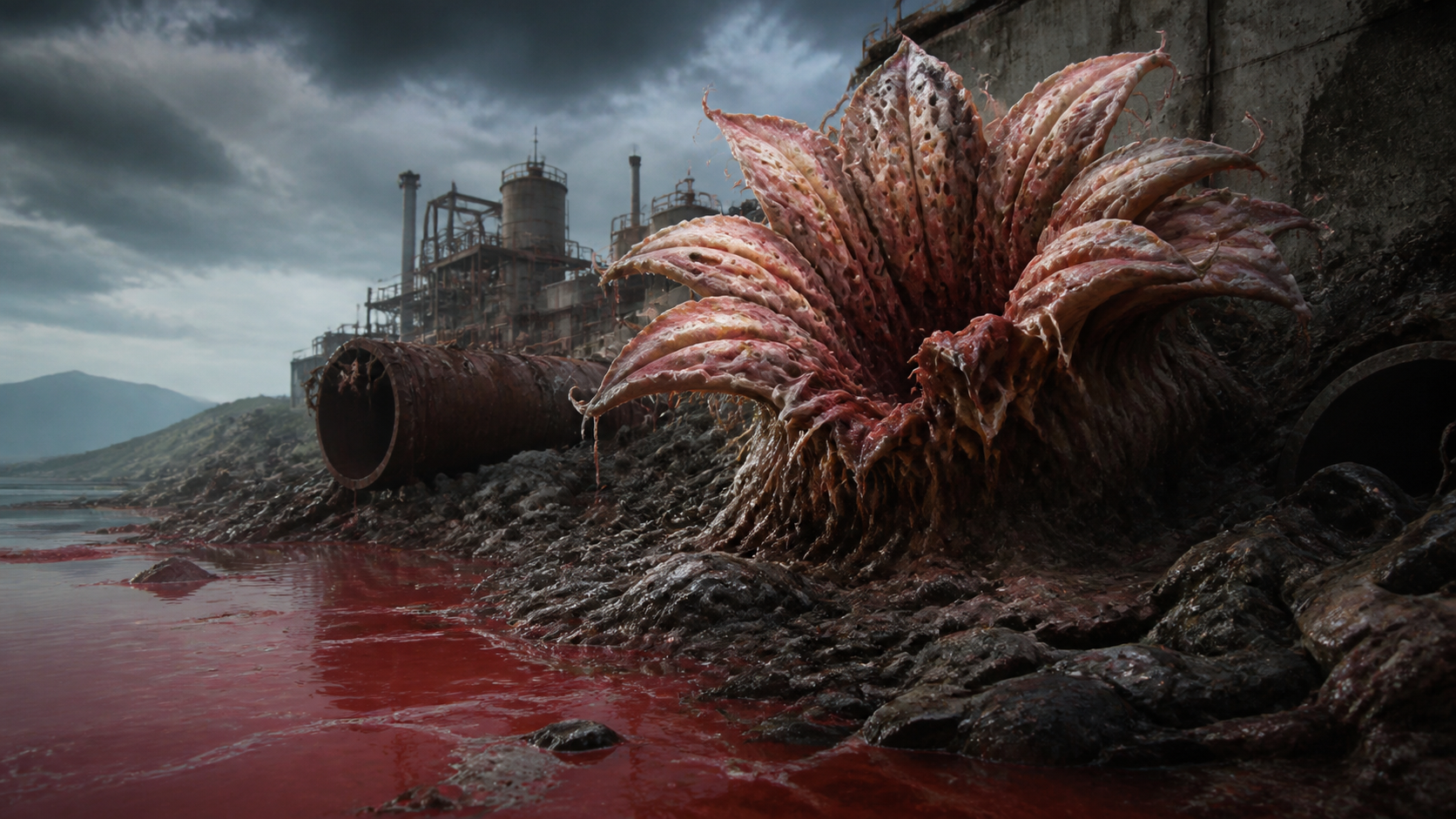
Tom lifted the torch. The beam caught a flank the colour of boiled shell, ridged with plates like overlapping fingernails. It was not a seal. It was not a fish. The thing moved with a slow, deliberate strength, pressing its long body against the basin wall, and when it turned I saw a head like a flattened wedge, with no eyes I could make out, only a seam of darker flesh set high on the skull and two pale, frilled openings where a mouth might have been.
One of the harbour men swore and stumbled back. The creature struck the wall once with a heavy suck of its underside, and a sheet of water climbed the concrete, leaving behind a line of silver slime. Then it was gone, slipping down into the harbour with a sound like a sack dragged across wet stone.
No one spoke for a moment.
“Did you see the size of it?” Jory whispered.
Tom gave him a look that shut him up. “Probably a basking shark got caught up under the wall.”
“Sharks don’t do that.”
“Neither do tide-scoopers.” Tom said the last with forced confidence, but I heard the strain in his voice.
That was the first time I had ever heard the old dockside name. Tide-scooper. People used to say it about any strange thing in the harbour, then laugh it away. My grandmother had once said, when I was little and running wild near the shore, that some things learned the shape of a place and never left it. She had a way of saying mad things as if she were reading them from a ledger.
“Did it come out of the sewer line?” I asked.
Tom rubbed his face. “Could’ve come in on the tide.”
“It was feeding off the mussel traps this afternoon,” one of the harbour men muttered. “I saw the lines jerking.”
Tom rounded on him. “Then why didn’t you say anything?”
“Because I thought it was the chain.”
I looked into the basin again, but the water had resumed its harmless blackness. There was no rippling, no sign of what had passed. Still, the slime clung to the wall in streaks, and the smell that rose from it was not the usual harbour stink of fish and diesel. It was salt and rot and something mineral beneath, like wet pennies.
Mum was waiting when I got home, though I had not told her I was late. She sat at the kitchen table with the bills spread out, her hair tied back and a pencil tucked behind one ear.
“You’ve been out by the basin,” she said as soon as I came in.
I took my coat off too slowly. “How do you know that?”
“Because you smell like the harbour, and because Jory’s mother rang. She says they’ve got something snagged in the nets and Tom’s gone to call the council man.”
“Did she say what it was?”
Mum frowned at the bills, though I knew she was not looking at them. “She said it had teeth where no teeth ought to be. Eat your tea.”
She said this last in that tone which meant she had no intention of talking until I obeyed. So I ate my tea, but I kept thinking about the creature’s sides, those layered plates flexing as it moved, and the way it had ignored the fish baskets hanging near the wall. Something had interested it enough to come close. Something in the basin.
At half past nine, just as the rain began, Jory knocked on our back door.
He was soaked through and carrying a crate so large he could barely manage the handle. Inside it, wrapped in tarpaulin, was a section of the trap net from the harbour. It was slick with slime and peppered with holes as neat as if cut with shears.
“Tom wants you to look at this,” he said to me. “You worked the line at Halsey’s docks last winter, didn’t you? You know what holes look like when they’re made by hooks.”
I did. We both knew I did.
Mum folded her arms. “If this thing is dangerous, why bring it here?”
“Because Tom says if word gets out, the wholesalers will pull out for the season.” Jory looked at the floor. “And because he thinks it may have been living under the old culvert since the storm in March. The council’s been talking about widening the quay. If they pump that section dry first, it’ll be cornered.”
I stared at him. “You’re telling me this now?”
“I’m telling you because Tom thinks it’s already in the fish rooms.”
That made the kitchen seem smaller. Mum said, “What do you mean, in the fish rooms?”
Jory swallowed. “There’s water on the lower floor. Fresh water, not tide water. And one of the crates was moved.”
My first thought was that some thief had gotten in. Then I remembered the thing in the basin and felt the house itself going strange around me, as if all the pipes and drains had begun listening.
We went with him.
The processing yard crouched at the harbour end like a row of sheds with too much concrete under them. The fish rooms were on the lower floor, where ice was stored and the draining gutters ran to the back of the building. Tom met us by the hatch. He had a baseball bat in one hand and a large wrench in the other, which struck me as less brave than desperate.
“You shouldn’t be here,” he said to me, though he let us in.
“What was moved?” I asked.
He led us to the cold room. A crate of pollock stood open at one end, its lid split and the seal torn clean through. The floor around it was wet. Not splashed. Wet in a line, as though something had been laid down and drawn away, leaving a trail that glistened beneath the strip lights.
“That came through the drain,” Tom said. “Or out of it.”
Jory stared at the steel grille in the corner. “You can’t be serious.”
A bang echoed from somewhere below us. Then another, slow and heavy, not like the cracking of a pipe but a body shouldering a barrier.
Mum, who had insisted on coming with us because she trusted no one to tell the truth in a crisis, gripped my arm. “Bethany,” she said very quietly, “do not go down there.”
Tom heard it too. He lifted the bat. “Stay behind me.”
We moved into the service corridor that ran past the freezers and down to the maintenance hatch. The building breathed around us. I could hear water moving inside the walls, a rattle in the pipes, and beneath that the muffled scrape of something dragging its underside over concrete. Jory kept glancing at the exits as if he meant to remember where safety had been, but safety had already gone elsewhere.
At the hatch, the lock hung open. Tom swore. He pulled it back and shone his light into the maintenance pit beneath the floorboards. There was a shallow channel for runoff there, clogged with scales, mud, and fish skin. In the middle of it lay a live herring, its sides shuddering.
The creature was under the grating.
I saw the pale plates first, pressed against the underside of the metal. Then the head came into view, craned up from the darkness below. It was broader than I had realised at the basin, perhaps as long as a man is tall from nose to feet, though its body bent with eel-like grace. The frilled openings by its mouth fluttered once and drew in air and damp. Its skin was not smooth but scaled in hard, salt-white tessellations. Along its spine ran a ridge of dull spines like broken shards of crockery.
It had no proper eyes that I could see, but the seams at the sides of its skull opened and closed as if feeling the room with the pressure of sound. It turned towards the herring, and the fish was sucked under in a single twitch, not bitten but engulfed with a wet, efficient motion that made Tom step back so quickly he hit the wall.
Then the thing struck upward.
The grating bowed beneath the force. Jory yelped and stumbled, and the creature’s front half pushed through the opening just enough for us to see the underside of its jaw, pale and lined with small hooked teeth that folded inward. It grabbed at the edge of the hatch with what seemed to be a pair of thick, boneless fins adapted for gripping, and hauled itself partway into the corridor before the metal frame caught on the ridged plates along its sides.
Tom did the only sensible thing he had left and brought the wrench down on the exposed flank. There was a crack like splitting stone. The creature jerked back with a sound that might have been pain or might simply have been the water sucked through its throat. The grating snapped shut under its weight and the thing vanished down into the pit, battering the underside hard enough to shake dust from the pipes.
“Get the doors,” Mum said.
We slammed the cold-room door and bolted the service one behind us. For a moment there was only the tremor of impacts below, then a scraping retreat. The creature was moving away, following the waterline, not trapped but redirected.
“Do not say this is a rat,” Mum told Tom, because her temper had finally outrun her fear. “Do not stand there and tell me some giant harbour rat is after your fish.”
Tom stared at the floor. “I wasn’t going to.”
Jory was breathing in quick, thin pulls. “It came in through the drain. It can fit through things smaller than that hatch.”
“Then where’s it going?” I asked.
Tom looked at me and, for the first time that night, seemed properly afraid. “Your street,” he said. “The storm drains run from here under the old seawall.”
Mum took one sharp breath. “No.”
But we knew it was true. The pipes under Brier Bay were old, patched, and half mapped by guesswork. If the thing could move through runoff and shallow channels, the storm drains would carry it like a road.
We ran.
By the time we got to our street, the rain had thickened into a hard, slanting sheet. Water was already running in the gutters, brown with grit. Several of the neighbours had come out in coats and boots, drawn by the storm and by the noise from the harbour. At the end of the road, where the drain opened beside the seawall, the cover lay twisted aside.
There was a smell rising from the outlet, stronger than before. Mum clutched the porch post and whispered, “My God.”
The creature slid into view from the drain in a surge of dark water and pale plates. It had learned the path of the pipes and used them well. Its body was flecked with grit and shreds of weed, and one side showed the mark of Tom’s wrench, a hairline split in the overlapping armour. It moved low, dragging and pushing itself with surprising speed, its frilled mouth opening and closing as it tasted the wet air. The stormwater had swollen into a shallow stream along the kerb, and it followed that line with terrible certainty.
But it did not come for the nearest person.
It came for the rain barrel beside Mrs Dale’s fence, where she had been collecting water all summer and, tucked under its lid, kept a bucket of pilchard heads for her cats. The barrel was half full. The creature found it at once, nosing the rim, and then the whole front of its head folded over the opening with a sucking movement that made the plastic sides bow.
It wanted salt.
Not fish alone. Saltwater.
That was what I understood then, with a clarity that made my stomach turn. It was not wandering. It was following the tide the way a hound follows a scent. The harbour had drawn it in, and the storm drains had carried that tide inland, but it needed the brine. Fresh water made it restless, slower, and perhaps vulnerable. Salt steadied it.
Jory saw it too. “The sea’s in it,” he said, and his voice broke on the words.
Tom, soaked and wild-eyed, was already dragging a sack of road salt from his truck. “Beth, help me!”
There were bags in every porch on our road that winter for the icy steps, and I knew where Mum kept hers. I ran for it while Tom and Jory tried to pull the barrel away from the creature. It struck with its head and shoulders, hard enough to split the plastic. A gush of brackish water poured over the path. Mrs Dale screamed and backed into her gate, and one of the lads from two doors down swung a garden rake at the creature, hitting the ridge of plates with no visible effect except a spray of slime.
By the time I got back with the salt, Tom was shouting for everyone to throw anything briny, anything sharp, anything that might keep it off the street. Mum had taken a kitchen knife and was slicing open a pack of cured anchovies from her freezer, flinging the pieces in handfuls with an expression I had never seen on her face before, which was pure, practical fury.
The creature recoiled from the first scatter of salt. Not dramatically. It did not burst into flames or vanish. It simply jerked as the crystals struck its frilled mouth and the wet plates along its side, then pulled back from the barrel and began to writhe over the pavement, seeking a wet line away from the burning grit. Its skin tightened where the salt touched it. The frills clamped flat. It was clearly in distress, but not disorganised. Its movement turned from feeding to escape, and that was when it became most dangerous.
It lunged for the open rainwater drain at the kerb. I got there first by accident more than design, dragging the sack of salt to block the outlet. The thing struck the bag and the heavy cloth split, spilling a white rush over its head and shoulders. It thrashed, and one of its side fins hooked my ankle. I went down hard, palms skidding on wet concrete. Its mouth opened over me, and for one suspended second I saw the interior: not a jaw like a fish’s, but a muscular, ringed throat lined with countless small inward teeth, made for gripping something alive and dragging it where it wanted.
Then Tom hit it with the road sign he had ripped out of the verge.
The signpost crashed across the ridge plates near its head. The creature convulsed and turned, and Jory, who had been shaking too hard to be useful until that instant, seized the end of the fallen post and levered it hard into the drain opening. Mum threw the rest of the anchovies. Mrs Dale, from somewhere behind me, hurled a bucket of salted water meant for her doorstep. The street became a clatter of improvised violence and panic, but it was working. The creature could not hold the dry ground. Salt seared its skin. It lost purchase, dragging itself in abrupt, ugly spasms towards the open sea.
I got my feet under me, grabbed the edge of the sack, and tipped the last of the salt directly into the cut in its flank where Tom had struck earlier. It made a low sound then, not a roar, but a wet, guttural expulsion from deep inside. It twisted so violently that the ridge of plates along its back scraped sparks from the road sign, and then it slipped free of us, pouring into the drain water with a final heave that sent a wave over our shoes.
A few seconds later, there was only rain and the hiss of salt dissolving in the gutters.
No one moved.
Tom was first to the drain, bat in hand, peering down until Mum swore at him and dragged him back. The outlet opened onto the channel that led beneath the seawall to the harbour mouth. Dark water ran there, carrying away the last of the foam.
“It’s gone,” Jory said.
“Gone where?” Mrs Dale demanded, though her voice was shaking. “Back to the sea?”
Tom looked at the drain and then at the harbour beyond the roofs. “Yes,” he said. “And it knows the route now.”
That should have been the worst of it. In one sense, it was. We found no more signs that night, and the storm eased by dawn. The Pritchards had the drain grilles replaced and the harbour wall inspected, though what they told the council was that a collapsed culvert had thrown up a panic. The fish yard shut for three days. People on our street spoke in fragments for weeks, each adding a different detail, and most of them too embarrassed by their own fear to insist on the truth. But there was one thing nobody forgot.
The creature had not been hunting blindly. It had been following saltwater to our address.
We found its trail in the mornings after a tide surge, a thin film of silver slime at porch steps, drain mouths and low cellar walls, as though the sea itself had taken our names and come looking. It never entered the houses again, not directly. Perhaps it had learned that the land was not worth the cost without water enough to carry it. Perhaps we had made ourselves less inviting. But for the rest of that autumn, whenever the tide was high and the wind came in off the harbour, Mum and I kept a bucket of salted brine by the back door, and Tom had the drain grilles on our street checked twice a week.
Jory came round one evening in November with a crate of cod and a sheepish look. He stayed for supper, and later, while Mum washed up, he stood with me on the back step and watched the harbour lights tremble through the rain.
“Tom’s talking about moving the business further inland,” he said.
“Is he?”
“Only half seriously.”
I thought of the thing in the drain, of the way it had moved through the pipes with the confidence of a creature that had already measured the town. “Maybe he should.”
Jory nodded. “Maybe we all should.”
He meant it as a joke, but neither of us laughed.
From the harbour came the low, repetitive clank of a buoy line against a mooring post. Somewhere beneath that sound, in the dark channels under Brier Bay, the water shifted towards the sea, and the sea, patient as a ledger kept by hand, remembered every address it had ever touched.

Monsters & Creatures