By six in the evening, Saffron Bay had the look of a place waiting to be forgiven.
The tourist buses had already gone. The café awnings had been rolled back against the wind. A line of fishing skiffs bobbed in the harbour, their paint blistered white by salt and sun. Beyond the breakwater, the Indian Ocean was a sheet of hammered pewter, and the sky over the mangrove flats was going the colour of bruised mango. The tide was falling. It always left behind a smell of mud, iodine, diesel and something sweetly rotten that clung to the town’s throat.
Leena Venkataraman stood at the railing outside the Municipal Archive and watched the gulls. She had lived in Saffron Bay all her life and still felt, in bad weather, as though the sea were a room full of strangers speaking too loudly. Her father had taught her to read the tides before he taught her to read accounts. Her mother said that was because water could take more of your life than figures ever would.
She folded the day’s papers into a neat stack and turned when her cousin Arun called from the foot of the steps.
“You’re still here,” he said.
“I have work.”
“You always have work when you’re avoiding dinner.”
He held up his phone. On the screen, a video was being shared through every local WhatsApp group in town. Poor quality, taken from the harbour road, but unmistakable. Something enormous moved in the shallows beyond the southern reef. It was half-obscured by spray, a dark shoulder rising and sinking with the surf. Then, in the shaky camera light, two pale points lifted above the waterline.
Leena frowned. “Those are navigation lamps.”
“Not on a boat they aren’t.”
The video ended in a scream, a blur, and the sound of a horn blaring wildly from somewhere off-screen.
Arun looked at her with a grin that did not reach his eyes. “You should see the comments. Half the town says it’s a hoax. The other half says the fishermen are drunk.”
“Are you?”
“I had two beers.”
She snorted. “Then you’re probably the one who filmed it.”
He held up both hands. “I have more sense than that. My sister says the same thing happened near the old jetty at dawn.”
Leena’s gaze drifted towards the harbour mouth. “Same shape?”
“Same lights. Same sound.” He hesitated. “And the nets.”
“What about them?”
“Drag marks. Something pulled three of old Iqbal’s crab cages clean out of the water.”
Leena wanted to dismiss him, but the hair at the back of her neck had already begun to tighten. Since childhood, the bay had had its oddities. Dead fish after unseasonal tides. Boats found with their engines cracked open. Dog tracks on the mudflats that ended in nothing. There were stories, of course. Every port had stories. Yet this felt different. Not an omen, not a superstition, but a pattern waiting to be recognised.
She locked the archive and started down the steps. “Take me to the jetty.”
Arun blinked. “Now?”
“Before the tide turns.”
The old jetty lay at the southern curve of the bay, where the tourists did not go and the fishermen preferred not to linger after dark. The place smelled of wet timber and rust. Beside the posts, black mangrove roots clawed at the mud, and the water lapped with a thin, papery sound. A couple of men stood there in rubber sandals, peering at the remains of a broken cage. One of them was old Iqbal, whose face was as creased as a dried fig. The other was a young deckhand with a cigarette stuck to his lower lip.
Leena crouched by the splintered bamboo. Something had not merely broken it. It had been crushed. The ends were flattened, striated as if by teeth, yet too broad and regular for any animal she knew. Across the mud were four enormous impressions, each one oval and deeply pressed. They trailed out into the harbour and were interrupted by a strip of slick, shining ooze that smelled faintly of copper.
Iqbal spat into the mud. “Not crocodile.”
Arun said, “No one said crocodile.”
The old man gave him a look. “No, but people with sense know the difference. This thing has hands. Or it has something like hands.”
Leena studied the tracks. “How deep?”
Iqbal shrugged. “Deep enough to pull a net ladder out of the water without rocking the boat.”
The deckhand crossed himself, then remembered he was not particularly religious and looked embarrassed. “It stood up,” he whispered. “That’s what I saw. It stood up in the mangroves, and the lights on its head came on.”
Leena looked at him sharply. “What lights?”
The boy swallowed. “Like lanterns. Big ones. Two of them. And it made a noise.” He rubbed his chest. “Like a bell under water.”
Arun gave a disbelieving laugh that sounded brittle. “A bell.”
The deckhand’s expression hardened. “You can laugh if you want. I saw it.”
Leena did not laugh. She looked out over the bay, where the sinking light touched the chop in strips of silver. Somewhere beyond the reef, the sea moved in one long breathing mass.
“What else did you see?” she asked.
The boy’s mouth trembled. “Only the head. It was higher than the poles. And the eyes, those lights, they looked through the nets like they were nothing.”
A gust of wind brought the smell of the sea in a thick, briny rush. Leena rose. “We need to tell the harbour master.”
Iqbal grunted. “He’ll say keep the fishers calm.”
“Then we tell him anyway.”
By the time they reached the harbour office, dusk had deepened and the town’s power grid had gone into its evening spasm, the streetlights flickering in a nervous chain. The harbour master, Dinesh Patel, was a broad man with a moustache like a wire brush and the temperament of someone forever irritated by weather. He listened to Leena with one hand on his hip and an expression that suggested he had heard enough nonsense to last a decade.
“Something big in the water,” he said flatly. “And you all came here for this?”
“It’s not a joke,” Leena said.
Dinesh glanced at the phone video Arun had forwarded. The frame shook as the thing surfaced. Only a portion was visible, but enough to suggest impossible scale. A shoulder the size of a house. A neck folding and unfolding like a crane’s boom. Two lantern-like eyes burning a steady greenish gold.
He handed the phone back. “That could be lighting from the fishing vessels.”
“On the reef?” said Leena.
Dinesh’s jaw tightened. “What do you want me to do? Close the harbour because someone saw a monster in the water?”
Arun started to answer, but Leena touched his arm. She could feel the resistance in the room, the familiar pressure of official disbelief. It was not cruelty. It was fear dressed as procedure.
“Check the sonar buoys,” she said. “Send a skiff with floodlights. If there’s nothing there, fine. If there is, we move the nets and warn the people on the southern strip.”
Dinesh looked from her to Arun and back again. “And if it’s a shark?”
“It isn’t.”
“And if it’s a whale?”
“Then it has been tearing up crab cages with its teeth.”
He sighed through his nose. “Fine. I’ll send men.”
Leena knew that meant maybe, and maybe meant too late.
The first real sighting came after dark, when the tide had turned and the harbour lights trembled on the black water. Leena was on the roof of the archive with a pair of binoculars borrowed from the birdwatching club, because the harbour office had sent no one. Below, the town had settled into its evening routines. Kitchens glowed. A radio played film songs from a verandah down the road. Motorbikes hissed past. Somewhere, a child was crying for no reason any adult could solve.
Then the sea changed.
It was subtle at first, a widening in the water beyond the breakwater, as if something immense had passed beneath it and the current had bent around its bulk. The mangroves along the flats trembled though there was no wind. Leena raised the binoculars and felt her breath catch.
At the edge of the moonlit shallows, a head emerged.
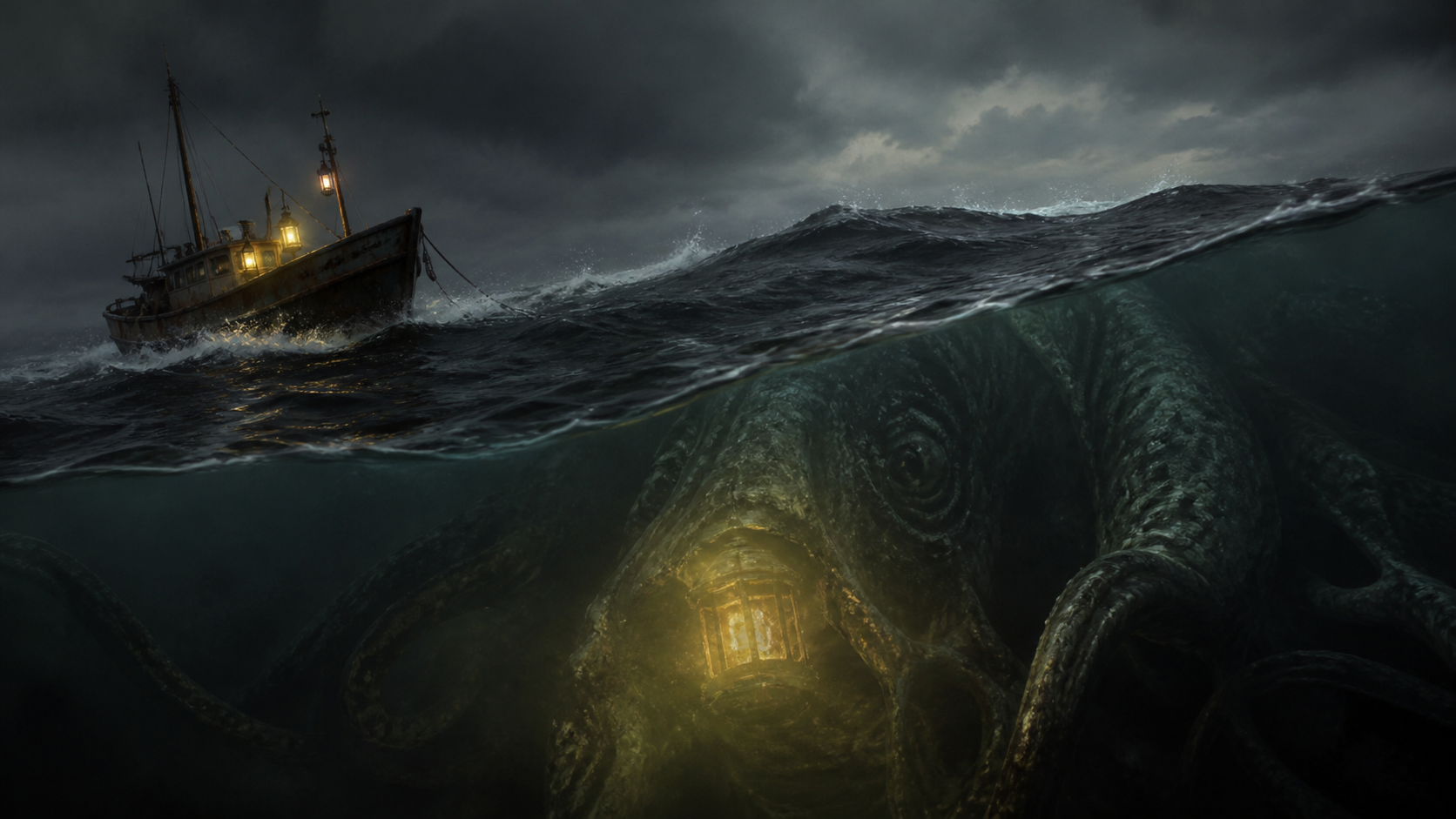
Not a head in the ordinary sense. It was elongated, ridged, with a crown of backward-pointing plates that glimmered wetly. The face had no visible mouth from this angle, only a blunt, mask-like front and the two lamps she had seen on the video. They were set deep in sockets on either side of the brow, and they shone with a hard internal light, not like animal eyes at all but like the glass of old lighthouse lenses. The creature’s neck was impossibly thick and jointed. As it rose, more of it followed, a column of dark, scale-armoured flesh rising from the tide like a collapsed tower righting itself.
The thing was monstrous in a way that did not belong to legend. It was too specific, too bodily. She could see the scars across its hide, old white furrows as if from ship cables. Barnacles clung to one shoulder. Its forelimbs were tucked beneath the water, but when they moved, the current shuddered with the force of them.
Then it turned its lantern eyes towards the town.
Leena froze. She had the irrational sense that she had been seen not by a beast but by something deliberate, something evaluating windows and roofs and the frail geometry of human life. The lights fixed on the harbour office, slid to the quayside, then moved inland.
A bell note rolled out over the water, deep and resonant. It came from the creature itself. The sound vibrated in her ribs.
Down in the harbour, men shouted. A skiff smashed against the pilings as its mooring snapped. Dogs barked furiously from the lanes. The creature made a slow, ponderous step through the shallows, each movement creating a surge that slapped over the quay wall and drenched the fishing sheds.
Then it lowered its head, and Leena saw the mouth.
It was not large for its body, a narrow beak-like opening ringed with hard plates, but when it opened there was a wet, pink radiance inside, and a stream of water and crushed shells spilled out. Something long and pale lay on its tongue, maybe a fish, maybe something it had torn from the mud. It swallowed with a convulsive motion and the lantern eyes dimmed, as if feeding dimmed them.
Arun climbed onto the roof breathless. “Jesus. Tell me you can see that.”
“I can see it.”
His face had gone grey. “What is it?”
Leena lowered the binoculars. “I don’t know.”
The creature did not charge. It did not roar. It simply waded, methodical and dreadful, along the edge of the harbour. Wherever it passed, the water glowed faintly green with disturbed plankton. A fishing line snapped. A fuel drum bobbed free. The giant’s forelimb came down on the roof of the customs shed, crushing corrugated iron with the ease of stepping on a tin can.
People began running from the southern lanes.
“Move inland,” Leena shouted, though her voice felt thin against the bell-sound and the screams. “Get away from the water!”
Dinesh’s voice boomed from the stairwell below, furious and frightened in equal measure. “Where is the police? Where are the men from the port authority?”
No one answered him.
The creature paused at the fish market. One of the neon signs flickered, then died beneath the shadow of its body. It lowered its head and touched the market wall with the tip of its beaked mouth, almost gently, as though sniffing. Then it exhaled.
The breath was foul with brine and fish rot, but there was something else in it, a sweetness like bruised fruit left too long in the sun. The shutters of three stalls burst outward. Glass rained across the road. People screamed again.
Arun gripped Leena’s sleeve. “We need to go.”
She looked down to the harbour road. Old Iqbal’s house sat two blocks from the waterline. So did the boarding rooms where two dozen labourers were sleeping, most of them new to town, most of them on the ground floor.
“Not yet.”
“Leena.”
She was already moving.
They descended into the street chaos. The town had woken in panic now. Motorbikes abandoned in the lane. Housewives dragging children by the wrists. Men shouting contradictory instructions. Someone had started a generator and the harsh white light of it threw everything into dreadful clarity. Over the roofs, the creature’s lantern eyes drifted, deliberate and calm.
By the time Leena reached the boarding rooms, two men were standing in the doorway with suitcases in their hands, too shocked to run. She shoved them aside. “Out. Now. The waterline is rising.”
One of them blinked. “What waterline?”
Then the floor shook.
A second later, the southern wall collapsed inward with a blow like an explosion. The giant’s forelimb, broader than a temple pillar, punched through the building and snared the staircase. Plaster dust burst into the air. Men inside cried out in a chorus of confusion and terror.
Leena stared at the limb. It was plated and scarred, but around the joints there were pale, fleshy membranes, webbed and translucent. The creature was not purely aquatic. It was amphibious, and old enough to have learned the shore as a hunting ground.
“Arun, get them out!”
He was already pulling the dazed men towards the street. Leena ran along the broken corridor, coughing through dust, and heard the giant shift outside. Another wall came down. Something screamed, then cut off abruptly.
She found the nearest room half open to the sea, the floor split in two by the creature’s limb. A bed lay overturned. On the mattress, under a spilled towel, was a little plastic toy boat.
It was absurdly small, absurdly human.
For a moment the bell sound stopped. In the silence that followed, Leena heard the creature’s breathing. Wet, measured, huge.
She stepped back, and the board beneath her foot cracked.
The lantern eyes swung towards her.
There was no malice in them, she realised with a cold lurch. That was worse. It was attention without pity. Something as old as tide and hunger, moving through the bay because the bay was part of its territory, and human structures were simply obstacles, edible or not.
Leena ran.
The next hour became a series of flashes. Dinesh shouting for the coastguard through a dead phone line. Arun helping drag a pregnant woman into a grocery store cellar. The harbour master at last ordering the fuel tanks shut off. The town siren, rarely used, wavering over the roofs like a bad memory. Then, from the darkness beyond the quay, the giant emerging fully from the harbour.
It was larger than any building Leena had seen from the ground. Its shoulders cleared the cranes. Its body moved with a slow, jointed grace that made the harbour infrastructure seem like children’s toys. The lantern eyes were brighter now, casting hard yellow pools over the street. It lifted one forelimb, and a moored trawler snapped free, spinning like a leaf in the surge.
People were still in the open road.
Without thinking, Leena snatched the megaphone from the harbour office steps and climbed onto the bonnet of a police jeep. Her hands shook so violently she nearly dropped it.
“Oi!” Her voice cracked and echoed. “Listen to me! It’s following the water. Keep away from the quay. Don’t use lights by the harbour. Get inland, get high, and do not run towards the noise!”
It was madness, talking to a panicked crowd as if reason could survive terror. Yet some turned. The sound of her voice pulled them, if only briefly, from the creature’s mesmerising glare.
Then the giant swung its head.
The bell note boomed again. This time the light from its eyes brightened with a searing intensity. The surf behind it surged unnaturally high. A fishing boat lifted stern-first and slammed into the dock. The creature had used the storm drain outflow as leverage, or perhaps the tide itself. Leena did not know. She only knew it had found the waterworks.
“Shut the gates!” she shouted.
Dinesh was already on the radio, cursing. The sluice controls were manual, but the mechanism had not been maintained properly in years. Two municipal workers ran for the pump house. One of them never reached it. The creature’s tail, thick as a bridge piling and lined with ridged spines, swept through the side alley and took him with a sound like luggage being dropped down stairs.
Arun grabbed Leena by the shoulders. “Come on!”
She shook him off. “If it gets into the canal channel, the whole town floods.”
“It’s already flooding!”
Rain began, sudden and tropical, drumming on the roofs in a roar. The wind shifted. Across the bay, the creature turned, perhaps sensing the change, perhaps hearing the sea call deeper water.
Leena understood then that it was not simply attacking. It was moving. Hunting the channel. Crossing from open water to the river inlet that threaded behind the market and into the low-lying parts of town. If it reached the sluice gates, the tide and the storm would compound, and the old quarter would be drowned.
She looked at Arun. “Get everyone to the school hill. Then go to the waterworks.”
“You’re insane.”
“Yes,” she said. “Go.”
He stared at her one second too long, then nodded and bolted into the rain.
Leena ran the other way.
The sluice house stood at the harbour mouth, a squat concrete block half hidden by palms. Its gates controlled the canal. As she reached the footbridge, she saw the mechanism house was already open and wrecked, the door torn from its hinges. Inside, the old hand winch lay bent out of shape. One of the workers had tried to brace the wheel with a crowbar. He was gone.
The giant was advancing towards the sluice, drawn by the widening watercourse. The rain streaked its scales and made it shine like iron. At close range, its size was more awful still. Its head alone rose above the palms, lantern eyes reflecting the floodlights in pale, murderous halos. Beneath the ridge of its jaw, scars crossed and crossed again, as if it had fought harpoons before and won.
Leena looked at the gate winch, then at the rusted chain coil beside it. A maintenance hook sat in the mud, heavy and shaped like an anchor arm. She knew, with a miserable clarity, that she had one chance.
The creature lowered its head to the canal mouth. The bell-note came again, but weaker now, as though it were listening to the water rather than searching for prey. Its forelimbs braced against the concrete wall. Then one great hand-like claw probed the sluice opening.
Leena seized the chain and looped it through the hook. She dragged the chain across the floor, across a spill of oily water, and hooked it over the wheel assembly. The goal was crude, nearly hopeless. She would trap the mechanism, jam it, make the gate fail closed if she could only pull the chain taut at the right moment.
The giant’s lantern eyes flicked to her.
For the first time, the creature made a different sound. A low, questioning rumble. Curious, almost.
Leena pulled with all her weight. The chain sang through the wet concrete. The hook caught.
She braced, screamed for muscle she did not have, and the gate wheel lurched. Somewhere inside the mechanism, rust gave way. The sluice blades began to swing shut with a groan that became a shriek of metal on metal.
The creature recoiled, one massive forelimb lifting. Water surged around its body.
Then the tide, the storm and the canal all met in one violent rush. The sluice gate crashed down with enough force to shake the wall. The creature’s hand was caught partly in the closing seam. The resulting sound was like a ship’s mast breaking. It bellowed then, not with rage but with immense, startled pain.
Leena fell backwards into the mud. The giant jerked away, tearing free with shredded flesh hanging from its claws. Dark fluid poured into the canal, thick as engine oil and luminous for an instant in the rain. The lantern eyes flared white, then steadied, and in that moment she saw something like recognition. Not of her. Of loss.
The beast stepped back from the sluice house and turned towards the open bay. The storm water ran in streams down its face. One eye-lamp flickered badly, fractured by the blow. The creature lifted its head, making the bell note softer now, almost mournful, and then it withdrew, wading backwards into the black surf as if the town had ceased to be worth the trouble.
It did not vanish at once. It moved slowly, hesitating at the breakwater, perhaps injured too badly to persist. Then the darkness took it.
By dawn, the rain had gone. The town looked as though a giant hand had smoothed it and left dents behind. Three warehouses were ruined. The boarding rooms were destroyed. Two men were dead, one missing, later presumed taken by the flood surge. The canal gates had held. The old quarter flooded only ankle-deep, not chest-high as Dinesh had feared. People spoke in stunned fragments, avoiding the word monster in daylight as if naming it might make it return.
Leena stood on the harbour wall while the fishermen salvaged nets from the wreckage. Dinesh joined her, sleeves rolled up, eyes bloodshot.
“You were right,” he said. “About the gates.”
She nodded without looking at him.
He rubbed his mouth. “Coastguard says no trace offshore. But one of the men on the patrol skiff found this.” He handed her a piece of scale, larger than her palm, cut with parallel ridges. It was black-green and still damp. “You want it for the archive?”
Leena turned it over in her hand. The underside was pale and soft where the injury had torn through to living tissue. She had expected triumph, or relief, but felt only a strange, grim compassion.
“No,” she said. “Throw it back.”
Dinesh frowned. “Into the sea?”
“Yes.”
He looked as if he might argue, then thought better of it and nodded once.
Behind them, the harbour bells began to ring for the dead.
Arun found her later at the school hill, where families had spent the night on mats under the trees. He had a split lip and a bandage wrapped around one forearm. He carried two cups of tea in a paper holder.
“You told me to go,” he said.
“I did.”
“I hate when you’re right.”
She managed the ghost of a smile. The children nearby were already playing at being rescued, shouting and crawling over each other in the grass, the horror of the night receding into story as quickly as breath.
Arun sat beside her. “Do you think it will come back?”
Leena watched the bay, now innocent in the morning light, a glittering blue curve with gulls wheeling above it. Somewhere beneath that calm surface, the giant might still be moving. Or resting. Or dying slowly in a trench beyond the reef.
“I think,” she said at last, “that we were never its first shore.”
He was quiet for a while. Then: “And the lights?”
She remembered the lantern eyes in the rain, the strange deliberation of the creature, the tenderness almost in its withdrawal when it had been wounded. “Not eyes,” she said. “Something grown into them. It used the light to see through dark water. Maybe to call. Maybe to warn others away. I don’t know.”
Arun gave a humourless laugh. “That makes it worse.”
“Yes.”
They sat until the sun climbed higher and the town began to repair itself with the stubborn competence of people who had survived too much to collapse properly. Men swept glass from the road. Women carried out trays of food for the displaced. Someone had already started arguing over compensation.
Near noon, a child came running up the hill with a shell in her fist. She thrust it towards Leena, eyes huge.
“Did the sea monster leave this?”
Leena took the shell. It was ordinary, spiral and chalk-white, except for a dark stain inside the whorl that looked almost like dried blood.
“No,” she said gently. “It’s been here a long time.”
The child stared, disappointed, and ran off again.
Leena turned the shell over in her fingers and listened to the sea wind moving through the trees. For the first time in her life, Saffron Bay felt less like a town on the edge of the ocean than a place the ocean had once visited, and might visit again when it pleased.
Down on the waterline, the surface flashed where a wave broke against the reef.
For an instant, two pale lights surfaced in the distance, low and steady, and then were gone.

Monsters & Creatures