By the time Lena first heard the rumour, the train she was standing on had already passed through Shinjuku twice.
It was a Friday night in November, the kind that made the glass of the carriage windows turn into mirrors. People looked back at themselves in the reflection instead of at each other: office workers with loosened ties, a boy asleep with his mouth open and his backpack clutched to his chest, two young women in matching wool coats sharing one earbud, a salaryman with the same exhausted face Lena had seen in every station from Yokohama to central Tokyo.
She had come to Japan three months earlier to translate safety manuals for a multinational construction firm that was doing work on tunnel repairs and commuter links. It was dull work, which was exactly why she had taken it. At thirty-four, after a divorce, after a year of freelance edits and sleeplessness and the slow humiliation of borrowing money from her brother, dull looked very much like salvation.
Her apartment was in Nakano, small enough that she could boil pasta from the sink if she were careless. Her office was near Shinjuku, on the twenty-second floor of a tower that looked, from below, like it had been designed by someone who hated human beings. That evening she had stayed late correcting a set of translated warnings about emergency evacuation routes. She was tired, hungry, and more than a little cross with herself for missing the earlier train.
At Nishi-Shinjuku-Gochome, the carriage eased to a stop. The doors opened. A gust of cold air came in carrying the smell of wet concrete and fried oil from a kiosk below.
A woman entered last, carrying a canvas tote and a folded umbrella. She looked to be in her late sixties, with dyed black hair gone silver at the roots and a careful face, the sort that had spent decades deciding what not to reveal. She stood near the end of the carriage and caught Lena looking at her.
“You work late,” she said in English, with a dry little smile.
Lena blinked. “Sorry?”
The woman switched to careful Japanese. “You look like you do.”
Lena gave an awkward laugh. “I do. Or I did today.”
The woman nodded, as if confirming a private theory. “Shinjuku keeps people too late. It likes the ones who stay.”
There was something in her tone that made Lena glance up. The woman’s eyes were not on her now but on the station name flashing above the door.
“What do you mean?”
The woman hesitated. “Nothing. A saying.” Then, after a beat, she added, “If you get off at Shinjuku and the platform has gone quiet, don’t stand near the yellow line. Don’t wait for your friend. Just get on the next train.”
Lena stared at her. “That’s a joke, yes?”
The woman’s expression did not change. “No. It is a warning.” She turned away before Lena could ask anything else.
The train lurched. The doors shut. The woman’s reflection slid over Lena’s own in the window, briefly merging them into one distorted face.
At Shinjuku the station was, as always, a living machine. Voices echoed under fluorescent light. Suitcases rattled. A guard in white gloves gestured at a crowd with the resigned elegance of a man directing rainwater. Lena got off with the stream and glanced over her shoulder, half expecting to see the woman still in the carriage, but the doors had already closed. The train moved away.
She did not think about the warning again until Monday morning, when a junior designer named Daisuke mentioned it over coffee.
He was from Osaka, in his late twenties, and had the shameless cheer of someone who had not yet been beaten into formal silence by office life. He and Lena often ate lunch together in the pantry because he claimed the view from the vending machines was “less depressing” than their desks.
“You ever heard of the disappearing platform at Shinjuku?” he asked, stirring his canned coffee with a plastic stick.
Lena looked up. “No.”
He grinned. “There’s a rumour. My cousin’s girlfriend’s older brother said it happened to him. You’re on the platform, and there’s a message over the PA for a delay, and then everyone around you just sort of… thins out. Like the station is emptying but nobody’s moving. The lights get dimmer. The platform number changes. And if you board the next train, you don’t arrive anywhere you know.”
“That sounds like a creepypasta,” Lena said.
“It does, but people say it with a straight face.” He leaned closer, delighted by his own performance. “There’s even a rule. If you hear your name called from the wrong side of the platform, do not answer. If you see the clock go backwards, you must not look at the tracks.”
Lena snorted. “And have you personally met anyone this happened to?”
“Not personally. But the old cleaning lady on our floor says her nephew went missing for three hours and came back from Shinjuku with his shoes full of gravel. Gravel on an underground platform, can you imagine?”
“Could’ve been drunk.”
“Or kidnapped by platform ghosts.”
“Or he was drunk and kidnapped by platform ghosts.”
Daisuke laughed. “You’re too sensible. That’s why you’ll never be cursed.”
Lena smiled, but the memory of the woman in the carriage brushed the back of her mind like a cold sleeve.
That evening, when she was leaving the office, her phone buzzed with a message from her former husband, Martin.
You still in Tokyo?
Need to talk about Dad.
She stared at it for a long time before replying.
What happened?
Not here. Call me?
Her hands tightened on the phone. Her ex rarely contacted her without a purpose, and his purposes were always ugly, practical, or both.
She called him in the alley outside the station, where the noise from the tracks swallowed most of the city. Martin sounded exhausted and unshaven. He said his father had had a stroke in Brighton, that the prognosis was poor, that the family wanted him flown back quickly. He said he had used the emergency fund they had once agreed to leave untouched for just such situations, and that the transfer had bounced because Lena’s name was still on the account.
“I thought we sorted that after the divorce,” she said.
“We didn’t get around to it,” he said, too fast. “Just take your name off it for a week. That’s all.”
“Why is my name still on it at all?”
There was a silence. She could hear him breathing, and beneath it the faint clatter of a pub or station concourse in the background. Martin always seemed to be in transit.
“Because I forgot,” he said. “And because the forms were a pain. Lena, please. I’m in a mess.”
She closed her eyes. “Send me the details.”
“Right. Thank you.”
After the call she stood in the alley listening to trains move behind the station wall like enormous animals shifting in their sleep. She had not spoken to Martin in months. The last time, they had been civil. The time before that, not quite. But the thought of his father, of old age and sudden damage and family obligations clawing back through the years, left a sour taste in her mouth.
She checked the bank app, sent a message to the lender’s helpline, and then went home on a later train than usual. At Shinjuku she changed lines under the eye-level glare of the platforms and the blur of everyone else’s lives. She saw the station clock when she looked up from her phone. 11:17 p.m.
Then the power flickered.
It was brief enough that a few people only lifted their heads. The overhead lights dimmed, snapped back, and somewhere nearby a woman gave a small startled cry. A train arrived, brakes shrieking. Lena stepped forward with the crowd, her mind already on the transfer forms, then stopped.
For a second, the platform had gone strangely thin.
Not empty. Thin. The shouting, the footsteps, the advertisements, the whole familiar crush of the station seemed to peel away and reveal a space underneath it, a darker copy of the same place. The clock on the wall stopped at 11:17 and then ticked backwards to 11:16. A station announcement crackled overhead, but the words came out wrong, blurred and stretched as though heard through water.
Then she heard her name.
Not near her. Not from the crowd.
From behind the barrier, from the track side, in a woman’s voice that sounded so much like her mother’s that Lena’s body reacted before her mind did. Her head turned.
A hand closed around her wrist.
“Don’t,” said a voice beside her. It was the elderly woman from the train, the one with the umbrella, though Lena had not seen her board. The woman’s grip was astonishingly strong. “If you look, you will answer.”
Lena jerked away. “What?”
The station lights snapped back fully on. The clock ticked forward. People around her moved as if nothing had happened. A man in a business suit brushed past her shoulder and swore under his breath.
The woman had vanished.
Lena stood rigid, heart hammering. She looked to the tracks despite herself. Nothing there but the gleam of steel and the blur of darkness beyond.
“Miss? Are you alright?” asked a station attendant in a cap, approaching with professional concern.
She could barely speak. “Did you see that? The lights?”
He glanced up, then at his colleagues. “There was a brief electrical fluctuation, yes. Please mind the line.”
She left the station with her skin prickling under her coat.
At home she slept badly. In the night she dreamed of standing on a deserted platform while a train arrived with no headlights, only a row of dark windows full of faces pressed close against the glass. One face was her own, older and bruised. Another was Martin’s. When she woke at 3:12, her phone was open on the pillow beside her.
A voice memo had been recorded.
She sat up so fast the blanket fell away. The file was nine seconds long. No name attached. She hit play.
Static. A breath. Then, very softly, her own voice saying, “Don’t answer.”
She deleted it, then checked the battery, the call logs, the permissions, as if a digital explanation would put the fear back in a box. But all morning she could not shake the sense that something had brushed past her in the station and left a mark.
At work, Daisuke noticed her distraction.
“You look wrecked,” he said. “Bad dreams?”
“Just tired.”
He studied her, then lowered his voice. “You heard something at Shinjuku, didn’t you?”
Lena looked up sharply. “Who told you that?”
“No one.” He shrugged. “You’ve got the face.”
“What face?”
“The face of someone who’s pretending not to believe in a thing that has already noticed them.”
She almost laughed. Instead she heard herself say, “What do people say happened?”
Daisuke glanced around the pantry, though it was empty except for a junior accountant eating yoghurt. “Not people. Just stories. There’s an old service platform under the station from before the east and west concourses got expanded. Mostly sealed now. Maintenance access, emergency use, that sort of thing. Apparently, sometimes the station makes a wrong turn. You get diverted, or the markings don’t match, or a platform appears where there shouldn’t be one. Then some people vanish for a bit.”
“Vanish for a bit?”
“Maybe an hour. Maybe a night. One guy said he woke up on a bench with no memory of boarding anything. Another came back pale and wouldn’t ride the train again.” He grinned, but the grin had gone thin. “Could all be nonsense. But my cousin’s girlfriend’s brother stopped taking Shinjuku after midnight, and he’s an idiot, not a coward.”
“You’re trying very hard to make this sound true.”
“I’m trying very hard to convince myself it isn’t.” He hesitated. “You were on the platform when the lights flickered last night, right?”
Lena said nothing.
Daisuke lowered his voice further. “If you hear your name from behind you, don’t turn.”
Her stomach tightened. “How do you know that?”
He looked embarrassed. “That was on a forum. Sorry.”
She should have brushed him off. Instead she asked, “Has anyone actually gone missing?”
He nodded once, reluctantly. “Three years ago. A trainee from one of the retail chains. Her bag and phone turned up in a locker. They said she’d missed her last train and got lost in the station. But her sister swears she was texting until 11:17. Then nothing.”
“Why 11:17?”
He spread his hands. “That’s the time everyone mentions. Maybe it’s coincidence. Maybe it’s because the station starts to thin out then.”
Lena laughed once, harshly, at the absurdity of the conversation. “I have to go to Shinjuku tonight.”
Daisuke stared. “Why?”
She told him about Martin’s father, the bank account, the forms. He listened without interrupting.
“Take a taxi,” he said at last.
“I can’t afford it.”
“Then go with someone.”
“There isn’t anyone.”
Daisuke hesitated, then reached for his phone. “I can leave at six. I’ll walk with you to the platform and wait until your train comes.”
She wanted to tell him not to be ridiculous. She wanted to say she was thirty-four, not a child, and she did not need escorting through a station in a city full of strangers. But the memory of a hand around her wrist stopped her.
“Alright,” she said quietly.
They met after dark. The station above ground had a damp metallic smell from recent rain. Commuters moved in streams beneath the signs. Daisuke bought her a canned tea from a machine because, he said, “if this is a horror story, you’re going to need one.”
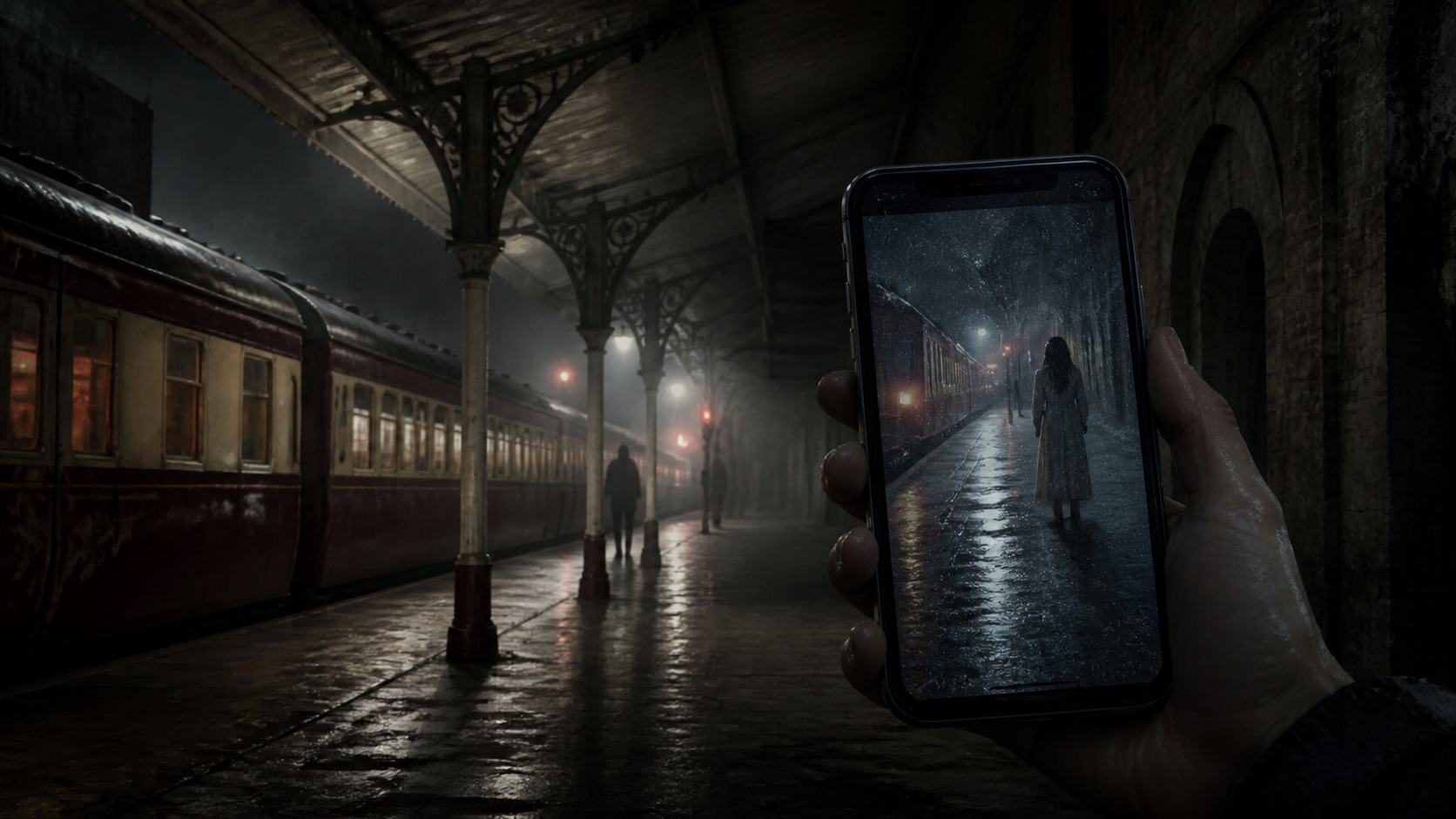
They rode two stops, then crossed to the central platforms under the honeycomb of fluorescent light. Shinjuku at night was always too alive to feel real, but that evening Lena noticed details she usually ignored: the ticket gate with one flickering panel; the man sleeping against a column with his shoes neatly placed beside him; a woman in a cream scarf standing far too still with both hands folded around a paper bag. The station loudspeakers announced delays in a cheerful female voice that made every sentence sound like a lie.
“It’s 10:58,” Daisuke said, checking his watch. “No drama. We’ll get you on the train and I’ll come back tomorrow to boast that I survived the curse.”
Lena smiled in spite of herself.
Then the station lights dimmed.
Not a blackout. A softening, as though someone had breathed over the whole concourse and blurred it. The crowd noise dipped. Lena’s pulse shot up.
Daisuke swore under his breath. “That’s not good.”
An announcement began, but it came through in fragments, each phrase separated by static.
“…due to… please remain…”
The clock over the stairwell shifted. 10:58. 10:57.
Lena froze.
“Don’t look at the tracks,” Daisuke said.
“What?”
“Just don’t.”
The platform around them seemed to stretch. The columns stood too far apart. The far end of the platform had gone dark, and in that darkness was the shape of another signboard, old-fashioned and rusted, with a platform number she could not make out.
A voice came from behind her, soft and urgent.
“Lena.”
She knew the voice. It was her mother’s, dead six years now.
The world narrowed. Every instinct she had, every ache of grief she had ever pretended to survive, rushed towards that sound. Her mother had not called her by her full name in years before the cancer took her. The voice was impossible and therefore irresistible.
Daisuke grabbed her sleeve. “No.”
Lena shook him off, tears burning her eyes. “I heard her.”
“It isn’t her.”
The voice came again, nearer. “Lena, turn round.”
She did.
There was nobody there.
But the woman in the cream scarf was now standing six feet away, staring directly at Lena with such terror on her face that Lena almost vomited. The woman’s lips moved without sound: Don’t.
The loudspeaker crackled. The station clock stopped.
Then the platform beneath Lena’s feet lurched.
It was not a physical movement. It was an interval, a gap opening in the world. People on both sides of her shifted further away as if she had stepped through a pane of glass. A train arrived at the adjacent line, headlights white and flat. The doors opened. Inside, the carriage looked old. Too old. The upholstery was a colour she had not seen in years. No advertisements. No passengers. Only a narrow corridor of dim light stretching down the centre.
A hand gripped her shoulder. Daisuke, furious and frightened, hauled her back. “Run.”
But the platform edge was gone.
Not gone, exactly. Hidden behind a second row of shadow, as if the station had acquired a duplicate threshold three feet in front of the real one. Beyond it, there was only blackness and the suggestion of movement, like figures walking just outside the reach of the lights.
The woman in the cream scarf screamed. One of the figures on the dark side reached up and took her by the wrist with a jerky, almost polite motion. She vanished with a sound like a wet cloth being dragged over tile.
Everyone around Lena started moving at once. Some ran. Some stood rooted in place. A man dropped his briefcase and fled without picking it up. The station attendants were shouting into radios, but their voices seemed absurdly far away.
Daisuke dragged Lena towards the stairwell. “Don’t let it get your name,” he said, sounding as if he were reciting a thing he had learned too late. “If it says your name, don’t answer. If someone you know calls you from the wrong side, don’t answer.”
Something in the dark beyond the platform called, “Lena.”
Then, in Martin’s voice, “Please.”
Lena stumbled. Daisuke hit the emergency button beside the wall. A piercing alarm split the air. The platform lights flickered violently, then came back in a blaze so bright it hurt to look at them.
When Lena blinked, the dark duplicate platform was gone. The train that had arrived was a normal commuter line. Passengers on board looked bored, tired, irritated. The woman in the cream scarf was not there. The crowd had fragmented into panic and confusion, but the station itself appeared solid again. Real attendants were forcing people back from the edge. Security personnel were arriving at a run.
Daisuke was white to the lips. “Did you see the train?”
“Yes.”
“It had no destination display.”
“I know.”
He swallowed. “Then we need to go.”
They were halfway to the stairs when Lena noticed something on the platform tiles.
A shoe.
Not one of the commuter shoes everyone wore in Tokyo, but a cheap black pump, the kind a woman might wear to the office. Beside it lay a strip of skin no larger than a thumbnail, pale and bloodless, still attached to a smear on the tile.
She made a strangled sound. Daisuke saw it and turned away sharply, putting a hand over his mouth.
The station attendants were telling everyone to keep moving. There had been a “minor electrical incident”. Medical staff were coming. No one said the word missing.
Lena got home before midnight. She locked her door, then chained it, then checked the window latches. Her hands were shaking so badly she could barely manage her keys. She called Daisuke twice. He did not answer. She called again. Still nothing.
At 12:41, someone knocked on her door.
Three measured knocks. Then silence.
Her apartment was on the fourth floor. No balcony. No external corridor. Only a narrow entrance hall with the door and a peephole that showed nothing if the light outside was off. Lena stood very still, listening to her own breathing.
The knocks came again.
“Who is it?” she asked, hating how small her voice sounded.
A pause. Then Martin’s voice, soft and tired. “Lena. Open up.”
She clamped a hand over her mouth. He was in England. He had said so that morning. Yet the voice was his exactly, down to the slightly husky crack at the end of a sentence.
“Go away,” she whispered.
“Please,” he said. “I’m sorry.”
Something scraped gently across the other side of the door, like fingernails testing the paint.
Then, beneath his voice, another voice began to speak. A woman’s. Her mother’s. “You left me.”
Lena backed away so quickly she hit the kitchen counter. She made a noise she had never made before, not quite a scream and not quite a sob. The voices outside began to overlap, her mother, Martin, the station woman from the train, all speaking at once in tones of pleading familiarity. Open the door. Let us in. Don’t leave us here.
She grabbed her phone and called emergency services. The operator answered in Japanese. Lena could barely form the words. “Someone is outside my flat. They are saying they know me.”
“Please keep the door locked,” the operator said. “Is there immediate physical threat?”
“I don’t know. They are not human.”
There was a tiny pause on the line. “Ma’am, police have been informed. Remain inside.”
The knocking stopped.
Silence returned all at once, so complete she could hear the fridge hum and the blood in her ears.
Her phone buzzed. A text from Daisuke.
DO NOT GO BACK TO SHINJUKU.
MEET ME TOMORROW. 9AM.
IF I DON’T SHOW, DON’T LOOK FOR ME AT THE STATION.
She stared at the message until the screen dimmed.
Daisuke did not show.
Lena waited at the café they had agreed on, a grim little place under the station where old businessmen read papers and nobody looked at anyone too long. 9:10. 9:20. She sent a message. No reply. She called. Straight to voicemail.
At 9:37 she got a call from an unknown number. She answered before thinking.
“Lena?” A man’s voice, breathless and frightened. “It’s Daisuke. Don’t come down here.”
“Where are you?”
“In the station. Not the station. Listen to me. I found the old service map.” A rush of static. “There’s a sealed platform under the west concourse. It’s connected to maintenance tunnels used before the redevelopment. The platform that appears isn’t random. It’s using old architecture. Like it remembers where the station used to be.”
“Daisuke, what happened?”
He sounded as if he were whispering from inside a cupboard. “I went back after you left. Stupid, I know. I wanted to prove it was a structural issue or something. I found the woman in the cream scarf.”
Lena went cold. “The one who was taken?”
“She was in a corridor below the platform. Alive. Or almost. She didn’t recognise me at first. She said there were others. Some were injured. Some kept hearing their names.” He swallowed hard. “Lena, they’re not all dead. But they aren’t… right.”
A tremor passed through the line. Then a different sound, a low chime like a station announcement starting up.
“Daisuke?”
“I have to go. The platform’s opening again. If I can get pictures, maybe—” His voice broke. “No. No, it’s calling me.”
“Who?”
“It knows my mother’s voice.”
Then the line went dead.
Lena sat in the café with her untouched coffee going cold before her. Around her, ordinary life continued in a blur of cups and conversations. Nobody else seemed to have heard the edge in his voice, the terror underneath it. She wanted to call the police, the station, anyone. Instead she found herself walking back above ground towards Shinjuku as if a thread had been tied to her ribs.
She told herself she was going to find Daisuke. That this was the only sane reason to go. She did not admit that part of her wanted the answer, however ugly.
By noon the station had returned to its usual violent bustle. There were no visible signs of the previous night. No cordon. No closed platforms. No headlines, though her phone showed a few brief online reports about a power fluctuation and a temporary delay on the line. The internet, she thought with grim contempt, was very good at making strange things small.
She took the east stairs, then the long transfer corridor Daisuke had once shown her while joking about shortcut legends. At the bottom of the escalator there was an area temporarily screened off with portable barriers and a sign saying Maintenance Access. A young security guard stood nearby on his phone. Lena stood there long enough that he eventually looked up.
“Can I help you?”
“I’m looking for a colleague,” she said, surprised by her own calm. “He came down here last night and didn’t come home.”
The guard’s polite face tightened. “This area is restricted.”
“He’s missing.”
“We’ve already reported an incident. If you give me a name, I can check whether he was logged out through staff access.”
Lena almost said Daisuke’s name. Instead she looked at the barrier.
Beyond it, under the fluorescent light, the corridor sloped down into a section that was older than the rest of the station. The walls were tiled in a yellowed cream no longer used in modern refurbishment. Pipes ran exposed along the ceiling. The air smelled faintly of damp metal and something else beneath it, sweet and rotten.
“Who reported the incident?” she asked.
The guard rubbed the bridge of his nose. “Someone from platform operations. There was an emergency call from below.”
Lena knew then that she could not leave.
She waited until the guard turned to answer a radio message, then slipped around the barrier and down the corridor.
No alarm sounded. No one shouted. The station swallowed her with the same indifference it gave everyone else.
The first sign that she was below the normal station came after a bend in the corridor. There, under a flickering fluorescent tube, was a wall sign with a faded arrow and a platform number she had never seen above ground.
11-B.
Her skin crawled. The sign looked old, half peeled at the corners, as if it had been there for decades and only now become visible. Beneath it was a rusted metal door marked STAFF ONLY. Its lock had been cut.
Beyond the door was a stairwell spiralling down into a heatless darkness. Lena descended slowly, the soles of her boots sticking slightly to each step. She could hear water dripping far below. Every few steps she passed old emergency notices in Japanese, some so faded that only fragments remained. Do not enter beyond this point. In case of radio failure, return to designated platform. No one had bothered to remove them.
At the bottom was a corridor with a low ceiling and peeling paint. The station noise from above had vanished. The silence was wrong, thick and padded, as though the air itself had become an absorbent wall.
Then she heard voices.
A man laughed once, too brightly. A woman said something in a tone of tired annoyance. Somewhere deeper in the corridor, a child was crying.
Lena moved towards the sound with her pulse in her throat.
The corridor opened onto a disused platform.
It was smaller than the active ones, with a low ceiling and old tiles underfoot. The tracks were visible on one side, but the darkness beyond them was not the ordinary darkness of tunnels. It was a dense, pooled blackness that seemed to hold its shape. The lights above the platform were dim and uneven, some buzzing, some dead.
There were people on the platform.
Not crowds. A handful at most. A man in a business shirt with his sleeve torn and blood drying at his elbow. A woman in a school uniform far too old to be real, her face grey with shock. The cream-scarf woman crouched near the wall, hugging her knees. And Daisuke, kneeling beside a metal bench with his hands pressed to his temples.
He looked up at Lena as if she were a ghost.
“You came.”
She crossed the platform in three strides and grabbed his shoulders. “What happened to you?”
He flinched. His eyes were red-rimmed, and one cheek had a dark bruise in the shape of fingers. “I thought I could get out before it opened again.”
“Why didn’t you answer your phone?”
“I did. You just weren’t there.”
She stared. “What?”
He swallowed. “It rang from my pocket while I was down here. When I answered, it was my own voice on the line, telling me not to come to the platform.”
Lena let go of him as if burned.
The woman in the cream scarf rose unsteadily. “You should not have come back,” she said, not unkindly. “It notices when people return.”
“How many are here?” Lena asked.
The woman looked around the platform as though counting something invisible. “I don’t know. Some leave. Some return wrong. Some… stay.”
“Stay where?”
The woman’s eyes flicked to the track darkness. “With it.”
A station announcement crackled overhead. Not the normal cheerful voice. A low, murmuring tone in Japanese that Lena could not fully follow, but she understood enough to know it was calling passengers to board.
The business-shirt man began to shake. “Not again,” he muttered.
Daisuke grabbed Lena’s wrist. His hand was icy. “Listen to me. The platform doesn’t take everyone the same way. It uses what you answer to. Names, voices, guilt. Whatever gets your attention. If you recognise it, it can pull you.”
Lena thought of the voice in her apartment. “Why?”
He gave a tiny, helpless laugh. “Why does anything haunt a station? Because too many people pass through and leave pieces behind.”
The loudspeaker spoke again. This time, the words came through as her own voice.
“Lena Tanaka, please board the train.”
The woman in the school uniform began to sob. The business-shirt man pressed his palms to his ears. Daisuke said, “Don’t react. Don’t look at the tracks.”
But Lena was already looking.
A train had arrived.
It was not old now. It was sleek and dark, reflecting the station lights in long, liquid strokes. The windows were too black to see through. Its doors were open.
Inside stood people.
Too many people. Faces crowding the glass, hands pressed against it. Their expressions were all the same, blank and pleading and hungry, as though every one of them had been frozen at the moment they understood they were trapped. Among them Lena saw the woman from the train, the office worker from the platform, and, with a surge of nausea so violent she nearly dropped, she saw Daisuke.
Or something wearing Daisuke’s face.
He saw it too and made a choking sound. “That’s not me.”
The version of Daisuke inside the carriage raised a hand and tapped the glass twice, like someone asking to be let out.
Then it smiled.
A low sound began from the track side, not quite a screech and not quite a song. The blackness beyond the rails stirred. Hands emerged from it, thin and pale, then faces, then bodies that seemed assembled from shadow and memory. They climbed with dreadful patience onto the platform, each one wearing an expression borrowed from someone Lena knew. Her mother’s face. Martin’s. Her own.
The cream-scarf woman backed away, screaming.
Daisuke shoved Lena hard. “Get to the stairs.”
“What about you?”
“I’ll distract it.”
“No.”
One of the shadow figures turned its head. Its face was Martin’s, but the eyes were wrong, too wide, reflecting station light like wet coins.
“Lena,” it said in his voice. “You were meant to stay.”
She felt the old grief rise in her, a hot, helpless thing. The station had found her weak point and was using it with surgical precision.
Daisuke snatched the emergency release handle on the wall. Nothing happened. He looked at her wildly. “There has to be something. It’s a station. Stations have procedures.”
Lena looked around, thinking as fast as terror allowed. The old notices. The cut lock. The maintenance corridor. The disused platform number. The old signs.
And then she saw it.
At the far end of the platform, half hidden behind a support column, was a manual panel with Japanese characters and a yellow lever, the kind used for signal failure or emergency shutdown. Beside it was a faded diagram. Route diversion. Sealing sequence. Old system, pre-renovation.
“Daisuke,” she said. “Can you reach the panel?”
He looked. “Maybe.”
“If we cut the power to this platform, maybe it can’t keep the connection open.”
“Or it traps us here in the dark.”
“It’s already trying to.”
He stared at the train, at the figures behind the windows, at the thing in Martin’s face stepping closer. Then he gave a single sharp nod.
Lena grabbed the cream-scarf woman and the schoolgirl by the arm and hauled them towards the stairs. “Go up. Now. Keep going until you hit the main concourse. Don’t stop for anything that calls your name.”
The schoolgirl looked at her as if she were insane. The woman with the scarf understood first. She nodded and pushed the girl ahead of her.
The shadow thing with Martin’s face reached for Lena. She slammed into it with her shoulder, and her hand went through something cold and rotten, like wet wool soaked in stagnant water. It recoiled, making a sound that was somehow both human and electrical.
Daisuke was at the panel. He yanked the lever down.
The platform lights died.
For one breathless second, the whole world was only darkness and the noise of panicking people.
Then emergency lights flared red, casting the platform in a blood-coloured glow. The train doors slammed shut. The blackness beyond the tracks surged up in furious, hungry waves, but now the barriers and walls were visible as if the station had exhaled and revealed its bones.
And there, under the red light, Lena saw the real boundary of the platform.
It was not the edge of concrete. It was a seam in the air, a vertical tear no wider than a door, standing between the platform and the tracks. Beyond it was not another tunnel but an immense darkness full of movement, as though an entire forgotten station lay stacked behind the one she stood in. Figures pressed against the seam from the other side. Faces. Hands. Mouths opening and closing without sound.
The thing that looked like Martin dragged its fingers over the seam and hissed.
Daisuke shouted something she could not hear. He was pointing to the train. The carriage had begun to move, but not along the tracks. It was sliding sideways into the dark seam, inch by inch, as if being swallowed.
The woman with the scarf and the schoolgirl had reached the stairs. The business-shirt man was crawling after them, bleeding from the forehead.
Lena realised, with a flash of appalling clarity, that if the train completed its movement into the seam, the platform would close again with them still on it. She did not know whether that meant death, disappearance, or becoming one of the faces in the windows. The only thing she knew for certain was that the lever had not fixed anything. It had only exposed the wound.
Daisuke shouted, “Lena, help me!”
She ran to him. The panel was old and resisted her grip. There were two switches beneath the lever, one labelled in faded Japanese and the other broken off completely. Daisuke was trying to hold the manual override down while the floor vibrated under their feet.
“What do I do?”
He pointed at the lower switch. “Pull it. I think it will flood the line.”
“With what?”
He gave her a crazed, humourless smile. “With everything this station has been keeping out.”
She had no time to argue. Lena hooked her fingers under the rusted switch and yanked.
Nothing happened for one terrible second.
Then somewhere deep below the platform, something boomed. Water? Air? A shockwave of pressure. The seam in the world shuddered violently. The train, halfway into it, lurched. The figures in the windows slammed against the glass.
The thing wearing Martin’s face opened its mouth in a soundless howl.
The seam began to collapse.
The platform lights stuttered. Red turned to white. White to dark. Daisuke grabbed Lena and pulled her backwards just as a gust of cold, filthy air surged out of the tracks and blew across the platform like breath from an open grave. It smelled of mould, rust, and old rainwater.
The train was gone.
So were the figures behind the windows.
In their place was only the tunnel, the rails, and the hard, ordinary shape of concrete.
Lena collapsed to her knees. Her ears rang. Daisuke was swearing under his breath, half laughing, half crying.
The station above them began to shake with the sounds of footsteps and shouting. Emergency teams. Real ones. People forcing their way down. Light flooded the stairwell.
The woman with the scarf appeared at the top of the stairs, alive and sobbing. The schoolgirl was with her. The business-shirt man made it too. Behind them came station staff, police, and a paramedic whose face went white when he saw the state of the platform.
Lena looked around for the others. For the versions in the train. For her mother’s face. For the false Martin. There was nothing left but water on the tiles and a smell that would linger for days.
“Can you stand?” Daisuke asked.
She tried and nearly fell. He caught her elbow.
Only then did she notice that her left hand was bleeding. She had sliced it on something during the struggle, perhaps the broken switch casing, perhaps a jagged edge of the panel. Blood ran down her wrist and dripped onto the platform tiles.
A paramedic rushed over, speaking fast Japanese. Lena tried to answer and failed. The man saw her wound, then looked past her to the line of the tracks.
His face changed.
“Don’t move,” he said, very quietly.
Lena followed his gaze.
At the edge of the platform, where the seam had been, something small and pale was lying on the concrete.
A shoe.
Not the black pump she had seen the night before. A child’s shoe, red and scuffed, with the fastening undone.
The paramedic took one involuntary step back.
Then, from somewhere beneath the rails, in a voice as gentle as a mother waking a child, someone said Lena’s name.
She did not answer.
Not this time.
The thing did not speak again.
Instead the shoe moved. Just once, a tiny inch across the tile, as though something unseen had tried to stand up from beneath the floor and failed.
Lena’s stomach turned. Daisuke tightened his grip on her arm. Around them the station had become a storm of uniforms, voices, questions, and the thudding arrival of reality.
But under the noise, hidden in the station’s throat, there was a faint and recurring sound, like a distant announcement repeating itself in an empty part of the building.
Train… platform… please mind…
And beneath that, so softly she thought she might have imagined it, her mother’s voice, patient and almost amused:
“Don’t answer.”
Lena kept her mouth shut, staring at the shoe until someone covered it with a towel and carried it away.

Urban Legends