
Clutching the Undead Connection
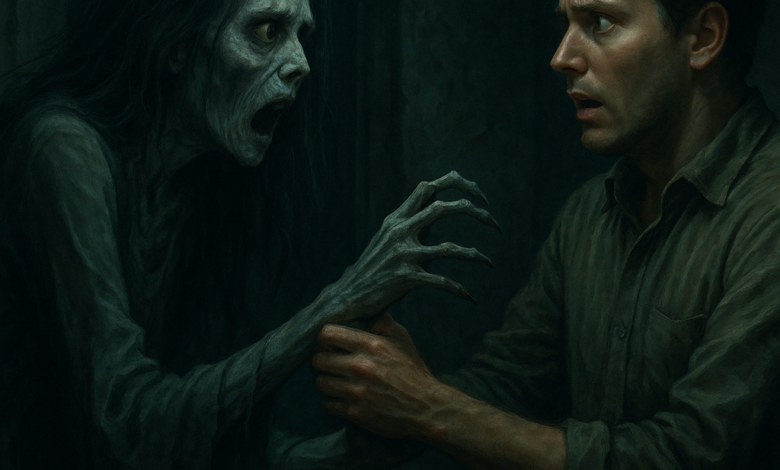
The night was mundane when Clara first sensed that something was amiss in her life. The streets of Hawthorne Lane slumbered peacefully under a blanket of fog, each lamppost casting soft, orange halos across damp cobbles. Clara, a typist for a local firm, had just returned home, her thin frame wrapped in a frayed wool coat that had seen better days. The familiar hum of her so-called sanctuary welcomed her as she entered. She flipped the light switch, but the bulbs flickered and dimmed, getting lost in the gloom of the evening.
Undeterred, Clara moved through her little flat, each room a familiar echo of her daily routine. As she stumbled into the cramped kitchenette, the kettle emitted its usual gurgles. It was only after she settled with a cuppa in her lap and the radio murmured softly to her about the weather, that she began to hear it: a soft tapping, like the timid rapping of knuckles on glass.
She paused, heart palpitating slightly. The sound persisted—delicate, insistent, a rhythmic pattern that seemed to pulse through her very core. With a mix of irritation and curiosity, she rose to investigate. The tapping led her to the small window overlooking the narrowest alley, where her gaze fell upon a figure in the mist: a girl, or at least, what seemed like one. Pale and translucent, she stood still, gazing up at Clara with hollow eyes.
Frozen, Clara couldn’t help but scrutinise the apparition, brimming with a sense of dread laced with fascination. The girl wore a long, tattered dress that looked as if it had been designed centuries ago. She extended a hand, beckoning Clara to join her outside, to step into the fog. Clara shook her head, a primal fear gripping her. She was alone, surely. It must be delirium brought on by fatigue.
Yet weeks turned into months, and the girl continued to return, each night tapping at the window. Clara began to notice that the girl had a name: Elinor. The name crept into her thoughts like ivy through cracked masonry. Disturbingly, she found herself plagued with fleeting memories that weren’t hers. Rushing through foreign hallways, the scent of lilacs heavy in the air, laughter—and then silence. Faces swam before her, people she couldn’t identify. Were they memories of the girl, or was she losing her past?
One evening, after another day spent twisting words into documents, Clara cracked. The tapping gnawed at her patience. She drew the curtains back fiercely, prepared to confront the ghost. “What do you want?” she snapped, though her voice trembled.
The girl’s eyes deepened, wells filled with sorrow. Her mouth moved, forming silent words that Clara could barely grasp. Fear and yearning coiled within Clara, sending chills coursing through her. “I don’t know you,” she murmured.
Suddenly, memories flowed unchecked, clamouring, overlapping like a turbulent river. She could feel the presence of Elinor like an iron chain wrapped around her heart, each memory dragging her down. Clara saw a group assembled in a dimly lit room, arguing with hushed voices. She felt warmth that turned cold, a cultural familiarity snatched away; the tug of community was primal, an instinct to protect which she couldn’t comprehend.
The following day at work, Clara found her hands trembling over the keyboard, stuttering keys refusing to follow her thoughts. She wrestled with the dislocation that now permeated her being. Conversations with colleagues grew distant, muffled by a tempest pounding in her ears. During lunch, she found herself staring into the distance, the chatter buzzing away into insignificance.
That evening, while flicking through an old book from the small library up the road, Clara stumbled upon a faded photograph. The face was familiar, a spitting image of the spectral girl. The photograph, dated from the early 20th century, captured a girl in a gathering of friends—Elinor stood in the front row with a mischievous smile, eyes like dark pools filled with secrets. Heart racing, Clara searched for context, but history remained mute.
After the revelation, Elinor manifested more aggressively, manifesting through sudden cold sweeps of air, strange voices leaking through the cracks of Clara’s mind. Friends remarked on her ever-shifting disposition. “You seem different, Clara,” they would say, concerned eyes peering through cracks of realisation. Isolation grew thick, as if the very air pressed down on her chest, leaving her gasping for normalcy that had slipped beyond her grasp.
In her abrupt new reality, Clara found herself caught in the heavy embrace of Elinor’s melancholy. She began to enact routines that were not her own, visiting places that felt both familiar and foreign, piecing together moments that ought to belong to a stranger. Surroundings morphed in odd, nauseating distortions; what had once been familiar now felt steeped in fog, disheartening cycles she could not escape.
One damp night, Clara was jolted to awareness. Elinor stood before her in full view, not just a whisper of the past, but a desperate sorrow needing to spill from her pale existence into the cracks of Clara’s life. The ghost’s mouth moved, and suddenly, clarity struck. “I am not malevolent! I am a guardian. I must be free!”
In that moment, as their thoughts intertwined, Clara saw Elinor hold a tiny baby in her arms. A cacophony of sorrow echoed through her, spectral wails demanding attention. Elinor had protected her own child from a loss, but this reverberation trapped her within layers of grief and belonged to a world far beyond Clara’s understanding.
If Elinor remained bound, she would take Clara with her. For every moment of defiance, Elinor grew more desperate, engulfing Clara’s spirit until the weight became unbearable. Cramped within the flat, the walls trembled as Clara fought against a swell of despair. Her life began to drain, relationships bending until they snapped like threads.
Clara turned to local legends, scouring every crumb of supernatural history about Elinor. She tried to coax Elinor into finding peace, stitching together old tales into rituals that resonated with something primal, a nod to the past she hoped would help release them both. Yet each invocation fell flat; each night, Clara witnessed her life corrode—every moment wasted like salt upon ice.
At last, with an overwhelming sense of finality, Clara surged into an improvised confrontation. She stood before Elinor, heart racing, calling on all the courage she had left. “You can’t drag me into this!” she shouted, though the words felt like shattering glass. “This was never my burden to carry!”
As she proclaimed her defiance, the air thickened, electric tension crackling around them. There was a flash—a collision of worlds. With a final all-consuming surge, Clara fell to the floor, gasping, staring at the phantom form of Elinor as she flickered, desperate and furious.
“You will never escape!” The words echoed like a thunderclap in Clara’s mind as warmth washed over her, steeped in sorrow.
Clara gasped, and a deeper understanding took root: the very bond she sought to sever reflected back at her. It was not merely Elinor who was fading; it was Clara who became Elinor amidst blurring identities. Silence enveloped her, calling her to the stillness of Elinor’s existence.
The following dawn arrived—a stillness draped in despair. Clara’s friends burst in, only to be met with an estranged stranger, behaviour distorted and haunting. They saw a darkened reflection of Clara gazing back at them, eyes filled with the weight of centuries past.
In their world, Elinor had claimed Clara. In the binding of their souls, the once-clear boundary melted away, forever entwined like the fraying of a cherished tapestry. The haunting was not merely Elinor but Clara, clutching the undead connection that would tether their fates across the void of existence, lost in unspoken promises and shared grief.


