Cursed Keepsake of Despair
Nina Parker had always cherished the oddities she found at flea markets, believing each object held the essence of its former owner. When she stumbled across an ancient music box nestled between grimy porcelain dolls and tarnished silverware, its allure was immediate. The wood was dark, polished but scarred, and the delicate, engraved lid felt cool beneath her fingertips. A soft melody tinkled out when she turned the key, a tune that danced through the air like wisping smoke. It seemed to resonate with something deep within her, a sense of warmth she hadn’t felt in years.
Days turned to weeks, and the old music box remained in her small flat in Brighton, perched on a shelf surrounded by books and other curios. Still, it never once drew Nina’s attention in a concerning way. That was until one evening, while she was engrossed in a novel, an unexplainable chill swept through the room. A grating sound broke her focus, an unnatural slamming emitting from the kitchen. Drawing her breath in, she laid her book aside and walked toward the sound. The music box lay open on the table, its lid agape, the melody still spilling through the air, albeit with an odd, discordant note.
She glanced around, pushing back the creeping unease, trying to convince herself that she’d simply forgotten she’d set the box down there. But as she turned to leave, a glass shattered at her feet, sending shards scattering across the floor. Heart pounding, she knelt to assess the damage, the echoes of the music box’s haunting tune reverberating in her mind. Something wasn’t just wrong—it felt personal.
Over the ensuing weeks, bizarre occurrences morphed into a full-blown assault on her daily life. Items in her flat flipped upside down, her favourite teacups were regularly found smashed, and more alarmingly, she’d wake at night with the music box playing alone, its melody warped. Sometimes there were whispers, indistinct yet urgent, just beyond the curtain of sleep. Collapsing beneath the growing weight of her unrest, she began to isolate herself from friends and family, believing it was her fault; perhaps if she could just rid herself of the music box, everything would return to normal.
But every time she thought to throw it away or burn it, something inexplicable stopped her. The moment she even considered disposing of it, her resolve crumbled. The ghost—whatever force had latched itself to the object—was drawing her in, ensnaring her deeper with each passing day.
Then, one night, while flipping through her old family photographs, she paused. Among faded images of birthdays and holidays, she saw her late grandmother standing beside a younger version of herself holding what looked like the very same music box. The earlier warmth of the box now felt sinister, and Nina’s heart sank into her stomach. Could this be the cause of her unrest? Swallowing her fear, she reached for her phone, determined to seek answers.
With the music box open before her, she researched its origins, frantically typing with trembling fingers. The box—she learned—was uniquely crafted and rumoured to have belonged to a young girl, Clara, whose life was tragically cut short in a fire that consumed her family home. Clara’s spirit had become bound to the music box after her death, her agony tethered to it like a shadow cast by a flickering flame.
Initially, the news sent a chill down Nina’s spine, but it quickly ignited a yearning to learn more about Clara’s past. Perhaps understanding would free Clara from her anguish, and by extension, Nina from hers. Over the course of several sleepless nights, she poured through digitised archives and local history records, acquiring pieces of Clara’s story. But each revelation only festered the ghost’s wrath. Vibrations shook her flat, windows rattled, and the air grew dense with an unseen pressure. The music played incessantly, dissonant notes weaving into something almost symphonic, a lament echoing of loss.
At last, one miserable evening, as Nina attempted to curry favour with Clara—after weeks of trying to placate the entity—an unbearable crash filled her living space. The music stopped dead, plunging her into stillness thick with tension. Shaken, she hurried to the source of the noise, her heart racing.
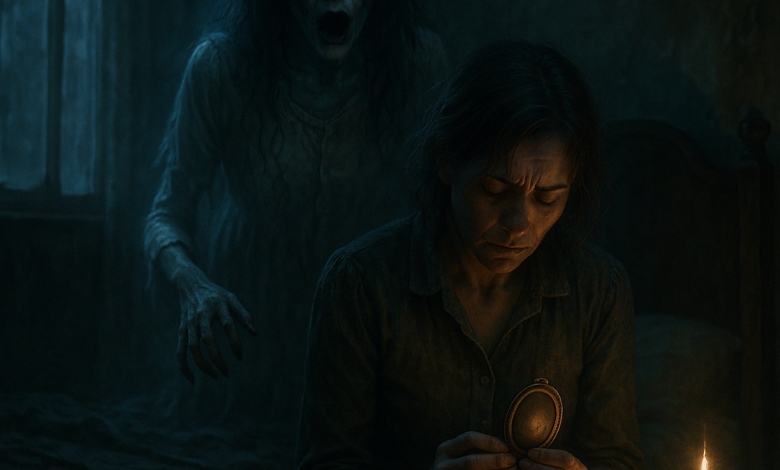
There on the floor lay the shattered remains of what had once been her grandmother’s vase, the heirloom made of the finest porcelain. And emerging from the ruins was a flickering light, coalescing into a thin figure—translucent and sorrowful, but unmistakably there.
“Why did you take them from us?” It was Clara’s voice, laced with despair and raw emotion. “All I wanted was to remember… to play.”
In that moment, everything shifted. Clara was no longer just a tormentor; she was a lost child, reaching out for something long gone. Nina’s heart ached for the sweet girl who had been thrust into tragedy. Clara’s rage morphed into boundless sorrow; the walls of the flat groaned with the weight of suffering.
“Help me,” Clara urged, her ethereal form flickering like a flame about to be extinguished. “You have what I need; you’ve kept me alive too long.”
Nina felt the weight of the box in her arms, its metal key heavy with expectation. But what did it mean to help? She had no answers. One thing was certain though: she could not simply give Clara back her music without facing the full breadth of the girl’s pain.
As if sensing her hesitation, the music box began to swell with sound, an emotional crescendo, twisting her memories into the melody. Faces once familiar—including that of her grandmother—flitted before her as if ensnared in the music itself. In that moment, their eyes bore into her soul, and she was no longer certain where she began and Clara ended.
The more Nina resisted the bond, the stronger Clara’s grasp on her became. Emotional isolation clawed at the edges of her existence, dragging out memories of laughter and joy from her past, unraveling her grip on reality. She began to forget, moments fading into quiet oblivion; friendships waned, conversations dulled. The music seared itself into the back of her mind, enveloping every thought with pain and longing. If she was ever to escape this torment, she had to confront Clara fully.
In the shadows of her cluttered living space, Nina wrestled with choices. They spiralled and swirled through her mind until she made a decision: to try to set Clara free. Clutching the music box, she aimed to break its hold by playing Clara’s tune, but it spiralled beyond her control—gloomy notes filled her ears, laced with the echoes of sorrow, dragging her spirit down into shadow.
The last thread snapped when Clara lunged forward, her anguish weaving into Nina’s very thoughts, their identities tumultuously merging, until at last Nina slipped willingly into the music.
Days later, a flatmate found her lifeless body sprawled beside shattered remnants of treasured keepsakes. Frantically sought after, Nina was never discovered, while Clara danced eternally in the hollow notes of the music box, each trill an echo of despair mingling with the memories of another empty life.